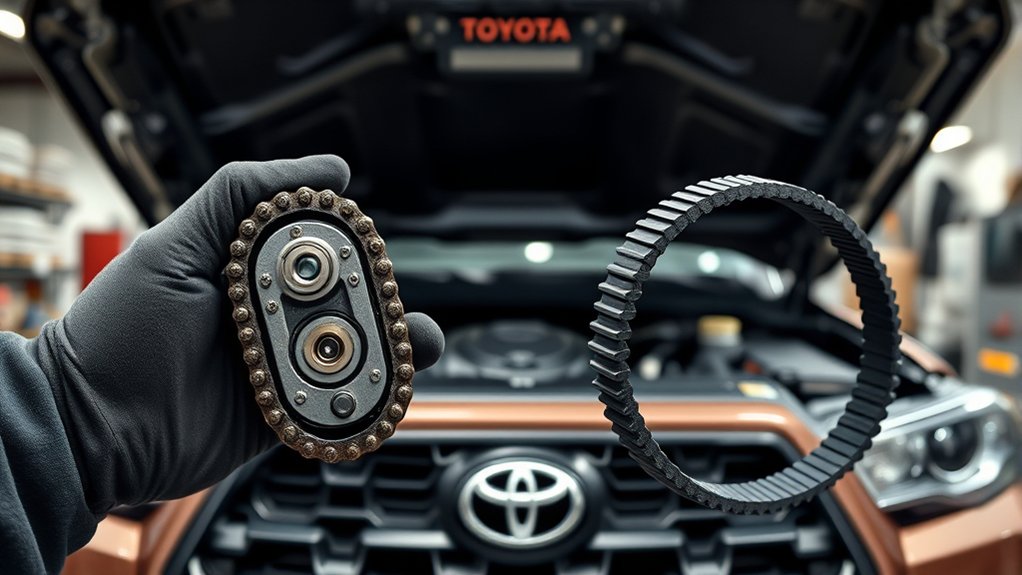
Whether a Toyota Tacoma uses a timing belt or timing chain depends on its engine, not just its model year. The key exception is the first-generation 3.4-liter 5VZ-FE V6, which uses a timing belt. The first-generation 2.4L and 2.7L four-cylinders use timing chains, and every U.S.-market Tacoma engine from 2005 through 2026 is chain-driven.
Last updated: September 22, 2026. This guide was rechecked against Toyota’s 2004 Scheduled Maintenance Guide, Toyota service and parts references, and Toyota’s current 2026 Tacoma powertrain information.
Quick Answer
A 1995–2004 Tacoma with the 3.4L 5VZ-FE V6 has a timing belt. The 2.4L and 2.7L four-cylinder engines from those years use timing chains. All U.S.-market Tacomas from 2005 through 2026 use timing chains, including the 4.0L, 3.5L, and 2.4L turbo engines. For a 2004 5VZ-FE Tacoma, Toyota specifies timing-belt replacement at 90,000 miles or 108 months; earlier model-year guides may use a different month limit, so check the guide for your exact year.
Key Takeaways
- Only the 1995–2004 Tacoma 3.4L V6 uses a timing belt.
- The 1995–2004 2.4L and 2.7L four-cylinder engines use timing chains.
- Every U.S.-market Tacoma engine from 2005 onward uses a timing chain.
- Toyota’s 2004 maintenance guide calls for replacing the 5VZ-FE timing belt at 90,000 miles or 108 months; check the exact guide for earlier model years.
- Timing chains have no routine replacement interval, but clean oil and prompt diagnosis of rattles or timing-related fault codes remain important.
Toyota Tacoma Timing Belt or Chain by Year and Engine
The table below covers U.S.-market Tacoma engines. Engine choices can differ in other countries, so verify your engine code before ordering parts or scheduling service.
| Model Years | Engine | Timing Drive | Maintenance |
|---|---|---|---|
| 1995–2004 | 2.4L 2RZ-FE four-cylinder | Timing chain | No scheduled chain replacement; maintain the oil correctly. |
| 1995–2004 | 2.7L 3RZ-FE four-cylinder | Timing chain | No scheduled chain replacement; investigate abnormal chain noise. |
| 1995–2004 | 3.4L 5VZ-FE V6 | Timing belt | Toyota guides use a 90,000-mile replacement point; the time limit varies by model year. The 2004 guide specifies 108 months. |
| 2005–2015 | 2.7L 2TR-FE four-cylinder | Timing chain | No routine replacement interval. |
| 2005–2015 | 4.0L 1GR-FE V6 | Timing chain | No routine replacement interval. |
| 2016–2023 | 2.7L 2TR-FE four-cylinder | Timing chain | No routine replacement interval. |
| 2016–2023 | 3.5L 2GR-FKS V6 | Timing chain | No routine replacement interval. |
| 2024–2026 | 2.4L i-FORCE turbo and i-FORCE MAX hybrid | Timing chain | No routine replacement interval; follow the model-year maintenance guide. |
For a Tacoma, the engine code gives you the reliable answer. “2004” alone does not tell you whether the truck has a belt or chain.
What Should You Do Next?
- 1995–2004 3.4L 5VZ-FE V6: Check service records now. If the timing-belt history is missing or the truck is past the applicable Toyota interval, schedule the service rather than waiting for symptoms.
- 1995–2004 2.4L or 2.7L four-cylinder: You have a timing chain, so there is no routine belt-replacement job. Keep the oil at the correct level and investigate abnormal timing noise or fault codes.
- 2005–2026 Tacoma: The factory engines are chain-driven. Follow the model-year maintenance guide and diagnose a suspected chain problem before replacing parts.
This decision path also prevents a common parts-ordering error: buying a timing-belt kit for a first-generation four-cylinder or assuming every 2004 Tacoma uses the same timing drive.
How to Identify Your Tacoma’s Engine
Before buying a timing kit, confirm the engine installed in your truck. This prevents the common mistake of assuming every first-generation Tacoma uses the same timing system.
- Check the underhood emissions label. It usually identifies the engine family or displacement.
- Review your owner records. Registration documents, repair invoices, or the original window sticker may list the engine size.
- Use your VIN. A Toyota dealer or reputable parts catalog can match the VIN to the factory engine.
- Consult the correct Toyota guide. Toyota provides model-year owner and maintenance information through its Tacoma manuals and warranties portal.
Pro Tip: Give the parts counter your full VIN instead of ordering only by model year. A 2004 Tacoma could have a chain-driven four-cylinder or a belt-driven 3.4L V6.
What the Timing Belt or Chain Does
The timing belt or chain synchronizes the crankshaft with the camshaft or camshafts. That synchronization lets the valves open and close at the correct point in each combustion cycle.
A rubber timing belt runs dry behind protective covers. A metal timing chain operates inside the engine and depends on engine oil for lubrication. Both systems also rely on supporting parts, such as sprockets, guides, tensioners, and pulleys.
Timing Belt vs. Timing Chain: Key Differences
| Feature | Timing Belt | Timing Chain |
|---|---|---|
| Material | Reinforced rubber | Metal links |
| Lubrication | Runs dry behind a cover | Lubricated by engine oil |
| Routine service | Replaced at a scheduled mileage | Usually replaced only after wear or a diagnosed fault |
| Common concern | Age, cracking, tooth damage, or missed replacement | Guide, tensioner, lubrication, or chain-stretch problems |
| Repair access | Scheduled but still labor-intensive | Often more invasive because the chain is inside the engine |
Timing Belt Maintenance for the 3.4L V6
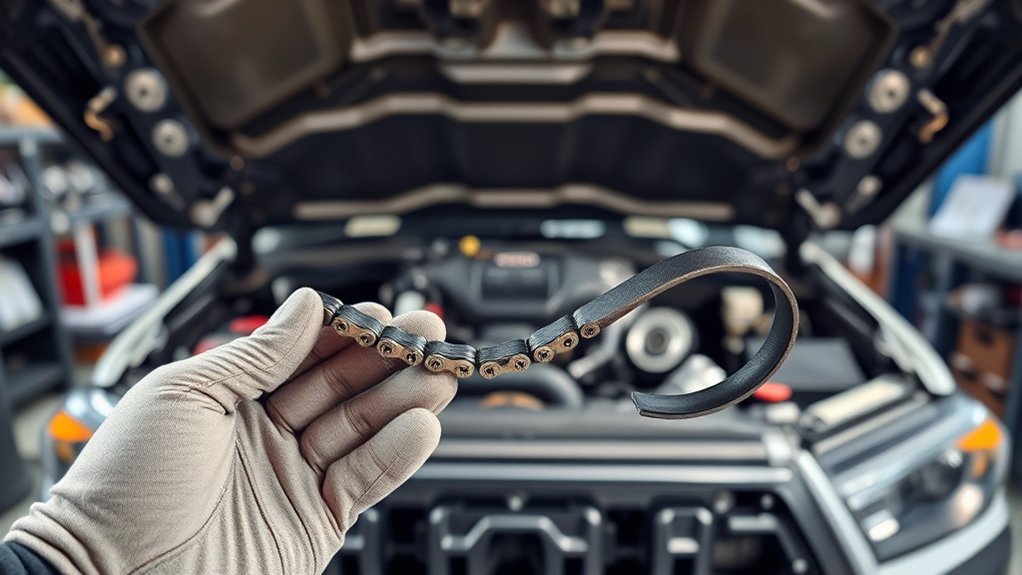
If your 1995–2004 Tacoma has the 3.4L 5VZ-FE V6, use the Toyota maintenance guide for that exact model year. Toyota’s 2004 Scheduled Maintenance Guide lists timing-belt replacement at 90,000 miles or 108 months for the Tacoma with the 5VZ-FE. Earlier first-generation guides also use a 90,000-mile replacement point, but the paired time limit can differ by year.
Do not wait for noise or drivability symptoms. A timing belt can be overdue without giving a useful warning. If the truck is beyond the applicable interval and its service history is unknown, treat the timing-belt status as unresolved until records confirm when the job was completed.
Parts to Inspect During Timing-Belt Service
A complete job should address the belt and the components that control or surround it. Your technician should inspect the following items and replace them when worn, leaking, or included in the approved service plan:
- Timing belt
- Belt tensioner and idler pulleys
- Water pump and coolant seals
- Camshaft and crankshaft seals
- Accessory drive belts
- Coolant condition
The water pump is commonly serviced at the same time because much of the labor overlaps. It is not a reason to replace a good part blindly, so base the decision on mileage, leakage, bearing condition, records, and the technician’s inspection.
Warning: A timing belt is not the visible serpentine or accessory belt. Replacing the external belt does not satisfy the 3.4L V6 timing-belt service requirement.
If the external belt is the part you are trying to identify, see the separate Toyota Tacoma serpentine-belt guide.
Timing Chain Maintenance for Chain-Equipped Tacomas
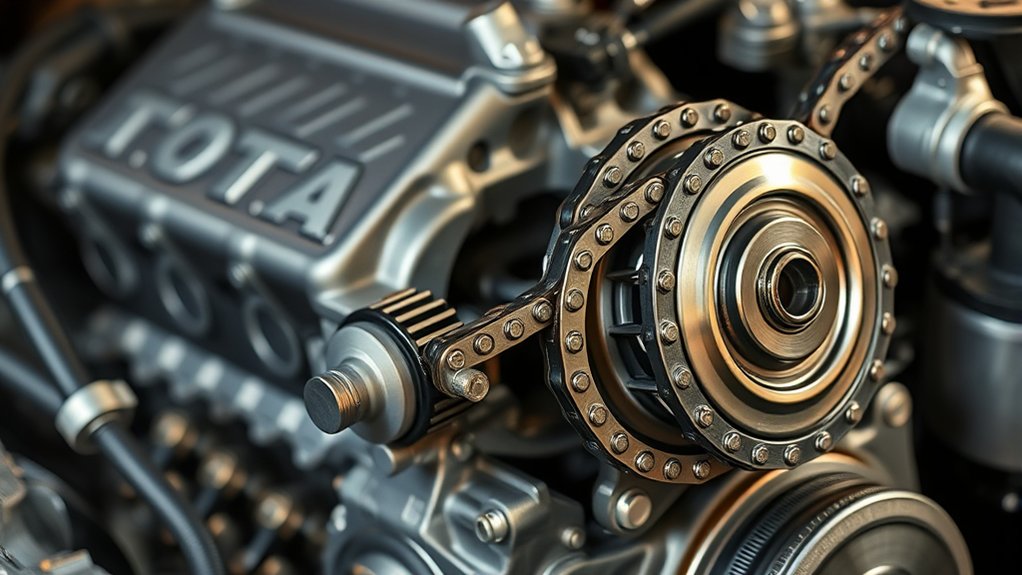
Toyota does not list routine timing-chain replacement as a normal maintenance item for chain-equipped Tacoma engines. That is not the same as a lifetime guarantee. The chain, guides, sprockets, and tensioners can still wear or develop faults, especially if lubrication is poor or the engine is operated low on oil.
Follow the oil grade, oil level, and service interval in your model-year owner’s manual. Clean oil is especially important because the timing chain operates inside the engine and its tensioning system depends on proper lubrication and oil pressure.
Possible Signs of Timing-Chain Trouble
- A persistent metallic rattle from the front of the engine, especially during startup
- A check-engine light with camshaft-to-crankshaft correlation codes
- Hard starting, rough running, misfires, or reduced power
- Metal debris found during an oil or filter inspection
- Noise that changes with engine speed
These symptoms can have other causes. A technician should confirm the fault with scan data, oil-pressure checks, and the applicable Toyota repair procedure before replacing chain components. Toyota’s Technical Information System provides model-specific service information and specifications.
What Happens If the Belt or Chain Fails?
If a belt breaks or a chain jumps timing, the engine may stop suddenly, crank without starting, run very poorly, or set timing-correlation fault codes. The exact damage depends on the engine, engine speed, failure type, and whether other parts broke at the same time.
Do not use an “interference” or “non-interference” label as a reason to extend the service interval. The Toyota maintenance document cited above still specifies scheduled timing-belt replacement for the 5VZ-FE. If the belt breaks, the engine will stop running, and the failure can still create secondary repair costs or leave the truck stranded.
Warning: If the engine loses power, develops severe timing noise, or cranks abnormally, stop trying to start it. Have the truck towed and diagnosed to avoid turning a repairable fault into a larger engine repair.
Replacement Cost and Parts Quality
A reliable nationwide fixed price is not possible because labor rates, engine layout, local taxes, parts brands, and the scope of the repair vary widely. A timing-belt quote may include the water pump, tensioner, idlers, seals, coolant, and accessory belts. A timing-chain repair may require extensive disassembly and additional guides, sprockets, tensioners, gaskets, oil, and coolant.
Ask for an itemized, VIN-specific estimate that separates parts, labor, fluids, and optional preventive work. Compare the warranty and included components rather than choosing the lowest total alone.
Choosing Replacement Parts
Use Toyota Genuine parts or a complete kit from a reputable manufacturer with correct engine-specific fitment. Avoid mixing unknown tensioners, pulleys, guides, or seals simply to reduce the initial price. Precise installation matters as much as part quality, so the repair should follow Toyota’s timing marks, torque specifications, sealant instructions, and bleeding procedures.
Note: Toyota’s current fourth-generation Tacoma uses a standard 2.4L i-FORCE turbo engine or an available 2.4L i-FORCE MAX hybrid powertrain. Toyota identifies these powertrains in its 2024 launch information and 2026 model update.
Frequently Asked Questions
How can I tell whether my Tacoma has a timing belt or chain?
Identify the engine code from the underhood emissions label, service records, VIN lookup, or Toyota dealer. A 1995–2004 3.4L 5VZ-FE V6 uses a belt. First-generation 2.4L and 2.7L engines, plus every U.S.-market Tacoma engine from 2005 onward, use chains.
Does a 2004 Toyota Tacoma have a timing belt or chain?
It depends on the engine. The 2004 Tacoma 3.4L V6 has a timing belt. The 2.4L and 2.7L four-cylinder engines have timing chains.
When should I replace a Tacoma timing belt?
For the belt-equipped 3.4L V6, Toyota uses a 90,000-mile replacement point. The time limit depends on model year; the 2004 Toyota guide specifies 90,000 miles or 108 months. Check the correct model-year guide when service history is unknown.
Does the Toyota Tacoma have a 3.6L V6 with a belt or chain?
No U.S.-market Tacoma used a 3.6L V6. You may be thinking of the 3.4L V6, which uses a belt, the 4.0L V6, which uses a chain, or the 3.5L V6, which also uses a chain.
Is the Toyota Tacoma 3.5L V6 belt-driven or chain-driven?
The 3.5L 2GR-FKS V6 used in 2016–2023 U.S.-market Tacomas is chain-driven. Toyota does not specify routine chain replacement as a normal maintenance item.
Does the 4.0L Tacoma V6 use a timing belt or chain?
The 4.0L 1GR-FE V6 used in 2005–2015 Tacomas has a timing chain. Toyota does not specify routine timing-chain replacement as a normal maintenance item.
How often should a Tacoma timing chain be replaced?
Chain-equipped Tacomas do not have a routine timing-chain replacement interval in the normal maintenance schedule. Replace chain components only after a confirmed wear or fault diagnosis, and maintain the engine with the correct oil and service interval.
Is the 3.4L 5VZ-FE an interference engine?
Toyota’s 2004 maintenance guide cited here does not identify the 5VZ-FE as interference or non-interference. For maintenance decisions, use Toyota’s verified timing-belt replacement schedule rather than extending service based on an unsourced interference classification.
Conclusion
Most Toyota Tacomas use timing chains, but the 1995–2004 3.4L 5VZ-FE V6 is the important exception. Confirm the engine before buying parts. If you have the 3.4L V6, check the model-year maintenance guide and service records now; if you have a chain-driven Tacoma, follow the correct oil schedule and diagnose abnormal timing noise or correlation faults before replacing chain components.
Sources
- Toyota 2004 Scheduled Maintenance Guide — lists timing-belt replacement at 90,000 miles or 108 months and identifies the Tacoma 5VZ-FE in the applicable footnote.
- Toyota 2004 Tacoma Manuals and Warranties — model-year owner and maintenance information.
- Toyota 2005 Tacoma Manuals and Warranties — second-generation owner and maintenance documentation.
- Toyota Technical Information System — official engine-specific repair procedures, specifications, and technical publications.
- Toyota 2024 Tacoma Launch Information — fourth-generation i-FORCE and i-FORCE MAX powertrain details.
- Toyota 2026 Tacoma Model Update — current i-FORCE and i-FORCE MAX lineup information.
