Water spots on a Toyota Camry can range from fresh mineral residue to permanent-looking marks etched into the clear coat. The safest approach is to begin with a proper wash, inspect the clean surface, and use the least aggressive method that works. Always work on cool panels in the shade, test any chemical in a hidden area, and follow its label rather than assuming one remover is safe for every surface.
Quick Answer
Wash and dry your Camry first. If spots remain, apply a water-spot remover approved for the exact surface, on a cool panel in the shade, using the label’s dwell time. Rinse or neutralize as directed, wipe with clean microfiber, and stop if the mark is etched into the clear coat.
Key Takeaways
- Treat water spots as a surface-specific problem: paint, uncoated glass, mirrors, coated glass, plastic, and metal may require different products.
- Use the least aggressive method first and never scrub dry mineral deposits into the paint.
- Work in the shade on a cool surface, wear gloves when the label recommends them, and never exceed the product’s dwell time.
- If chemical removal does not change the mark, the defect may be etched into the clear coat and may require polishing by an experienced detailer.
- Dry the car promptly after washing and maintain wax, sealant, or a compatible coating to make future cleanup easier.
At a Glance
| Time Required | About 30–60 minutes for light-to-moderate spots |
| Difficulty | Beginner for surface deposits; advanced for etched paint |
| Tools Needed | Car-wash soap, wash mitt, buckets, hose, microfiber towels, applicator, surface-approved water-spot remover, and nitrile gloves if required |
| Cost | Roughly $15–$40 if you need to buy cleaner and towels; professional correction costs more |
Understanding Water Spots: Causes and Effects
Water hardness is mainly the amount of dissolved calcium and magnesium in water. When droplets evaporate on a vehicle, dissolved material can remain as visible rings or cloudy residue. The U.S. Geological Survey’s water-hardness guide explains why hard water leaves mineral film and scale on surfaces.
Not every circular mark is the same. A fresh deposit may sit above the paint and dissolve with washing or a compatible remover. A bonded deposit may need a dedicated chemical. An etched spot is a depression or texture change in the clear coat or glass; cleaner may remove the remaining mineral but cannot rebuild material that has already been damaged.
Three Levels of Water-Spot Damage
| Type | Typical Sign | Safest Response |
|---|---|---|
| Fresh residue | Light rings that improve after washing | Wash, rinse, and dry |
| Bonded mineral deposit | Spot remains on a clean, dry surface | Use a surface-approved remover exactly as labeled |
| Etching | Outline, crater, haze, or texture remains after mineral removal | Evaluate for polishing or professional paint correction |
How to Identify Water Spots on Your Toyota Camry
Inspect the Camry only after it has been washed and dried. Dirt, pollen, wax smears, overspray, sap, and clear-coat defects can resemble water spots. Check the paint, uncoated exterior glass, mirrors, gloss-black trim, chrome-colored pieces, and textured plastic separately because the same cleaner may not be approved for all of them.
Visual Inspection Techniques
- Park in open shade and look across the surface from several angles.
- Use a bright handheld light for curved panels, edges, the roof, and the trunk lid.
- Look closely below mirrors, around washer nozzles, beside trim, and under door handles where water can collect.
- Compare an affected area with a nearby clean section before applying any product.
Spot Characteristics Analysis
Water spots often appear as circular or irregular rings, but appearance alone does not prove the cause. A chalky film that transfers to a damp microfiber towel is more likely to be surface residue. A sharp ring that remains unchanged after proper chemical treatment is more likely to be etched or caused by another contaminant.
| Observation | What It May Mean |
|---|---|
| Spot disappears while wet but returns when dry | Mineral residue or a shallow surface defect |
| Spot remains after the label-approved treatment | Possible etching, staining, or another contaminant |
| Mark is on a mirror or coated glass | Use only a product specifically approved for that surface |
| Roughness covers the whole panel | Could be bonded contamination rather than water spots alone |
Surface Feel Assessment
Do not rub a dry, dirty panel with your fingertips. After washing, place a clean plastic sandwich bag over your hand and lightly glide it across the paint. This can make bonded contamination easier to feel without pressing hard. A rough feel does not automatically mean mineral etching, so use it as one clue rather than a diagnosis.
Note: Paint, mirrors, coated glass, raw plastic, polished metal, and ceramic-coated panels are not interchangeable. Read both the Camry owner’s manual for your model year and the cleaner’s label before treatment. Toyota provides model-specific manuals through its manuals and warranties portal.
Supplies You Need to Remove Water Spots Safely
- Automotive car-wash soap and clean water
- Two buckets if available: one for wash solution and one for rinsing the mitt
- Soft microfiber wash mitt
- Several clean microfiber drying and wiping towels
- Microfiber or foam applicator approved by the remover manufacturer
- A dedicated water-spot remover approved for the affected surface
- Nitrile gloves and eye protection when required by the product label or safety data sheet
- Wax, sealant, or coating-compatible topper for protection after the surface is fully clean
A heavy-duty water-spot gel is one option, not a universal requirement. For example, the Chemical Guys product directions require a cool surface, a hidden test spot, short working time, and avoidance of mirrors, coated glass, coated metal, and ceramic coatings. Other removers have different instructions, so never transfer one brand’s method to another product.
Warning: Do not work in direct sun or on hot paint, do not let an acidic remover dry, and do not exceed its stated dwell time. Never mix cleaners. Keep the product away from surfaces the label excludes, and rinse immediately if it reaches an incompatible area.
[Amazon Products Picked for You]

DISSOLVES STUBBORN WATER SPOTS: Acidic formula breaks down hard mineral deposits, sprinkler stains, and dried water marks that regular soaps leave behind, restoring a clear and spotless finish on treated surfaces.
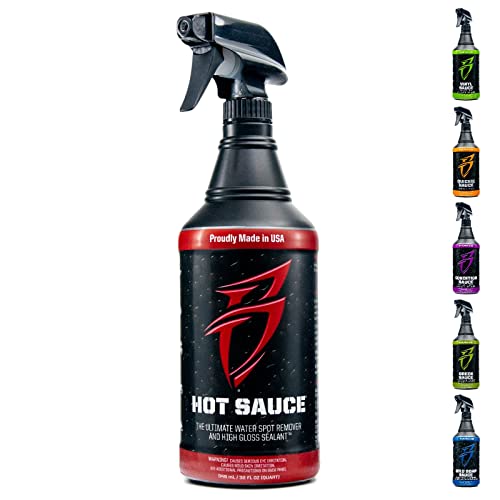
REMOVES HARD WATER SPOTS FAST – Boat Bling Hot Sauce is a premium spray-on, wipe-off hard water spot remover designed to quickly cut through water spots, mineral deposits, and light exhaust residue. Ideal for use after a day on the lake, river, or ocean, this powerful detailing spray helps restore a clean, glossy finish without heavy scrubbing or complicated application steps.

HEAVY DUTY WATER STAIN REMOVER FOR CARS(SPI10816) – Trusted by detailers for years, this gel formula targets stubborn mineral stains and water spots on paint, glass, and metal surfaces
Step-by-Step: Washing Your Camry Properly
- Move the Camry into shade. Let the paint and glass cool before washing.
- Rinse loose debris away. Pay attention to the roof, windshield edges, mirrors, trunk channels, and lower panels.
- Wash from top to bottom. Use automotive soap mixed according to its label and a clean microfiber mitt. Avoid household dish detergent for routine washing because it is not formulated as a paint-maintenance wash.
- Rinse the mitt often. A separate rinse bucket helps reduce the amount of grit returned to the paint.
- Rinse thoroughly. Do not allow soap solution to dry on the surface.
- Dry immediately. Blot or gently glide a clean microfiber drying towel over the paint and glass. Use a low-pressure air blower around mirrors and trim if available.
Pro Tip: If your hose water is very hard, finish with filtered or deionized rinse water when practical, then dry the vehicle before droplets evaporate. This reduces the amount of dissolved material left behind.
Apply Water Spot Remover Gel Effectively
Use a dedicated remover only after washing and confirming that ordinary residue remains. The following method is a safe framework, but the label controls the exact amount, compatible surfaces, dwell time, agitation, and rinse or neutralization method.
[Amazon Products Picked for You]

PROFESSIONAL HARD WATER STAIN REMOVER: Get the powerful industrial and commercial strength that takes stains, spots, and rust out! Remove years of unwanted hard minerals
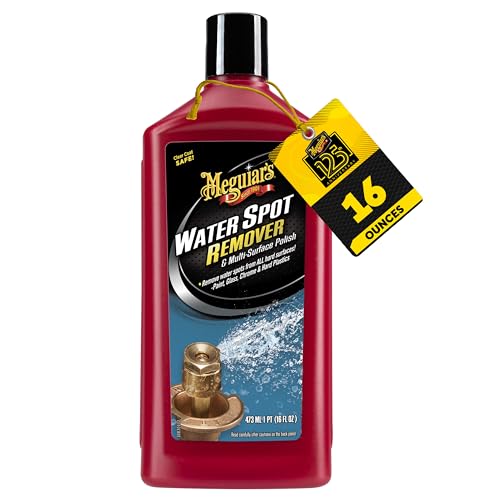
NO MORE WATER SPOTS: This car water spot remover by Meguiar’s works quickly to remove stubborn, unsightly water spots caused either through washing or weather, all without harming delicate paint finishes, glass, or hard plastics.

WATER SPOT REMOVER FOR AUTO GLASS: Removes baked-on water spots, hard water minerals, and bonded deposits from windshields and automotive glass that regular glass cleaner can't reach.
Prepare Surface Properly
- Confirm that the panel is clean, dry unless the label says otherwise, cool to the touch, and out of direct sun.
- Read the label and safety data sheet before opening the product.
- Mask or avoid adjacent surfaces that the label excludes.
- Test a small, inconspicuous area and inspect it after wiping and drying.
- Use separate towels for paint and glass so residue is not transferred between surfaces.
Apply Gel Evenly
Place the amount specified by the manufacturer on a clean applicator rather than pouring it over the panel. Work a small section at a time, usually no larger than the product directs. Use light pressure and straight, overlapping passes. Do not assume more pressure or a longer dwell time will improve the result; both can increase the risk of staining or finish damage.
Wipe Off Thoroughly
Remove the product before it dries. Use a clean microfiber towel and turn it frequently to a fresh side. Wipe in straight passes, then inspect for smears. If the towel begins dragging or becomes saturated, replace it instead of continuing to rub the surface.
Neutralize and Wipe Off Residue
“Neutralize” is product-specific. Some labels call for a thorough water rinse; others permit water, a compatible quick detailer, or another named follow-up product. Use only the method stated on the bottle. For example, Chemical Guys instructs users to soak the treated area with water or quick detailer, then wipe it clean, while other formulas may require a different process.
After the required rinse or neutralization step, dry the section completely and inspect it before repeating treatment. Do not repeatedly apply chemical remover to a mark that is no longer improving.
Check for Remaining Water Spots
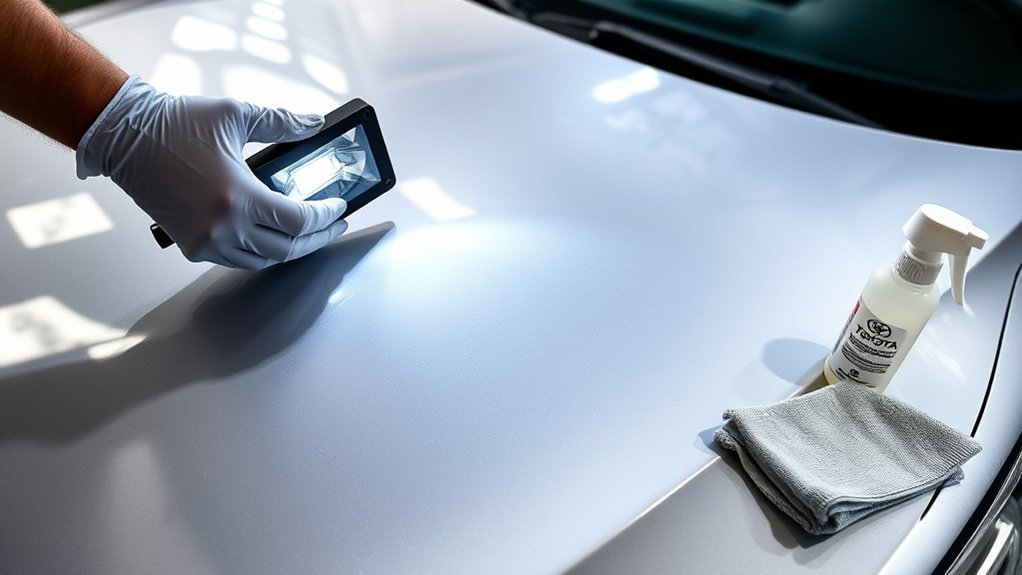
Inspect every treated section when it is clean and fully dry. Water can temporarily hide haze and shallow defects, so a wet panel is not a reliable final check.
Inspect All Surfaces Thoroughly
- Check paint, glass, trim, and metal separately.
- Inspect around mirrors, windows, emblems, seams, and washer nozzles.
- Look for color change, dullness, streaking, or residue from the remover itself.
- Document stubborn areas so you do not treat the same section too many times.
Use Proper Lighting Techniques
Use bright, diffuse daylight in the shade or a handheld LED inspection light. Move the light and your viewing angle rather than moving the vehicle into direct sun for chemical work. Low-angle light is useful for seeing rings and texture changes on horizontal panels.
Test With Water Spot Remover
If the first test section improves without dulling or staining, treat the remaining compatible areas in small sections. Repeat only as allowed by the label. If the deposit does not change, stop. A cleaner cannot safely remove every defect, and repeated chemical exposure or hard scrubbing may worsen the finish.
Choose the Right Method for Paint, Glass, and Trim
| Surface | Recommended Approach | Avoid |
|---|---|---|
| Clear-coated paint | Wash, test a paint-safe remover, then protect | Dry scrubbing, Magic Eraser, household abrasives, excessive dwell time |
| Uncoated exterior glass | Use a glass-approved remover and clean glass towel | Assuming the product is safe for mirrors or coated glass |
| Mirrors or coated glass | Use only products explicitly approved by the surface or coating manufacturer | Acidic remover without approval |
| Gloss-black trim or polished metal | Test carefully and use a compatible product | Aggressive rubbing that can haze the finish |
| Textured plastic | Use a plastic-safe cleaner and soft brush only if approved | Polish or acid not approved for raw plastic |
[Amazon Products Picked for You]
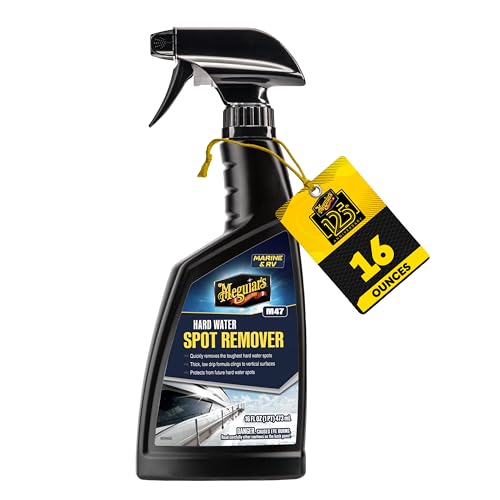
EFFICIENT MINERAL DEPOSIT REMOVAL: This marine water spot remover is specially formulated to clean and eliminate hard water spots from marine and RV surfaces with ease.

REMOVE STUBBORN WATER SPOTS FAST: A must-have in your car wash kit, this car stain remover dissolves tough mineral deposits, eliminating water spots from exterior vehicle surfaces and more

Includes Heavy Duty Water Spot Remover that instantly removes water spots and mineral deposits from paint, glass and metal surfaces. Prepares surface for wax.
When Water Spots Are Actually Etched
If the mineral residue is gone but a ring, crater, or cloudy patch remains, the clear coat or glass may be etched. On paint, the next step is controlled polishing, which removes a small amount of clear coat to level the defect. Because clear-coat thickness and prior repairs are unknown, aggressive compound, machine polishing, wet sanding, and repainting are not beginner water-spot-removal steps.
Ask an experienced detailer or body shop to inspect the panel when spots are deep, widespread, on a repainted panel, or accompanied by cracking, peeling, or obvious clear-coat failure. A professional can test a small area and choose the least aggressive correction method.
How to Keep Your Camry Protected With a Ceramic Coating
A ceramic coating can make the surface easier to wash and dry, but it does not make a Camry immune to mineral spots. Droplets can still dry on top of a coating. Coating life and chemical resistance vary by product, preparation, application, climate, and maintenance, so avoid blanket claims that every coating lasts for years.
Before applying any coating, remove contamination and correct paint defects to the level you want to preserve. Follow the coating manufacturer’s preparation, curing, and maintenance directions. If the Camry is already coated, confirm that the water-spot remover is coating-safe; the Chemical Guys remover cited above specifically warns against use over ceramic coating.
Best Practices to Prevent Water Spots on Your Camry
- Wash in the shade and avoid washing hot panels.
- Dry the roof, hood, trunk, glass, and mirrors before droplets evaporate.
- Use filtered or deionized final-rinse water when hard-water spotting is a recurring problem.
- Blow trapped water from mirror housings, trim, emblems, and panel gaps.
- Maintain a compatible wax, sealant, or coating according to its instructions.
- Remove sprinkler water, bird droppings, sap, and chemical fallout promptly.
- Park away from sprinklers and areas where irrigation overspray repeatedly reaches the car.
Maintenance Tips for a Spot-Free Vehicle
Inspect the Camry after rain, washing, and sprinkler exposure. Light residue is easier to address before repeated wet-and-dry cycles make it more stubborn. Keep several clean drying towels available, wash microfiber separately from lint-producing fabrics, and retire towels that feel contaminated or rough.
Reapply wax or sealant when water behavior and slickness decline according to the product’s maintenance schedule. For coated cars, use the coating maker’s wash and decontamination system. Protection helps maintenance, but prompt drying remains the most reliable way to reduce visible spotting.
Troubleshooting Stubborn Water Spots
- The spots returned after the panel dried: Residue may remain, or the defect may be etched. Reinspect under low-angle light before repeating treatment.
- The product left haze: Stop, rinse or neutralize as the label directs, dry with a fresh towel, and do not add another chemical until the surface is stable.
- The mark is only on glass: Confirm whether the glass is coated, tinted, mirrored, or treated before using a stronger product.
- The paint feels rough everywhere: The panel may have mixed contamination such as overspray or industrial fallout. Get a professional evaluation instead of assuming every bump is a water spot.
- The clear coat looks dull after treatment: Stop immediately. Do not polish until the cause is identified and the remaining finish is assessed.
Frequently Asked Questions
How do you remove water spots from a car without damaging the paint?
Wash and dry the car first, then test a water-spot remover that is explicitly approved for automotive paint. Work on a cool panel in the shade, use light pressure, follow the label’s dwell time, and rinse or neutralize exactly as directed. Stop if the mark does not improve.
Is Dawn dish soap OK for car paint?
Use an automotive car-wash soap for routine cleaning. Dish detergent is designed for kitchen grease rather than regular maintenance of automotive waxes, sealants, coatings, rubber, and trim. A one-time accidental use is not automatically catastrophic, but it is not the preferred wash product.
Does WD-40 remove water spots on car glass?
WD-40 Multi-Use Product is marketed for lubrication, moisture displacement, rust protection, penetration, and related maintenance—not as an automotive mineral-deposit remover. It can leave an oily film that must be cleaned from glass, so use a glass-approved water-spot product instead.
Will a Magic Eraser remove hard-water stains on a car?
Do not use a Magic Eraser on clear-coated automotive paint. Melamine foam cleans by mild abrasion and can dull glossy finishes. Use a paint-safe chemical remover first. For glass, use only products and tools approved for that exact glass surface, especially when coatings or mirror finishes are present.
Can vinegar remove water spots from a Toyota Camry?
A diluted acidic solution can dissolve some mineral residue, but household vinegar is not automatically safe for every automotive surface, coating, trim, or repaired panel. A dedicated automotive product with clear compatibility and dwell-time instructions is easier to use consistently and safely.
Is water-spot remover safe on a ceramic coating?
Only when both the remover and coating manufacturers approve the combination. Some acidic removers can weaken or remove coating performance, and some labels explicitly prohibit use on ceramic coatings. Test a hidden area and be prepared to reapply protection if the approved process affects it.
When should a professional detailer remove the spots?
Get professional help when the spots remain after a label-correct chemical test, cover large areas, are on a repainted panel, or appear as craters, haze, peeling, or clear-coat failure. Those signs may require measured polishing or body-shop repair rather than more cleaner.
Conclusion
The safest way to remove water spots from a Toyota Camry is to identify what is on the surface, begin with a proper wash, and escalate carefully. A compatible water-spot remover can dissolve many mineral deposits, but it must be used on a cool surface, in the shade, with the exact dwell time and follow-up stated on its label. If the mark does not improve, stop before aggressive rubbing turns a small defect into a larger one. Prompt drying and consistent protection will make future spotting easier to control.
Sources
- U.S. Geological Survey — Hardness of Water — explains dissolved calcium and magnesium, mineral residue, and scale.
- Toyota Owners — Manuals and Warranties — provides model-year-specific Toyota care and maintenance information.
- Chemical Guys — Heavy Duty Water Spot Remover — provides product-specific compatibility, dwell-time, testing, neutralization, and safety directions.
- Griot’s Garage — Water Spot Remover — supports using a dedicated surface-compatible mineral-deposit remover rather than a universal household cleaner.
- WD-40 — Multi-Use Product — lists the product’s intended lubrication, protection, penetration, and moisture-displacement uses.
