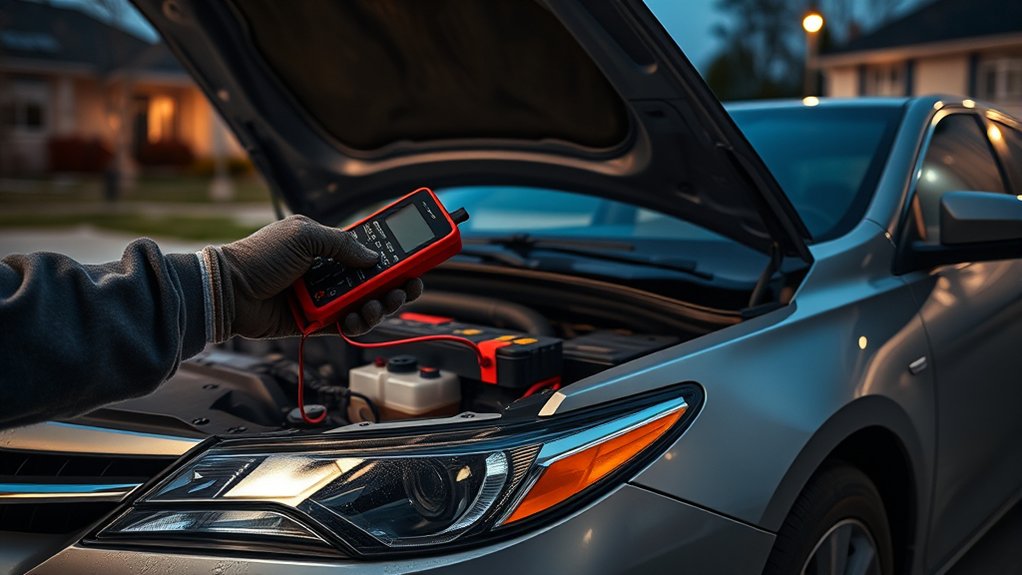
If your Toyota Camry starts one day and refuses the next, do not guess at parts first. Start by separating the symptom: does the engine fail to crank, crank slowly, click once, click rapidly, or crank normally without starting? That one detail points you toward the battery, terminals, starter circuit, ignition switch, range switch, fuel system, security system, or engine-control sensors.
Quick Answer
Most intermittent Toyota Camry starting problems come from a weak 12-volt battery, loose or corroded battery terminals, a failing starter motor, a worn starter relay, an ignition switch issue, or a transmission range switch that does not confirm Park or Neutral. If the engine cranks normally but will not start, check fuel, spark, security, and trouble codes next.
Key Takeaways
- A no-crank Camry points first to the battery, terminals, starter relay, starter motor, ignition switch, brake switch, or Park/Neutral range switch.
- A Camry that cranks normally but will not start needs a different path: fuel delivery, immobilizer, spark, crankshaft sensor, camshaft sensor, and OBD-II codes.
- A resting battery voltage near or below 12.4 volts suggests low charge, but a load test gives a better answer than voltage alone.
- Do not bypass starter wiring unless you are trained. A safer DIY approach is visual inspection, battery testing, fuse checks, and code scanning.
- Before replacing expensive parts, check your model-year manual, open recalls, and Toyota service campaigns by VIN.
At a Glance
| Time Required | 10–30 minutes for basic checks; longer if the starter circuit, fuel system, or security system needs shop diagnosis. |
| Difficulty | Easy for visual checks and battery testing; moderate to advanced for voltage-drop testing, relays, sensors, and starter replacement. |
| Tools Needed | Safety glasses, gloves, flashlight, digital multimeter, battery terminal brush, OBD-II scanner, and access to a battery load tester. |
| Cost | Basic inspection can be free. Repair cost depends on whether you need terminal cleaning, a battery, relay, starter, sensor, wiring repair, or professional diagnosis. |
Warning: Work around the 12-volt battery only with the ignition off, the transmission in Park, and the parking brake set. Wear eye protection, keep metal tools away from both battery posts at the same time, and do not touch orange high-voltage cables or hybrid components on Camry Hybrid models. If you see battery swelling, leaking, smoke, melted wiring, or warning messages, stop and call a qualified technician.
What Are the Common Causes of Toyota Camry Starting Problems?
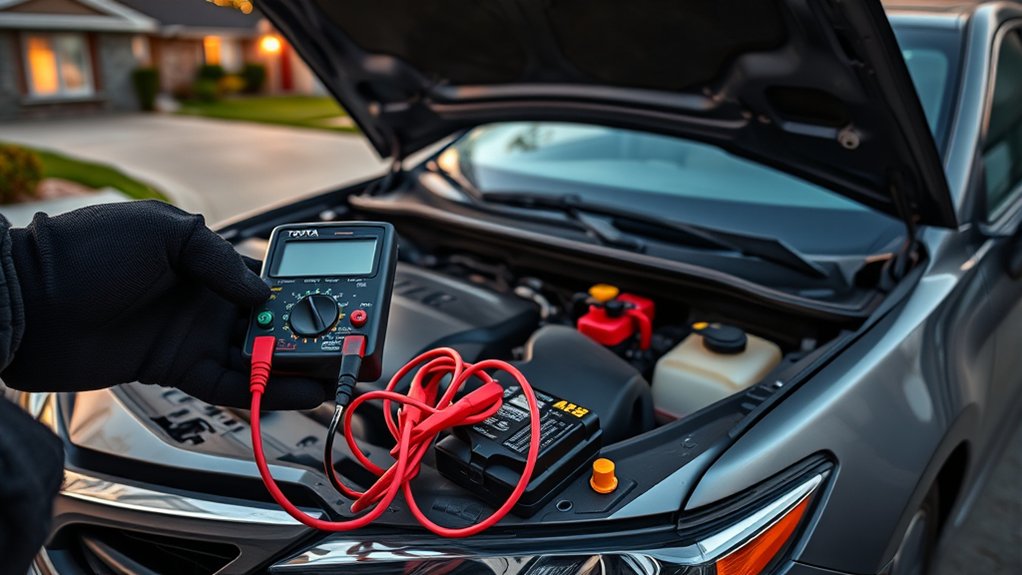
The most common causes depend on what happens when you turn the key or press the Start button. A Camry that does not crank usually has an electrical or starter-circuit problem. A Camry that cranks normally but does not fire usually has a fuel, spark, security, or sensor problem.
Start with these likely causes:
- Weak or discharged 12-volt battery: You may hear rapid clicking, see dim lights, or get slow cranking.
- Loose or corroded battery terminals: Corrosion can block current even when the battery itself is still usable.
- Failing starter motor or solenoid: A single click, grinding sound, or intermittent no-crank can point here after the battery tests good.
- Starter relay, fuse, or wiring issue: A bad relay or loose ground can interrupt power only sometimes.
- Ignition switch, brake switch, or Start button issue: The car may not send a start signal even though lights work.
- Neutral safety switch or transmission range switch issue: The car may not recognize that the shifter is in Park or Neutral.
- Immobilizer or key issue: A security light, weak key fob battery, or unrecognized key can stop the start sequence.
- Fuel or engine-control issue: If the engine cranks strongly but will not start, check fuel pump operation, fuel pressure, spark, crankshaft position sensor, camshaft position sensor, and trouble codes.
Start With the Symptom: No-Crank vs. Crank-No-Start
Before you test parts, write down exactly what your Camry does. This prevents random battery, starter, and fuel-pump replacements.
| Symptom | Most Likely Area | First Check |
| Rapid clicking | Weak battery or poor terminal connection | Battery voltage, terminal tightness, corrosion, and load test |
| One click, no crank | Starter, solenoid, relay, cable, or ground | Battery test first, then starter-circuit voltage checks |
| No sound at all | Start signal, brake switch, range switch, fuse, relay, or security system | Try Park and Neutral, check brake lights, check security light, scan codes |
| Slow crank | Weak battery, high resistance, starter drag, or engine mechanical load | Battery load test and cable/ground inspection |
| Cranks normally but will not start | Fuel, spark, immobilizer, sensor, or engine-control issue | Scan OBD-II codes and listen for fuel-pump prime |
How Can You Diagnose Battery and Electrical Issues?
Battery and connection problems cause many intermittent starting complaints because the starter needs far more current than the radio, lights, or dashboard. Your Camry may still light up inside and still fail to crank.
- Check the battery age and condition. If the battery is several years old, has swollen sides, leaks, or repeatedly needs a jump, replace or professionally test it.
- Measure resting voltage. With the car off and loads turned off, a resting reading near or below 12.4 volts suggests the battery is partly discharged or weak. Charge it fully, then test again.
- Load-test the battery. A battery can show acceptable voltage with no load and still fail when the starter draws current.
- Inspect the terminals. Look for white, green, or blue corrosion on the posts and cable ends. Also check for loose clamps.
- Check the main ground. A loose or corroded ground cable between the battery, body, and engine can create random no-start symptoms.
- Watch voltage during cranking. If voltage drops sharply while the starter struggles, suspect the battery, cables, or starter draw.
Pro Tip: Clean battery posts and cable clamps only after the ignition is off and the negative cable is disconnected first. Reconnect the negative cable last. If you are not comfortable doing this, ask a shop or parts counter to test and clean the battery safely.
How Do You Identify and Test the Starter Motor and Solenoid?
After the battery and cables test good, move to the starter circuit. A failing starter motor or solenoid often acts worse when hot, after short trips, or after the car sits in one position overnight.
Use these safer checks before replacing the starter:
- Listen carefully: A single heavy click can mean the solenoid is trying to work but the starter is not turning.
- Check for grinding: Grinding can point to starter drive or flywheel engagement trouble. Stop repeated start attempts if you hear it.
- Confirm power and ground: A technician can perform voltage-drop testing across the positive starter cable and ground path.
- Check the relay and fuse: Use your model-year fuse diagram before pulling or swapping relays.
- Scan for codes: Some start-request, immobilizer, brake-switch, and range-switch issues can set diagnostic trouble codes.
Warning: Do not jump the starter terminals or bypass the solenoid as a casual DIY test. The engine can crank unexpectedly, the vehicle can move, and the circuit can spark. Leave direct starter-circuit bypass testing to a trained technician.
A gentle tap on an older starter may sometimes make a worn starter work once, but treat that as a clue, not a repair. If tapping changes the symptom, the starter likely needs professional testing or replacement.
How Do Ignition and Neutral Safety Switches Affect Starting?
The ignition switch, Start button, brake switch, and transmission range switch all help decide whether your Camry sends power to the starter. When one of these inputs fails intermittently, the car may start after several tries or after you move the shifter.
Try these checks:
- Move the shifter fully into Park. Then try starting again.
- Try Neutral. If the car starts in Neutral but not Park, suspect the range switch or shifter adjustment.
- Press the brake pedal firmly. Push-button Camrys need a brake-pedal signal before starting.
- Check the brake lights. If the brake lights do not work, the brake switch may not be sending the start-permission signal.
- Try a spare key or fresh key-fob battery. A weak fob battery or key recognition issue can mimic a starting problem.
- Watch the security light. A flashing or unusual security indicator during start attempts can point to an immobilizer issue.
If the dash lights flicker, go dark, or behave differently each time, return to the battery terminals, grounds, and ignition feed before replacing the starter.
Check Fuel, Security, and Engine-Control Causes
If your Camry cranks at normal speed but does not start, the starter is already doing its job. Shift your attention to fuel, spark, air, compression, immobilizer authorization, and engine-control data.
Common crank/no-start checks include:
- Fuel pump sound: Listen near the rear of the car for a brief pump prime when you turn the ignition on. Silence does not prove the pump is bad, but it is a useful clue.
- Fuel level: Confirm fuel level with more than the dash gauge if the problem started after parking on a slope or after running low.
- OBD-II codes: Scan for crankshaft position sensor, camshaft position sensor, immobilizer, fuel trim, or misfire codes.
- Security system: Try a spare key and watch for security warnings.
- Recent work: Recheck anything touched during battery replacement, engine repair, radio installation, alarm installation, or fuse-box work.
- Weather pattern: Heat-related failures can point to a starter, relay, or sensor. Wet-weather failures can point to wiring, connectors, or ignition components.
Note: A bad alternator usually causes a battery to go low after driving or after repeated starts. If the battery tests good after charging but keeps coming back weak, test the charging system and check for parasitic draw.
How Can You Fix Starting Problems in Your Toyota Camry?
The right fix depends on the test result. Use this order so you solve the cause instead of replacing good parts.
- Clean and tighten the battery terminals. Fix corrosion and loose clamps first because they are common and inexpensive.
- Charge and load-test the battery. Replace the battery only if it fails testing, will not hold charge, is damaged, or is near the end of its service life.
- Check fuses and relays using the owner’s manual. Use the correct fuse-box diagram for your Camry model year.
- Try Park and Neutral. A change in behavior can point toward the range switch or shifter adjustment.
- Try a spare key or replace the key-fob battery. Do this before assuming the immobilizer or Start button is bad.
- Scan for diagnostic trouble codes. Codes help separate starter-control issues from fuel, sensor, and security issues.
- Test the starter circuit. If the battery is strong and the start signal reaches the starter, a failing starter motor or solenoid becomes more likely.
- Check fuel and sensor data if the engine cranks normally. Do not replace the starter when the engine already cranks at normal speed.
- Look up recalls and service campaigns by VIN. Use Toyota’s official recall lookup and the NHTSA recall tool before paying for a repair that may be campaign-related.
- Match replacement parts by VIN. Starter, battery, relay, and sensor fitment can vary by model year, engine, trim, and hybrid status.
Toyota provides official owner manuals and warranty information through its Toyota Owners Manuals and Warranties page. For recall checks, use Toyota’s Safety Recalls and Service Campaigns lookup and the NHTSA recalls tool. If you need replacement parts, Toyota’s official parts site lets you add your vehicle or VIN to browse parts that fit through Toyota Genuine Parts.
When Should You Stop DIY Diagnosis and Call a Mechanic?
Stop testing and call a qualified technician if the problem involves burning smells, smoke, melted wiring, repeated blown fuses, battery acid, starter grinding, hybrid warnings, or a no-start after a recent electrical repair. Also stop if you do not have a safe place to work with the vehicle in Park and the parking brake set.
You should also get professional diagnosis when the battery and terminals test good, but the Camry still starts only sometimes. Intermittent starter, relay, range-switch, immobilizer, and sensor problems often need live data, wiring diagrams, and voltage-drop testing.
Frequently Asked Questions
Why is my Toyota Camry not starting sometimes?
Your Camry may not start sometimes because of a weak 12-volt battery, loose battery terminals, corrosion, a failing starter motor, a bad starter relay, an ignition switch issue, a Park/Neutral range switch problem, a brake-switch issue, or an immobilizer/key problem. If it cranks normally but will not start, check fuel, spark, sensors, and OBD-II codes.
Why does my car sometimes start and sometimes not start?
Intermittent starting usually comes from a part or connection that works only under certain conditions. Heat, vibration, moisture, low battery charge, loose terminals, worn starter contacts, weak relays, poor grounds, or an inconsistent start-permission signal can all make the problem come and go.
How do you diagnose intermittent starter issues?
Start with a battery load test and terminal inspection. Then check whether the starter receives the start signal when the problem happens. If battery voltage is strong, cables are clean, and the start signal reaches the starter but the engine does not crank, the starter motor or solenoid becomes a strong suspect.
What is the most common starting problem with a Toyota Camry?
The most common first checks are the 12-volt battery and battery terminals. A weak battery, loose clamp, or corroded connection can cause clicking, slow cranking, or a random no-start. If those test good, move to the starter circuit, range switch, ignition input, fuel system, and scan data.
Can the lights work if the battery is still too weak to start?
Yes. Lights, the radio, and the dashboard need much less current than the starter motor. A weak battery can power small accessories but still fail under starter load. That is why a load test is more useful than looking only at dash lights.
Is it safe to jump-start a Toyota Camry with intermittent starting problems?
It can be safe if you follow the exact procedure in your Camry owner’s manual and use the correct jump points. Do not jump-start a leaking, frozen, swollen, or damaged battery. Hybrid models may have specific 12-volt jump-start instructions, so confirm the procedure before connecting cables.
Conclusion
Intermittent starting problems in a Toyota Camry are easier to solve when you follow the symptom. If the engine does not crank, start with the 12-volt battery, terminals, grounds, starter relay, starter motor, ignition input, brake switch, and Park/Neutral signal. If it cranks normally but will not start, move to fuel, spark, immobilizer, sensors, and scan data.
Do the simple checks first, avoid unsafe starter-circuit shortcuts, and confirm your model-year manual, VIN-specific parts, and open recall status before replacing expensive components. That approach gives you a cleaner diagnosis and a better chance of fixing the real problem the first time.
Sources
- Toyota Owners Manuals and Warranties — supports model-specific owner manual guidance.
- Toyota Safety Recalls and Service Campaigns Lookup — supports checking Toyota recalls and campaigns by VIN or license plate.
- NHTSA Recalls Lookup — supports VIN recall checks, recall limitations, and safety-recall process guidance.
- Toyota Genuine Parts — supports VIN-based fitment checks for replacement parts.
