Last updated: September 19, 2026 — checked against current CARB, EPA, FTC, and Toyota warranty information.
Toyota Camry California emissions warranty coverage is generally 3 years/50,000 miles, with 7 years/70,000 miles for specific long-term emissions parts on an eligible California-certified vehicle. Federal law separately provides 8 years/80,000 miles for specified major components such as the catalytic converter, emissions-control ECU or computer, and OBD device or computer. Older qualifying PZEV/TZEV Camrys may have 15-year/150,000-mile enhanced coverage, but that term should never be assumed from a SULEV label or hybrid powertrain alone.
Quick Answer
For an eligible California-certified Toyota Camry, California emissions coverage is generally 3 years/50,000 miles, with specific long-term parts covered for 7 years/70,000 miles. Federal coverage separately reaches 8 years/80,000 miles for specified major emissions components. CARB also identifies 15-year/150,000-mile enhanced coverage for qualifying 2001–2017 PZEV and 2018–2025 TZEV vehicles. Toyota’s 2026 Camry warranty guide, however, lists 3-year/50,000-mile and 7-year/70,000-mile California periods rather than a 15-year/150,000-mile Camry term.
Key Takeaways
- Do not assume that every Camry receives the same California emissions warranty.
- Federal law sets a 2-year/24,000-mile minimum for most covered emissions parts and 8 years/80,000 miles for specified major components; Toyota may provide longer coverage under another warranty.
- California’s 7-year/70,000-mile term applies only to high-cost parts listed for the specific model year.
- Enhanced 15-year/150,000-mile coverage applies only when the vehicle meets the applicable PZEV/TZEV requirements; it is not the listed California term for the 2026 Camry.
- Independent maintenance does not automatically void the warranty, but improper repairs, tampering, or neglected maintenance can affect a claim.
Key Coverage Details for the Toyota Camry Emissions Warranty
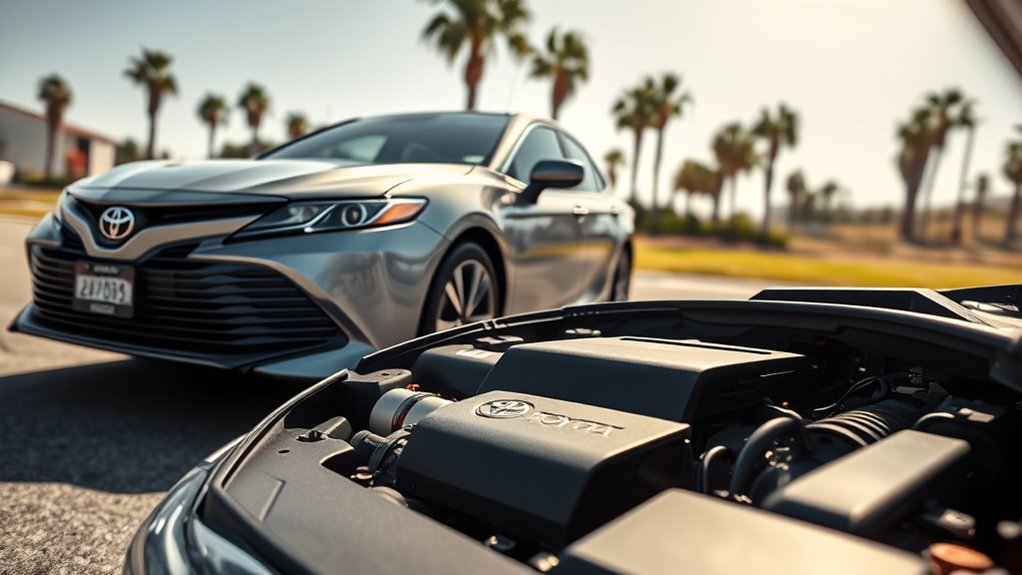
A Toyota Camry may have overlapping federal, California, hybrid, and new-vehicle warranty protection. The failed component should be checked against every applicable warranty rather than assigned automatically to one mileage limit.
The California Air Resources Board warranty summary lists the following general periods for passenger vehicles. All time and mileage limits end when either limit is reached first.
| Coverage | General Period | What It Generally Covers |
|---|---|---|
| Federal emissions minimum | 2 years/24,000 miles | Federal design/defect coverage for most emissions-related parts and performance coverage when the federal test-failure conditions are met. Toyota can provide longer coverage under its own warranty; the 2026 Camry guide states 3 years/36,000 miles under the Basic Warranty for federal emissions defect coverage. |
| Federal major-component warranty | 8 years/80,000 miles | The catalytic converter, emissions electronic control unit, and onboard emissions diagnostic device or computer. |
| California defects and performance warranty | 3 years/50,000 miles | Emissions-related parts on an eligible California-certified vehicle. |
| California high-cost parts warranty | 7 years/70,000 miles | Only the high-cost emissions parts specifically identified in the Warranty & Maintenance Guide for that model year. |
| Eligible PZEV/TZEV enhanced warranty (CARB model-year framework) | 15 years/150,000 miles | Emissions-related parts on qualifying 2001–2017 PZEV or 2018–2025 TZEV-certified vehicles, except for separately limited batteries or energy-storage devices. |
| Eligible PZEV/TZEV battery or energy storage (CARB model-year framework) | 10 years/150,000 miles | A qualifying battery or other energy-storage device when the enhanced California provision applies. |
2026 Camry check: Toyota’s official 2026 Camry Warranty & Maintenance Guide lists California emissions coverage of 3 years/50,000 miles and 7 years/70,000 miles for the specified long-term parts. It does not list a 15-year/150,000-mile Camry emissions term. The same guide says the California warranty applies to an eligible California-certified 2026 Camry registered and operated in California, Connecticut, Delaware, Maine, Maryland, Massachusetts, Minnesota, Nevada, New Jersey, New York, Oregon, Pennsylvania, Vermont, Virginia, or Washington.
Note: A component can fall under more than one warranty. For example, a catalytic converter may remain federally covered through 8 years or 80,000 miles even though California’s general high-cost period is 7 years or 70,000 miles.
How to Check Whether Your Camry Qualifies
The words “California emissions warranty” on a general website are not enough to establish coverage. Use the following checks before relying on a mileage figure:
- Identify the model year and original in-service date. Warranty time normally begins when the vehicle is first placed in service, not when a subsequent owner buys it.
- Inspect the emissions-control information label. It is commonly located under the hood or in the engine compartment. Look for language stating whether the vehicle conforms to California emissions regulations as well as federal requirements.
- Open the correct Warranty & Maintenance Guide. Toyota provides model-specific materials through its Manuals and Warranties portal.
- Find the covered-parts list. Do not assume that every sensor or hybrid component is classified as a high-cost or enhanced-warranty part.
- Check the state-eligibility language. Registration, operation, original sale, and state-adoption requirements can differ by model year and certification. For example, Toyota’s 2026 Camry guide lists California plus Connecticut, Delaware, Maine, Maryland, Massachusetts, Minnesota, Nevada, New Jersey, New York, Oregon, Pennsylvania, Vermont, Virginia, and Washington for its California emissions warranty.
- Compare the current mileage with every applicable warranty. Federal, California, hybrid, and basic new-vehicle coverage may overlap.
Pro Tip: Photograph the emissions label and the odometer before visiting the dealer. Bring the relevant warranty-guide pages and ask the service adviser to place the warranty request and diagnosis in writing.
How Long Is a Toyota Camry Emissions Warranty?
Time and mileage are only two parts of the coverage decision. The failed part must also be listed or meet the applicable definition, the Camry must have the required certification, and no exclusion may apply.
If your question is specifically about the federal 2-year/24,000-mile and 8-year/80,000-mile rules, see our Toyota Camry federal emissions warranty guide. This page focuses on California/CARB coverage and how it overlaps with federal and hybrid warranties.
The model-specific Warranty & Maintenance Guide—not a generic online mileage chart—is the controlling starting point for a Toyota Camry warranty claim.
Commonly discussed emissions-related components include:
- Catalytic converters
- Engine or emissions electronic control modules
- Onboard diagnostic hardware
- Oxygen and air-fuel-ratio sensors
- Evaporative-emissions canisters and related valves
- Exhaust-gas-recirculation parts on vehicles so equipped
- Fuel-injection and ignition components when expressly treated as emissions-related
- Hybrid control or energy-storage components when specifically included by the applicable warranty
This is not a universal covered-parts list. Toyota’s guide for the exact model year determines how each component is classified.
Hybrid, PZEV, TZEV, and SULEV Coverage Explained
These terms describe different things and should not be used interchangeably:
- Hybrid describes the powertrain. Toyota states that its general hybrid-battery warranty is 10 years or 150,000 miles for model year 2020 and newer hybrid vehicles. Earlier Camry hybrids can have different terms.
- SULEV is an emissions-performance classification. A SULEV rating alone does not prove that every emissions component has a 15-year/150,000-mile warranty.
- PZEV is the enhanced category CARB identifies for qualifying 2001–2017 model-year vehicles.
- TZEV is the enhanced category CARB identifies for qualifying 2018–2025 model-year vehicles.
An eligible PZEV or TZEV certification may provide 15 years or 150,000 miles of coverage for emissions-related parts, with a separate 10-year/150,000-mile limit for a qualifying battery or other energy-storage device. CARB’s current summary ties that enhanced framework to 2001–2017 PZEV and 2018–2025 TZEV model years. For a 2026 Camry, Toyota’s model-specific guide instead lists the 3-year/50,000-mile and 7-year/70,000-mile California periods, while the Toyota hybrid battery warranty is 10 years/150,000 miles and specified hybrid-related components are covered for 8 years/100,000 miles.
Warning: Do not approve an expensive catalytic-converter, control-module, or hybrid-component replacement as customer-pay work until the dealer has checked federal, California, hybrid, and basic warranty coverage and provided the result in writing.
Steps to Take If Your Warranty Claim Is Denied
A verbal statement that the vehicle is “out of warranty” is not enough to evaluate a denial. Ask for the failed component, diagnostic result, applicable warranty provision, and exclusion in writing.
- Request the diagnosis and denial reason. The paperwork should name the failed part, diagnostic trouble codes, mileage, test results, and the reason coverage does not apply.
- Compare the decision with the model-specific guide. Check the standard emissions list, high-cost list, federal major components, hybrid provisions, and any PZEV/TZEV section.
- Provide maintenance and repair records. Include dated receipts, mileage, part numbers, fluids or specifications used, and the work performed.
- Ask the dealer’s service manager to review the claim. Request confirmation that the claim was submitted to Toyota rather than rejected only at the service-desk level.
- Escalate through Toyota. Use the customer-assistance and dispute-resolution procedure printed in the applicable Warranty & Maintenance Guide. Toyota’s 2026 Camry guide lists the Toyota Brand Engagement Center at (800) 331-4331 and the National Center for Dispute Settlement at (800) 777-8119; confirm current contact details in the guide for your model year.
- Contact CARB for California emissions-warranty help. CARB lists its helpline as (800) 242-4450 and the email address helpline@arb.ca.gov.
- Use the formal dispute procedure. If the issue remains unresolved, follow the informal settlement process named in the warranty guide and consider the appropriate state consumer-protection or Attorney General’s office.
Online owner forums can help identify similar symptoms, but forum posts are not a substitute for the warranty guide, diagnostic evidence, or an official coverage determination.
How to Maintain Emissions Compliance and Protect Your Warranty
Routine maintenance supports reliable emissions-system operation and gives you better documentation if a claim occurs. It does not mean every service must be performed by a Toyota dealer.
- Follow the model-year maintenance schedule. Complete required oil, filter, fluid, spark-plug, and inspection services at the specified time or mileage.
- Respond to the check-engine light promptly. Continued driving can create additional damage and make the original failure harder to document.
- Keep complete records. Save receipts showing the service date, mileage, parts, materials, and work performed.
- Use parts and fluids that meet the required specifications. A manufacturer generally cannot require a named brand merely to preserve a warranty unless the item is supplied free or another lawful exception applies.
- Do not tamper with emissions controls. Removing, disabling, reprogramming, or installing noncompliant emissions equipment can create legal and warranty problems.
- Use a qualified repairer. An independent shop does not automatically void the warranty, but damage caused by incorrect installation, unsuitable parts, neglect, or an improper repair may not be covered.
Federal warranty law addresses restrictions that condition coverage on a branded article or service. The relevant provision appears in 15 U.S.C. §2302(c).
Tips for Understanding CARB Regulations
CARB establishes minimum California emissions-warranty requirements, but it does not turn every Toyota Camry into a PZEV or TZEV vehicle. Certification is assigned to a specific vehicle configuration by the manufacturer.
Keep these distinctions in mind:
- The 3-year/50,000-mile term is the general California defects and performance period for eligible vehicles.
- The 7-year/70,000-mile term applies to specific high-cost emissions parts identified in the owner’s warranty materials.
- The federal 8-year/80,000-mile term covers the catalytic converter, emissions ECU, and OBD device or computer.
- The 15-year/150,000-mile term is enhanced coverage for an eligible PZEV or TZEV vehicle in the applicable CARB model-year framework, not every SULEV or hybrid Camry; Toyota’s 2026 Camry guide does not list that term.
- The qualifying PZEV/TZEV battery or energy-storage period is 10 years/150,000 miles rather than 15 years/150,000 miles.
You do not need PZEV status to operate a Camry legally. The certification matters here because it can change the warranty period. Owners should instead avoid emissions-system tampering, complete required maintenance, and verify the exact certification before filing a claim.
Frequently Asked Questions
What is covered under a Toyota Camry emissions warranty?
Coverage may include a part whose failure causes an emissions defect or test failure, as well as specific components listed in the Warranty & Maintenance Guide. The exact list depends on the model year, certification, warranty category, and failed component.
What parts receive the federal 8-year/80,000-mile warranty?
Federal extended emissions coverage generally applies to the catalytic converter, emissions electronic control unit, and onboard emissions diagnostic device or computer. Other emissions parts generally fall under shorter federal coverage unless another warranty applies.
Are all check-engine-light repairs covered?
No. A check-engine light can be caused by a covered defect, an expired component, accident damage, tampering, neglected maintenance, an improperly installed part, or another excluded condition. A diagnostic code identifies the affected system but does not by itself prove warranty coverage.
Does a SULEV Camry automatically have a 15-year/150,000-mile warranty?
No. SULEV describes emissions performance. The enhanced 15-year/150,000-mile warranty requires an eligible PZEV or TZEV certification and compliance with the terms in the model-specific warranty guide.
Is every Toyota Camry hybrid battery covered for 10 years or 150,000 miles?
No. Toyota’s general 10-year/150,000-mile hybrid-battery warranty applies to model year 2020 and newer Toyota hybrids. Earlier Camry hybrids and vehicles relying on a California emissions provision must be checked against their own model-year guide.
Will using an independent mechanic void the emissions warranty?
Not automatically. Keep receipts and use qualified repairers, suitable parts, and the required procedures. A claim may still be denied when the failed component was damaged by improper work, unsuitable parts, tampering, abuse, or neglected maintenance.
Does a 2026 Toyota Camry have a 15-year/150,000-mile California emissions warranty?
Toyota’s 2026 Camry Warranty & Maintenance Guide does not list a 15-year/150,000-mile California emissions term. It lists 3 years/50,000 miles for the short-term performance and defect warranty and 7 years/70,000 miles for specified long-term emissions parts. Separate hybrid-system and hybrid-battery warranties may also apply.
Which states does Toyota list for the 2026 Camry California emissions warranty?
Toyota’s 2026 guide says the California emissions warranty applies to an eligible California-certified Camry registered and operated in California, Connecticut, Delaware, Maine, Maryland, Massachusetts, Minnesota, Nevada, New Jersey, New York, Oregon, Pennsylvania, Vermont, Virginia, or Washington.
Can a used Toyota Camry still have emissions-warranty coverage?
A used Camry may still be within an applicable time-and-mileage period. Coverage does not restart when the vehicle is resold, so check the original in-service date, current mileage, emissions certification, state requirements, and transfer provisions in the warranty guide.
Conclusion
The most important Toyota Camry emissions-warranty rule is to verify coverage for the exact vehicle and failed part. California coverage is generally 3 years/50,000 miles, with 7 years/70,000 miles for specified long-term emissions parts, while federal law provides 8 years/80,000 miles for specified major emissions components. Older qualifying PZEV/TZEV vehicles may have 15-year/150,000-mile enhanced coverage, but Toyota’s 2026 Camry guide does not list that term. Check the emissions label, model-year warranty guide, state eligibility, mileage, and written diagnosis before paying for a repair.
Sources
- California Air Resources Board — California Vehicle and Emissions Warranty Periods — California, PZEV/TZEV, battery, and federal warranty periods.
- Toyota Manuals and Warranties — model-specific warranty guides and Toyota hybrid-battery coverage information.
- Toyota 2026 Camry Warranty & Maintenance Guide — current Camry-specific federal, California, hybrid-system, battery, state-eligibility, and claim-procedure details.
- U.S. EPA — Transportation, Air Pollution, and Climate Change FAQs — federal 2-year/24,000-mile and 8-year/80,000-mile emissions-warranty rules.
- Federal Trade Commission — Auto Warranties and Auto Service Contracts — consumer guidance on warranties, maintenance, and service contracts.
- 15 U.S.C. §2302 — federal warranty-disclosure requirements and the prohibition on certain branded-service conditions.

