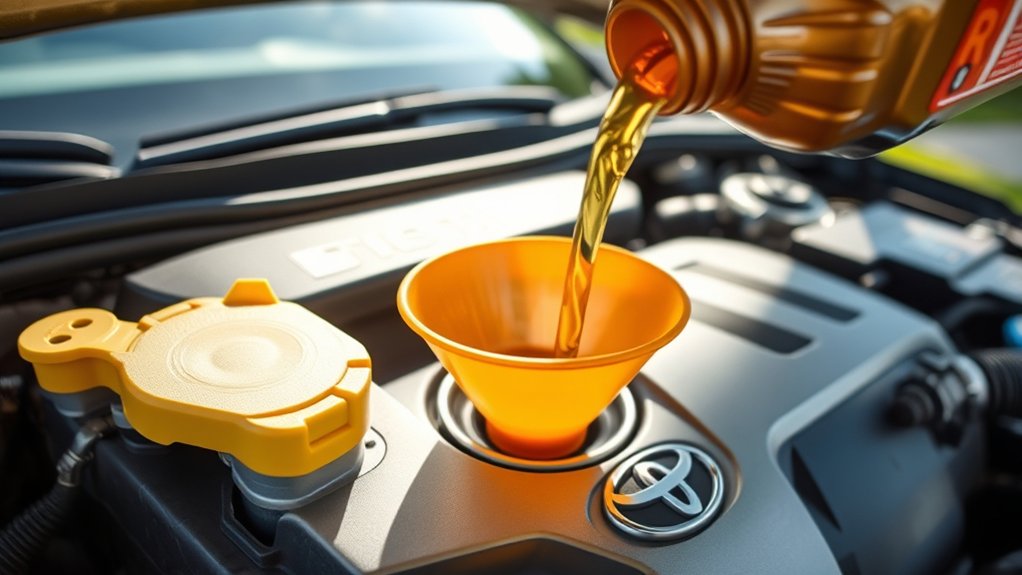
Park the Toyota Camry on level ground and let the engine cool. Confirm the correct oil grade in the owner’s manual, usually 0W-16 or 0W-20, and verify capacity by engine type. Open the hood, remove the oil filler cap, and use a clean funnel to add oil gradually. Reinstall the cap, start the engine briefly, then shut it off and check the dipstick. If the level or warning light suggests a problem, further guidance follows.
What Oil Does a Toyota Camry Need?

Oil selection for a Toyota Camry depends primarily on model year and engine specification, with most models requiring either 0W-16 or 0W-20 motor oil. Determining the correct oil begins with the owners manual, which specifies the approved oil type for each engine. This disciplined check frees the operator from guesswork and reduces avoidable wear.
Toyota Camry oil choice hinges on model year and engine specification; consult the owners manual to avoid unnecessary wear.
Toyota Camry Oil in newer vehicles is usually full synthetic, selected for improved thermal stability, cleaner operation, and extended service performance. Older Camry models may permit conventional formulations, depending on factory guidance.
Viscosity ratings such as 0W-20 describe cold-start and operating-temperature flow behavior; lower winter numbers improve circulation during cold starts. Seasonal conditions can justify alternate grades when approved, including 5W-30 for colder environments or 10W-40 in warmer climates.
The operator should also inspect oil condition regularly. If the lubricant appears excessively dark or feels gritty, it may be time to change your oil promptly.
How Much Oil Does a Toyota Camry Take?
Capacity varies by model year and engine, so the correct fill quantity must be confirmed before adding Toyota Camry Oil. For a 2022 Toyota Camry equipped with the 2.5L engine, the oil capacity is about 4.5 quarts when a new filter is installed. Older versions differ. A 1997 Toyota Camry typically requires about 4 quarts with a new filter, though exact numbers must come from the owner’s manual.
This verification frees the process from guesswork and prevents underfilling or overfilling. The owner’s manual remains the controlling specification for any Toyota Camry because engine design and approved oil type, such as 0W-16 or 0W-20, vary by application.
If inspection shows the oil level at the minimum dipstick mark, adding about one quart is generally appropriate to restore a safe operating range. After any addition, the oil level should be rechecked to confirm the final quantity aligns with the specified oil capacity for that vehicle.
How Should You Prep Before Adding Oil?
Preparation starts with positioning the Toyota Camry on a level surface and allowing the engine to cool fully, since both conditions are necessary for an accurate dipstick reading. This first step establishes control and prevents false readings caused by tilted parking or heat-expanded oil circulating through the engine.
Next, the operator should open the hood, identify the dipstick, and inspect the current oil level before making any adjustment. That measurement indicates whether oil is actually needed and helps estimate quantity.
The owner’s manual should then be consulted to verify the correct specification for the Camry, commonly 0W-16 or 0W-20 on newer vehicles, so the procedure remains aligned with factory requirements.
The oil filler cap, usually marked with an oil can symbol, should be located and loosened by turning it counterclockwise. A clean funnel should also be prepared in advance. This simple tool protects the filler neck area from contamination and minimizes spills during servicing.
How Do You Fill a Toyota Camry With Oil?
Begin by removing the oil filler cap, typically identified by an oil can symbol on the engine cover, after confirming the Camry is parked on a level surface and the engine is fully cool. The oil cap should be turned counterclockwise and set aside in a clean location to prevent contamination during oil changes.
Next, the operator should verify the required viscosity in the manual; many newer Camry models specify 0W-16 or 0W-20. Using a funnel, fresh oil should be poured steadily into the filler neck. Adding approximately four quarts provides a controlled starting point and helps owners avoid overfilling.
Verify the manual’s viscosity specification, then add fresh oil slowly with a funnel, starting with about four quarts to prevent overfilling.
The oil filter area should remain clean and undisturbed unless service is being performed there.
Once the initial quantity has been added, the oil cap should be reinstalled securely. The engine can then be started and allowed to idle for several minutes so the lubricant circulates fully, supporting reliable operation and mechanical independence.
How Do You Check the Toyota Camry Oil Level?
The vehicle should be parked on a level surface with the engine off and cold to obtain an accurate oil-level reading.
The dipstick should then be removed, wiped clean, fully reinserted, and withdrawn again to verify that the oil film falls between the minimum and maximum marks.
If the level is below the specified range, the correct engine oil should be added through the filler cap to protect engine operation and performance.
Park And Cool
Before checking the oil level, the Toyota Camry should be parked on a level surface with the engine turned off and allowed to cool completely, since heat can distort the reading.
This controlled setup lets the owner park with intention and gain a trustworthy baseline, free from false measurements caused by hot, circulating oil inside the engine.
The hood can then be opened, and the dipstick identified by its bright handle. It should be removed, wiped clean, and fully reinserted so the oil level can later be verified against the marked range.
If the reading indicates insufficient oil, the correct grade, usually 0W-16 or 0W-20, is added through the oil filler cap.
This orderly preparation promotes mechanical independence, reduces error, and equips the driver to proceed with confidence and accurate assessment.
Read The Dipstick
With the Camry cooled and positioned on level ground, the dipstick is pulled from its tube, wiped clean with a lint-free cloth or paper towel, and fully reinserted to establish an accurate reading. It is then withdrawn again so the oil level can be verified on the marked blade. To read the dipstick correctly on a Toyota Camry, the film should sit between the minimum and maximum indicators.
| Checkpoint | What is observed | Meaning |
|---|---|---|
| Position | Between marks | Normal oil level |
| Appearance | Dark or gritty | Possible oil change |
| Surface | Clear, smooth film | Serviceable condition |
This method grants drivers practical independence. The oil’s color and texture are also inspected, since contamination may signal maintenance needs, even when the measured level remains acceptable.
Add Oil If Needed
Add the appropriate motor oil only if the dipstick shows the level below the minimum mark. With the engine cold and the vehicle on level ground, the operator confirms a low oil condition after wiping, reinserting, and rereading the dipstick.
This disciplined sequence secures an accurate assessment and prevents unnecessary filling.
To add oil, remove the oil filler cap on top of the engine and pour in the specified 0W-16 or 0W-20 gradually. He or she should check your owners documentation for the exact recommendation.
After each small addition, wait briefly, then recheck the dipstick until the level rests between minimum and maximum. This method protects against overfilling while restoring operational freedom.
As routine maintenance, regular monitoring reduces engine wear and preserves peak Toyota Camry performance in severe driving conditions.
What If Your Toyota Camry Is Low on Oil or Leaking?
If a Toyota Camry is low on oil, the oil level should be checked with the dipstick and corrected with the specified 0W-16 or 0W-20 oil to the proper mark.
If the low oil pressure light illuminates, the engine should be shut off immediately and inspected for leaks or oil consumption.
Leak diagnosis should begin with visible oil spots and falling dipstick readings, followed by inspection of the drain plug, oil filter gasket, and rear main seal.
Low Oil Warning
A low oil warning on a Toyota Camry signals insufficient oil pressure and requires immediate attention, since continued operation can cause rapid engine damage. When the low oil light appears, the vehicle should be stopped promptly and not driven further except as necessary for safety.
Oil levels should then be checked with the dipstick on level ground after the engine rests briefly. If below the minimum mark, the specified oil type in the owner’s manual should be added, preferably a genuine Toyota recommended product.
A continuing drop in oil levels may indicate oil leaks. Typical external signs include oil spots beneath the car. Immediate correction preserves mechanical reliability, reduces repair expense, and supports independent vehicle ownership through disciplined maintenance.
The drain plug, filter gasket, and rear main seal warrant inspection carefully.
Finding Oil Leaks
Once low oil has been confirmed, the next step is to determine whether the loss results from leakage rather than normal consumption. In a Toyota Camry, finding oil leaks begins with disciplined observation and direct inspection.
- Check for fresh oil spots beneath the parked Toyota Camry.
- Verify a measurable dipstick level drop between routine checks.
- Inspect the drain plug for wetness, looseness, or damaged sealing surfaces.
- Examine the oil filter and gasket area for seepage or residue.
- Confirm the oil fill cap is tight; inspect the rear main seal area.
Regular monitoring supports early intervention and greater mechanical independence.
Minor seepage may respond to oil leak stopper additives, but persistent oil leaks require corrective repair.
If leakage is identified and source confirmation remains uncertain, professional diagnosis provides the fastest path to reliable engine protection.
Frequently Asked Questions
How Do I Add Oil to My Toyota Camry?
To add oil, one parks level, opens the filler cap, pours correct oil types carefully, then performs a dipstick check. Secure cap afterward. Proper engine maintenance complements oil change intervals and oil filters for mechanical autonomy.
Can I Fill up Engine Oil Myself?
Yes—just as independence often begins with small acts, one can fill engine oil personally by verifying oil types, following maintenance tips, avoiding common mistakes, checking levels carefully, and treating oil changes as essential engine care.
How to Fill up a Toyota Camry?
A Toyota Camry is filled by cooling the engine, opening the oil cap, adding specified oil types gradually, and checking fluids with the dipstick. This oil change supports engine maintenance, vehicle care, and independent operation.
How Do I Read the Oil Level on My Toyota Camry?
To read it, one guarantees a cold, level engine, then performs oil dipstick usage: wipe, reinsert, reread. Between marks means acceptable. Then emerge engine maintenance tips: checking fluid levels, understanding viscosity ratings, oil change frequency.
Conclusion
Filling a Toyota Camry with oil is straightforward when the correct grade, quantity, and checking sequence are followed exactly. Each step—from preparation to dipstick verification—serves a mechanical purpose and prevents overfill, starvation, or seal damage. Yet the final reading matters most. A level that drops again, dark spots under the vehicle, or abnormal engine noise may indicate a deeper fault. At that point, the routine task ends, and a more serious diagnosis quietly begins.

