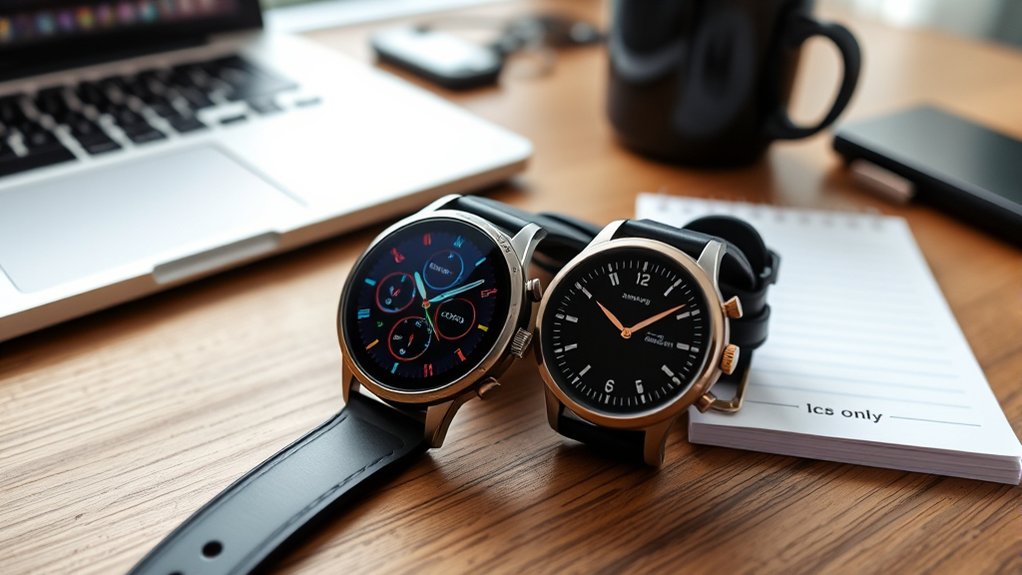
Galaxy Watch 7 improves on the Galaxy Watch 5 in nearly every core area. It uses a faster Exynos W1000 chip, adds 2GB RAM and 32GB storage, and runs newer Wear OS 5 software. Its larger, brighter Sapphire Crystal AMOLED display is easier to see outdoors. It also offers more accurate BioActive health tracking and dual-frequency GPS. Galaxy Watch 5 remains the lower-cost option for basics, while the fuller comparison below clarifies the better fit.
Galaxy Watch 7 Vs Watch 5: Which Should You Buy?
Which model makes more sense depends chiefly on priorities: the Galaxy Watch 7 is the stronger buy for users who value faster performance, a brighter and larger AMOLED display, newer software, and more accurate health tracking, while the Galaxy Watch 5 remains the better value for buyers focused on lowering upfront cost.
From a practical buying perspective, the Galaxy Watch 7 offers more headroom and autonomy. Its 2GB RAM and 32GB storage support smoother multitasking and greater app freedom than the Galaxy Watch 5 with 1.5GB and 16GB.
Its Wear OS 5 and One UI 6 platform also gives buyers a more current experience than Wear OS 3.5 with One UI Watch 4.5.
Still, price shifts the equation. At about $300, the Galaxy Watch 7 asks for a premium, whereas the Galaxy Watch 5 near $200 preserves flexibility in a tighter budget.
For users prioritizing reliable health tracking, improved GPS, and upgraded BioActive sensors, the newer model justifies that higher spend.
Galaxy Watch 7 Vs Watch 5: Key Differences
Although both watches share Samsung’s broader design language, the core differences between the Galaxy Watch 7 and Galaxy Watch 5 are concentrated in display quality, processing power, memory, software generation, and pricing.
The Galaxy Watch 7 and Watch 5 diverge most clearly in display, performance, memory, software generation, and price.
The Galaxy Watch 7 uses a larger AMOLED display with higher brightness, while the Galaxy Watch 5 relies on an older Sapphire Crystal Glass AMOLED display that is comparatively less vivid in demanding light conditions.
Performance separation is more decisive. The Galaxy Watch 7 pairs an Exynos processor, specifically the Exynos W1000, with 2GB of RAM; the Galaxy Watch 5 uses the Exynos W920 and 1.5GB.
That shift gives the newer model stronger responsiveness and greater headroom for multitasking. The storage capacity also doubles, moving from 16GB on the Galaxy Watch 5 to 32GB on the Galaxy Watch 7.
Software likewise marks generational distance, with Wear OS 5 and One UI 6 replacing Wear OS 3.5 and One UI Watch 4.5.
Galaxy Watch 7 Vs Watch 5 Price and Value
A launch-price comparison shows the Galaxy Watch 7 starting at $300 for the 40mm model and $330 for the 44mm version, with LTE adding $50.
Meanwhile, the Galaxy Watch 5 originally entered the market at $200. Current retail value is less straightforward, as the older Watch 5 now often sells for roughly $325 to $360, narrowing or even reversing its apparent price advantage.
From an upgrade-cost perspective, the Watch 7’s higher entry price is partly supported by added value such as 32GB of storage, newer health and performance features, and potential trade-in savings for existing Samsung users.
Launch Pricing Comparison
Price is one of the clearest dividing lines between these two models. At launch, Galaxy Watch 7 entered at $300 for 40mm and $330 for 44mm, while LTE adds $50. The Galaxy Watch 5 debuted lower at $200, creating a sharp pricing gap. That difference signals Samsung’s strategy: charge more for meaningful upgrades in display quality, sensors, and overall speed, giving buyers more freedom to prioritize performance.
| Model | Launch price |
|---|---|
| Galaxy Watch 7 | $300/$330, LTE +$50 |
| Galaxy Watch 5 | $200 |
From a value perspective, trade-in options can soften the Galaxy Watch 7 premium. Meanwhile, Galaxy Watch 5 pricing has become less predictable because Samsung no longer sells it directly, leaving third-party listings to shape perceived value rather than original positioning alone.
Current Retail Value
Retail pricing changes the value equation more than launch MSRP alone. The Galaxy Watch 7 currently starts at $300 for 40mm and $330 for 44mm, while LTE versions add $50.
By contrast, the Galaxy Watch 5 launched at $200, yet its current retail value is less straightforward because Samsung no longer sells it directly and third-party listings often hover near $325.
These pricing differences complicate any simple budget narrative. The Galaxy Watch 7 includes 32GB of storage, doubling the 16GB in the Galaxy Watch 5, which helps justify its present positioning.
For buyers seeking liberation from outdated hardware limits, that matters. Meanwhile, trade-in options can narrow the effective gap and improve perceived value, though the Galaxy Watch 5 still appeals as a familiar, more budget-friendly entry for some shoppers today.
Upgrade Cost Considerations
How much the upgrade really costs depends on whether the buyer values immediate savings over longer-term gains in performance and capacity.
The Galaxy Watch 7 begins at $300 for 40mm and $330 for 44mm, while the Galaxy Watch 5 sits near $200, creating a clear upfront cost gap.
That premium buys stronger specifications: a brighter display, Exynos W1000 processor, 2GB RAM, and 32GB storage, versus the Galaxy Watch 5 with Exynos W920, 1.5GB RAM, and 16GB.
Trade-in offers can reduce the upgrade burden for buyers moving into Galaxy Watch 7, although availability varies.
Since Samsung no longer sells the older model directly, Watch 5 pricing depends on retailers.
For budget-focused users seeking financial freedom, the older watch preserves cash; for users prioritizing speed and storage, the newer model delivers broader long-term value.
Galaxy Watch 7 Vs Watch 5 Design and Sizes
In design terms, the Galaxy Watch 7 and Galaxy Watch 5 remain closely aligned, with both using an aluminum case, identical 40mm and 44mm size options, and a digital bezel with haptic feedback instead of a physical rotating bezel.
The main distinction lies in the display, where the Galaxy Watch 7 pairs its familiar form factor with a larger, brighter AMOLED panel and sapphire crystal protection for greater durability.
Strap compatibility also remains consistent between the two, reinforcing continuity while the screen upgrades mark the clearest visual and functional separation.
Case Design Differences
At a glance, the Galaxy Watch 7 and Galaxy Watch 5 follow the same core case formula, with aluminum builds, 40mm and 44mm size options, and strap compatibility across both generations.
- Both use aluminum cases, preserving a lightweight, practical case design.
- Neither the Galaxy Watch 7 nor Galaxy Watch 5 includes a physical rotating bezel.
- Each relies on a digital bezel, signaling Samsung’s cleaner, more liberated interface direction.
- External continuity means owners can move between generations without changing bands.
- Differences are subtler in the shell than in internal hardware and screen treatment.
From a comparative standpoint, the case architecture remains intentionally stable. That consistency benefits users seeking freedom from unnecessary redesigns.
Visually, the Galaxy Watch 7 does not radically separate itself from the Galaxy Watch 5, instead refining an already established smartwatch silhouette.
Size And Display
Size parity keeps the comparison straightforward: both the Galaxy Watch 7 and Galaxy Watch 5 are offered in 40mm and 44mm versions, so overall fit and band compatibility remain consistent across generations.
That continuity gives buyers freedom to upgrade without rethinking wrist comfort or accessory investment.
The real shift appears in the display. Galaxy Watch 7 expands the AMOLED panel to 1.3 inches and 1.5 inches, versus 1.19 inches and 1.36 inches on Watch 5.
It also delivers stronger brightness and higher resolution, improving legibility outdoors and increasing visual immersion.
Both watches retain aluminum cases and a digital bezel rather than a physical rotating mechanism, preserving a clean, modern interface.
Watch 5 still offers Sapphire Crystal Glass protection, but Watch 7 pushes practical usability further through a larger, brighter, more readable viewing surface overall.
How Much Faster Is the Galaxy Watch 7?
How much faster the Galaxy Watch 7 feels comes down to more than a simple clock-speed bump. In comparative use, the Galaxy Watch 7 gains responsiveness from the Exynos W1000, added RAM, and a newer software base. Together, those upgrades reduce friction and give users more freedom to move between tasks without pauses.
- Exynos W1000 replaces the older Exynos W920, lifting overall performance in everyday interactions.
- 2GB of RAM, versus 1.5GB on the Watch 5, supports smoother multitasking and fewer slowdowns.
- Apps should open with less hesitation, especially when several background processes remain active.
- 32GB of storage doubles the Watch 5 capacity, allowing more apps and media without constant management.
- Wear OS 5 with One UI 6 feels more current and efficient than Wear OS 3.5 with One UI Watch 4.5.
Measured purely by hardware and platform changes, the Watch 7 stands as the faster, less restrictive smartwatch of the two overall.
Galaxy Watch 7 Vs Watch 5 Health and GPS
Where the Galaxy Watch 7 separates itself most clearly is in tracking precision. Its updated BioActive sensor improves health tracking accuracy over the Galaxy Watch 5, giving readings that are generally more refined during workouts, sleep analysis, and daily wellness checks.
Both watches support ECG and blood pressure measurement through Samsung Health Monitor, though these tools still depend on a paired Samsung phone and remain region-limited in some markets.
Location performance shows an equally clear divide. The Galaxy Watch 7 adds dual-frequency GPS, which strengthens route accuracy in dense cities, wooded trails, and other signal-challenging environments where standard GPS can drift.
The Watch 5 relies on conventional positioning, making it less resilient under difficult conditions. Software also widens the gap: Galaxy Watch 7 runs Wear OS 5 with One UI 6, enabling deeper health insights and more advanced fitness guidance than the Watch 5 on Wear OS 3.5 for users seeking more autonomy.
Who the Galaxy Watch 7 and Watch 5 Are Best For
For buyers deciding between them, the Galaxy Watch 7 fits those who value the most current Samsung smartwatch experience, particularly in health tracking, GPS precision, display quality, and software longevity.
- Galaxy Watch 7 suits users wanting advanced BioActive sensing and more reliable route accuracy.
- Galaxy Watch 5 remains practical for budget-conscious buyers seeking dependable health tracking.
- Galaxy Watch 7 appeals to those preferring a larger, brighter AMOLED display for easier reading.
- Galaxy Watch 5 Pro better serves fitness enthusiasts who need stronger battery life for long outings.
- Galaxy Watch 7 benefits users prioritizing Wear OS 5 and newer One UI features.
From a comparative standpoint, the Galaxy Watch 7 grants greater freedom through cutting-edge tools and longer software relevance.
The Galaxy Watch 5, however, offers a balanced path for users who want essential smartwatch functions without paying for every latest refinement.
Choice depends on whether liberation means maximum capability, lower cost, or greater endurance away from the charger.
Frequently Asked Questions
Is the Galaxy Watch 7 Better Than the 5?
Yes, the Galaxy Watch 7 is generally better, offering stronger Galaxy Watch features, faster performance, improved Health tracking, longer Software updates, and a favorable Design comparison, though Battery life and lower cost can still favor the 5.
What Are Some Cool Things I Can Do With My Galaxy Watch 7?
Like a wristbound command center, what can it release? It enables Fitness tracking, Sleep monitoring, Music control, Health insights, and Custom watchfaces, giving users more autonomous daily oversight than older models through clearer, faster, more adaptive interactions.
What Are the Key Differences Between the Galaxy Watch5 and 6?
Key differences include faster Watch6 performance, brighter display, slimmer Design features, and enhanced Health tracking. Battery life slightly favors Watch5, while App compatibility remains similar; Price comparison typically positions Watch5 as the more budget-liberating choice.
What Are Some Tips and Tricks for the Samsung Galaxy Watch 7 / Ultra?
Prioritize power-saving for battery life, refine fitness tracking via BioActive sensors and dual-frequency GPS, exploit app integration with Samsung Health Monitor, and expand customization options; comparatively, these tactics elevate health monitoring while reducing daily dependence.
Conclusion
Overall, the Galaxy Watch 7 presents a sharper, speedier, and more sensor-savvy smartwatch, while the Galaxy Watch 5 remains a practical, price-conscious pick. The comparison shows meaningful gains in processing power, health tracking, and GPS precision on the newer model. Still, buyers focused on solid daily performance and better budget value may find the Watch 5 sufficient. In simple terms, performance seekers should prefer the 7, while savings-minded shoppers may stay satisfied with the 5.

