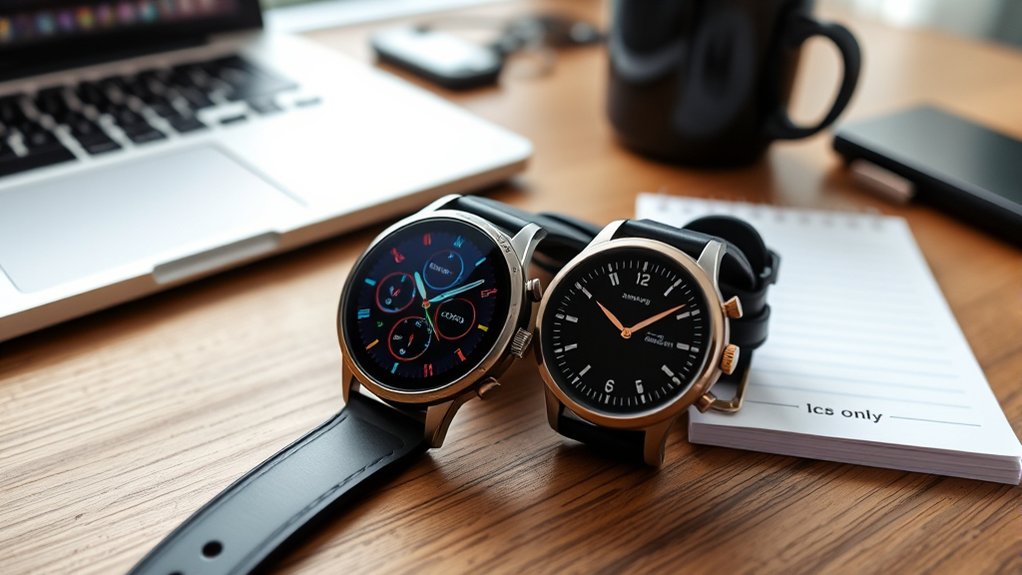
The Galaxy Watch 7 vs Watch 5 comparison comes down to performance, display quality, health tracking, GPS accuracy, and price. Both Samsung smartwatches handle everyday notifications, workouts, sleep tracking, and Android apps. However, the Watch7 brings major hardware improvements while keeping a familiar design. Here’s how the differences affect daily use and whether upgrading makes sense.
Quick Answer
The Galaxy Watch7 is better overall because of its faster Exynos W1000 processor, larger display, 32GB storage, improved BioActive sensor, and dual-frequency GPS. Choose the Watch5 if it costs significantly less and you mainly need everyday smartwatch features. Both support modern Wear OS software, so upgrading solely for software features may not be worthwhile.
Key Takeaways
- The Watch7 has a five-core 3nm processor, compared with the Watch5’s dual-core 5nm chip.
- Both have sapphire crystal displays, but the Watch7 provides larger screens and higher resolution in both case sizes.
- The Watch7 adds dual-frequency GPS and an updated BioActive sensor, making it more attractive for outdoor exercise.
- Both watches have received Wear OS 6 and One UI 8 Watch, although some hardware-specific features remain exclusive to the Watch7.
- Battery capacity is slightly higher on the Watch7, but actual battery life depends on settings, usage, and battery condition.
Last checked: October 23, 2026. Dates and figures were verified against official sources.
Galaxy Watch 7 vs Watch 5: Which Should You Buy?
Choose the Galaxy Watch7 if you want faster apps, better outdoor visibility, improved GPS tracking, and greater storage capacity. Its newer processor also makes everyday interactions feel more responsive.
The Galaxy Watch5 still handles notifications, calls, exercise tracking, sleep monitoring, and popular Wear OS apps. If you already own one that performs well, these basic features alone do not justify replacing it.
The biggest reasons to upgrade are the Watch7’s improved hardware and location tracking. Its updated BioActive sensor also provides more advanced health measurements.
Price matters just as much. A discounted Watch5 can be a sensible purchase, but an older model at a price close to the Watch7 offers less value.
Bottom line: Buy the Watch7 when the price difference is reasonable. Keep or consider the Watch5 when your needs are basic and the savings are substantial.
Galaxy Watch 7 vs Watch 5: Key Differences
The Galaxy Watch7 improves several important specifications without changing Samsung’s familiar round smartwatch design. The biggest upgrades involve processing speed, storage, display size, health sensors, and GPS technology.
The following comparison uses Samsung’s official Galaxy Watch7 product specifications and Galaxy Watch5 specifications.
| Feature | Galaxy Watch7 | Galaxy Watch5 |
|---|---|---|
| Release year | 2024 | 2022 |
| Case sizes | 40mm and 44mm | 40mm and 44mm |
| Processor | Exynos W1000, five-core, 3nm | Exynos W920, dual-core, 5nm |
| RAM | 2GB | 1.5GB |
| Storage | 32GB | 16GB |
| 40mm display | 1.3-inch AMOLED, 432 × 432 | 1.2-inch AMOLED, 396 × 396 |
| 44mm display | 1.5-inch AMOLED, 480 × 480 | 1.4-inch AMOLED, 450 × 450 |
| Screen protection | Sapphire crystal | Sapphire crystal |
| GPS | Dual-frequency L1 + L5 | Conventional single-frequency GPS |
| 40mm battery | 300mAh | 284mAh |
| 44mm battery | 425mAh | 410mAh |
| Original software | Wear OS 5, One UI 6 Watch | Wear OS 3.5, One UI Watch 4.5 |
| Software update status | Wear OS 6, One UI 8 Watch available | Wear OS 6, One UI 8 Watch available |
| Durability | 5ATM, IP68, MIL-STD-810H | 5ATM, IP68, MIL-STD-810H |
The Watch7 wins in processor performance, display size, storage, and GPS capability. However, both offer similar basic construction, water-resistance ratings, and access to common smartwatch apps.
Neither standard model has the physical rotating bezel found on certain Galaxy Watch Classic models. Both use a touch-sensitive digital bezel for navigation.
Galaxy Watch 7 vs Watch 5 Price and Value
The Galaxy Watch7 launched at a higher price than the Watch5, but their original U.S. starting prices were only about $20 apart. Current discounts and remaining stock can make a much bigger difference.
When comparing prices, match the same case size, Bluetooth or LTE connectivity, and product condition. A refurbished Watch5 should not be compared directly with a new Watch7.
Launch Pricing Comparison
Samsung introduced the Galaxy Watch5 in August 2022 and the Galaxy Watch7 in July 2024. Their U.S. starting prices were $279.99 and $299.99, respectively, for the 40mm Bluetooth models.
| Model | Launch price |
|---|---|
| Galaxy Watch7 | 40mm Bluetooth: $299.99; 44mm Bluetooth: $329.99; LTE: $50 extra |
| Galaxy Watch5 | 40mm Bluetooth: $279.99; 44mm Bluetooth: $309.99; LTE: $50 extra |
These figures are original U.S. launch prices, not guaranteed selling prices today. Both watches have appeared in discounted listings since their release.
Current Retail Value
Current pricing depends on the retailer, remaining inventory, and whether the watch is new, open-box, or refurbished. Older hardware does not always become cheaper when new stock grows scarce.
During this review, Samsung’s U.S. Galaxy Watch7 listing showed Bluetooth pricing of $249.99 for 40mm and $279.99 for 44mm configurations. Promotions, availability, and selected options can change these figures.
Galaxy Watch5 pricing is less consistent because buyers now encounter older inventory and secondhand units alongside refurbished products.
A very cheap Watch5 can still deliver good value. However, paying almost as much for an older model as a newer Watch7 is difficult to justify, especially when the newer watch offers twice the storage.
Upgrade Cost Considerations
If you already own a Watch5, the real upgrade cost is the Watch7 purchase price minus any trade-in credit or resale value. You should also consider whether your existing watch still performs well.
- Upgrade: If slow app performance, unreliable GPS routes, or limited storage regularly frustrate you.
- Keep the Watch5: If notifications, sleep tracking, and everyday workouts already meet your needs.
- Buy the Watch5: If you find a substantial discount on a unit with a healthy battery and reliable seller support.
- Choose the Watch7: If prices are close or you plan to keep the watch for several years.
Trade-in promotions can make upgrading more attractive. However, discounts and eligibility depend on the offer available when you buy.
Galaxy Watch 7 vs Watch 5 Design and Sizes
The Galaxy Watch7 and Watch5 look similar because both use round aluminum cases with two physical side buttons. Each comes in 40mm and 44mm sizes, giving buyers a choice between a compact fit and a larger display.
The Watch7’s biggest visual improvement is its screen rather than a dramatic case redesign.
Case Design Differences
Both watches use aluminum construction and sapphire crystal screen protection. Neither has a mechanical rotating bezel, and both rely on a digital touch bezel for scrolling.
The watches also share 5ATM water resistance, an IP68 rating, and MIL-STD-810H durability certification. These ratings do not make either watch waterproof under every condition.
Weight differences are small:
- Watch7 40mm: 28.8g without the band.
- Watch5 40mm: 28.7g without the band.
- Watch7 44mm: 33.8g without the band.
- Watch5 44mm: 33.5g without the band.
Both generations use 20mm band connections. Samsung confirms that compatible Watch5 bands can fit the Watch7, although certain shaped or model-specific bands may not fit perfectly.
Its official Galaxy Watch band compatibility guide explains the exceptions, including metal bands designed for specific models.
Size and Display
The Galaxy Watch7 offers a larger display in both sizes. Its 40mm version has a 1.3-inch screen, compared with the Watch5’s 1.2-inch screen. The 44mm versions measure 1.5 inches and 1.4 inches, respectively.
Resolution also improves:
- Watch7 40mm: 432 × 432 pixels.
- Watch5 40mm: 396 × 396 pixels.
- Watch7 44mm: 480 × 480 pixels.
- Watch5 44mm: 450 × 450 pixels.
These improvements provide more screen area for notifications, maps, workout statistics, and app controls.
The Watch7 also reaches up to 2,000 nits of display brightness, helping improve visibility in bright outdoor conditions. The older Watch5 remains readable in many everyday situations, but its smaller display provides less viewing space.
Both use Super AMOLED technology with rich colors, deep blacks, and always-on display support. Both also have sapphire crystal protection, so scratch resistance is not exclusive to the newer watch.
How Much Faster Is the Galaxy Watch 7?
The Galaxy Watch7 is substantially faster on paper, thanks to its Exynos W1000 processor. Samsung advertised up to three times faster CPU performance than the previous generation, along with improved processor power efficiency.
The W1000 uses five CPU cores built on a 3nm process. The Watch5’s Exynos W920 uses two cores and a 5nm process.
The hardware difference affects several everyday tasks:
- App launching: The Watch7 can open demanding applications faster.
- Multitasking: Its 2GB RAM provides more headroom than the Watch5’s 1.5GB.
- Storage: The Watch7 has 32GB compared with 16GB, leaving more room for apps, downloaded music, and offline content.
- Interface response: Faster processing helps reduce delays while switching between watch screens and features.
Actual speed depends on the application, background activity, and software version. The advertised processor improvement does not mean every task finishes three times faster.
Does the Watch7 Have Newer Software?
The Watch7 launched with Wear OS 5 and One UI 6 Watch, while the Watch5 originally shipped with Wear OS 3.5 and One UI Watch 4.5. Those original versions no longer describe their full software capabilities.
Samsung’s official Galaxy Watch7 update history confirms Wear OS 6 with One UI 8 Watch.
The Galaxy Watch5 update history also confirms Wear OS 6 and One UI 8 Watch updates.
This matters because the Watch5 has received newer interface improvements and selected health features through software upgrades. The Watch7 still has newer hardware and a later release date, making it the stronger choice for buyers concerned about long-term performance.
Update availability can differ by model, country, and carrier. An individual watch may need a software update before these features appear.
Galaxy Watch7 vs Watch5 Battery Life
The Watch7 has slightly larger batteries, but that does not guarantee longer battery life. Both are compact smartwatches whose endurance changes with the display settings, GPS activity, cellular use, and health-tracking features.
The 40mm Watch7 has a 300mAh battery compared with 284mAh in the Watch5. The 44mm models have 425mAh and 410mAh batteries, respectively.
Samsung’s newer processor is more power-efficient, but the brighter display and additional features also require energy. As a result, the Watch7 should not be purchased solely because of its larger battery capacity.
Always-on display, continuous health tracking, GPS workouts, and LTE usage can reduce runtime on either watch.
If you are buying a used Watch5, battery age is especially important. An older battery may hold noticeably less charge than it did when new.
Galaxy Watch 7 vs Watch 5 Health and GPS
The Galaxy Watch7 offers more advanced sensor hardware and more precise location-tracking technology. The Watch5 still includes useful health features, including heart rate monitoring, sleep tracking, body composition measurements, and skin temperature sensing.
The key distinction is that the Watch7 can collect certain measurements with improved sensor hardware, while some software-based wellness features are now available across both generations.
Heart Rate, Sleep, and BioActive Sensors
The Galaxy Watch7 uses an updated BioActive sensor with improvements designed to provide more accurate health data. This can be useful during workouts, sleep monitoring, and everyday heart rate tracking.
The Watch5 also includes a BioActive sensor capable of measuring heart rate and supporting body composition analysis. It remains practical for following general activity and wellness trends.
One additional Watch7 feature is the AGEs Index, which estimates advanced glycation end-product levels through optical sensing. Samsung presents it as a wellness indicator related to metabolic health.
These readings are useful for spotting patterns, but neither watch can replace a medical examination or professional-grade equipment.
ECG, Blood Pressure, and Sleep Apnea Features
Both watches support ECG capabilities through Samsung Health Monitor when used with compatible Samsung Galaxy phones and in supported regions.
Samsung began a phased U.S. rollout of blood pressure monitoring on March 31, 2026, for eligible Galaxy Watch4 and newer models. That includes the Watch5 and Watch7.
According to Samsung’s U.S. blood pressure announcement, the feature requires calibration with a compatible upper-arm blood pressure cuff every 28 days.
Sleep apnea screening was introduced with the Watch7 and later expanded to certain earlier models through software support. Compatible Watch5 models can also use the feature where supported, provided they meet the software and phone requirements.
Availability varies by region, installed software, and supported Samsung Health Monitor services. These medical-related features are not automatically available on every phone and watch combination.
Note: ECG, blood pressure, and sleep apnea features are not substitutes for medical diagnosis or treatment. Discuss concerning readings or symptoms with a qualified healthcare professional rather than relying on smartwatch results alone.
Dual-Frequency GPS vs Standard GPS
GPS is one of the clearest hardware improvements on the Watch7. It supports dual-frequency GPS using L1 and L5 signals, while the Watch5 uses conventional single-frequency positioning.
Dual-frequency GPS can improve location accuracy where satellite signals bounce off buildings or face interference from trees and other obstacles.
This is particularly useful for:
- Running through city streets surrounded by tall buildings.
- Tracking walks and hikes through wooded areas.
- Recording cycling routes with frequent turns.
- Reviewing workout distance and pace afterward.
The Watch5 remains suitable for casual walking, running, and outdoor exercise. However, people who depend on accurate recorded routes have a stronger reason to prefer the Watch7.
Neither system guarantees perfect GPS tracking. Buildings, weather conditions, satellite visibility, and watch position can still affect recorded routes.
Phone Compatibility
Both models work with compatible Android smartphones, but they have different minimum requirements. Neither can be paired normally with an iPhone.
Samsung lists Android 11 or newer for the Galaxy Watch7 and Android 8 or newer for the Galaxy Watch5, subject to supported phone models and memory requirements.
Its Galaxy Watch phone compatibility guide also explains which functions work with non-Samsung Android phones.
Basic notifications, exercise tracking, and many third-party apps work with other compatible Android devices. However, Samsung Health Monitor features such as ECG and blood pressure require a supported Galaxy phone.
Who the Galaxy Watch 7 and Watch 5 Are Best For
The Galaxy Watch7 is the stronger all-around choice, while the Watch5 still makes sense for buyers who prioritize lower cost over maximum performance.
Your ideal model depends on how you plan to use it.
- Best for runners and cyclists: Galaxy Watch7, because dual-frequency GPS can improve route accuracy.
- Best for faster everyday performance: Galaxy Watch7, thanks to its five-core processor and additional RAM.
- Best for advanced health sensing: Galaxy Watch7, with updated BioActive hardware and AGEs Index support.
- Best for basic notifications and workouts: Galaxy Watch5, particularly if available at a substantial discount.
- Best for larger screens: Galaxy Watch7, which provides more viewing area in both case sizes.
- Best for existing Watch5 owners: Keep the Watch5 if battery life and performance remain satisfactory.
The Galaxy Watch5 Pro is worth distinguishing from the standard Watch5. It has a larger 590mAh battery, titanium case, and outdoor navigation features that make it more suitable for long activities. However, it is a separate model with different specifications.
If you are choosing between a used Watch5 and a Watch7, inspect the older device’s battery condition, charging behavior, screen, and software status before deciding.
Pro Tip: If you already have a Watch5, update its software and try the available features before replacing it. Some improvements that originally arrived with newer Samsung watches have also reached older models through One UI Watch updates.
Frequently Asked Questions
Is the Galaxy Watch 7 Better Than the 5?
Yes, the Galaxy Watch7 is better overall for performance, GPS accuracy, screen size, and advanced health sensing. Its newer processor and larger storage capacity make it more capable for demanding tasks. However, a Watch5 in good condition remains useful for notifications, sleep tracking, and everyday fitness monitoring.
What Are Some Cool Things I Can Do With My Galaxy Watch 7?
You can track workouts, monitor sleep, record GPS routes, control music, use navigation apps, and customize watch faces. You can also view health insights, track body composition, and use supported Galaxy AI features. Certain advanced health tools require a compatible Samsung phone and regional availability.
What Are the Key Differences Between the Galaxy Watch5 and 6?
The Galaxy Watch6 introduced a faster processor, larger displays, more RAM, and refinements to sleep tracking. Both models support common Wear OS apps and health features. The Watch5 may cost less, while the Watch6 offers a more spacious screen and improved responsiveness without changing the basic smartwatch experience.
What Are Some Tips and Tricks for the Samsung Galaxy Watch 7 / Ultra?
Customize quick settings, enable useful gestures, and adjust power-saving options to suit your routine. Set up workout tracking, sleep monitoring, and Samsung Health notifications. The Watch Ultra adds a larger battery and outdoor-focused features, while the Watch7 offers a lighter design for everyday fitness and smartwatch use.
Conclusion
The Galaxy Watch7 is the better smartwatch for most buyers comparing these two models. Its faster processor, larger display, improved health sensor, and dual-frequency GPS deliver meaningful hardware upgrades.
The Watch5 remains a sensible choice if you already own one or find it at a much lower price. Since both can run newer Wear OS software, the best reason to upgrade is improved hardware rather than software alone.
Compare the actual selling prices, match the size and connectivity options, and choose the model whose features you will use regularly.
Sources
- Samsung Mobile Press: Galaxy Watch7 Announcement: Official Watch7 specifications, processor, displays, sensors, GPS, and battery capacities.
- Samsung Mobile Press: Galaxy Watch5 Announcement: Original Watch5 specifications, release information, pricing, and Watch5 Pro differences.
- Samsung US: Galaxy Watch7 Product Listing: Listed U.S. pricing and configuration options.
- Samsung Support: Galaxy Watch Band Compatibility: Band connection sizes and compatibility between watch generations.
- Samsung: Galaxy Watch7 Software History: Wear OS 6, One UI 8 Watch, and software update records.
- Samsung: Galaxy Watch5 Software History: Wear OS 6, One UI 8 Watch, and software update records.
- Samsung Mobile Press: U.S. Blood Pressure Monitoring: March 2026 rollout, eligible models, calibration requirements, and health-feature limitations.
- Samsung Support: Galaxy Watch Phone Compatibility: Android requirements, supported phone features, and Samsung-only functions.

