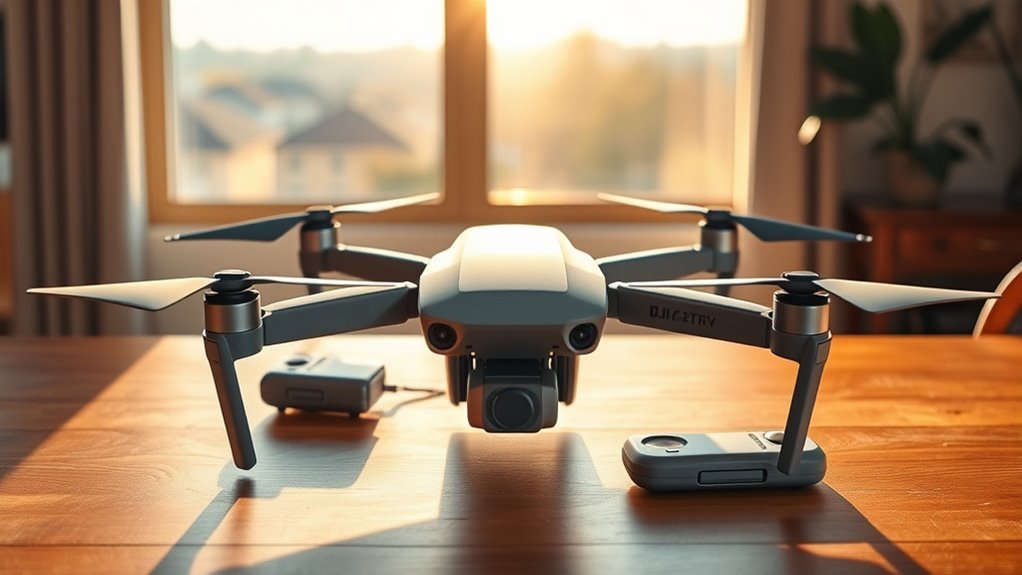
The DJI Mavic 4 Pro introduces the Infinity Gimbal, 51-minute flight time, and claimed 41 km range, positioning it as a serious tool for aerial work. Its 360° horizontal rotation and 70° upward tilt expand framing options beyond typical drone limits. Yet U.S. buyers face a different issue: limited availability, tariff pressure, and possible firmware restrictions on imported units. The real question is whether these gains justify the cost and complications.
What the DJI Mavic 4 Pro Offers
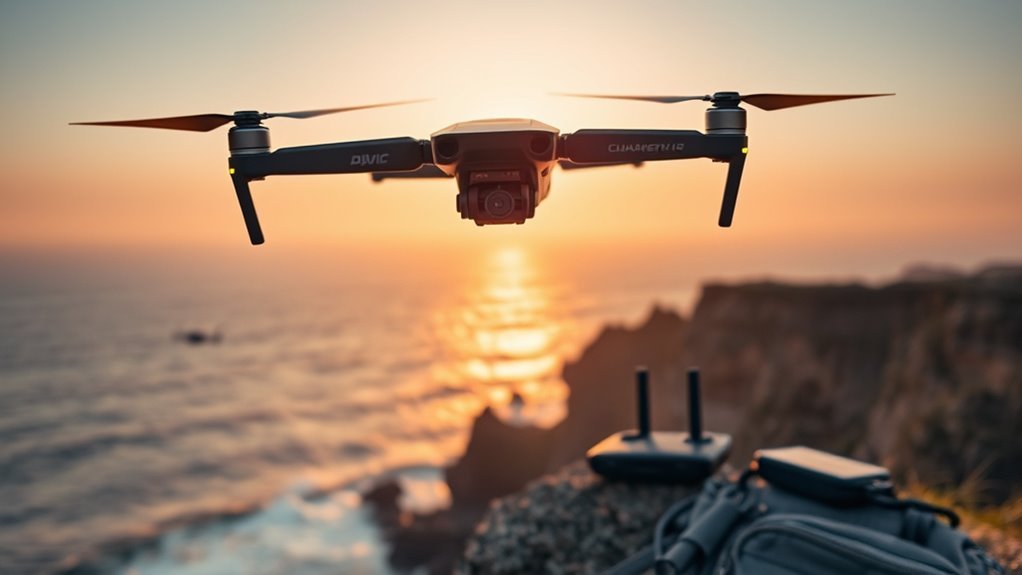
The DJI Mavic 4 Pro offers a high-end imaging and flight package built around a 100MP Hasselblad main camera that records 6K/60fps HDR video, along with a maximum 51-minute flight time and a top speed of 90 kph (56 mph).
The Mavic 4 Pro pairs this with the Infinity Gimbal and omnidirectional obstacle avoidance, giving operators a stable platform and broader freedom in complex environments. Its Hasselblad main camera is built for detailed stills and motion capture, while 10-bit HDR video preserves tonal range for post-production flexibility.
O4+ video transmission extends control and monitoring out to 18.6 miles, supporting a high-quality link for distant work. In low-light conditions, navigation remains supported down to 0.1 lux, adding safety when visibility drops.
How the Infinity Gimbal Changes Aerial Shooting?
With its Infinity Gimbal, the DJI Mavic 4 Pro expands aerial framing through a full 360° horizontal rotation and a 70° upward tilt, reducing reliance on complex rigging for unconventional compositions.
This Infinity Gimbal changes aerial photography by widening shooting perspectives while preserving stability and a level horizon. Its advanced control system suppresses vibration, supporting cleaner footage in wind and during abrupt maneuvers.
The result is greater freedom to orbit subjects, reveal architecture from uncommon angles, and shift smoothly between shots without reconfiguring gear. Dynamic range in framing improves because the camera can be positioned more precisely relative to light and subject geometry.
Greater freedom to orbit subjects and reveal architecture from uncommon angles, with smoother shot transitions and more precise framing.
In demanding environments, obstacle avoidance remains more effective as the gimbal supports safer navigation and controlled movement. The design also benefits low-light performance by enabling steadier nighttime operation, where motion blur and instability are harder to manage.
DJI Mavic 4 Pro Camera and Image Quality
Image quality becomes the next area of focus, and the DJI Mavic 4 Pro centers that capability around a 100MP 4/3 CMOS Hasselblad main camera capable of 6K video at 60fps.
The Mavic 4 Pro uses a quad-bayer design to deliver detailed stills, while Hasselblad Natural Color Solution supports accurate tonal rendering and cleaner color shifts. Its high ISO performance is strengthened from ISO 800 onward, helping preserve detail in lower light without excessive noise.
- The dual-camera system adds a 48MP medium telephoto and 50MP long telephoto lens.
- Both telephoto cameras record 4K video at 60fps, extending framing options.
- The 360° Infinity Gimbal enables true vertical and straight-down compositions for liberated aerial framing.
Taken together, the camera stack gives the Mavic 4 Pro a flexible image pipeline built for clarity, color fidelity, and compositional freedom.
Flight Time, Speed, and Real-World Range
Boasting up to 51 minutes of maximum flight time, the DJI Mavic 4 Pro offers the longest endurance in the Mavic series and a substantial operating window for extended aerial work. This flight time supports longer sorties, fewer landings, and more deliberate planning for high resolution capture.
The drone’s speed reaches 90 kph, enabling rapid repositioning across large sites. Its effective flight range extends to 41 km, giving operators wide operational latitude for remote work and route flexibility.
In practice, range and endurance depend on wind, temperature, payload, and maneuvering load, so real-world results may be lower. Even so, the platform is engineered for efficient performance under varied conditions.
Omnidirectional obstacle avoidance adds a safety layer during complex navigation, helping preserve momentum without sacrificing control. Together with its video transmission system, the Mavic 4 Pro is built for dependable flight, long range, and practical freedom in demanding aerial operations.
How Stable Is OcuSync 4+?
OcuSync 4+ is designed for stable long-range transmission, with a reach of up to 18.6 miles under ideal conditions. Compared with OcuSync 4, it extends operational distance while preserving stable connections for control and video transmission.
Enhanced algorithms reduce dropouts in urban environments, where competing signals can disrupt links. The system also shifts across multiple frequencies to match conditions, improving resilience when obstacles or interference appear. Its 10-bit HDR feed supports clean, high-fidelity imagery, helping pilots monitor subject detail without sacrificing clarity.
Low-light performance remains strong, so the link stays dependable at dusk, at night, or in low-visibility airspace.
- Longer transmission range supports wider, freer missions.
- Adaptive frequency use helps maintain signal integrity.
- Urban environments and low-light performance are handled with fewer interruptions.
What’s New in the RC Pro 2 and Battery Dock
The RC Pro 2 adds a 7-inch Mini-LED display rated up to 2000 nits, a custom wheel button for rapid camera control, and an improved ergonomic layout for easier operation.
It also powers on automatically when the drone arms are extended, reducing setup time in the field.
The redesigned battery dock supports simultaneous charging of three batteries, reaching one full charge in 51 minutes or three in 90 minutes.
RC Pro 2 Upgrades
With the RC Pro 2, DJI adds a 7-inch rotatable high-bright display rated at up to 2000 nits, improving visibility in strong ambient light and giving pilots more flexibility in framing and monitoring.
For the Mavic 4 Pro, the DJI RC Pro also brings a custom wheel button for direct camera control, while the updated body supports faster power-up and improved battery life management.
Control sticks fold away for compact storage, reducing bulk in transport.
- Large screen for clearer visibility outdoors
- Custom wheel button for precise adjustments
- Foldable sticks for compact storage and easier handling
The charging hub further supports flight time by letting operators prepare multiple packs efficiently, helping the system stay ready for extended missions without unnecessary delay.
Battery Dock Benefits
A redesigned battery dock streamlines field operations by charging up to three Mavic 4 Pro batteries at once, reducing downtime and improving turnaround between flights. This simultaneous charging setup raises charging efficiency for crews that need sustained mobility and control.
Intelligent charging first tops up each pack before full-cycle transfer, helping maximize battery life and preserve performance over time. With each battery delivering an impressive flight time of up to 51 minutes, the system supports longer missions with fewer interruptions.
Paired with the RC Pro 2 controller, which improves visibility and handling, the battery dock completes a practical power workflow. Together, these upgrades give operators more autonomy, less waiting, and steadier access to airworthy batteries in the field.
DJI Mavic 4 Pro Vs Mavic 3 Pro
The DJI Mavic 4 Pro introduces major design and camera upgrades over the Mavic 3 Pro, led by a 100MP main sensor and the new Infinity Gimbal for full 360° rotation.
It also extends flight performance with a 51-minute maximum flight time, compared with the Mavic 3 Pro’s 43 minutes.
These changes position the Mavic 4 Pro as a more capable, higher-end platform, with added weight and a higher price reflecting the upgrade.
Design And Camera Upgrades
Mechanical refinements define the DJI Mavic 4 Pro’s advantage over the Mavic 3 Pro, starting with a 100MP Hasselblad main camera that replaces the older 20MP sensor and delivers greater detail and dynamic range.
The Mavic 4 Pro pairs this with the Infinity Gimbal, a 3-axis 360° system that enables full rotation and 70° upward tilt for freer framing.
Image quality gains extend to the telephoto lens, now 6.5x with sharper output, while low-light performance improves alongside 0.1-lux obstacle avoidance.
- Hasselblad imaging supports cleaner files and stronger color latitude.
- Infinity Gimbal expands composition without manual compromise.
- The upgraded telephoto lens and obstacle avoidance broaden operational confidence.
Flight Time And Range
Beyond imaging and gimbal refinements, flight endurance becomes another clear separator between the two drones. The Mavic 4 Pro delivers a maximum flight time of 51 minutes, ahead of the Mavic 3 Pro’s 43 minutes, giving pilots more room to plan longer missions with fewer interruptions.
Its top speed of 56 mph, or 90 kph, also supports faster repositioning when conditions demand it. Range is another advantage: the Mavic 4 Pro reaches up to 41 km, expanding operational flexibility for wide-area aerial photography.
The O4+ video transmission system strengthens signal stability at distance, helping the DJI drone maintain control and live view integrity over longer runs. For users seeking freedom in the air, these gains make the Mavic 4 Pro the more capable platform.
U.S. Availability and Pricing
U.S. buyers currently face limited access to the DJI Mavic 4 Pro, as direct domestic purchase remains unavailable under tariff-related restrictions on Chinese goods.
Pricing begins near $2,199 for the base kit with the DJI RC 2, while the Fly More Combo ranges from $2,899 to $3,899 depending on controller choice.
U.S. availability is consequently indirect, with some buyers choosing to import units from retailers such as B&H. That route can preserve access, but it may also introduce region-locked firmware and the absence of official DJI support or the official DJI U.S. warranty.
- Base Mavic 4 Pro: about $2,199 with DJI RC 2
- Fly More Combo: $2,899 to $3,899
- Imported units: possible, but support and firmware limits apply
Who Should Buy the Mavic 4 Pro?
For buyers able to access the DJI Mavic 4 Pro, the target audience is clearly professional photographers and videographers who need top-tier image quality and long operational endurance.
The Mavic 4 Pro is best suited to professional photographers, especially those working in commercial photography, where the 100MP Hasselblad camera, 6K capture, and strong dynamic range support demanding deliverables. Its improved low-light performance also makes it a strong choice for dusk, interior, and high-contrast scenes.
Creative operators who value liberation from restrictive framing will benefit from the Infinity Gimbal, which enables unique angles and more flexible compositions. Extended flight time of up to 51 minutes and long range reduce interruption during complex aerial work.
For multi-day assignments, the Fly More Combo is the practical option, adding batteries and accessories that improve continuity. This drone is less about casual use and more about disciplined, high-end production workflows.
Frequently Asked Questions
Can You Fly a DJI Mavic 4 Pro in the US?
Yes, it can be flown in the U.S. if drone regulations, local laws, and federal requirements are followed.
The operator must check airspace classifications, observe flight restrictions, complete the registration process when required, and follow safety guidelines.
Imported units may have firmware limits, but legality to fly remains separate from purchase status.
Privacy concerns should also be considered, especially near people, property, and sensitive locations where compliance is essential.
Why Is the DJI Mavic 4 Pro Not Available in the USA?
It remains absent in the USA because bureaucracy loves a good checkpoint, and tariffs make import math ugly.
DJI regulations, supply chain constraints, and a cautious pricing strategy keep the Mavic 4 Pro features out of official channels. Market demand is strong, yet competition analysis and consumer feedback suggest limited U.S. upside until an international launch stabilizes.
For now, liberation-minded buyers must tolerate preorders, gray-market risks, and warranty uncertainty.
How Far Can You Fly a DJI Mavic 4 Pro?
It can fly up to 41 kilometers under ideal conditions.
Actual flight distance factors include battery efficiency, altitude restrictions, signal interference, GPS accuracy, weather conditions, drone regulations, and aerial photography limits.
Strong wind, low temperatures, or dense obstacles can reduce range considerably.
O4+ transmission helps preserve control at distance, but safe operation depends on terrain and compliance.
For liberated, extended missions, performance remains condition-dependent rather than absolute.
What Is the Maximum Flight Time of the Mavic 4 Pro?
The Mavic 4 Pro’s maximum flight time is up to 51 minutes under ideal conditions.
This Mavic 4 Pro features strong battery performance, supporting longer sessions with stable gimbal stability and high camera quality.
User experience benefits from efficient flight modes and low-power standby.
Real-world endurance varies with wind, temperature, and payload.
Maintenance tips include balanced charging and storage.
Pricing options differ by bundle, but sustained flight aids creative freedom.
Conclusion
In conclusion, the DJI Mavic 4 Pro arrives like a modestly priced luxury spaceship, offering an Infinity Gimbal, long flight time, and range that make ordinary drones seem politely obsolete. Its camera and control upgrades are genuinely impressive, while U.S. availability remains a masterclass in frustration, thanks to tariffs and region-locked headaches. For professionals, it is a compelling tool; for everyone else, it is a reminder that premium aerial freedom still comes with paperwork.
