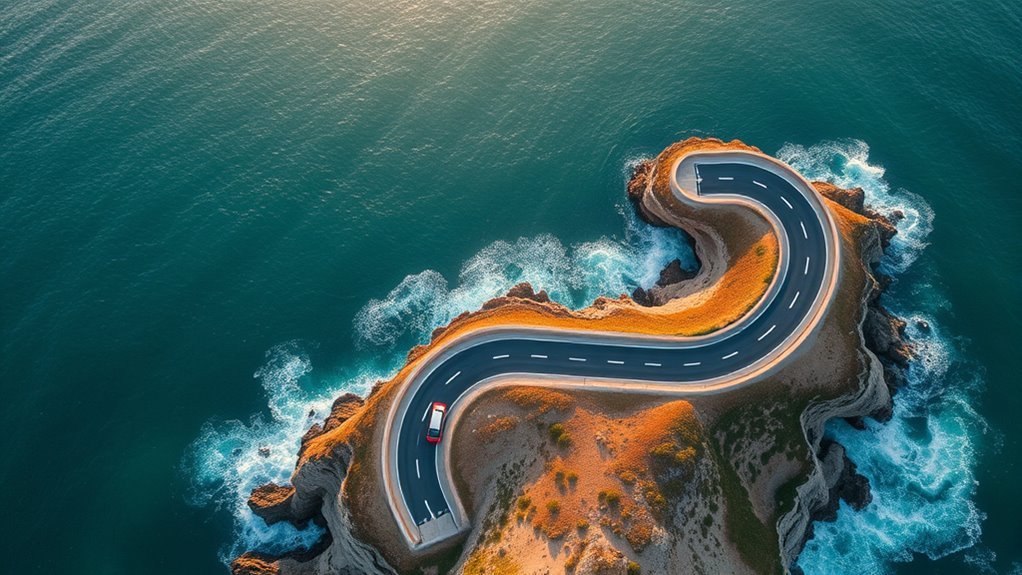
Drone photography composition depends on controlled angles, clear subject placement, and deliberate use of space. Foreground elements add depth, while a 45-degree view can introduce stronger lines and shadow structure. Bird’s-eye perspectives reveal patterns, but height must still support the subject. Light, especially at golden hour, changes the frame fast. The next rules show how small shifts in position can transform a flat aerial shot into something far more precise.
Drone Composition Essentials
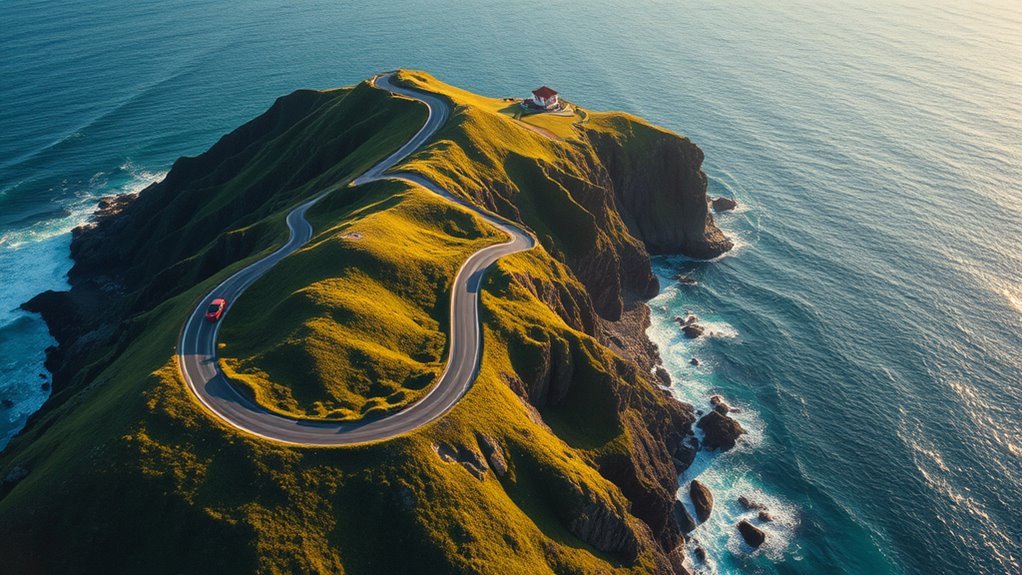
Strong drone composition begins with deliberate framing: foreground elements can add depth and visual anchor points, while a 45-degree shooting angle often sharpens horizon lines and introduces dramatic shadow separation, especially at golden hour.
In drone photography, this baseline supports photography composition that feels expansive yet controlled. Aerial images gain clarity when altitude is chosen to reveal structure rather than flatten it.
At higher viewpoints, landscapes expose geometric patterns, roads, fields, and water edges that ordinary sight misses. Adjusting tilt and elevation changes the balance between abstraction and place, giving the pilot room to select cleaner lines and stronger spatial rhythm.
Each movement should serve intent: lift for pattern, angle for tension, descent for scale. The result is visual freedom without chaos, where the frame remains disciplined and expressive.
Use Foreground Elements for Depth
Foreground elements give drone images immediate depth by leading the eye from near detail into the wider scene. In aerial photography, foreground elements such as rocks, roofs, crops, or water texture can anchor different compositions and create a measured visual path toward the subject.
Foreground elements add depth, guiding the eye from near detail into the wider aerial scene.
Their presence adds scale, context, and a layered structure that turns a flat view into a spatial scene. Lower altitude often strengthens this effect, because near detail occupies more of the frame and connects the viewer to the landscape below.
Different focal lengths also shift emphasis: wider views keep the environment clear, while tighter framing can enlarge foreground texture without losing background sharpness.
Used with intent, foreground elements sharpen contrast between near and far, making the image feel more immersive and more alive. The result is a disciplined composition that still feels free, expansive, and open to movement.
Frame Stronger Shots at 45 Degrees
A 45-degree camera angle adds depth by tilting the frame enough to show horizon, terrain, and structure in one view. This diagonal perspective pushes the scene forward, giving the image motion without losing orientation.
It is a clean way to frame stronger shots because the landscape reads in layers instead of flat planes. The best drone for this work supports steady tilt control, such as the DJI Mavic Pro, allowing precise adjustments in flight.
At a 45-degree angle, shorelines, ridges, roads, and buildings gain clear separation and sharper visual tension. During golden hour, low sun extends shadows and saturates color, increasing contrast across surfaces.
The result is a freer, more expansive image that feels open and alive. This approach rewards careful positioning and reveals natural geometry that standard overhead views often suppress.
Use Bird’s-Eye Views for Patterns
Bird’s-eye views isolate pattern by pointing the camera straight down, turning rivers, roads, fields, and other landforms into clean geometric designs. In aerial work, this bird’s-eye view strips away horizon clutter and exposes structure. A DJI Mavic can hold the overhead angle with minimal effort, letting the frame map lines, curves, and repeats with precision.
Bird’s-eye views reveal pattern, turning land into geometry and overhead frames into precise visual structure.
- Scan for contrast: pale sand against dark water, crop rows against soil, asphalt against grass.
- Use golden hour: low sun sharpens texture and throws long shadows that deepen relief.
- Revisit ordinary places: parking lots, canals, and farms often reveal liberated visual order from above.
This perspective is strongest when the subject becomes pattern, not object. From overhead, familiar ground can read as abstraction, giving the image a clean visual rhythm.
The result is simple: aerial composition that feels precise, open, and quietly powerful.
Balance Height and Subject Focus
Pattern is only one part of aerial composition; altitude also controls how strongly a subject reads against its surroundings. When using a drone, a lower flight height can pull the main form forward, letting the foreground dominate while the background recedes. This shift gives the frame clarity and a freer visual hierarchy, useful for a new account building a distinct style.
Higher elevations can widen the scene and expose landscape structure, but the subject may lose force if the camera climbs too far. The useful range comes from testing heights until the subject remains crisp and the environment still breathes.
A slight downward tilt at lower altitude can tighten framing, isolate key edges, and keep the image dynamic. Balance is not fixed; it is tuned by lift, distance, and focus. The result is a composition that feels open, controlled, and alive.
Choose Angles That Add Depth
Angles that add depth often rely on a lower viewing line, where the subject separates more clearly from the background and the frame gains dimensionality. In drone work, this is a practical route to stronger depth perception techniques, because foreground, subject, and distance begin to read as separate layers.
- Lower altitude with a slight downward tilt to include foreground elements and expand spatial cues.
- Shift to a 45-degree angle for sharper horizon definition and a more kinetic silhouette.
- Use bird’s eye framing when pattern structure matters more than perspective, revealing shapes that flatten and enrich the scene at once.
These angle variation strategies let the operator move beyond fixed viewpoints and build images with clearer structure. The result is not decoration but control: a liberated composition that feels open, intentional, and visually immediate.
Such dynamic composition tips reward small changes in position, since even a modest shift can alter scale, separation, and the viewer’s sense of space.
Use Light and Shadows for Drama
Golden hour light, just after sunrise or before sunset, produces sharp contrast that gives aerial scenes a dramatic edge.
Shadows from terrain and structures can form leading lines, guiding the eye across the frame while adding depth and structure.
Golden Hour Contrast
Shortly after sunrise and before sunset, soft warm light creates high-contrast conditions that add texture and drama to aerial scenes. Golden hour techniques depend on precise light manipulation, with shadow play defining form across terrain, roofs, and roads.
A drone positioned low or high can exploit the sun’s angle to reveal contours and geometric order, freeing compositions from flatness.
- Capture elongated shadows to emphasize scale.
- Rotate the drone to test different azimuths.
- Vary elevation until contrast separates subject from ground.
These methods convert ordinary fields, coastlines, and urban blocks into crisp visual structures. The result is not decoration but clarity: light carves, shadow anchors, and the scene becomes legible from above.
Shadow Leading Lines
As contrast sharpens under low sun, shadows can be treated as directional structure rather than background detail.
In drone perspectives, these dark extensions operate as leading lines, pulling attention across fields, rooftops, ridges, and shorelines.
During golden hour, long cast forms intensify depth and create sharp shadow patterns that reveal geometric order from above.
Light dynamics matter: a slight change in altitude or yaw can stretch, compress, or redirect those lines, turning a plain scene into a clear visual path.
Foreground elements should be used to anchor the composition, letting shadow bands connect near and far space.
The result is a balanced frame with disciplined tension, where the landscape appears less fixed and more liberated by structure.
Sculpting With Light
Light at golden hour can be used to sculpt the scene, with low sun sharpening highlights and deepening shadows into dramatic structure.
In drone work, light manipulation techniques turn flat terrain into relief maps of form and freedom. A 45-degree angle often reveals edges, ridges, and surface tension with precision.
- Use shadow play strategies to steer attention toward the primary subject.
- Shift altitude and bearing to expose hidden patterns in fields, water, or stone.
- Pursue textural contrast exploration where bright planes meet dark recesses.
Shortly after sunrise or before sunset, natural light interacts with each surface differently, enabling informed composition choices.
The result is visual release: structure, depth, and motion made legible from above.
Capture Subjects Up Close
Dropping the drone close to the subject reveals textures, edges, and fine details that are often lost from higher altitude. Close proximity techniques reduce visual distance, intensify emotional impact, and expose unique perspectives that feel immediate and unguarded. A low flight path can frame surfaces with crisp relief, while foreground elements add depth and context.
| Move | Effect | Result |
|---|---|---|
| Lower altitude | Enlarges surface detail | Stronger visual presence |
| Tight framing | Reduces empty space | Clearer subject focus |
| Angle shift | Alters geometry | Fresh portfolio value |
When the aircraft hovers near a subject, the scene reads as intimate rather than distant. This proximity supports a liberated viewing experience: the subject appears accessible, not remote. Angling the camera slightly upward, downward, or sideways can reshape lines and reveal structure from uncommon vantage points. Used with control, close shots turn ordinary forms into precise visual statements.
Avoid Common Composition Mistakes
Common drone compositions fail when the subject sits dead center, the background crowds the frame, or the aircraft angle distorts shape and scale. These composition pitfalls weaken spatial tension and flatten the image. A disciplined frame restores visual freedom.
- Place the subject on a rule of thirds point, not the center, so the scene feels balanced and less rigid.
- Scan for background distractions: roofs, poles, vehicles, and bright patches can hijack attention from the focal subject.
- Make altitude adjustments and refine the drone angle until lines look natural and proportions stay believable.
Foreground elements can add depth, but only when they frame rather than block. A clean horizon, controlled scale, and intentional negative space create a more open composition.
After capture, review and edit to spot recurring errors; peer feedback often exposes blind spots that the pilot missed in flight.
Practice With Real Drone Examples
Real flight examples provide a direct test of composition rules in changing terrain, light, and altitude.
Angle practice shots, including 45-degree frames and straight-down bird’s eye views, reveal how geometry, shadows, and foreground elements alter visual impact.
Repeated drone control practice refines these choices and improves the precision of each aerial frame.
Real Flight Examples
Practical flight examples show how altitude and angle reshape a scene in a drone frame. Real flight paths expose altitude effects that free composition from ground-bound habits and reveal perspective shifts with precision. A low pass can emphasize foreground texture, then lift into wider context.
- At low height, grass, rocks, or rooflines become anchor points that add depth.
- At 45 degrees, horizon lines and long golden-hour shadows create a dynamic diagonal read.
- From a bird’s-eye view, fields, streets, and water form geometric patterns that appear almost abstract.
Different times of day alter contrast and shadow length, sharpening form. By pairing foreground elements with aerial distance, the frame gains tension, clarity, and a clean visual path.
Angle Practice Shots
A few angled practice passes can quickly show how a 45-degree tilt adds motion and depth, especially at golden hour when long shadows cut diagonally across fields, rooftops, or water. This angle experimentation refines shooting techniques by revealing how light sculpts form without locking the frame into flatness.
Bird’s-eye tests, with the camera pointed straight down, expose geometric patterns and natural designs hidden from ground level. Foreground elements, such as trees or fences, strengthen spatial layering and pull the eye forward.
Different drone models, including the DJI Mavic Pro, support perspective variations that invite controlled freedom. Repeated flights at varied altitudes and lighting conditions sharpen judgment, helping each pilot discover cleaner compositions and more liberated visual outcomes.
Frequently Asked Questions
What Are the 10 Most Important Rules for Photography Composition?
The ten key rules are rule of thirds, leading lines, symmetry, framing, depth, foreground interest, scale, contrast, simplicity, and viewpoint control.
Effective subject placement strengthens balance, while lighting techniques define form and mood.
Angle variations can free an image from repetition, revealing hidden structure.
Each rule guides the eye with precision, creating images that feel open, deliberate, and visually liberated through disciplined composition.
What Is the 1:1 Rule for Drones?
The 1:1 rule for drones is a composition guideline that keeps the subject and background in balanced proportion, often placing the subject at roughly one-third of the frame.
It relies on precise drone altitude, deliberate framing techniques, and a controlled aerial perspective to prevent dominance by either element.
The result is a liberated, open image where subject and landscape coexist, creating clarity, context, and visual tension without confinement.
What Are the 12 Essential Rules of Composition in Photography?
The 12 essential composition rules include rule of thirds, leading lines, framing, symmetry, patterns, contrast, balance, negative space, depth, color harmony, perspective, and foreground interest.
A barren road beside a crowded skyline can sharpen focus through juxtaposition. Effective framing techniques guide the eye, while color theory controls mood and structure.
Depth perception emerges from layered planes, releasing the image from flatness and giving the subject visual authority and freedom.
What Are the 9 Rules of Composition in Photography?
The 9 rules of composition in photography are: rule of thirds, leading lines, visual balance, symmetry, framing techniques, depth, patterns, contrast, and negative space. Each guides the eye, organizes the frame, and strengthens subject emphasis.
Leading lines direct movement; framing techniques isolate the focal point; visual balance prevents visual weight from collapsing. Used with intention, these rules free images from confusion and give composition clarity, rhythm, and impact.
Conclusion
Drone composition is not just a matter of altitude; it is a system of visual decisions. Foreground layers, 45-degree framing, and overhead symmetry each serve a distinct purpose in guiding attention and creating depth. Some may argue these rules limit creativity, yet they function as controls, not constraints. Once understood, they allow the photographer to shape light, space, and subject with precision, turning an aerial view into a deliberate and compelling image.
