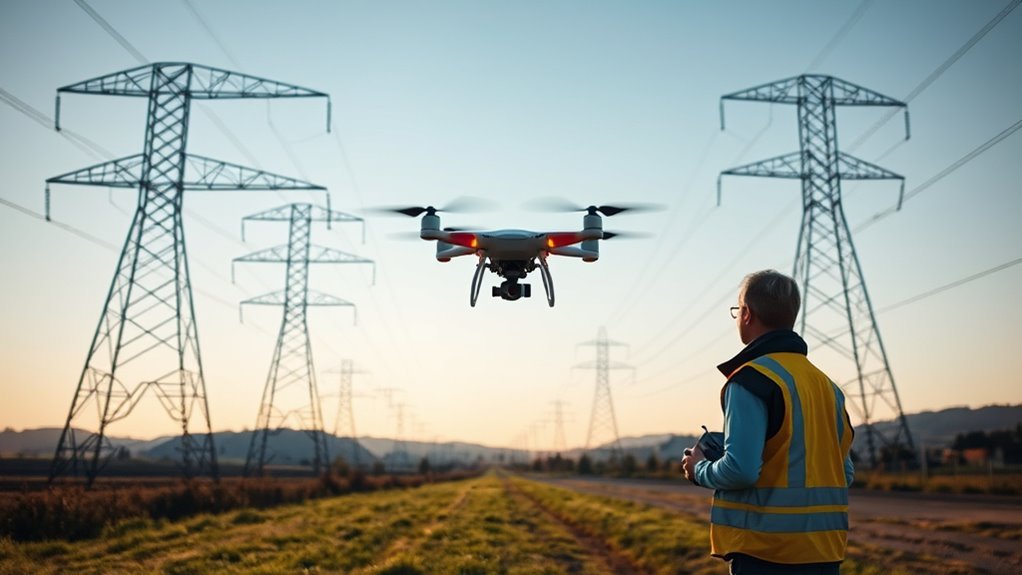
Flying drones near power lines is often treated as a minor hazard, but the real issue is electromagnetic interference. Power lines can disrupt GPS, compass data, and control stability, increasing the chance of drift, loss of position, or impact. Safe operation depends on distance, situational awareness, and compliance with local rules. The critical question is not whether interference can occur, but how much margin is enough before the risk becomes unacceptable.
Do Power Lines Interfere With Drones?
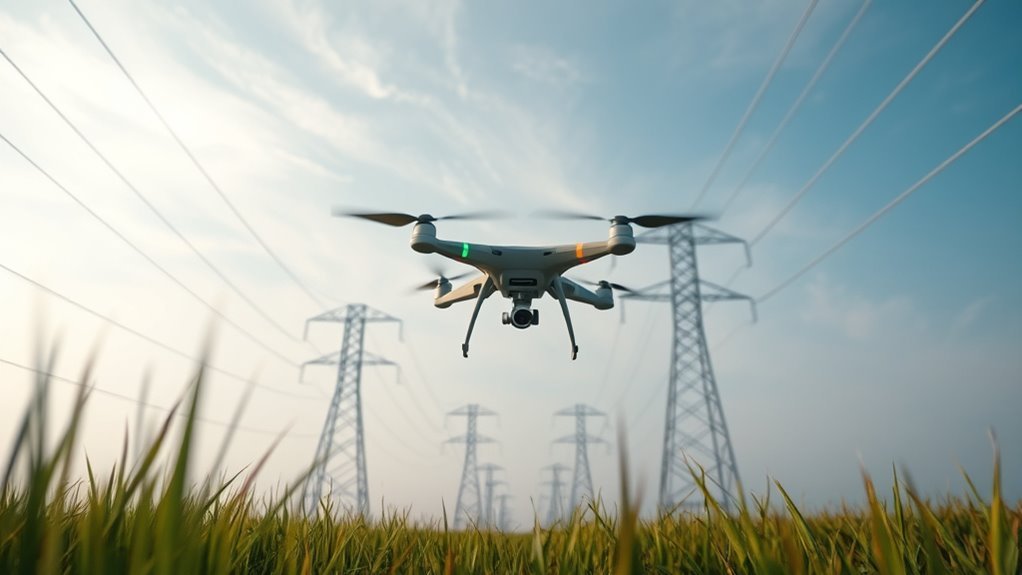
Yes, power lines can interfere with drone operation, especially near high-voltage transmission equipment.
Drones near power lines face electromagnetic interference that can degrade GPS reception, distort compass readings, and reduce magnetometer accuracy. As the aircraft closes in, the field strength rises, increasing the likelihood of interference and unstable flight behavior.
This is not a theoretical concern; communication links may also be affected, creating safety risks that can lead to loss of control, erratic movement, or navigation errors. Magnetometer sensors may saturate in strong magnetic fields, making orientation data unreliable.
For operators seeking freedom of movement, the practical conclusion is straightforward: distance remains the primary control measure. A minimum separation of 200 feet from power lines is recommended to reduce interference and preserve safe drone operation.
In this environment, disciplined spacing is the clearest safeguard against preventable hazards.
How Power Line EMI Affects Drone Control
Electromagnetic interference from high-voltage power lines can destabilize a drone’s control systems by corrupting navigation data, degrading communication links, and distorting magnetometer readings. A Drone exposed to power lines may show erratic attitude changes, delayed response, or autonomous corrections that do not match pilot input. In flight control, magnetometer saturation is especially hazardous because the system may issue false heading warnings and reject valid orientation data. Communication dropouts also rise near energized conductors, reducing command integrity and telemetry reliability.
| Effect | Control Impact | Risk |
|---|---|---|
| Navigation corruption | Erratic movement | Loss of control |
| Link degradation | Delayed commands | Signal dropout |
| Magnetometer saturation | False warnings | Crash hazard |
These failures are not theoretical; they intensify when electromagnetic interference is strong enough to overwhelm onboard sensors. For operators seeking liberated, precise flight, avoiding EMI exposure is essential to preserve stable, predictable control and prevent abrupt failures.
How Far Should Drones Stay From Power Lines?
Drones should maintain a minimum separation of at least 200 feet from power lines, with local rules potentially requiring different buffers and a general best practice of avoiding flight within 4 meters.
This margin reduces exposure to electromagnetic interference that can degrade navigation and trigger control loss, erratic motion, or collision.
If a drone encroaches on a power line corridor, retrieval should be treated as a hazard-controlled operation, with emergency steps prioritized to prevent entanglement, injury, and equipment damage.
Safe Distance Basics
A minimum clearance of at least 200 feet from power lines is a prudent baseline for drone operations, reducing the chance of collision and limiting exposure to electromagnetic interference. This safe distance should be treated as a hard planning constraint around electrical equipment, not a suggestion.
| Factor | Control |
|---|---|
| Power lines | Maintain 200 feet |
| Flight path | Avoid direct overflight |
| Mapping | Verify during flight planning |
| Regulations | Check local requirements |
| Risk | Preserve situational awareness |
High-voltage corridors can distort navigation, so disciplined flight planning supports autonomous freedom by preventing avoidable losses. Operators should confirm all mapped utilities before launch and adjust routes early, rather than improvising near energized infrastructure.
EMI and Control Loss
Strong electromagnetic fields around energized power lines can disrupt a drone’s navigation and command links, so a minimum standoff of at least 200 feet is a prudent baseline to reduce EMI-related control loss.
- EMI can corrupt compass and GPS inputs.
- Magnetometer saturation may trigger flight warnings.
- Control loss becomes more likely when flying near high-voltage conductors.
- Communication interference can degrade command reliability.
Distance regulations support safer, freer operational planning. Detachment is essential: close approach amplifies risk, and misjudged spacing often precedes collisions.
Technical crews should treat power-line corridors as interference zones, not open airspace, and preserve a wide buffer to maintain stable flight, protect autonomy, and sustain operational freedom under adverse electromagnetic conditions.
Retrieval and Emergency Steps
Maintaining at least 200 feet of separation from power lines is the safest operational baseline, because closer flight increases the likelihood of EMI-driven navigation errors, control loss, and collision.
If a drone becomes downed on conductors or adjacent electrical equipment, retrieval should not be attempted by the pilot. The hazard remains energized, and direct contact can escalate into shock, fire, or secondary failure.
The correct emergency response is to isolate the area, keep clear, and contact the local utility for removal support. Treat all downed lines as live and call 911 immediately to report the hazard. In Texas, use (915) 877-3400; in New Mexico, use (575) 523-7591.
Freedom in flight depends on disciplined distance, not reckless proximity to interference.
What to Do If a Drone Hits Power Lines
If a drone contacts power lines, it should not be retrieved by hand or with any improvised tool, because approaching energized conductors creates a serious electrocution hazard.
If a drone crashes into conductors, the operator should assume the airframe and surrounding infrastructure are unsafe. Contact the local electric utility immediately and request professional recovery support.
Treat downed power lines as live conductors at all times; if any line has fallen, call 911 and keep others away. Maintain at least 200 feet away from power lines to reduce collision exposure and preserve safe navigation. Electromagnetic interference may distort control signals, so hovering near conductors is a high-risk choice.
- Do not touch the drone.
- Do not move barriers.
- Mark the hazard from a distance.
- Warn bystanders to stay clear.
- Await utility responders before any action.
Drone Safety Rules for Flying Near Power Lines
Safe operation near power lines begins with strict separation: a minimum 200-foot distance reduces collision risk and limits electromagnetic interference that can disrupt control signals.
Pre-flight checks are essential, as any battery, motor, GPS, or link fault can become hazardous in proximity to electrical infrastructure.
Compliance with FAA rules and local clearance requirements remains mandatory, and any entangled drone should be left for the utility to recover.
Safe Distance Basics
A minimum separation of 200 feet from power lines and electrical equipment is a practical baseline for reducing collision risk and limiting exposure to electromagnetic interference that can disrupt flight control. This safe distance preserves maneuver margin, supports visual line of sight, and reduces time spent near hazardous infrastructure.
When flying drones, direct overflight of power lines should be avoided because EMI can trigger erratic responses, altitude drift, or command lag. Local regulations may impose stricter buffers, so compliance is essential.
- Hold position outside the corridor
- Track line geometry before approach
- Maintain visual contact continuously
- Treat interference as a control hazard
- Exit immediately if stability degrades
Preflight Hazard Checks
Before any flight near power lines, the drone should undergo a full preflight inspection to identify structural damage, loose components, battery issues, or sensor faults that could increase the likelihood of a loss of control.
These preflight inspections should also confirm propeller integrity, calibration status, and control-link reliability.
Mapping tools should be used to locate high-voltage lines, and the planned route should remain 200 feet away to reduce the risk of collision and electromagnetic fields that interfere with drone systems.
Weather conditions must be checked for wind shear and gusts that can destabilize flight.
The aircraft should stay within visual line of sight so hazards are detected and corrected immediately.
A disciplined hazard check preserves operational freedom by limiting preventable failures.
How Utilities Use Drones to Inspect Power Lines
Utilities deploy drones to inspect power lines because aerial surveys accelerate fault detection, improve access to difficult terrain, and reduce outage duration. For utilities, drones convert inspections into data-driven workflows that support rapid fault location, condition scoring, and safer maintenance planning.
High-resolution imagery reveals corrosion, conductor sag, damaged insulators, vegetation encroachment, and substation anomalies without exposing crews to hazardous spans. Automated drone-in-a-box systems extend this capability, enabling scheduled, localized monitoring and near-real-time analysis at critical sites.
Pilot deployments indicate stronger network reliability and better operational efficiency, especially where manual access is slow, costly, or dangerous.
- Faster identification of defects on poles, lines, and substations
- Reduced personnel exposure in hard-to-reach corridors
- Continuous surveillance through automated docking platforms
- Improved outage triage through geotagged visual evidence
- Lower lifecycle risk through repeated, consistent inspections
Frequently Asked Questions
Can I Shoot Down a Drone Spying on My Property?
No, the person should not shoot down a drone.
Drone privacy laws generally prohibit destroying an aircraft, and property rights issues do not override federal aviation rules. Legal consequences can include criminal charges, civil liability, and damage claims.
Ethical considerations favor documentation, operator identification, and reporting to authorities. For a liberty-minded response, the safest path is evidence collection, local law consultation, and lawful privacy remedies, not force.
Is It Safe to Fly a Drone Near Power Lines?
No, it is not safe to fly a drone near power lines.
Drone navigation challenges can intensify as electromagnetic interference effects disrupt sensors, guidance, and control, increasing crash risk.
Safety protocol guidelines recommend at least 200 feet of separation from energized infrastructure.
Pilot awareness training should emphasize avoidance, because entanglement threatens equipment, utilities, and bystanders.
Freedom in flight depends on disciplined distance, not proximity to hazard.
How Far Away From Power Lines Is It Safe to Live?
A generally prudent residential setback from power lines is at least 300 feet, though 200 feet is often cited and local distance regulations may differ.
At that range, electromagnetic fields typically drop substantially, reducing health concerns and improving peace of mind. Higher-voltage corridors may still warrant larger buffers.
For liberated choice, residents should weigh property values, easements, and utility plans, then consult local codes and independent environmental assessments before settling.
Why Can’t You Fly a Drone Above 400 Feet?
Drone flights above 400 feet are barred because the sky is not an open frontier; it is regulated airspace.
Under drone altitude regulations and FAA restrictions, pilots must respect airspace limitations to avoid conflicts with manned aircraft, preserve visual line of sight, and reduce loss-of-control risk from wind and weaker GPS.
These safety compliance guidelines limit freedom, but they also prevent collisions, penalties, and uncontrolled operations.
Conclusion
In closing, power lines are not benign landmarks but active electromagnetic hazards, capable of unsettling GPS, compasses, and flight stability when a drone comes too near. Like a needle to a compass, their influence can redirect an aircraft’s control logic without warning. The prudent margin remains 200 feet, paired with strict visual contact, pre-flight checks, and regulatory compliance. In this field, caution is not optional; it is the operational standard.
