Barbless fishing hooks have no protruding barb behind the hook point, which generally makes them faster to remove during catch-and-release fishing. They can reduce hook-removal injury and handling time, although research does not show the same survival benefit in every species or fishery. As of January 1, 2026, Wyoming requires single-point, barbless hooks on specified North Platte River tailwaters, including the Miracle Mile, Alcova Afterbay, Gray Reef, and Fremont Canyon. Always check the current rules for the exact waterbody, species, season, and tackle method before fishing.
Last updated: September 21, 2026 — reviewed against current agency regulations and catch-and-release guidance.
Quick Answer
A barbless hook is a fishing hook with no raised barb behind the point. It is generally quicker to remove and can reduce removal-related injury, but its effect on fish survival varies by species and fishing method. Some waters require barbless hooks, and some go further by requiring single-point barbless hooks, so check the exact regulation before you fish.
Key Takeaways
- Barbless hooks generally come out faster and can reduce hook-removal injury, but survival benefits vary by fishery.
- Wyoming now requires single-point, barbless hooks on specified North Platte River tailwaters, including the Miracle Mile, Alcova Afterbay, Gray Reef, and Fremont Canyon.
- A barbed hook can often be made barbless by carefully pinching the barb completely closed with pliers, if local rules allow it.
- Good release technique matters as much as hook choice: use appropriate tackle, keep fish wet, minimize air exposure, and avoid forcing out a deeply swallowed hook.
What Are the Benefits of Barbless Fishing Hooks?

For anglers who plan to release fish, the clearest advantage of barbless fishing hooks is faster hook removal. Less time spent working a hook free can mean less handling, less restraint, and a quicker return to the water.
A U.S. Geological Survey summary of rainbow-trout research found that injury rates were higher with barbed J hooks and that barbed J hooks took longer to remove. The same research also found that barbed J hooks landed fish more efficiently, showing that barbless hooks involve a real tradeoff rather than being better on every metric.
NOAA Fisheries recommends barbless hooks, hooks with crimped barbs, or circle hooks where appropriate as part of catch-and-release gear selection. NOAA also emphasizes strong enough tackle, wet hands, suitable landing nets, and minimal handling.
Barbless hooks can also be easier to remove from nets, clothing, or other gear. For the angler, that can make dehooking and tackle handling simpler, especially when several hook points are involved.
Pro Tip: If local rules allow a crimped barb, use pliers to bend the barb completely closed against the hook. Inspect it visually rather than running a bare finger over the sharp point. Where compliance is especially strict, a factory-made barbless hook removes more ambiguity.
How Do Barbless Hook Regulations Work?

Fishing regulations can control hook type, the number of hook points, bait, lure type, seasons, size limits, catch limits, and whether a fish must be released. A setup that is legal in one part of a river can be prohibited upstream or downstream.
The important distinction is that barbless and single-point barbless do not mean the same thing. A barbless rule controls the barb. A single-point barbless rule also limits each hook to one point, so a barbless treble hook would not satisfy a single-point requirement.
Check these four details before you fish:
- Exact waterbody and boundary: Special rules may start or stop at a dam, bridge, tributary, access point, or management boundary.
- Hook construction: Confirm whether the rule says barbless, single-point, single-shank, circle hook, or another specific design.
- Species and season: A restriction may apply only while targeting a particular species or during a particular season.
- Current source: Use the current state or federal regulation rather than last year’s guide or another angler’s memory. The site’s fishing regulations guide explains the broader checks anglers should make before a trip.
Warning: Do not assume “barbless” applies only to fly fishing. Hook restrictions can apply to bait, lures, jigs, salmon gear, marine fisheries, or every legal tackle method within a designated area.
Where Are Barbless Hooks Required in 2026?

Wyoming’s new North Platte tackle rule took effect on January 1, 2026. According to the Wyoming Game & Fish Department, designated high-use North Platte tailwaters now require single-point, barbless hooks. The affected areas include the Miracle Mile, Alcova Afterbay, Gray Reef, and Fremont Canyon.
The wording matters. An angler using a hook that is barbless but has multiple points may still violate a regulation requiring a single-point barbless hook.
Wyoming Game & Fish has also documented substantial hooking-injury pressure in this fishery. The agency reported that 54% of trout sampled at the Miracle Mile in 2018 showed some degree of injury, and later sampling found hooking scars on more than 70% of sampled fish there. These figures document the prevalence of hooking injuries; they do not establish that every injury was caused specifically by a barbed hook.
Note: River-specific rules can change by date and exact boundary. Check the current Wyoming fishing regulations before fishing the North Platte, especially around named tailwaters, bridges, access points, and seasonal closures.
Barbless vs. Barbed Hooks: What Is the Difference?
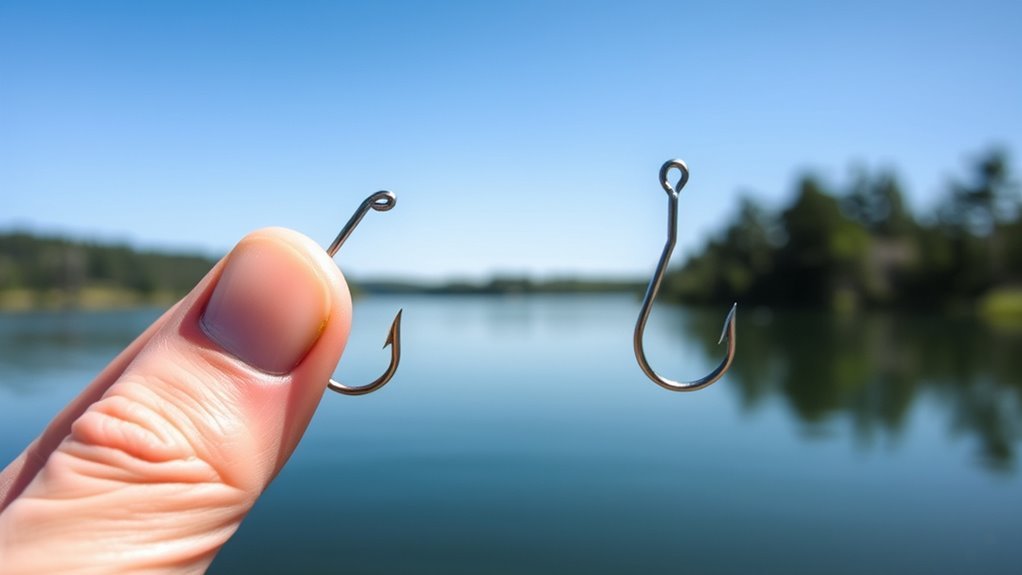
The main practical differences between barbless hooks and barbed hooks are removal time, hook retention, and the amount of tissue disturbance that can occur during removal. The effect on post-release survival is less simple and varies by species, hook style, hooking location, water temperature, fight duration, and handling.
Research summarized by the USGS found that barbed J hooks caused more injuries and took longer to remove in an Alaskan rainbow-trout fishery, while those same barbed J hooks were more efficient at landing fish. Other trout research has found quicker removal with barbless hooks without a clear mortality advantage. That is why hook choice should be considered together with handling technique rather than treated as the only factor controlling survival.
Here’s how they compare:
- Hook removal: Barbless hooks are generally easier and quicker to back out.
- Removal injury: Eliminating the barb can reduce the extra tearing that occurs while a hook is being withdrawn.
- Hook retention: Barbed hooks can hold more securely once set, while barbless hooks reward steady line pressure.
- Regulation: Some fisheries allow either design, while others specifically require barbless or single-point barbless hooks.
| Feature | Barbless Hooks | Barbed Hooks |
|---|---|---|
| Hook removal | Generally faster and easier | Often takes more effort to back out |
| Fish injury | Can reduce removal-related injury; mortality benefit varies | May cause more removal injury in some hook-and-fish combinations |
| Landing fish | Steady line pressure is especially important | Can retain a hooked fish more securely in some situations |
| Best use | Release-focused fishing and waters where barbless hooks are required | General fishing where regulations allow them and stronger hook retention is preferred |
Best Practices for Catch and Release Fishing

Hook type is only one part of successful catch and release. NOAA Fisheries recommends landing fish without fighting them to exhaustion, dehooking them in the water when possible, using wet hands, supporting the body, and minimizing air exposure. If a swallowed hook cannot be removed easily, NOAA recommends cutting the line as close to the hook as possible instead of causing additional injury while digging it out.
At a Glance
| Air Exposure | Keep it to a minimum; NOAA says less than 60 seconds is ideal when a fish must leave the water |
| Difficulty | Easy with practice; conditions, fish size, current, and hook placement can make release harder |
| Tools Needed | Legal hooks, needle-nose pliers or hemostats, a wet soft-mesh or rubber net, and a suitable dehooking tool |
| Cost | Low; anglers can buy factory-made barbless hooks or crimp permitted barbs on hooks they already own |
| Best Practices | Benefits |
|---|---|
| Use legal barbless or release-friendly hooks where appropriate | Can shorten dehooking and reduce removal-related injury |
| Wet your hands before handling | Helps protect the fish’s mucus coating |
| Minimize out-of-water time | Reduces unnecessary handling and air-exposure stress |
| Use pliers or a dehooking tool when helpful | Can shorten handling and allow some fish to be released in the water |
| Cut the line if a swallowed hook cannot be removed easily | Avoids causing additional injury by forcing out a deeply embedded hook |
For more detail on supporting fish, protecting the slime layer, and preparing for a quick release, see the safe fish handling guide.
How to Fish Barbless Hooks Without Losing Fish
The concern that barbless hooks can cost you fish is not imaginary. Some studies have found higher landing efficiency with barbed hooks. The difference can be reduced with good technique because the biggest practical weakness of a barbless hook is that slack line gives it an easier path back out.
- Keep steady pressure: Avoid slack line, especially when a fish jumps, changes direction, or runs toward you.
- Use a smooth drag: Set the drag so a strong run can take line without creating sudden slack or excessive pressure.
- Choose the right hook size: Match hook size and pattern to the bait, lure, species, and applicable regulations.
- Land fish efficiently: Use tackle strong enough for the target species so the fight does not continue simply for a photo.
- Use a suitable landing net: NOAA recommends wet, soft knotless mesh or a rubber landing net because these materials reduce damage to fins, scales, eyes, and the protective mucus coating.
How to Check If a Hook Is Truly Barbless
The legal definition matters more than a homemade snag test. For example, California regulations define a barbless hook as a hook whose barb has been removed, completely bent closed, or that was manufactured without barbs.
After crimping a barb, inspect it closely and confirm that no raised projection remains. Do not assume that a partially flattened barb qualifies simply because it looks smaller.
Definitions can differ by jurisdiction, and another rule may also limit the number of hook points. In special-regulation water, compare your hook directly with the current agency definition. Factory-made barbless hooks are often the clearest choice when you want to avoid uncertainty.
Related Guides
Frequently Asked Questions
What States Require Barbless Hooks?
There is no accurate one-line list of states where every angler must use barbless hooks because most requirements are fishery-specific. Current examples include specified North Platte tailwaters in Wyoming, Washington Marine Areas 5 through 13 with stated exceptions, and certain California salmon fisheries. Always check the exact waterbody, species, season, and gear rule.
Are Single Barbless Hooks Always Required?
No. Some waters allow barbed hooks, some require any barbless hook, and others specifically require a single-point barbless hook. “Single-point” is an additional restriction, so a barbless treble hook does not satisfy a rule that requires one hook point.
Are Treble Hooks Illegal in Texas?
Treble hooks are not generally prohibited everywhere in Texas. Restrictions can apply to particular waters, fishing methods, facilities, or programs, so anglers should check the current Texas Parks and Wildlife legal fishing devices and restrictions plus any waterbody-specific rules.
Is Fishing With Corn Illegal in Kentucky?
Corn is not generally banned statewide in Kentucky, but it is prohibited in artificial-bait-only areas. Kentucky’s current fishing regulation specifically lists corn among the organic baits that cannot be attached while fishing in those areas. Check the current Kentucky regulation and waterbody exceptions before using it.
Do Barbless Hooks Hurt Fish Less?
They can reduce hook-removal injury and shorten removal time, but the effect on survival is not identical in every fishery. Hook location, fish species, water temperature, fight duration, air exposure, and handling technique can matter as much as whether a barb is present.
Can I Make a Barbed Hook Barbless?
Often, yes. If local regulations allow a crimped barb, use pliers to bend the barb completely closed against the hook. Some jurisdictions define barbless hooks precisely, and a rule may also require a single hook point, so check the applicable regulation before relying on a modified hook.
Conclusion
Barbless hooks are most useful when regulations require them or when quicker dehooking is a priority. Research supports shorter removal times and reduced removal-related injury in some fisheries, but barbless hooks should not be treated as a guarantee of higher post-release survival in every species.
For catch and release, combine the right hook with proper tackle, steady line pressure, wet-hand handling, minimal air exposure, and a quick release. Before every trip, check the current rule for the exact water you plan to fish because “barbless,” “single-point barbless,” and other tackle restrictions are not interchangeable.