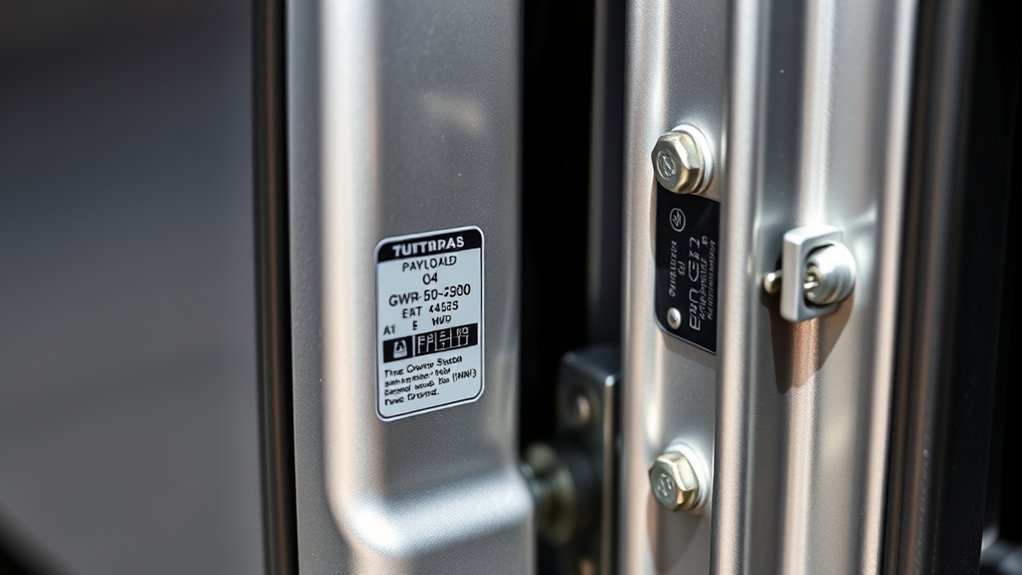
Your Toyota Tundra’s driver-side door jamb holds the numbers that matter most when you load the bed or connect a trailer. The labels show how much weight the truck can carry, how much each axle can support, and the correct cold tire pressures. Reading them correctly helps you avoid overloading the truck.
Last updated: July 12, 2026
Quick Answer
Your Tundra’s door area normally has two important labels. The Tire and Loading Information label gives the occupant-and-cargo limit, tire sizes, and cold pressures. The certification label gives GVWR and GAWR. Use Toyota’s manual or towing chart, not the door sticker alone, to confirm towing capacity.
Key Takeaways
- Start with the label stating the combined weight of occupants and cargo.
- Count the driver, passengers, cargo, installed accessories, hitch equipment, and trailer tongue weight.
- GVWR limits the loaded truck, while GAWR limits the weight carried by each axle.
- The door labels do not tell you the truck’s complete towing capacity.
- Advertised maximums apply only to certain configurations, so your truck’s labels and manual control.
At a Glance
| Time Required | About 10 to 20 minutes, plus travel time if you use a public scale |
| Difficulty | Easy for label reading; moderate for a complete towing calculation |
| Tools Needed | Phone or calculator, Toyota owner’s manual, door labels, and an optional public vehicle scale |
| Cost | Free for label checks; public-scale fees vary by location |
Decoding the Tundra Door Jamb Sticker
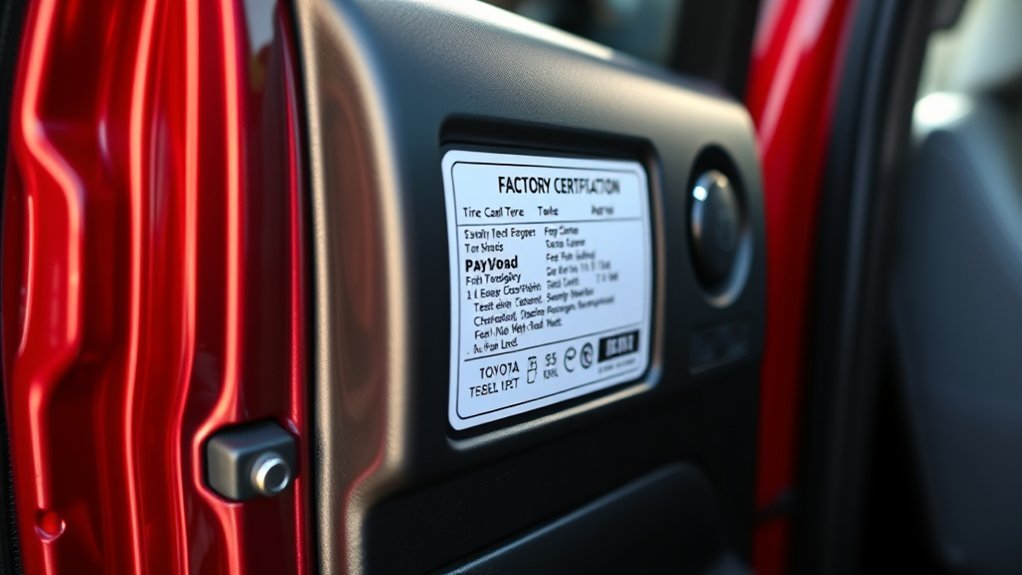
Open the driver’s door and look at the door edge and B-pillar. Depending on the model year and market, you may find more than one label. Two labels are especially useful when you are calculating payload or preparing to tow.
The Tire and Loading Information Label
This label normally lists the original tire sizes, recommended cold tire pressures, seating capacity, and the maximum combined weight of occupants and cargo.
Federal labeling rules require the placard to express vehicle capacity with wording similar to “The combined weight of occupants and cargo should never exceed” a stated number. You can review the applicable labeling requirements in 49 CFR 571.110.
For everyday loading calculations, the occupant-and-cargo number is usually the most useful starting point because it is assigned to the truck as manufactured.
The Certification Label
The certification label normally includes the Vehicle Identification Number, Gross Vehicle Weight Rating, and front and rear Gross Axle Weight Ratings. It may also list tire and rim information associated with each axle rating.
Do not add the front and rear GAWR figures together and treat the result as a new GVWR. The loaded truck must remain within its GVWR while each axle also remains within its individual GAWR.
The occupant-and-cargo limit is specific to the truck as built. An advertised maximum payload for the Tundra lineup may be much higher than the number printed on your truck.
How to Read Your Payload and GVWR Information
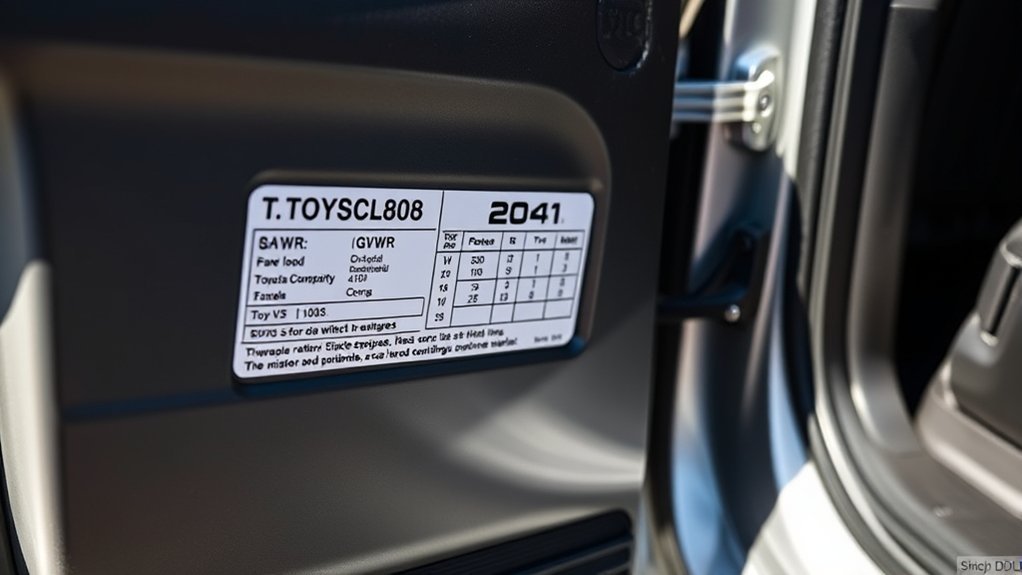
You can perform a useful first calculation without looking up a brochure curb weight. Start with the occupant-and-cargo number printed on your Tundra’s Tire and Loading Information label.
1. Record the Occupant-and-Cargo Limit
Find the line that states how much the combined weight of occupants and cargo should never exceed. Write down that number exactly as shown.
This allowance covers the driver, every passenger, cargo in the cab, cargo in the bed, and other weight added to the truck. When towing, the trailer’s actual tongue weight also presses on the truck and uses part of this allowance.
2. Subtract Everyone and Everything Added to the Truck
Use this calculation:
Remaining payload = door-label occupant-and-cargo limit − occupants − cargo − added equipment − hitch equipment − actual trailer tongue weight
Factory-installed equipment should already be reflected in the original label. Equipment added later, such as a bed cap, toolbox, replacement bumper, winch, running boards, recovery gear, or auxiliary tank, uses part of your remaining payload.
3. Check GVWR and Both Axle Ratings
Payload arithmetic is only the first check. The truck’s actual loaded weight must not exceed GVWR, and neither axle may exceed its GAWR.
A heavy trailer can place substantial weight on the rear axle even when the total truck weight remains below GVWR. That is why a public scale with separate axle platforms is more useful than a single total-weight reading.
4. Check the Recommended Tire Pressure
Use the cold tire pressure printed on the Tire and Loading Information label unless Toyota provides different instructions for a specific condition. Do not use the maximum pressure molded into the tire sidewall as your normal target.
The National Highway Traffic Safety Administration’s tire guidance also directs owners to the driver-side label or owner’s manual for the manufacturer’s recommended cold pressure.
5. Compare the Result With Your Planned Load
Do not plan to use every remaining pound without checking axle loads, tire limits, trailer ratings, road conditions, and the owner’s manual. A small margin also gives you room for items that are easy to overlook, including food, water, tools, fuel containers, and last-minute luggage.
Worked Payload Example
Assume a Tundra’s Tire and Loading Information label gives a 1,550-pound occupant-and-cargo limit. The following example shows how quickly that capacity can be used.
| Item | Weight | Payload Remaining |
|---|---|---|
| Door-label limit | 1,550 lb | 1,550 lb |
| Driver and passengers | 450 lb | 1,100 lb |
| Cab and bed cargo | 250 lb | 850 lb |
| Hitch and added accessories | 100 lb | 750 lb |
| Measured trailer tongue weight | 700 lb | 50 lb |
In this example, the payload arithmetic leaves only 50 pounds. The owner must still confirm GVWR, front and rear GAWR, GCWR, TWR, hitch ratings, tire limits, and the trailer’s own ratings.
Warning: Staying below one number does not prove that the complete combination is within every limit. Never exceed the truck’s GVWR, either GAWR, GCWR, TWR, receiver rating, tire capacity, wheel rating, or any trailer component rating.
What Is Payload and Why It Matters for Towing?
Payload is the weight placed on or carried by the truck. It includes occupants, cargo, removable equipment, added accessories, hitch hardware, and the trailer load applied to the hitch.
The entire trailer does not become truck payload. However, the portion pressing downward or otherwise loading the hitch affects the truck’s total weight and axle loads.
According to the 2026 Toyota Tundra owner’s manual, conventional trailer cargo should be arranged so tongue weight is 9% to 11% of gross trailer weight, while remaining within all stated limits.
For example, a loaded 7,000-pound conventional trailer would have a target tongue-weight range of about 630 to 770 pounds under that guidance. You must use the loaded trailer weight, not an empty or advertised dry weight.
The actual tongue weight must also fit within:
- The remaining occupant-and-cargo allowance
- The truck’s GVWR
- The rear GAWR and front GAWR
- The receiver and ball-mount ratings
- The trailer coupler and hitch-ball ratings
- Toyota’s applicable tongue-weight limit
A weight-distribution hitch can move some load among the truck’s axles and trailer axles. It does not create extra GVWR, payload, GCWR, or towing capacity.
Payload, GVWR, GAWR, GCWR, and TWR Explained
Weight ratings work together. Passing only one of them is not enough.
| Term | What It Means | Where to Check |
|---|---|---|
| Payload or total load capacity | Occupants, cargo, luggage, added equipment, hitch hardware, and trailer tongue weight carried by the truck | Tire and Loading Information label and owner’s manual |
| GVWR | Maximum permitted weight of the loaded truck | Certification label |
| GAWR | Maximum permitted weight on the specified front or rear axle | Certification label |
| GCWR | Maximum permitted combined weight of the loaded truck and loaded trailer | Owner’s manual or Toyota towing data |
| TWR | Maximum rated loaded trailer weight for the applicable truck configuration | Owner’s manual or configuration-specific towing chart |
| Tongue weight | The trailer load applied to the hitch connection | Tongue-weight scale or properly performed scale measurements |
| Curb or unloaded weight | The truck’s weight under the manufacturer’s stated unloaded conditions | Specifications; use a scale for your truck’s current operating weight |
GVWR is not a suggested target. It is the maximum loaded truck weight assigned by the manufacturer. GAWR applies separately to each axle, so a truck may exceed its rear-axle rating before reaching GVWR.
GCWR includes the loaded truck and loaded trailer. TWR applies to the loaded trailer itself. The lowest applicable limit controls the combination.
Why Curb Weight and Actual Scale Weight Matter
Payload can be described generally as GVWR minus unloaded vehicle weight. However, a published curb-weight figure may not match the truck sitting in your driveway.
Differences can come from factory options, dealer-installed equipment, aftermarket parts, fuel level, tools, bed covers, floor liners, recovery equipment, and personal items. That is why the door-label occupant-and-cargo figure is a better starting point than a brochure curb weight.
A public scale gives you the truck’s actual operating weight. Load the truck as it will travel, including passengers, cargo, hitch equipment, and other gear.
How to Verify Your Loaded Weight
- Fill the truck to the fuel level you expect during the trip.
- Load the passengers, cargo, tools, hitch equipment, and accessories you plan to carry.
- Weigh the truck without the trailer and record the front axle, rear axle, and total weight.
- Connect and load the trailer exactly as it will travel.
- Weigh the complete combination and record each axle group.
- Compare the tickets with GVWR, both GAWR figures, GCWR, TWR, and trailer ratings.
A scale does not change the ratings printed by Toyota. It shows how much of each rating you are actually using.
Pro Tip: Weigh the truck and trailer in ready-to-travel condition. Water, propane, batteries, food, camping equipment, tools, and luggage can make a loaded trailer much heavier than its published dry weight.
Decoding Towing Capacity for Your Tundra
The Toyota Tundra door labels do not provide a complete towing-capacity figure. They tell you whether the loaded truck and its axles remain within important limits, but you must find TWR and GCWR in Toyota’s manual or configuration data.
Toyota currently advertises up to 12,000 pounds of towing and up to 1,850 pounds of payload for the U.S. 2026 Tundra lineup. Those are maximum figures achieved by specific configurations. Your Tundra may have substantially lower ratings. Review the current Toyota Tundra specifications and the manual for your model year.
Note: “Up to” is not a rating for every Tundra. Your cab, bed, drivetrain, powertrain, trim, axle setup, factory equipment, and model year can change both payload and towing limits.
Understanding Payload Ratings While Towing
Before connecting the trailer, subtract all occupants, cargo, accessories, and hitch equipment from the occupant-and-cargo limit. The amount left is the maximum room available for tongue weight under that one calculation.
You must then confirm that the loaded truck remains below GVWR and both GAWR figures. A rear axle can become the limiting factor when passengers, bed cargo, and trailer tongue weight are concentrated toward the back of the truck.
How to Confirm Towing Capacity Correctly
Check every item below before towing:
- Truck payload: Occupants, cargo, accessories, hitch equipment, and tongue weight must fit within the truck’s occupant-and-cargo allowance.
- Truck GVWR: The loaded truck must remain at or below the certification-label GVWR.
- Front and rear GAWR: Each measured axle weight must remain at or below its own rating.
- TWR: The loaded trailer must not exceed the rating for your exact truck configuration.
- GCWR: The loaded truck and loaded trailer together must stay within the combined rating.
- Hitch equipment: The receiver, ball mount, hitch ball, coupler, and weight-distribution components must each be rated for the load.
- Trailer limits: The trailer’s GVWR, axle ratings, tire ratings, and wheel ratings must not be exceeded.
The allowable trailer weight is determined by whichever applicable rating is reached first. Payload frequently becomes the practical limit before the truck reaches an advertised maximum towing figure.
Importance of Weight Distribution
Correct trailer loading supports stable steering and braking. For a conventional trailer, Toyota’s current manual specifies a tongue-weight target of 9% to 11% of gross trailer weight.
Too little tongue weight can contribute to trailer instability. Too much tongue weight can overload the truck’s payload allowance, rear axle, receiver, tires, or suspension components.
A weight-distribution hitch may redistribute some load from the truck’s rear axle toward the front and trailer axles. It does not increase Toyota’s certified GVWR, GAWR, GCWR, payload, or TWR.
How Model Configurations Affect Payload Capacities
Two Tundras from the same model year can have different payload and towing ratings. Added equipment increases the truck’s own weight, which can leave less capacity for people, cargo, and trailer tongue weight.
Capacity can change with:
- Two-wheel drive or four-wheel drive
- Double Cab or CrewMax body
- Bed length and wheelbase
- Gas or hybrid powertrain
- Trim level and option packages
- Off-road, luxury, suspension, and towing equipment
- Factory and dealer-installed accessories
The Tundra’s composite bed is one part of the complete vehicle design, but bed material alone does not tell you the truck’s payload or GVWR. Read the labels on the actual truck instead of estimating capacity from one component.
Factory specifications are useful when comparing trucks before purchase. After purchase, the specific door labels, owner’s manual, equipment ratings, and actual scale weights provide the information you need for loading decisions.
Real-World Examples of Payload Use
The following examples are hypothetical. They show how to use a door-label limit without claiming that one number applies to every Tundra.
Example 1: Carrying Cargo Without a Trailer
A Tundra has a 1,650-pound occupant-and-cargo limit. The driver and passengers weigh 400 pounds. A bed cover, toolbox, and carried tools add 200 pounds. Bed cargo weighs 600 pounds.
1,650 − 400 − 200 − 600 = 450 pounds remaining
The owner still needs to check GVWR, front GAWR, rear GAWR, and tire pressures. The remaining 450 pounds is not permission to place all additional weight at the rear of the bed if doing so would exceed the rear GAWR.
Example 2: Towing a Conventional Trailer
A Tundra has a 1,550-pound occupant-and-cargo limit. Occupants weigh 450 pounds, cargo weighs 250 pounds, and hitch equipment plus added accessories weigh 100 pounds.
1,550 − 450 − 250 − 100 = 750 pounds available before tongue weight
If the loaded trailer places 700 pounds on the hitch, 50 pounds remain under the label calculation. The owner must still check the truck’s axle weights, GVWR, GCWR, TWR, receiver rating, trailer ratings, and Toyota’s tongue-weight requirements.
The example does not mean any trailer with 700 pounds of tongue weight is acceptable. The loaded trailer could exceed TWR or GCWR even while its tongue weight fits within payload.
Tips for Accurate Weight Management When Towing
- Photograph both door labels so you can review the figures while planning.
- Use the occupant-and-cargo limit from your truck, not a dealer advertisement or online maximum.
- Include the driver’s weight in every payload calculation.
- Count hitch hardware, bed accessories, tools, coolers, luggage, pets, and recovery gear.
- Use the trailer’s loaded weight rather than its empty or dry weight.
- Measure or verify tongue weight after loading the trailer.
- Check front and rear axle weights separately at a suitable scale.
- Use the cold tire pressures printed on the truck’s label unless Toyota directs otherwise.
- Secure cargo so it cannot shift and change axle or tongue loads while driving.
- Recheck weights after adding major equipment or changing the trailer’s loading arrangement.
Common Door-Sticker and Towing Mistakes
Using an Advertised Maximum for Every Tundra
A maximum payload or towing figure describes a particular configuration. It does not override the labels or manual for your truck.
Using the Tire Sidewall Pressure
The pressure molded into a tire sidewall is not normally the recommended operating pressure for your Tundra. Use the manufacturer’s cold pressure shown on the Tire and Loading Information label.
Ignoring Aftermarket Equipment
Replacement bumpers, winches, toolboxes, bed caps, skid plates, steps, larger spare tires, and other parts add weight. They can also change how weight is distributed between the axles.
Assuming Suspension Parts Increase Payload
Air springs, helper springs, shocks, or upgraded tires may change ride height, handling, or component capability. They do not automatically increase the GVWR, GAWR, GCWR, payload, or towing rating assigned by Toyota.
Assuming a Weight-Distribution Hitch Creates More Capacity
A weight-distribution hitch can change axle loading when selected and adjusted correctly. It cannot raise the truck’s certified ratings, and the hitch itself adds weight to the truck.
Using Dry Trailer Weight
Published dry weight may exclude cargo, water, propane, batteries, dealer-installed options, and personal equipment. Use the trailer’s actual loaded weight when comparing it with TWR and GCWR.
Frequently Asked Questions
How do you read a Toyota Tundra door-jamb sticker?
Start with the Tire and Loading Information label. Record the occupant-and-cargo limit, original tire sizes, and recommended cold pressures. Then read the certification label for GVWR and front and rear GAWR. Subtract all occupants, cargo, added equipment, hitch hardware, and tongue weight from the occupant-and-cargo limit.
How do you read a GVWR sticker?
Find the GVWR on the certification label and compare it with the truck’s actual loaded weight. Also compare the measured front and rear axle weights with their individual GAWR figures. Staying under GVWR does not excuse an overloaded axle.
Can the door sticker tell you the Tundra’s towing capacity?
No. The labels help you check payload, GVWR, GAWR, tires, and inflation pressure. You must use Toyota’s manual or configuration-specific towing data to find TWR and GCWR. You must then confirm that the loaded truck, trailer, axles, hitch, and tires remain within all applicable ratings.
What does a GVWR or payload package mean?
“Payload package” is not a universal rating printed the same way on every vehicle. A package may include equipment that affects the truck’s configuration, but the certification label, Tire and Loading Information label, owner’s manual, and equipment ratings establish the limits for the completed truck.
Does Tundra payload include the driver?
Yes. The driver and every other occupant count against the combined occupant-and-cargo limit. Cargo, accessories, hitch equipment, and trailer tongue weight also use part of that capacity.
Do airbags, helper springs, or upgraded tires increase GVWR?
Not by themselves. These parts may affect ride height, handling, or individual component capability, but they do not automatically change the vehicle ratings assigned by Toyota. Continue to follow the original certified limits unless the vehicle has been lawfully recertified by an authorized manufacturer or alterer.
Conclusion
Your Toyota Tundra’s door labels give you the vehicle-specific starting point for safe loading. Use the occupant-and-cargo limit to account for passengers, cargo, accessories, hitch equipment, and tongue weight. Then verify GVWR, both GAWR figures, GCWR, TWR, hitch ratings, tire limits, and trailer ratings.
Do not substitute an advertised maximum, brochure curb weight, or guessed tongue weight for the numbers assigned to your truck. When the combination is close to any limit, weigh it in ready-to-travel condition and follow the owner’s manual.
Sources
- 2026 Toyota Tundra Owner’s Manual — total load capacity, towing limits, and conventional-trailer tongue-weight guidance
- Toyota 2026 Tundra Specifications — current advertised maximum towing and payload figures
- NHTSA TireWise — tire-label location, tire sizing, and recommended cold-pressure guidance
- 49 CFR 571.110 — federal Tire and Loading Information placard requirements
- NHTSA Interpretation 23087 — GVWR and load-carrying-capacity definitions
