
Regular Toyota Tundra tire rotation helps control irregular tread wear, maintain predictable handling, and make it easier to spot pressure, alignment, suspension, or tire problems early. The correct interval and pattern depend on your model year, drivetrain, tire size, tread design, and whether a matching full-size spare is included.
Quick Answer
For recent U.S. Toyota Tundra models, rotate the tires every 5,000 miles or six months, whichever comes first. Use the pattern specified in your model-year owner’s manual. Uniform-size, non-directional tires may use a rearward-cross or X-pattern, while directional tires normally move front to rear on the same side.
Key Takeaways
- Toyota’s 2026 U.S. Tundra maintenance schedule calls for service every 5,000 miles or six months and lists tire rotation at each 5,000-mile interval.
- There is no single correct pattern for every Tundra; check the drivetrain, tire sizes, directional arrows, spare-tire compatibility, and owner’s manual first.
- Rotation cannot repair alignment, balance, suspension, pressure, or tire-damage problems.
- A DIY rotation requires truck-rated lifting equipment, jack stands, wheel chocks, and a calibrated torque wrench.
At a Glance
| Time Required | About 45–90 minutes for a careful DIY rotation; a professional service commonly takes about 15–30 minutes. |
| Difficulty | Moderate; the truck’s weight and required lifting procedure make this more demanding than changing one flat tire. |
| Tools Needed | Truck-rated floor jack, correctly rated jack stands, wheel chocks, breaker bar, correct socket, calibrated torque wrench, tire-pressure gauge, tread-depth gauge, and chalk or position labels. |
| Cost | No additional service cost if you already own suitable tools; shop prices vary, and rotation may be included with tire installation or a maintenance plan. |
Why Regular Tire Rotation Matters on a Toyota Tundra

Each tire position carries a different combination of steering, braking, cornering, load, and drive forces. On a Tundra, towing, payload, rough roads, off-road use, and aggressive acceleration can make those differences more noticeable.
Moving compatible tires to new positions helps distribute normal wear across the set. It also gives you an opportunity to inspect the inner tread, sidewalls, wheels, brake components, and suspension areas that are harder to see when the wheels are installed.
The National Highway Traffic Safety Administration advises owners to follow the vehicle manufacturer’s rotation interval and pattern. NHTSA also notes that rotation can reduce irregular wear, while correct pressure, balance, and alignment remain separate parts of tire care.
NHTSA reported 511 U.S. traffic fatalities in tire-related crashes during 2024, reinforcing the value of routine pressure, tread, damage, and maintenance checks.
How Often Should You Rotate Toyota Tundra Tires?
The 2026 Toyota Tundra Warranty & Maintenance Guide schedules maintenance every 5,000 miles or six months, whichever comes first. Its maintenance chart lists tire rotation at every 5,000-mile interval.
This means a low-mileage truck should not wait indefinitely for the odometer to reach 5,000 miles. If six months pass first, the scheduled service interval has arrived.
Note: Maintenance schedules can vary by model year and market. Use Toyota’s manuals and warranties portal to confirm the schedule and rotation instructions for your exact Tundra.
Inspect the tires sooner than the scheduled rotation when the truck is regularly used for towing, heavy payloads, construction sites, gravel roads, off-road driving, or repeated hard braking. These conditions do not automatically replace Toyota’s published interval, but they can reveal wear or damage that should be addressed before the next service.
Choose the Correct Tire Rotation Pattern
Before removing a wheel, inspect all four tire sidewalls and compare the front and rear tire sizes. Look for a molded ROTATION arrow, different front and rear dimensions, or other fitment restrictions. Then check the model-year owner’s manual and the tire manufacturer’s warranty booklet.
| Tire and Drivetrain Setup | Typical Pattern | Important Limit |
|---|---|---|
| 4×2 rear-wheel drive with four uniform-size, non-directional tires | Rearward cross: rear tires move straight forward; front tires cross to the opposite rear positions. | Use only when permitted by the Toyota manual and tire manufacturer. |
| 4×4 with four uniform-size, non-directional tires | An X-pattern may be appropriate: each tire moves diagonally to the opposite axle and side. | The vehicle manual controls; some tire makers or applications specify another pattern. |
| Directional tires of the same size | Front to rear on the same side. | Do not cross the tires unless they are professionally demounted, remounted, and balanced in the correct direction. |
| Different front and rear tire sizes | Side to side on the same axle may be possible if the tires are non-directional. | Do not move a wheel to an axle requiring a different size or specification. |
| Matching full-size spare | A five-tire pattern may be used when Toyota and the tire maker permit it. | The spare must be compatible in size, construction, load rating, wheel fitment, and tread design. Never include a temporary spare. |
Bridgestone’s rotation guide distinguishes rearward-cross, X-pattern, forward-cross, directional, staggered, and five-tire arrangements. Michelin likewise advises that the pattern must match the drivetrain and tire construction.
Rearward Cross Versus Forward Cross
These two patterns are often confused:
- Rearward cross: Rear tires move straight to the front, while front tires cross to the rear. This is commonly used for compatible rear-wheel-drive applications.
- Forward cross: Front tires move straight to the rear, while rear tires cross to the front. This is commonly associated with compatible front-wheel-drive vehicles and should not be presented as a universal Tundra pattern.
X-Pattern for Compatible 4×4 Tires
In an X-pattern, every tire moves diagonally: left front to right rear, right front to left rear, left rear to right front, and right rear to left front. This can help distribute wear on compatible 4×4 applications, but only when all four tires are the same size and are non-directional.
Directional Tire Considerations
A directional tire has a sidewall arrow showing its intended rolling direction. Keep it on the same side of the truck during a normal rotation. Installing it so the tread runs backward may reduce the tire’s intended water-evacuation performance.
Pro Tip: Label each wheel’s original location—LF, RF, LR, and RR—before lifting the truck. This prevents pattern mistakes and creates a useful wear-history record.
How to Rotate Toyota Tundra Tires Safely
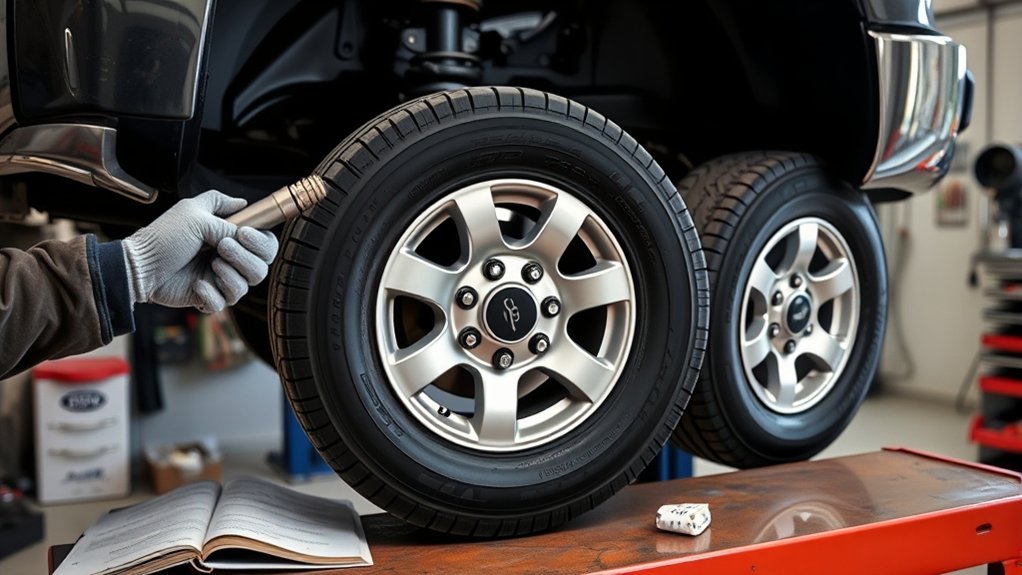
Warning: Never work under or around a Tundra supported only by a jack. Use level, solid pavement; properly rated lifting equipment; designated lifting and support points; wheel chocks; and jack stands rated for the truck. Use a professional shop if you cannot identify the correct points or safely support the vehicle.
1. Confirm the Pattern and Torque Specification
Use the tire sidewalls and your model-year owner’s manual to confirm the correct pattern. Locate the exact wheel-nut torque specification for your truck and wheel configuration. Do not assume that one torque value applies to every Tundra year, trim, wheel, or aftermarket setup.
2. Prepare the Truck
Park on a firm, level surface away from traffic. Shift into Park, apply the parking brake, switch off the engine, and remove the key or keep the smart key away from the truck. Chock the wheels that will remain on the ground during the first lifting stage.
Remove heavy cargo or disconnect a trailer before lifting the truck. Do not perform the rotation on dirt, gravel, a slope, or soft asphalt.
3. Record Tire Condition and Pressure
Before moving the tires, record each tire’s:
- Current position.
- Cold inflation pressure.
- Tread depth at the inner, center, and outer grooves.
- Visible cuts, bulges, punctures, cracking, exposed cords, or uneven wear.
- Direction arrow and tire size.
Stop and obtain professional inspection if a tire has a bulge, exposed material, deep cut, severe cracking, rapid pressure loss, or badly irregular wear. Do not use rotation to hide the symptom.
4. Loosen the Wheel Nuts Before Lifting
With the tires still touching the ground, break each wheel nut loose by a small amount. Do not fully remove the nuts. Use the correct socket so the nut and wheel finish are not damaged.
5. Lift and Support the Truck
Position the floor jack only at an approved lifting point. Raise the truck according to the owner’s manual, place rated jack stands at approved support points, and lower the vehicle carefully onto the stands. Confirm stability before removing any wheel.
Depending on your equipment and the selected pattern, you may support one axle at a time or raise the truck so all required wheel positions are accessible. Never improvise with concrete blocks, wood scraps, stacked jacks, or undersized stands.
6. Remove and Inspect Each Wheel
Remove the wheel nuts and wheels. Keep the nuts clean and inspect the studs and nut seats for damage, corrosion, cross-threading, or contamination. Check the inside tread, wheel barrel, brake components, and visible suspension parts.
If a wheel is stuck to the hub, do not crawl under the truck or strike a raised vehicle violently. Reinstall the nuts loosely and use an approved wheel-removal method, or have a shop handle it.
7. Move the Tires to Their New Positions
Follow the selected pattern exactly. For example, a compatible rearward-cross rotation moves:
- Left rear to left front.
- Right rear to right front.
- Left front to right rear.
- Right front to left rear.
A compatible X-pattern instead moves all four tires diagonally. Directional tires remain on their original side and move only between the front and rear axles.
8. Reinstall the Wheels
Seat each wheel squarely against the hub. Install the wheel nuts by hand to avoid cross-threading. Snug them gradually in a crisscross or star sequence. Unless the vehicle or wheel manufacturer specifically instructs otherwise, do not lubricate the wheel studs or nut seats.
9. Lower the Truck and Apply Final Torque
Raise the truck enough to remove the stands, then lower it until the tires are firmly on the ground. Tighten the wheel nuts in a crisscross pattern with a calibrated torque wrench set to the exact specification for your Tundra and wheel setup.
Do not use an impact wrench as the final torque measurement. Over-tightening can damage studs or wheels, while under-tightening can allow a wheel to loosen.
10. Set Pressure and Complete a Road Check
Adjust all tires to the cold pressures printed on the driver-side Tire and Loading Information label, not the maximum pressure molded on the tire sidewall. Front and rear placard pressures may differ on some configurations.
After the rotation:
- Confirm that every directional arrow points forward at the top of the tire.
- Verify that all wheel nuts were torqued.
- Remove all tools and wheel chocks.
- Drive slowly at first and listen for unusual noise.
- Have the truck inspected promptly if it develops vibration, pulling, knocking, or a loose-wheel sensation.
Benefits and Limits of Tire Rotation
Correct rotation can help distribute normal wear and maintain more consistent tread depth across a compatible set. This can support stable steering, braking, and traction while helping you obtain the intended service life from the tires.
Rotation has limits. It cannot:
- Restore worn tread.
- Repair a damaged tire or wheel.
- Correct an alignment problem.
- Balance a vibrating wheel-and-tire assembly.
- Repair worn suspension or steering parts.
- Compensate for chronic overloading or incorrect inflation.
When severe wear is already present, moving the tire may only relocate the symptom. Diagnose and correct the cause before continuing normal rotation service.
When Is a Side-to-Side Tire Swap Appropriate?

A side-to-side swap may be appropriate when the front and rear tires are different sizes but the two tires on each axle match and are non-directional. In that situation, the left and right tires can sometimes exchange positions on the same axle.
Do not perform a side-to-side swap when:
- The tires are directional and would rotate backward afterward.
- Left- and right-specific tires or wheels are installed.
- The tire or wheel manufacturer prohibits crossing sides.
- One tire has damage or wear that requires diagnosis.
- The front and rear specifications would be mixed incorrectly.
If the setup combines staggered sizes with directional tires, routine rotation may not be possible without professional demounting and remounting.
Signs the Tires Need Inspection Before the Next Rotation
| Symptom | Possible Cause | Recommended Action |
|---|---|---|
| Wear on both outer shoulders | Underinflation, overloading, or both | Check cold pressure and loading; inspect the tire before rotation. |
| Center tread wearing faster | Possible overinflation or application mismatch | Compare pressure with the door placard and obtain inspection if wear is advanced. |
| One-sided or feathered tread | Alignment, steering, or suspension issue | Have the truck inspected and aligned as necessary; rotation alone is not a repair. |
| Cupping or scalloped patches | Balance, shock, bearing, suspension, or alignment problem | Request professional diagnosis before routine rotation. |
| Steering pull | Pressure difference, alignment, tire conicity, brake drag, or road crown | Check pressures and obtain diagnosis; do not assume rotation will fix it. |
| Vibration at speed | Imbalance, bent wheel, tire damage, debris, or worn components | Inspect and balance or repair as required before normal service continues. |
NHTSA states that tires should be replaced when tread reaches 2/32 inch. Replace a tire sooner when damage, manufacturer guidance, local requirements, weather needs, or loss of safe performance calls for it.
How Driving Conditions Affect Tundra Tire Wear
Towing and Heavy Payloads
High axle loads increase heat and tread stress. Stay within the truck, axle, wheel, and tire load limits; use the correct cold pressure for the vehicle and load; and inspect the rear tires and inner tread surfaces more often.
Off-Road and Rough-Road Driving
Rocks, ruts, potholes, and sharp debris can cause cuts, bruising, punctures, bent wheels, and alignment changes. Inspect the tires after demanding trips rather than waiting for the next scheduled rotation.
Winter and Wet Conditions
Consistent tread depth helps maintain predictable traction, but rotation cannot make a worn tire suitable for snow or standing water. Check tread depth, pressure, and tire type before severe weather.
Aggressive Driving
Hard cornering, rapid acceleration, and late braking increase heat and localized wear. A smoother driving style reduces unnecessary tread stress and makes normal rotation more effective.
Common Tire Rotation Myths
Myth: Every Tundra Uses the Same Pattern
Reality: Pattern selection depends on drivetrain, tire size, directionality, wheel fitment, spare compatibility, and model-year instructions.
Myth: Rotation Fixes Alignment Problems
Reality: Rotation moves the tires; alignment adjusts wheel angles. Uneven wear may continue until the underlying pressure, alignment, balance, suspension, or load problem is corrected.
Myth: A TPMS Light Makes Manual Pressure Checks Unnecessary
Reality: TPMS is a warning system, not a replacement for monthly cold-pressure checks. NHTSA recommends checking all tires, including the spare, with an accurate gauge.
Myth: The Maximum Pressure on the Sidewall Is the Correct Setting
Reality: Use the cold inflation pressures on the driver-side vehicle placard. The sidewall number is not the normal vehicle-specific inflation recommendation.
Myth: New Tires Should Always Go on the Front
Reality: When replacing only two tires, tire-industry guidance generally places the new pair on the rear axle to help preserve rear stability on wet roads. Confirm the recommendation with the tire manufacturer and installer.
Maintaining Tire Health Between Rotations
- Check cold pressure monthly: Include the spare and use the driver-door placard values.
- Measure tread in several places: Compare the inner, center, and outer grooves rather than checking one spot.
- Inspect for damage: Look for cuts, punctures, bulges, cracking, exposed cords, embedded objects, and damaged valve stems.
- Respect load limits: Do not exceed the truck, axle, wheel, or tire ratings when carrying cargo or towing.
- Watch for performance changes: New vibration, noise, pulling, pressure loss, or handling changes require inspection.
- Keep service records: Record mileage, date, pattern, pressures, and tread measurements. Tire warranties may require proof of regular rotation.
The U.S. Tire Manufacturers Association identifies pressure, tread, rotation, and alignment as four core parts of ongoing tire maintenance and recommends regular inspection of installed tires and spares.
Related Guides
Frequently Asked Questions
How often should I rotate Toyota Tundra tires?
For the 2026 U.S. Tundra, Toyota schedules maintenance every 5,000 miles or six months, whichever comes first, and lists tire rotation at every 5,000-mile interval. Confirm the schedule for your model year and market.
What is the best tire rotation pattern for a Tundra 4×4?
An X-pattern may be suitable for four uniform-size, non-directional tires, but the model-year owner’s manual and tire manufacturer take priority. Directional tires normally move front to rear on the same side.
What pattern should a rear-wheel-drive Tundra use?
A rearward-cross pattern is common for compatible rear-wheel-drive vehicles with uniform-size, non-directional tires: rear tires move straight forward and front tires cross to the rear. Follow Toyota’s instructions when they specify a different pattern.
Can directional Tundra tires be crossed from one side to the other?
Not during a normal wheel-and-tire rotation. Directional tires should remain on the same side and move between the front and rear axles. Crossing sides requires professional demounting, remounting, and balancing so the tread continues rotating in the correct direction.
Does a Toyota Tundra need a TPMS reset after tire rotation?
A standard four-tire rotation may not require a reset on every model, but position displays, replacement sensors, or a five-tire rotation can require registration or relearning. Follow the TPMS procedure in the model-year owner’s manual.
Should I rotate tires that already have severe uneven wear?
Have them inspected first. Severe one-sided wear, cupping, exposed material, bulges, vibration, or rapid pressure loss may indicate alignment, balance, suspension, wheel, or tire damage. Rotation alone will not correct the cause.
Conclusion
Rotate compatible Toyota Tundra tires on the model-year schedule—5,000 miles or six months for the current U.S. maintenance schedule—and use the pattern that matches the drivetrain and tire construction. Check pressure, tread, sidewalls, wheels, and visible brake or suspension components during every service.
A correct rotation can help control irregular wear, but it is not a substitute for balancing, alignment, repair, or tire replacement. When lifting equipment, tire configuration, torque information, or wear symptoms are uncertain, professional service is the safer choice.
Sources
- Toyota 2026 Tundra Warranty & Maintenance Guide — scheduled maintenance interval and tire-rotation chart.
- Toyota Manuals and Warranties — model-year owner’s manuals and maintenance guides.
- NHTSA TireWise — tire pressure, tread, rotation, alignment, TPMS, and safety guidance.
- Bridgestone Tire Rotation Guide — rearward-cross, X-pattern, directional, staggered, and spare-tire patterns.
- Michelin Tire Rotation Guide — drivetrain and directional-tire pattern guidance.
- U.S. Tire Manufacturers Association Tire Care & Safety — pressure, tread, rotation, alignment, damage, and professional-inspection guidance.
