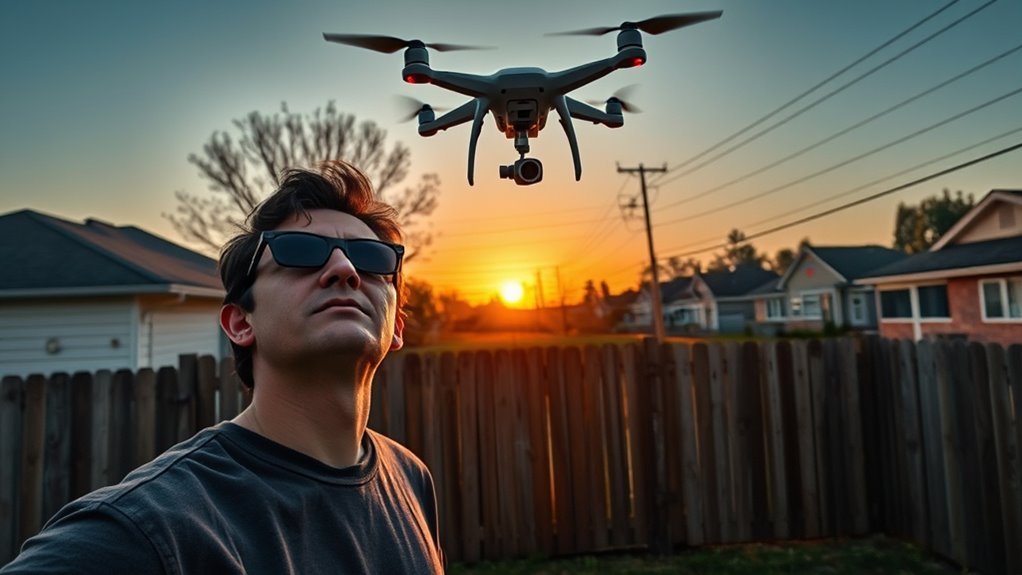
Drones may legally pass over private property under federal airspace rules, yet that authority is not unlimited. Property owners do not control every foot above their land, but privacy laws, nuisance claims, and state restrictions can still apply. The real question is where lawful flight ends and unlawful intrusion begins, especially when cameras, repeated hovering, or low-altitude surveillance enter the picture.
Can Drones Fly Over Private Property?
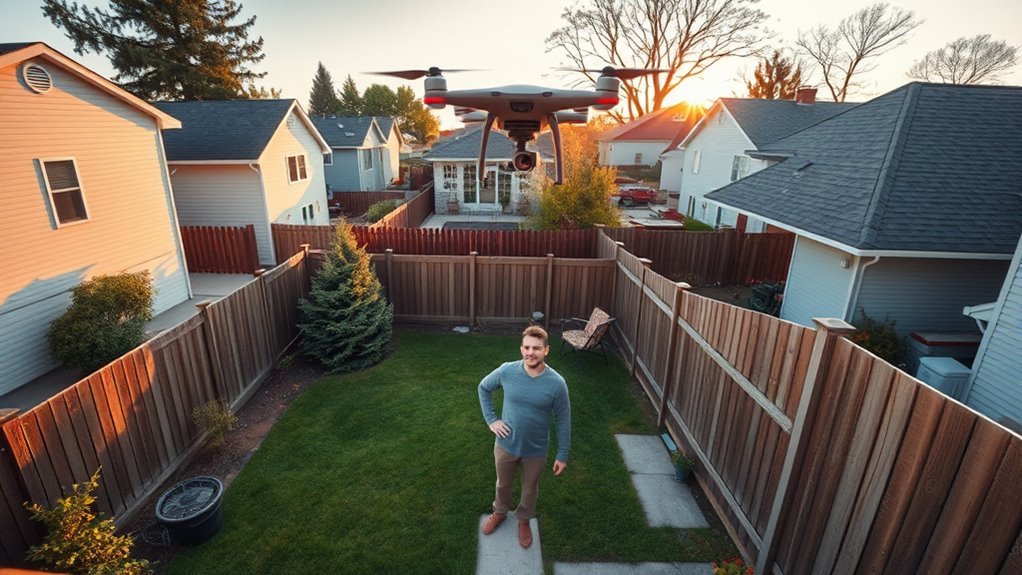
Drones may fly over private property because the airspace above land is regulated by the federal government through the FAA, not by the property owner. Accordingly, drones can legally fly above a parcel when operators comply with federal rules, including the general ceiling of 400 feet above ground level.
This framework preserves access to the sky while preventing arbitrary private control over navigable airspace. Yet lawful flight is not unlimited. States may impose additional restrictions, including permission requirements for photography over private land, and some jurisdictions treat very low-altitude operation as trespass.
Operators thus must consider federal and local rules together, rather than rely on one system alone. The result is a limited but meaningful freedom: drones can legally fly over private property, but only within a regulated zone that balances mobility, sovereignty, and public order.
What Privacy Rights Apply to Drones Over Your Property?
Although drones may lawfully pass over private property, privacy rights remain a distinct legal constraint on how they may be used. The law generally recognizes a protected sphere within homes and enclosed spaces, where surveillance by drone may become unlawful if it intrudes without consent.
Several states further restrict drone photography or recording of private property, reinforcing that aerial access does not create unlimited authority. When a drone’s conduct becomes persistent, intrusive, or harassing, affected persons may treat it as a nuisance or invasion of privacy and seek legal remedies.
Documentation matters: photos, videos, and dates can help establish the pattern required in any dispute. For those seeking freedom from unwarranted observation, the governing principle is precise: flight is not a license to peer into protected life.
Photos, videos, and dates can prove a pattern; flight is never permission to intrude.
- Quiet is not surrender.
- Seclusion deserves respect.
- Consent remains decisive.
- Intrusion can be challenged.
- Evidence strengthens every claim.
What Can You Do About a Drone?
When a drone crosses from abstract concern into an actual intrusion, the next steps should be practical and documented. A person observing that a drone flies over private land should record the incident with photos, video, and written notes, preserving times, locations, and any visible conduct. This evidence can support later claims of privacy invasion, nuisance, or property damage.
If the activity appears unsafe or unlawful, the matter may warrant notification to police, particularly when safety is threatened or privacy rights are violated. Where the drone seems to exceed the 400-foot altitude limit or lacks proper certification, a complaint to the FAA may be appropriate.
Persistent interference can justify civil action, including requests for injunctive relief or a restraining order. Because rules vary by jurisdiction, local and state law should be consulted before action is taken.
Careful documentation allows property holders to defend their autonomy with precision.
How Do You Report Illegal Drone Activity?
Illegal drone activity should be reported promptly and with documentation. A person who observes unsafe or suspicious conduct should contact local law enforcement without delay, especially when the flight appears to conflict with federal laws or state-specific rules governing private property.
Clear evidence strengthens any complaint: photographs, videos, timestamps, and brief written notes can preserve what was seen. If witnesses are present, their names and contact information should be collected so accounts can be corroborated.
- A sudden drone overhead can feel invasive.
- Careful records restore control.
- Witnesses can confirm what was endured.
- Official reports create accountability.
- Prompt action defends freedom.
For regulatory violations, a report should also be filed with the FAA, particularly if the drone is above the legal altitude of 400 feet.
This dual reporting path helps guarantee that unlawful operators are identified, and that those seeking lawful privacy are not left without recourse.
When Does Drone Activity Become Illegal?
Drone activity becomes unlawful when it crosses into protected privacy or property interests, such as recording people inside a home or enclosed backyard without consent. On private property, the law turns sharply against operators who intrude, linger, or capture images where liberty should remain secure.
| Conduct | Risk | Result |
|---|---|---|
| Filming a backyard | Privacy invasion | Civil claims |
| Flying below 400 feet | Trespass | Property dispute |
| Persistent hovering | Nuisance | Injunction |
| Breaking FAA limits | Regulatory violation | Fines |
Texas and Florida, among other states, restrict drone photography of private property without permission. Low-altitude flight may also be treated as trespass in some jurisdictions. When surveillance becomes persistent, it may support actions for nuisance, invasion of privacy, or property damage. Separate from state law, FAA rules forbid operations beyond visual line of sight or above permitted altitude. In lawful society, freedom for residents depends on firm limits for unauthorized aerial intrusion.
Frequently Asked Questions
Is It Legal for a Neighbor to Fly a Drone Over My Yard?
Yes, a neighbor may legally fly a drone over a yard in many cases, because drones are generally treated as aircraft under federal law.
That permission is not unlimited. Drone Privacy rules still bar intrusive surveillance, window-peering, and unlawful recording, and state laws may impose stricter limits.
If the flight becomes harassing or invasive, documentation should be gathered immediately, and nuisance claims or restraining relief may be available through local authorities.
Can I Stop a Drone From Flying Over My House?
No, one generally cannot stop a drone from passing over a house like a shadow crossing a roof at dusk.
Drone Regulations usually permit flight in public airspace above private property. However, a homeowner may document the activity and pursue remedies if privacy is invaded or a nuisance arises.
Low-altitude flight may be trespass in some states. Shooting it down remains illegal and can trigger severe penalties.
How Can I Tell Who Is Flying a Drone Over My House?
Identifying the operator usually begins with Drone Identification marks on the aircraft, especially the registration number required on many models. That number can be reported to the FAA or local authorities to trace ownership.
If the drone is unmarked, observers should document flight times, routes, altitude, and any distinguishing features. Video evidence, eyewitnesses, and local ordinances may further narrow the source.
Without such evidence, certainty remains limited.
Can I Shoot Down a Drone Spying on My Property?
No. Shooting down a drone is illegal and dangerous; it is treated as destroying an aircraft, not as lawful Drone Defense.
Federal law and FAA rules prohibit such force, even when the device appears to be spying on private property.
A better course is to document the intrusion, preserve evidence, and report it to local law enforcement or the FAA.
If privacy is violated, legal remedies, not retaliation, should be pursued.
Conclusion
To summarize, drones may lawfully pass over private property within federal airspace, yet that permission ends where privacy and nuisance begin. A homeowner who sees a quiet machine hovering above a backyard or peering toward a window need not imagine the air as lawless; instead, the law draws a clear boundary around intrusive surveillance. Documenting the activity and reporting it to local authorities or the FAA remains the prudent, lawful response when a drone crosses that line.