Last updated: September 22, 2026
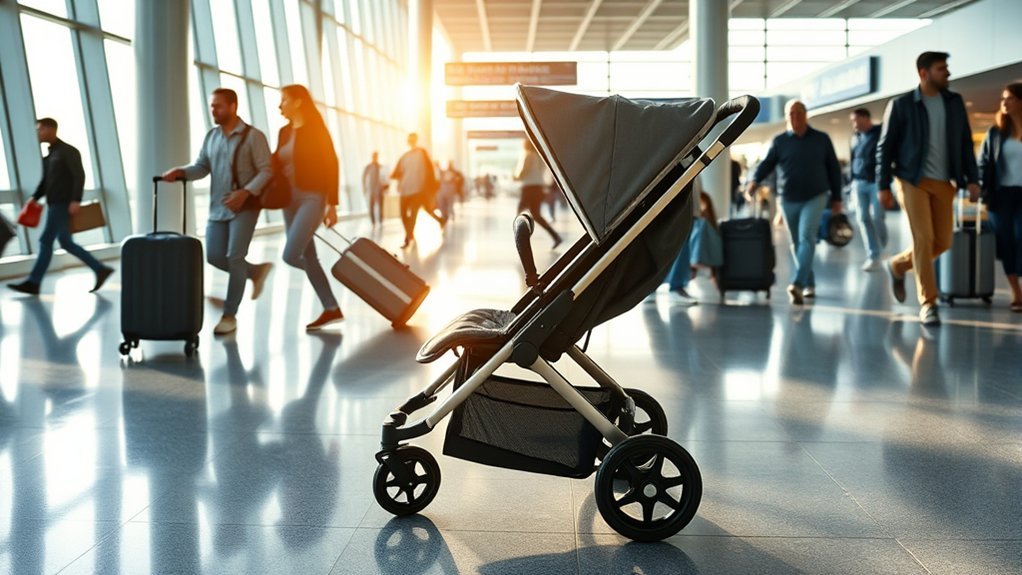
Yes—you can bring a stroller wagon to the airport, but you should not assume it can enter the aircraft cabin or even be taken all the way to the gate. Whether a stroller wagon is gate-checked, checked at the ticket counter, carried free as child equipment, or treated as regular baggage depends on the operating airline and the wagon’s design, folded size, weight, and child-safety features.
Before you fly, check the airline’s current stroller and wagon policy, measure the wagon when folded, and confirm where it must be handed over. A carrier that accepts ordinary strollers for free may still apply different rules to stroller wagons or cargo wagons.
Quick Answer
You can usually bring a child-carrying stroller wagon to the airport, but airline rules determine whether it can be used through the terminal, gate-checked, checked at the ticket counter, or carried in the cabin. Folding alone does not guarantee gate-check eligibility. Confirm your operating airline’s rule before travel.
Key Takeaways
- Airlines do not treat every stroller wagon the same way, even when they allow ordinary strollers to be checked free.
- American Airlines specifically requires non-collapsible strollers and stroller wagons without built-in child safety straps to be checked at the ticket counter.
- Alaska Airlines publishes a specific free stroller-wagon threshold: the wagon must be designed to carry children and collapse to under 90 linear inches and 35 pounds.
- TSA screening and airline acceptance are separate issues: child equipment must still pass airport security screening when taken beyond the ticket counter.
- Label your wagon, remove loose accessories, photograph it before checking, and confirm where it will be returned after landing.
At a Glance
| Best Airport Option | A child-carrying stroller wagon that folds securely and falls within your airline’s published wagon or stroller limits. |
| Gate Check | Possible when the carrier accepts your wagon type at the gate; folding alone does not guarantee approval. |
| Ticket-Counter Check | Expect this when the airline requires it for your wagon type, or when the wagon is large, non-collapsible, or outside the carrier’s gate-check rules. |
| Cabin Storage | Uncommon for stroller wagons. The item must satisfy the airline’s cabin-baggage policy and fit the available aircraft storage space. |
| Check Before Flying | Operating-airline policy, wagon classification, folded dimensions, weight, child-safety restraints, gate-check eligibility, fees, and return location. |
Can You Bring a Stroller Wagon on a Plane?
You can bring a stroller wagon as part of many family air-travel itineraries, but “bring it on a plane” can mean three different things: taking it through the airport for gate check, checking it at the ticket counter, or carrying it inside the aircraft cabin. The airline decides which option applies.
A child-carrying stroller wagon with built-in seats, restraints, and a secure folding design is more likely to fit a carrier’s child-equipment policy than a general-purpose cargo wagon. Do not assume that a policy saying “stroller” automatically includes every wagon.
How this guide was checked: Airline examples, TSA screening guidance, FAA child-restraint guidance, and U.S. DOT baggage information were reviewed against current official sources on September 22, 2026. Policies can change, so recheck the operating carrier shortly before departure.
Current Airline Examples for Stroller Wagons
These examples show why there is no single stroller-wagon rule across airlines. They are not a substitute for checking the carrier operating your specific flight.
| Airline | Published Rule | What It Means for a Stroller Wagon |
|---|---|---|
| American Airlines | One stroller and one car seat may be checked free when traveling with a child. Non-collapsible strollers and stroller wagons without built-in child safety straps must be checked at the ticket counter. | Do not assume every folding wagon qualifies for gate check. Built-in child-safety restraints and the stroller classification matter. |
| Alaska Airlines | Its free stroller policy also applies to stroller wagons designed to carry children that collapse to under 90 linear inches and 35 pounds. | Measure the folded wagon and weigh it before travel. Larger wagons or wagons not designed to carry children fall under standard baggage rules. |
| Delta Air Lines | Delta’s published child-baggage page says children’s strollers and child safety seats may be checked free at curbside, the ticket counter, or the gate. | The cited page does not specifically define stroller wagons, so confirm that your wagon will be treated as a stroller before relying on the stroller rule. |
Important: Check the operating airline, not only the company that sold the ticket. Codeshare and partner-operated flights can have different baggage and child-equipment procedures.
Ticketing Options for Children

For U.S. air travel, children under two may generally travel as lap children, subject to airline ticketing and documentation rules. The FAA strongly recommends securing a young child in an approved child restraint system in a purchased seat rather than relying on lap travel.
Children aged two and older need their own seat on U.S. commercial flights. If you want a baby or toddler to use an approved car seat during the flight, the child needs an aircraft seat available for that restraint.
Family boarding and proof-of-age requirements differ by airline. Keep the child’s required travel documents accessible and check the carrier’s boarding policy before departure.
Note: International infant fares, taxes, documentation, and seat rules can differ from U.S. domestic travel. Confirm the rules for every operating carrier and country on the itinerary before booking.
Traveler Pro Tips
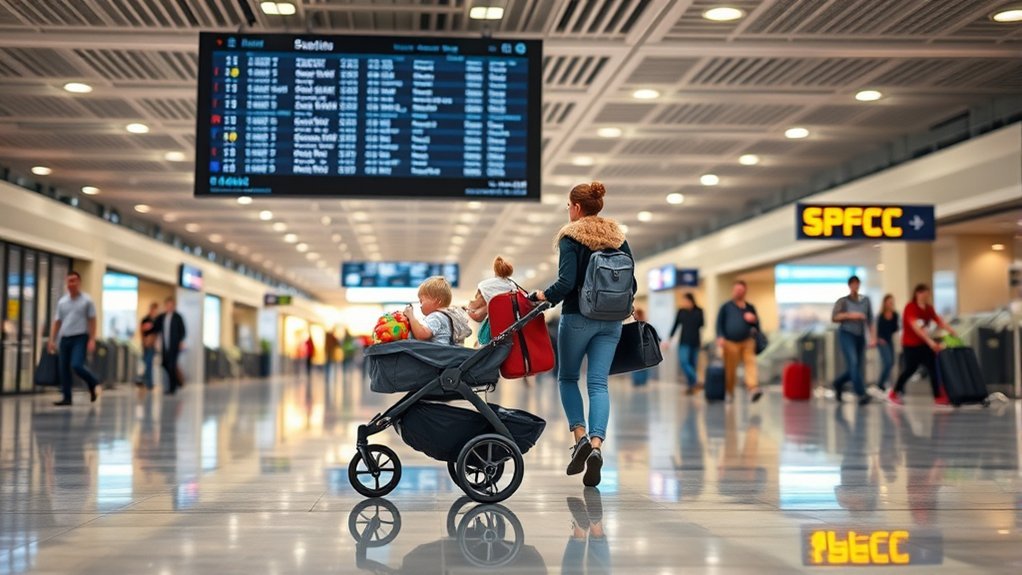
Before leaving home, confirm whether your airline explicitly accepts your stroller wagon as child equipment. Measure the wagon while folded, write down its weight, and save a screenshot of the current airline policy on your phone.
Remove loose cup holders, toys, blankets, snack trays, rain covers, organizers, and other detachable accessories before handing the wagon over. Pack must-have items such as medication, passports, formula, keys, and comfort items in a carry-on rather than leaving them in the wagon.
Stroller Wagon Policies
A stroller wagon policy can depend on more than whether the frame folds. Airlines may look at whether the item is designed to carry children, whether it has integrated child restraints, its folded dimensions and weight, and whether the airline classifies it as a stroller, wagon, or standard bag.
If the airline’s website mentions only “strollers” and does not define stroller wagons, confirm the classification before travel. A general-purpose folding cargo wagon should not automatically be assumed to receive the same exemption as a child stroller.
Checking Procedures Explained
The correct handoff point depends on the airline’s rule for your specific wagon. Use this sequence:
- Check the operating carrier’s current stroller and wagon policy before leaving home.
- If the carrier requires ticket-counter check-in, hand over the wagon before security.
- If gate check is allowed, take the wagon through security, obtain the required gate-check tag, and fold it when directed.
- Remove loose accessories and anything you need during the flight before handing it over.
- Ask whether the wagon will return at the aircraft door, jet bridge, baggage claim, or oversized-baggage area.
Pro Tip: Photograph the stroller wagon after it is emptied and folded but before you hand it over. Include the condition of the frame, wheels, fabric, and any travel bag.
Checking Strollers and Wagons at the Airport

Many airlines carry a child’s stroller without a standard checked-bag fee, but stroller wagons require closer policy checking. American and Alaska, for example, publish wagon-specific conditions, while Delta’s cited child-baggage page discusses strollers without specifically defining stroller wagons.
If your wagon is accepted for gate check, you can usually keep it through the terminal until boarding. If it must be counter-checked, plan another way to move your child and carry your essentials after check-in.
A compact stroller may sometimes qualify for cabin storage if the airline allows it and it fits the aircraft’s carry-on limits. A stroller wagon is generally larger, so checking or gate checking is the more realistic plan unless your airline explicitly confirms cabin acceptance.
Stroller Policies for Gate Check

Gate check allows you to use an accepted stroller or stroller wagon through the terminal and hand it over near boarding rather than at the main baggage counter. Gate check does not mean the item travels in the passenger cabin.
Before relying on gate check, confirm these points:
- Does the airline explicitly accept your stroller wagon or only traditional strollers?
- Does the carrier require the wagon to be collapsible?
- Are there wagon-specific size or weight limits?
- Does the carrier distinguish child-carrying stroller wagons from cargo wagons?
- Must the item have built-in child safety restraints?
- Where will the wagon be returned after landing?
For a narrower walkthrough of the handoff process, see Can Stroller Wagons Be Gate Checked?
Warning: Do not assume that “folding” automatically means “gate-check eligible.” Airline-specific classification, restraints, size, weight, aircraft handling, and airport procedures can all affect the decision.
Collapsible vs. Non-Collapsible Wagons

A collapsible stroller wagon is generally easier to travel with because it takes less space during handling, can be secured more easily, and is more likely to fall within a carrier’s stroller-wagon rules. That does not make every collapsible wagon automatically eligible for gate check.
A non-collapsible or unusually bulky wagon is more likely to require ticket-counter or oversized-baggage handling. American Airlines expressly requires non-collapsible strollers and certain stroller wagons to be checked at the ticket counter.
The most useful comparison is therefore not simply “folding versus non-folding.” Check the folded measurements, weight, intended child-carrying design, safety restraints, and the airline’s own classification.
How to Prepare Your Stroller Wagon Before Flying
A little preparation reduces delays and gives you better documentation if the wagon is lost or damaged. Before the trip, clean out the wagon and practice folding it without referring to the manual.
- Measure the stroller wagon while folded, including protruding wheels and handles.
- Weigh it if your airline publishes stroller-wagon or checked-item weight limits.
- Check whether it is marketed and built as child-carrying equipment rather than a cargo wagon.
- Attach a luggage tag with your name, phone number, and email address.
- Use a stroller travel bag if your wagon fits inside one.
- Secure straps, buckles, wheels, and loose fabric before handing it over.
- Remove detachable accessories and carry essential small parts with you.
- Take photos of the wagon from multiple angles immediately before check-in.
If the wagon has removable wheels, a battery, power bank, or powered accessory, follow both the manufacturer’s instructions and the airline’s current battery/electronics policy.
Airline Policy Checklist Before You Book
Because stroller-wagon treatment can differ even between major airlines, use this checklist before buying a ticket if the wagon is important to your airport plan.
- Does the operating airline explicitly mention stroller wagons?
- Does it distinguish a child-carrying stroller wagon from a general folding wagon?
- Can your wagon be used through the terminal and gate-checked?
- Does it have to be checked at the ticket counter?
- Are there folded-size, linear-inch, or weight limits?
- Are built-in child safety restraints required?
- Will it be treated as free child equipment or ordinary checked baggage?
- Can any compact version enter the cabin, and would it count as a carry-on?
- Where will a gate-checked wagon be returned after landing?
- Are there different rules for partner-operated, regional, or international segments?
Save a current screenshot of the policy and note the date you checked it. For a separate comparison of stroller handling points, see Guide to Checking Your Stroller at the Airport.
Bringing Car Seats to the Airport
Car-seat rules are separate from stroller-wagon rules. Many airlines provide special handling for child restraint systems, while the FAA governs whether a restraint can be used during a U.S. flight.
The FAA strongly recommends an approved child restraint system for young children, including children under two, rather than lap travel. The restraint must carry the required aircraft-use approval and be installed according to its instructions.
Check-in Procedures Explained
When traveling with a car seat, confirm both the airline’s baggage policy and the FAA requirements for in-cabin use:
- Airlines may allow a stroller and car seat to be checked under their child-equipment rules, but the exact allowance varies.
- If you plan to use the car seat onboard, the child must have an aircraft seat available for it.
- The restraint must be approved for aircraft use and installed according to the manufacturer’s instructions.
- Car seats are generally positioned so they do not block another passenger’s path to the aisle.
- Booster seats and backless child restraints are not approved for use during ground movement, takeoff, or landing.
Security Guidelines Overview
At U.S. airport security, TSA requires strollers, umbrella strollers, baby carriers, car seats, booster seats, and backpacks to be screened by X-ray when they fit. Equipment too large for the X-ray machine receives a visual or physical inspection.
If you take a stroller wagon beyond the ticket counter, arrive with it emptied and ready for screening. Follow the TSA officer’s directions for folding, placing, or presenting it for inspection.
Formula, breast milk, toddler drinks, and baby or toddler food may be carried in quantities greater than 3.4 ounces or 100 milliliters and do not have to fit inside the normal quart-size liquids bag. Tell the TSA officer about these items at the beginning of screening and remove them for separate screening when directed.
In-Cabin Regulations Summary
Cabin rules for a stroller wagon are controlled by the airline’s carry-on policy and the actual aircraft storage space. In practice, most stroller wagons are designed for checking rather than overhead-bin storage.
- An approved child restraint system can be used onboard when the child has a seat available and the restraint is certified for aircraft use.
- A very compact stroller or folding child item may qualify for cabin storage only when the airline permits it and it fits the published carry-on limits.
- Do not assume a stroller wagon can be brought into the cabin merely because it folds.
- The FAA-approved CARES device is an alternative for eligible children who meet its size requirements.
Nursing and Baby Care While Traveling

TSA treats formula, breast milk, toddler drinks, and baby or toddler food as medically necessary liquids. Quantities over 3.4 ounces or 100 milliliters may be carried through U.S. security and do not need to fit in the standard quart-size liquids bag. Your child does not need to be present for breast milk, formula, or related supplies.
Many airports provide nursing rooms, family rooms, or lactation spaces. If you plan to pump or feed during travel, keep the supplies you will need in your cabin bag rather than inside a checked stroller wagon.
For diaper changes, bring a portable changing mat, extra diapers, wipes, clothing, and small disposal bags. Aircraft facilities vary, so plan for the possibility that a lavatory may not have the setup you prefer.
Keeping Kids Entertained During the Flight
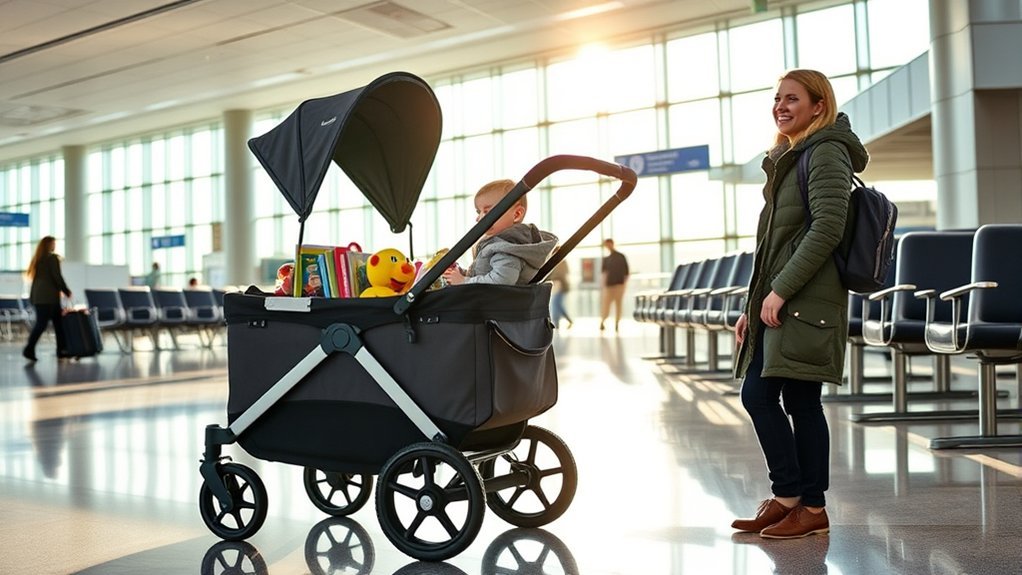
Once the stroller wagon has been handed over, keep the items your child will need during the flight in an accessible cabin bag rather than in wagon storage.
- Pack small toys, sticker books, or coloring books.
- Download movies, shows, music, or audiobooks before leaving home.
- Prepare familiar snacks that comply with your travel and security requirements.
- Bring one or two small surprise activities.
- Use child-safe headphones when appropriate.
- Pack a compact comfort item such as a blanket or stuffed toy.
When the crew permits movement and the seatbelt sign is off, a short walk or stretch may help with restlessness. Keep activities compact so they are easy to manage without the stroller wagon nearby.
What to Do if Your Stroller Is Lost or Damaged
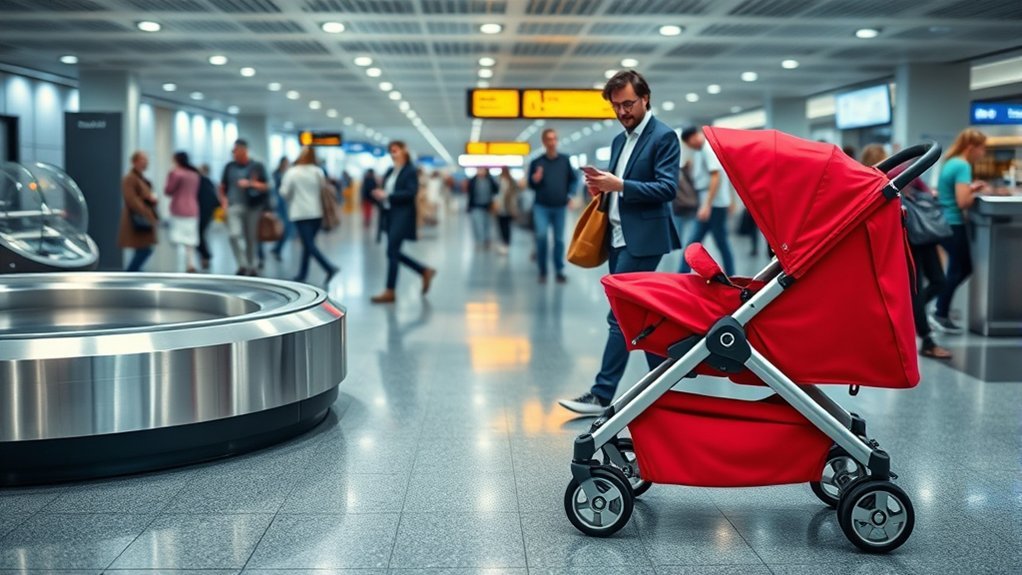
If your stroller wagon is missing or visibly damaged after a flight, report the problem to the airline before leaving the airport whenever possible. Keep photos, baggage or gate-check tags, boarding passes, receipts, and any written claim number.
For U.S. domestic flights, the Department of Transportation currently lists a maximum baggage-liability limit of $4,700 per passenger. For most international flights covered by the Montreal Convention, the current limit is 1,519 Special Drawing Rights per passenger. These are general baggage-liability limits; the carrier’s contract, exclusions, depreciation rules, and the facts of the claim can still affect compensation.
Report Immediately at Airport
Start the claim process as soon as you discover loss or damage. Ask the airline where stroller or special-item damage must be reported and request written confirmation of the report.
- Document the damage: Photograph the entire wagon and close-ups of the affected area.
- File promptly: Follow the airline’s stated deadline and claim process.
- Keep records: Save email, chat, phone, and claim-reference details.
- Save tags: Keep baggage tags, gate-check stubs, and any limited-release tag you were given.
Do not discard a damaged wagon or travel bag until the airline tells you whether it needs photographs, inspection, repair estimates, or other evidence.
Document Damage Thoroughly
Compare the damaged wagon with the photos you took immediately before handoff. Record damage to the frame, wheels, folding mechanism, fabric, restraints, handles, travel bag, or missing components.
Keep the purchase receipt if available, plus repair estimates and replacement-cost documentation. Review the airline’s current Contract of Carriage because domestic coverage can include exclusions and claim procedures that differ by carrier.
Understand Compensation Policies
Baggage compensation is not determined solely by the original purchase price. Liability limits, depreciation, repairability, proof of value, and airline contract terms can all affect a claim.
- Review the operating airline’s Contract of Carriage and baggage-claim rules.
- Submit the claim through the airline’s required baggage or customer-service channel.
- Keep photographs, receipts, repair estimates, baggage tags, and claim numbers together.
- Ask whether the airline proposes repair, replacement, reimbursement, or another resolution.
Additional Resources for Traveling Families
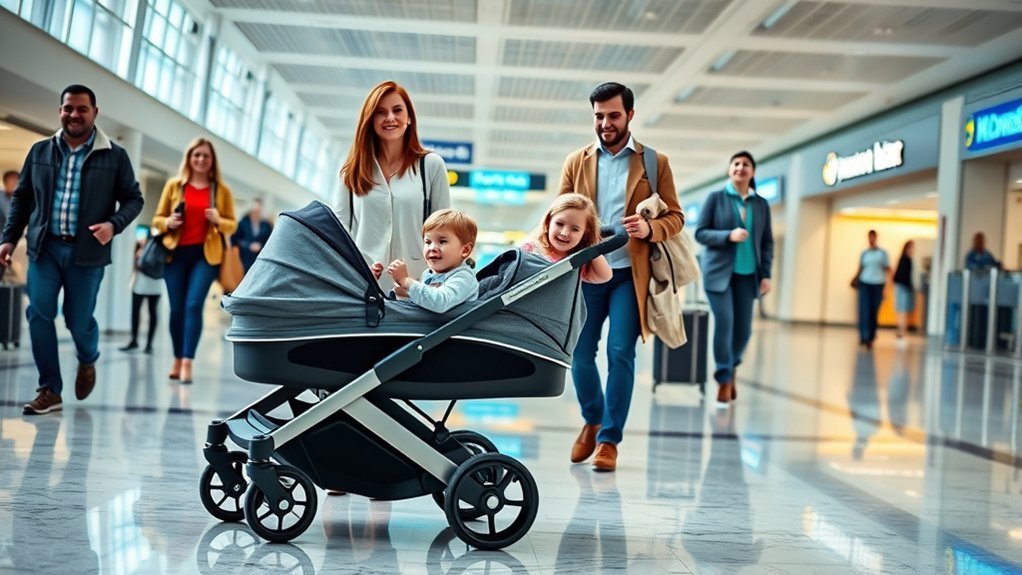
For stroller-wagon travel, use four sources before departure: the operating airline’s current child-equipment page, TSA guidance for security screening, FAA guidance if you will use a child restraint onboard, and the stroller-wagon manufacturer’s folding and transport instructions.
Do not rely on a single generic “strollers fly free” statement. The practical question is whether your exact wagon is treated as a stroller, stroller wagon, cargo wagon, oversized item, or cabin item by the airline operating the flight.
Checking these details at home is much easier than solving a classification dispute at the ticket counter or boarding gate.
Related Guides
Frequently Asked Questions
Can I bring a stroller wagon on the plane?
You can bring a stroller wagon as part of many air-travel itineraries, but that does not mean it can ride in the passenger cabin. Depending on the operating airline and the wagon’s design, size, weight, and restraints, it may be gate-checked or checked at the ticket counter instead.
Can I gate-check a stroller wagon?
Sometimes. Gate-check eligibility is airline-specific. Some carriers publish stroller-wagon rules, while others publish rules only for strollers. Confirm that your operating airline accepts your exact wagon type at the gate before relying on gate check.
Are there size or weight restrictions for checked stroller wagons?
Yes, some airlines publish stroller-wagon-specific limits. Alaska Airlines, for example, says qualifying child-carrying stroller wagons must collapse to under 90 linear inches and 35 pounds to fall under its free stroller-wagon provision. Other airlines use different rules, so there is no universal stroller-wagon limit.
Are stroller wagons free to check?
They can be, but free stroller handling does not automatically cover every wagon. American and Alaska publish conditions that specifically affect stroller wagons. If your airline does not explicitly mention wagons, confirm whether your model will be treated as child equipment or ordinary baggage.
Do stroller wagons count as my carry-on luggage?
A stroller wagon checked under an airline’s child-equipment policy may be handled separately from normal carry-on baggage. If you want to put one in the aircraft cabin, however, it must satisfy the airline’s cabin-baggage rules and available storage space. Most stroller wagons are too bulky for normal overhead-bin use.
How does TSA screen a stroller wagon?
TSA says strollers and other listed child equipment must be screened by X-ray when they fit. Equipment that does not fit through the X-ray machine receives a visual or physical inspection. Empty the wagon, remove loose belongings, and follow the TSA officer’s directions at the checkpoint.
Can I use a stroller wagon for airport transportation?
You may be able to use an accepted stroller wagon through the terminal until its required handoff point. If your airline requires ticket-counter check-in, however, you will need another plan for moving your child and carry-on items after you surrender the wagon.
Should I gate-check or ticket-counter-check my stroller wagon?
Follow the operating airline’s rule. Gate-check it only when the airline accepts your wagon type at the gate. Use ticket-counter check-in when the carrier requires it or when the wagon falls outside the airline’s gate-check conditions.
Do I need a stroller bag for a stroller wagon?
A travel bag is not universally required, but it can keep straps and loose parts contained and help protect the wagon from dirt and minor scuffs. Label both the bag and the wagon, and keep valuables and essential child-care items with you.
Conclusion
You can travel by air with a stroller wagon, but there is no universal airline rule that covers every wagon. The safest planning method is to identify the operating carrier, confirm whether it recognizes your exact type of stroller wagon, measure and weigh the wagon when folded, and determine in advance whether it must be checked at the ticket counter or may be taken to the gate.
Before leaving home, save the airline policy, remove loose accessories, label and photograph the wagon, and keep essential child items in your cabin bag. Those steps reduce both airport surprises and problems if the wagon is delayed or damaged.
Sources
- American Airlines — Traveling with Children — current stroller and stroller-wagon handling rules.
- Alaska Airlines — Car Seats Fly Free — current stroller-wagon size, weight, and child-equipment conditions.
- Delta Air Lines — Children & Infant Baggage — current free stroller and child-safety-seat checking guidance.
- Transportation Security Administration — What Can I Bring? — breast milk, formula, baby-food, and screening guidance.
- Federal Aviation Administration — Kids’ Corner — child restraint, lap-child, and CARES safety guidance.
- U.S. Department of Transportation — Lost, Delayed, or Damaged Baggage — current baggage-claim and liability guidance.
