For recent U.S.-market Toyota RAV4 models, the safe answer is generally no: do not flat tow the vehicle with all four wheels on the road unless the owner’s manual for that exact year and configuration expressly allows it. Toyota’s 2025 RAV4 and RAV4 Hybrid manuals state that the vehicle is not designed for four-wheels-down dinghy towing. Some older manual-transmission RAV4s are genuine exceptions, so model year, transmission, drivetrain, and market all matter.
Last updated: September 22, 2026. Scope: U.S.-market RAV4 guidance unless otherwise noted.
Quick Answer
Recent Toyota RAV4 models should not be flat towed with all four wheels on the road unless Toyota provides an explicit procedure for that exact vehicle. Some older manual-transmission RAV4s were approved for dinghy towing under specific limits. A compatible front-wheel-drive RAV4 may use a tow dolly only when the owner’s manual and dolly provider approve the setup. When the manual does not permit wheels-on-road towing, use a full trailer or flatbed.
Key Takeaways
- Flat towing means pulling the RAV4 with all four wheels on the road. A tow dolly is a different transport method.
- Treat a RAV4 as not flat-towable unless the owner’s manual for the exact year, transmission, drivetrain, and market provides a recreational or dinghy-towing procedure.
- Toyota’s 2003 U.S. manual shows why configuration matters: the automatic-transmission RAV4 was not designed for dinghy towing, while the manual-transmission version had an approved procedure.
- Selecting Neutral does not guarantee that internal drivetrain parts receive proper lubrication.
- A compatible FWD model may travel with its front wheels on a tow dolly. AWD, 4WD, Hybrid, and Plug-in Hybrid configurations require extra caution and may require all four wheels off the road.
- Emergency recovery instructions are not permission for long-distance recreational towing.
Can You Flat Tow a Toyota RAV4 With All Four Wheels Down?
For recent U.S.-market Toyota RAV4 models, the practical answer is no. Toyota’s 2025 RAV4 and RAV4 Hybrid owner’s-manual information says the vehicle is not designed to be dinghy towed with all four wheels on the ground. If Toyota does not publish a recreational-towing procedure for your exact configuration, do not assume that Neutral makes it safe to pull behind a motorhome.
Older RAV4 models require a model-specific check rather than a blanket rule. Toyota sold different transmissions and drivetrains under the same RAV4 name, and an approved procedure for one configuration does not automatically apply to another.
Warning: Do not rely on a forum post, a baseplate listing, or the fact that the shifter has a Neutral position. None of those confirms that the transmission, differentials, transfer components, or hybrid system can tolerate continuous wheel rotation while the engine or hybrid system is off.
Which Toyota RAV4 Years Can Be Flat Towed?
There is no safe one-line year cutoff that replaces the owner’s manual because transmission and drivetrain can change the answer within the same model year. Toyota’s official 2003 RAV4 manual is a useful example: the automatic-transmission version was not designed for four-wheels-down towing, while the manual-transmission version could be dinghy towed from the front when Toyota’s procedure was followed.
| Example | Four-Wheels-Down Guidance | What It Shows |
|---|---|---|
| 2003 RAV4, automatic transmission | Not designed for dinghy towing | An older RAV4 is not automatically flat-towable |
| 2003 RAV4, manual transmission | Toyota provided a front-facing dinghy-towing procedure; 4WD versions were limited to 55 mph and 200 miles before the specified engine-idle break | Transmission and drivetrain can change the answer within the same year |
| 2025 RAV4 | Not designed for four-wheels-down dinghy towing | Do not use an older RAV4 procedure on a recent model |
| 2025 RAV4 Hybrid | Not designed for four-wheels-down dinghy towing | Electrified drivetrain instructions must be followed exactly |
These are verified examples, not a complete year-by-year compatibility list. Before towing any older RAV4, read the exact manual rather than applying the 2003 instructions to another year. Toyota’s official 2003 RAV4 Owner’s Manual shows the automatic-versus-manual distinction directly.
Flat Towing vs. Tow-Dolly and Trailer Transport
The towing terms are easy to confuse, but the difference affects your vehicle’s drivetrain.
- Flat towing or dinghy towing: All four RAV4 wheels remain on the road, and the vehicle connects to the motorhome with a tow bar.
- Tow-dolly transport: One axle rests on a two-wheel dolly. A compatible front-wheel-drive vehicle normally travels with its front drive wheels on the dolly.
- Full-trailer or auto-transport towing: All four RAV4 wheels remain off the road on a trailer.
- Emergency towing: A tow truck moves a disabled vehicle under limited procedures. These instructions are not automatically suitable for highway travel behind an RV.
A tow dolly therefore does not make a RAV4 “flat-towable.” It changes which wheels rotate during transport, and the vehicle manual still controls whether that arrangement is allowed.
Why Most RAV4 Models Cannot Be Flat Towed
Putting a transmission in Neutral disconnects engine power from the wheels, but it does not always stop internal shafts, gears, bearings, differentials, or couplings from rotating. Some transmissions depend on an engine-driven or electrically controlled pump for lubrication.
When the engine or hybrid system is off, rotating parts may not receive the oil flow or cooling they need. Long-distance towing can then cause heat, accelerated wear, seal damage, or transmission failure.
AWD and 4WD models create additional concerns because wheel movement may rotate front and rear driveline components. Hybrid and Plug-in Hybrid RAV4 models also use electrified transaxles and control systems that should not be treated like a conventional manual transmission.
A Neutral gear position shows that the engine is not driving the wheels. It does not prove that the drivetrain can lubricate itself while the vehicle is being pulled.
Toyota’s Guidance: Check the Exact Owner’s Manual
Your model-specific owner’s manual is the controlling source. Use Toyota’s official Manuals and Warranties portal and select the correct year and model. For older documentation, you can also check the Toyota Technical Information System.
Search the manual for these terms:
- Dinghy towing
- Recreational towing
- Emergency towing
- Wheel-lift towing
- Towing with a sling-type truck
- Transporting the vehicle
Note: A manual may permit a limited emergency tow at a low speed or for a short distance. That procedure does not authorize hundreds of miles of recreational towing behind a motorhome.
At a Glance
| Recent RAV4 | Do not flat tow four-down unless the exact Toyota manual explicitly provides a recreational-towing procedure |
| Older Exception Example | The 2003 manual allows specified manual-transmission versions to be dinghy towed but prohibits the automatic-transmission version |
| FWD Tow Dolly | May be suitable with the front drive wheels raised when both the exact vehicle instructions and dolly provider approve the combination |
| AWD / Hybrid / PHEV | Use the exact Toyota transport instructions; a full trailer or flatbed keeps all four wheels off the road when wheels-on-road transport is not approved |
AWD vs. FWD RAV4 Towing Options
The drivetrain determines which wheels can safely remain on the road. The table below provides a conservative starting point, but your exact manual and equipment provider must approve the final setup.
| RAV4 Configuration | Four-Wheels-Down Flat Tow | Preferred Transport Method |
|---|---|---|
| FWD with automatic or CVT | Usually not approved; verify the exact year | Compatible tow dolly with front wheels raised when approved, or a full trailer |
| AWD or 4WD | Treat as not approved unless the exact manual says otherwise | Full trailer or flatbed when the manual prohibits wheels-on-road towing |
| RAV4 Hybrid | Do not assume it is permitted | Follow Toyota’s exact transport procedure; full trailer or flatbed is the conservative choice |
| RAV4 Plug-in Hybrid or Prime | Do not assume it is permitted | Follow Toyota’s exact transport procedure; full trailer or flatbed is the conservative choice |
| Older manual-transmission model | Possible only when the exact manual explicitly authorizes it | Follow every speed, distance, gear-position, ignition, and preparation instruction in that manual |
Can Modifications Make a RAV4 Safe to Flat Tow?
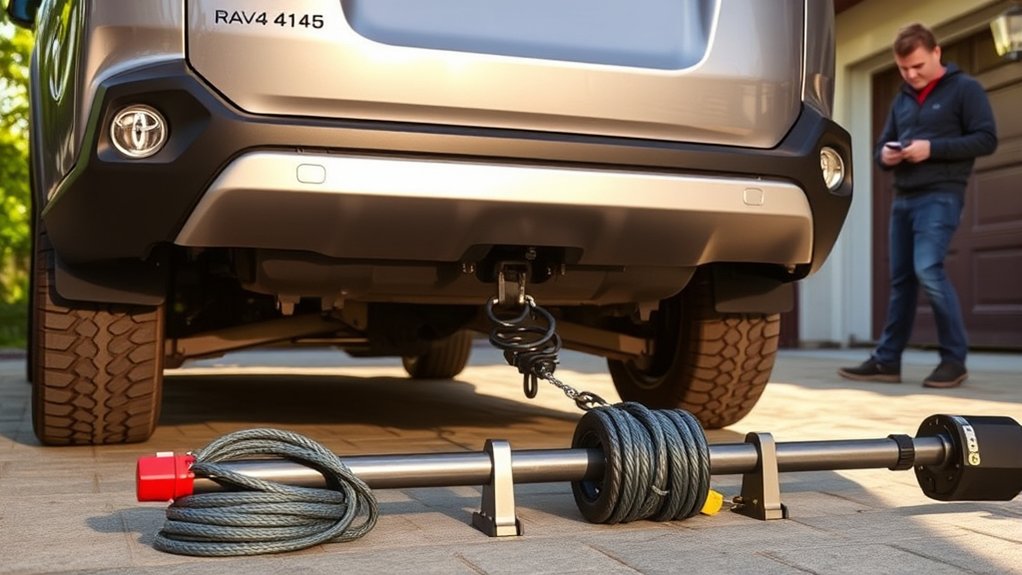
Aftermarket companies may offer components such as a driveshaft disconnect or transmission-lubrication pump for selected vehicles. These products do not provide a universal solution for every Toyota RAV4.
A complete flat-towing setup may also require a model-specific baseplate, tow bar, safety cables, supplemental braking system, breakaway switch, lighting connection, battery-charge line, and steering procedure. A baseplate listing confirms that mounting hardware exists; it does not by itself establish that Toyota approves four-wheels-down towing for that drivetrain.
Before modifying a RAV4, obtain written confirmation from the equipment manufacturer that the complete system supports your exact VIN, drivetrain, transmission, wheel size, and model year. You should also discuss the conversion with a Toyota dealer or qualified drivetrain specialist.
In the United States, installing an aftermarket part does not automatically cancel the entire vehicle warranty. However, warranty coverage may be denied for damage caused by the modification, part, or towing method. The Federal Trade Commission’s warranty guidance explains this distinction.
Safer Alternatives to Flat Towing a RAV4
If the owner’s manual does not explicitly approve four-wheels-down towing, choose an approved transport method that prevents prohibited drivetrain rotation.
| Method | Suitable Use | Important Cautions |
|---|---|---|
| Tow dolly | Compatible FWD models with the front drive wheels on the dolly | Verify vehicle weight, tire fit, ground clearance, steering procedure, lighting, and the owner’s-manual instructions |
| Full vehicle trailer | FWD, AWD, 4WD, Hybrid, and Plug-in Hybrid models when the complete combination is properly rated | The tow vehicle, hitch, trailer, tires, axles, and brakes must be rated for the combined load |
| Flatbed tow truck | Breakdowns, recovery, and professional transport | Tell the operator the exact drivetrain and whether the vehicle is a Hybrid or Plug-in Hybrid |
| Professional vehicle carrier | Long-distance relocation when you do not want to tow the vehicle yourself | Confirm insurance, loading method, inspection records, and delivery terms |
For tow-dolly operation, follow the equipment provider’s complete instructions. The current U-Haul tow-dolly guide, for example, requires the vehicle to face forward, places a front-wheel-drive vehicle’s drive wheels on the dolly, and calls for tire straps, security chains, operational lights, and repeated connection checks. U-Haul also warns that simply selecting Neutral is not sufficient to prevent transmission damage in configurations that require drivetrain disconnection.
Pro Tip: Before renting a dolly or trailer, provide the equipment company with the RAV4’s exact year, drivetrain, curb weight, tire size, and any suspension or body modifications. A generic “Toyota RAV4” compatibility result may not account for every trim or powertrain.
How to Choose and Prepare the Correct Towing Method
- Identify the exact vehicle. Confirm the model year, market, transmission, FWD or AWD configuration, and whether the vehicle is gasoline, Hybrid, or Plug-in Hybrid.
- Read the applicable manual. Look for recreational, dinghy, emergency, wheel-lift, and flatbed towing instructions. Do not combine instructions from different model years or transmissions.
- Select compatible equipment. Confirm the RAV4 fits the dolly or trailer and remains within every vehicle, hitch, axle, tire, and equipment rating.
- Follow the equipment provider’s loading procedure. Use the required wheel orientation, straps, chains, steering position, parking-brake setting, transmission position, and lighting connections.
- Check braking and legal requirements. Supplemental or trailer brakes, breakaway equipment, lighting, mirrors, and registration requirements vary by equipment weight and location.
- Inspect the complete combination. Check tires, coupler engagement, hitch pins, chains, electrical plugs, straps, ramps, clearance, and fluid leaks.
- Recheck after moving. Stop after the initial short distance and at regular intervals to inspect straps, chains, tires, lights, and hitch connections.
Never carry passengers in the RAV4 while it is on a dolly or trailer. Avoid loading unnecessary cargo inside the transported vehicle because added weight affects the equipment rating and handling.
Frequently Asked Questions
Which Toyota RAV4 years can be flat towed?
Flat-towing approval cannot safely be reduced to a single year range because transmission and drivetrain matter. For example, Toyota’s 2003 U.S. manual prohibits dinghy towing for the automatic-transmission RAV4 but provides a four-wheels-down procedure for the manual-transmission version. Check the exact owner’s manual for your year and configuration before towing.
Can a 2025 Toyota RAV4 be flat towed?
No four-wheels-down recreational-towing procedure is provided for the 2025 U.S.-market RAV4. Toyota’s owner’s-manual information says the vehicle is not designed to be dinghy towed with all four wheels on the ground. Use the exact Toyota transport instructions for your drivetrain.
What are the risks of flat towing a RAV4?
An unapproved setup can rotate transmission, transaxle, differential, coupling, or electric-drive components without proper lubrication or cooling. Possible results include overheating, premature wear, seal failure, warning lights, battery discharge, and major drivetrain damage.
Can I use a tow dolly with a Toyota RAV4?
A tow dolly may be suitable for a compatible front-wheel-drive RAV4 when the front drive wheels are raised. Verify the exact model in the owner’s manual and the dolly provider’s compatibility system. Do not assume that an AWD, 4WD, Hybrid, or Plug-in Hybrid RAV4 can use a dolly unless the applicable instructions approve that arrangement.
Can a RAV4 Hybrid or RAV4 Prime be flat towed?
Do not assume that a RAV4 Hybrid or Plug-in Hybrid can be pulled with all four wheels down. Electrified models use specialized transaxles, motors, batteries, and electronic controls. Follow the exact Toyota transport procedure for that model; a flatbed or full vehicle trailer keeps all four wheels off the road when wheels-on-road towing is prohibited.
Does putting the RAV4 in Neutral make it safe to tow?
No. Neutral prevents the engine from driving the wheels, but internal drivetrain parts may still rotate. The vehicle is safe for recreational towing only when the exact owner’s manual provides an approved procedure for that method.
What is the maximum towing capacity of a Toyota RAV4?
The amount a RAV4 can pull varies by model year, market, trim, drivetrain, powertrain, equipment, and trailer-brake configuration. See the Toyota RAV4 towing capacity guide and confirm the final number in the exact owner’s manual. A trailer-towing rating does not indicate whether the RAV4 itself can be flat towed behind another vehicle.
Will flat towing void my RAV4 warranty?
Using an aftermarket part does not automatically cancel every part of a U.S. vehicle warranty. However, warranty coverage may be denied for damage caused by an unapproved towing method, modification, or component. Keep the manual, installation records, equipment approvals, and service documentation.
How do I prepare my RAV4 for towing?
First choose an owner’s-manual-approved method. Then follow the manual and equipment provider for loading direction, transmission position, steering lock, parking brake, straps, safety chains, lighting, braking equipment, tire pressure, and connection checks. Do not use a generic Neutral-only procedure.
Conclusion
Recent Toyota RAV4 models generally should not be flat towed with all four wheels on the road. Older RAV4s require closer inspection because transmission and drivetrain can change the answer even within the same model year. Toyota’s 2003 manual, for example, prohibits dinghy towing for the automatic version but provides a procedure for the manual-transmission version.
The exact owner’s manual should make the final decision. If it does not provide a recreational or dinghy-towing procedure for your configuration, do not invent one from Neutral, a baseplate listing, another model year, or emergency-towing instructions. Use an approved tow-dolly arrangement where permitted or keep all four wheels off the road on a properly rated trailer or flatbed.
Sources
- Toyota Manuals and Warranties — official model-specific owner’s manuals, towing instructions, and warranty documents.
- Toyota 2003 RAV4 Owner’s Manual — official Toyota documentation showing different dinghy-towing instructions for automatic- and manual-transmission versions.
- Toyota Technical Information System — technical and historical Toyota vehicle documentation.
- U-Haul Tow Dolly User Instructions — tow-dolly loading, drivetrain, equipment, inspection, and operating precautions.
- Federal Trade Commission Warranty Guidance — warranty coverage, third-party parts, repairs, and damage-caused exclusions.

