
Not all Toyota RAV4 models have a CVT transmission. From 2019 onward, RAV4 Hybrid and RAV4 Prime models feature an Electronic Continuous Variable Transmission (e-CVT) for improved efficiency. Traditional gasoline models (available through the 2025 model year) use a Direct Shift 8-speed automatic transmission. So while hybrid models use advanced e-CVT technology, gasoline variants stick to the more conventional geared setup. Starting with the 2026 model year, Toyota moved the entire RAV4 lineup to hybrid-only powertrains, meaning all 2026 RAV4 models now use some form of e-CVT.
Disclosure: As an Amazon Associate, we earn from qualifying purchases. If you click an affiliate link and make a purchase, we may receive a small commission at no extra cost to you.
Quick Answer
- The RAV4 Hybrid and RAV4 Prime (2019 and newer) use an electronic CVT (e-CVT), not a traditional belt-driven CVT.
- Gas-only RAV4 models (2019 through 2025) use a conventional 8-speed automatic transmission.
- Starting in 2026, Toyota eliminated gas-only RAV4 models. Every 2026 RAV4 is a hybrid or plug-in hybrid with an e-CVT.
- Toyota’s e-CVT relies on planetary gears and electric motors, making it more durable than typical belt-driven CVTs found in some competing brands.
Deal tip: Shopping for your RAV4 this month? Our October Prime Day RAV4 accessory deals cover floor mats, console organizers, cross bars and mud flaps for 2019–2025 and 2026 models.
Overview of RAV4 Transmission Options Over the Years
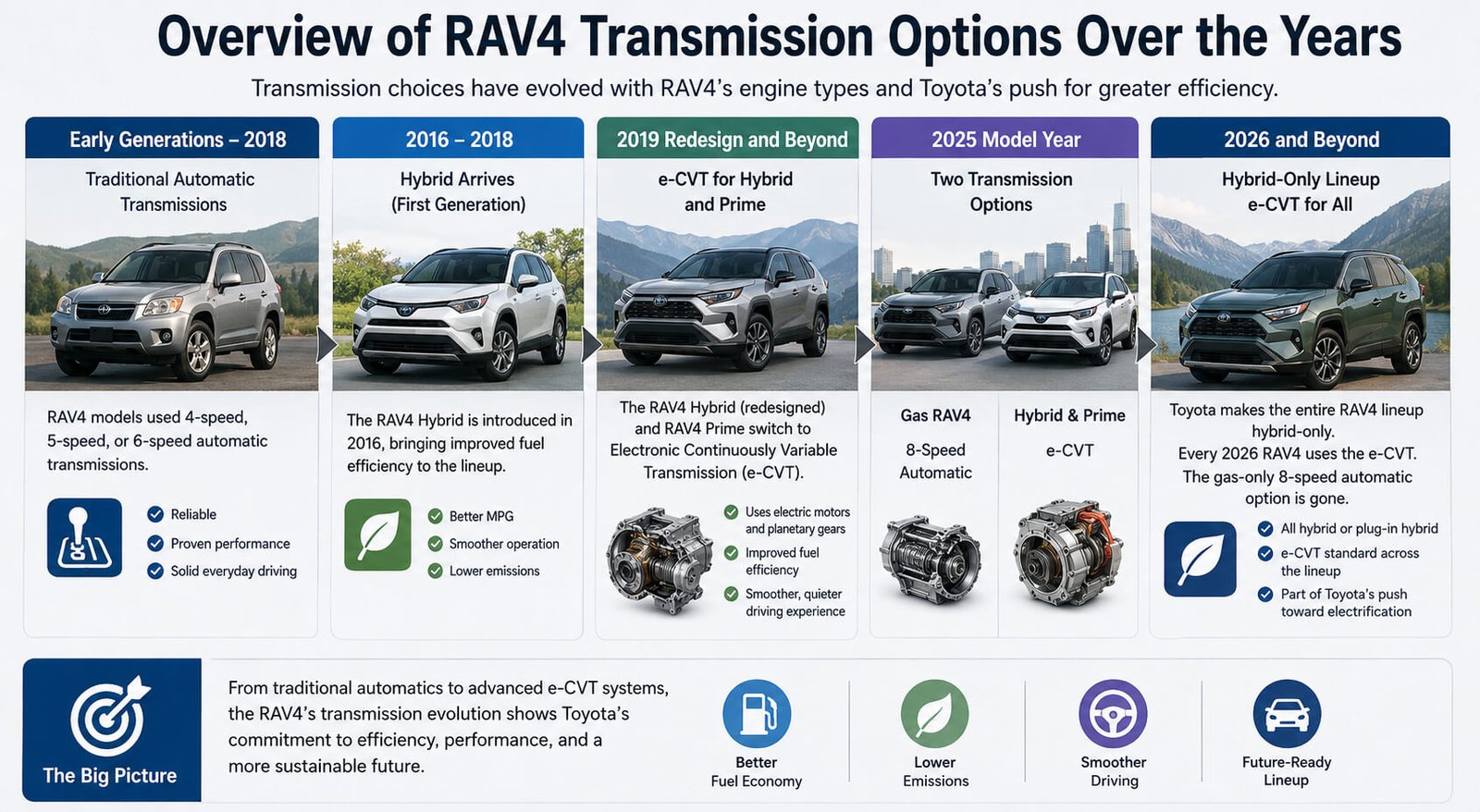
The Toyota RAV4’s transmission options have changed quite a bit over the years, and the split largely depends on the engine type.
From the RAV4’s early generations through the 2018 model year, the lineup relied on traditional 4-speed, 5-speed, or 6-speed automatic transmissions. These provided solid performance and good reliability.
The introduction of the RAV4 Hybrid (first in 2016, then redesigned for 2019) brought major changes in efficiency.
Starting with the 2019 redesign, the RAV4 Hybrid and RAV4 Prime shifted to the Electronic Continuously Variable Transmission (e-CVT). Unlike standard belt-driven CVTs, this system uses electric motors and planetary gears to improve fuel efficiency and deliver a smoother driving experience.
For the 2025 model year, gas RAV4s still used the 8-speed automatic, while Hybrids and Primes featured the e-CVT. But for 2026, Toyota made a big change: the entire RAV4 lineup is now hybrid-only. Every 2026 RAV4 uses the e-CVT, and the gas-only 8-speed automatic option is gone. This reflects Toyota’s broader push toward electrified powertrains across its lineup.
CVT Adoption Timeline for RAV4 Models

With the redesign of the RAV4 Hybrid in 2019, Toyota committed to e-CVT technology for its electrified models. This shift improved fuel efficiency without the wear-and-tear issues often linked to traditional belt-driven CVTs.
Here’s a quick timeline of key developments:
- 2019: The 5th-generation RAV4 Hybrid debuts with an advanced e-CVT, targeting eco-conscious drivers.
- 2021: The RAV4 Prime launches, using the same e-CVT architecture to handle its high-output plug-in hybrid powertrain.
- 2025: The RAV4 Hybrid and RAV4 Prime continue with the e-CVT, while gas models retain the Direct Shift 8-speed automatic.
- 2026: Toyota drops gas-only RAV4 models entirely. Every 2026 RAV4 runs on a hybrid or plug-in hybrid powertrain with an e-CVT. The 5th-generation hybrid system now produces up to 236 horsepower (AWD), and fuel economy reaches up to 48 city / 42 highway MPG on select trims.
This timeline shows Toyota’s strategy clearly: the company reserved CVT technology for electrified models to maximize MPG, and eventually made the entire lineup hybrid.
RAV4 Transmission Types: CVT vs. Traditional Differences
Understanding the mechanical differences between the Electronic CVT (e-CVT) in hybrid models and the traditional 8-speed automatic in gasoline models can help you pick the right RAV4.
The e-CVT, found in the RAV4 Hybrid and RAV4 Prime, delivers seamless acceleration. It has no physical gears or belts. Instead, it uses electric motors to blend power from the gas engine and battery. This design helps hybrid models achieve impressive fuel economy (often 40+ MPG) and instant torque from the electric motors.
The RAV4 Hybrid’s e-CVT provides smooth acceleration and exceptional fuel efficiency, perfect for urban driving.
The 8-speed automatic transmission in traditional (pre-2026) RAV4 gas models delivers a more conventional driving feel with distinct shift points. It also supported higher towing capabilities on certain trims, such as the Adventure and TRD Off-Road, which could tow up to 3,500 lbs. Standard Hybrids were limited to 1,750 lbs, and the Prime could handle up to 2,500 lbs.
For 2026, the towing picture has changed. AWD RAV4 Hybrid models (except the base LE trim) can now tow up to 3,500 lbs, matching what the old gas Adventure and TRD trims offered. FWD models and the AWD LE remain rated at 1,750 lbs.
2026 RAV4: The Move to an All-Hybrid Lineup
The biggest RAV4 transmission news for 2026 is that Toyota dropped gas-only models entirely. Every 2026 RAV4 now runs on Toyota’s 5th-generation hybrid system, pairing a 2.5-liter four-cylinder engine with electric motors through an e-CVT.
The standard hybrid makes 226 horsepower with front-wheel drive or 236 horsepower with all-wheel drive. The plug-in hybrid RAV4 Prime pushes output to 324 combined horsepower and offers roughly 50 miles of electric-only range.
This means every 2026 RAV4 buyer gets an e-CVT. If you prefer a conventional automatic transmission, you’ll need to look at a 2025 or earlier gas-only RAV4, or consider a different Toyota model. For more details on the 2026 lineup, you can check Edmunds’ 2026 RAV4 overview.
To explore more Toyota RAV4 information and automotive gear reviews, visit Backpack-and-Gear.
What Are the Upsides and Downsides of RAV4’s e-CVT?
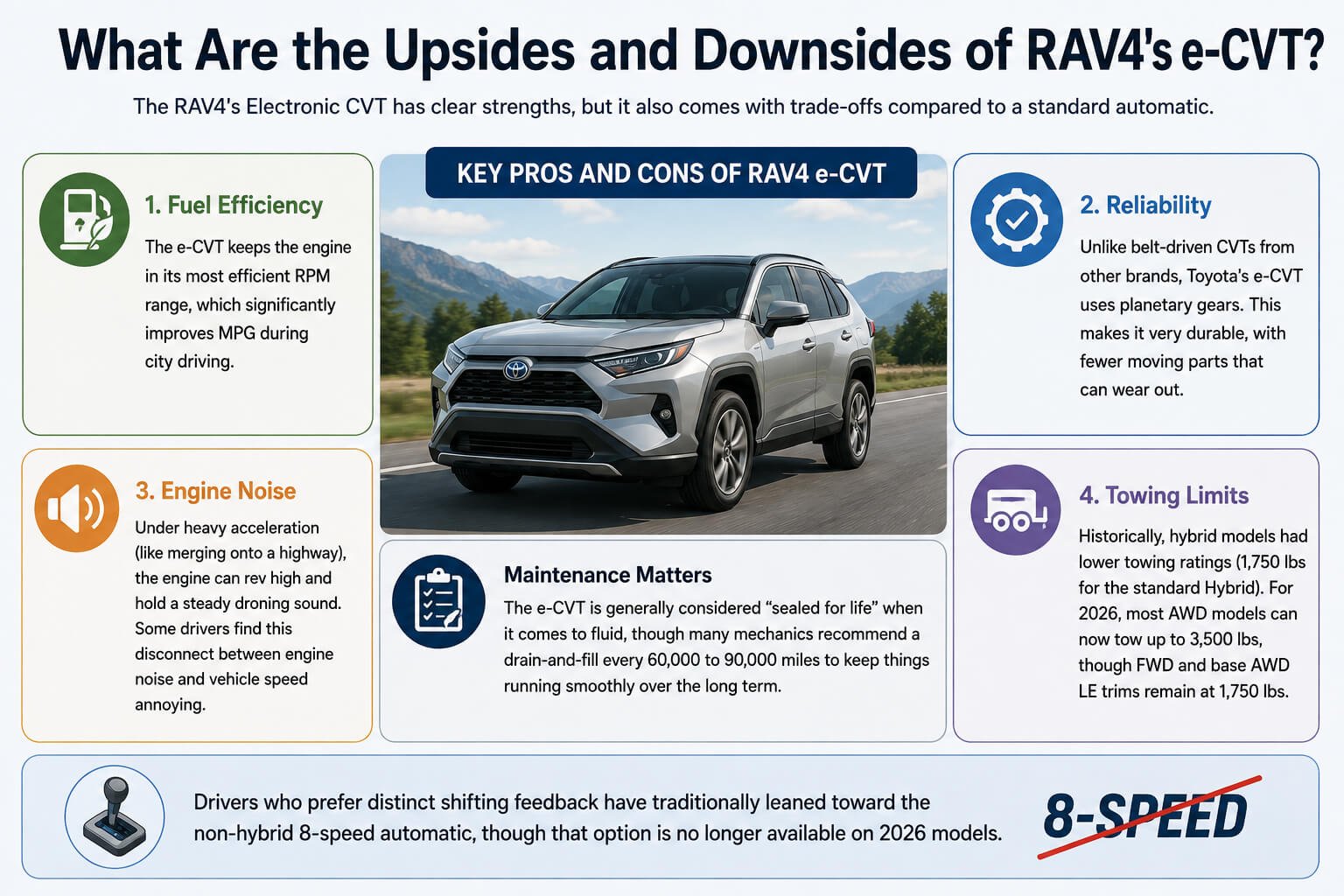
The RAV4’s Electronic CVT has clear strengths, but it also comes with trade-offs compared to a standard automatic. Here are the main pros and cons:
- Fuel Efficiency: The e-CVT keeps the engine in its most efficient RPM range, which significantly improves MPG during city driving.
- Reliability: Unlike belt-driven CVTs from other brands, Toyota’s e-CVT uses planetary gears. This makes it very durable, with fewer moving parts that can wear out.
- Engine Noise: Under heavy acceleration (like merging onto a highway), the engine can rev high and hold a steady droning sound. Some drivers find this disconnect between engine noise and vehicle speed annoying.
- Towing Limits: Historically, hybrid models had lower towing ratings (1,750 lbs for the standard Hybrid). For 2026, most AWD models can now tow up to 3,500 lbs, though FWD and base AWD LE trims remain at 1,750 lbs.
Regular maintenance still matters. The e-CVT is generally considered “sealed for life” when it comes to fluid, though many mechanics recommend a drain-and-fill every 60,000 to 90,000 miles to keep things running smoothly over the long term. Drivers who prefer distinct shifting feedback have traditionally leaned toward the non-hybrid 8-speed automatic, though that option is no longer available on 2026 models.
Drain-and-fill pick: Toyota 00289-ATFWS ATF WS Transmission Fluid, 1 Quart (Pack of 4)
Toyota calls for Toyota Genuine ATF WS in the e-CVT (hybrid transaxle) of 2019-2025 RAV4 Hybrid and RAV4 Prime models, and warns that other fluids may cause abnormal noise or vibration. If you decide to do a drain-and-fill, this genuine fluid matches that spec. Check your owner’s manual for the exact fluid and capacity first, especially on a 2026 model.
Owner Reviews: What RAV4 Drivers Say About Transmission Performance
Many RAV4 owners are happy with their vehicle’s transmission, though preferences differ between the hybrid and gasoline models. Here’s a general snapshot:
| Model Type | Primary Benefit | Driving Experience |
|---|---|---|
| RAV4 Hybrid | High MPG & Smoothness | Quiet city driving, instant electric torque |
| RAV4 Gasoline (through 2025) | Towing & familiarity | Traditional gear shifts, familiar highway cruising |
| RAV4 Prime | Performance | Fastest acceleration (0-60 in about 5.5 seconds) |
Hybrid drivers tend to love the e-CVT in urban settings where stop-and-go traffic is common. Gasoline RAV4 owners (2025 and earlier) favor the 8-speed automatic for its familiar feel and higher towing ratings on certain trims. With the 2026 shift to an all-hybrid lineup, new buyers will be getting the e-CVT regardless of trim level.
Related Guides
Frequently Asked Questions
Are All RAV4 Hybrid Models Equipped With CVT Since 2022?
Yes. All RAV4 Hybrid and Prime models manufactured since the 2019 redesign feature the Electronic CVT (e-CVT). This transmission is a core part of the Toyota Hybrid System. Starting in 2026, all RAV4 models (not just hybrids) use the e-CVT, since the entire lineup is now hybrid or plug-in hybrid.
What Is the Fuel Efficiency of RAV4 With CVT Compared to Automatic?
The RAV4 Hybrid with e-CVT significantly outperforms the standard gas automatic. For 2025, Hybrids typically achieve around 41 MPG city / 38 MPG highway, while the gas 8-speed automatic models average roughly 27 MPG city / 35 MPG highway. The 2026 Hybrid models push even further, reaching up to 48 MPG city / 42 highway on FWD trims.
Can I Tow With a RAV4 That Has a CVT?
Yes, but capacity varies by model and year. The standard RAV4 Hybrid (e-CVT) was rated to tow up to 1,750 lbs through 2025. The RAV4 Prime can handle 2,500 lbs. For 2026, most AWD RAV4 models (except the LE) are now rated at 3,500 lbs, which is a significant increase.
Towing pick: CURT 13615 Class 3 Trailer Hitch, 2-Inch Receiver (Select 2019-2025 Toyota RAV4)
If you plan to tow with a 2019-2025 RAV4, you’ll need a receiver hitch. This CURT model is a custom-fit Class 3 hitch listed for select 2019-2025 RAV4 models, including the 2021-2024 RAV4 Prime. The hitch itself is rated for 4,500 lbs gross trailer weight, which is more than any RAV4 tow rating above, so your RAV4’s own rating (1,750 lbs for the standard Hybrid through 2025) is the limit that counts. You’ll also need a ball mount and trailer wiring, and it’s worth confirming fitment for your trim on the listing.
How Does CVT Affect Rav4’s Acceleration Performance?
The e-CVT provides smooth, linear power delivery without the “jerk” of gear changes. The RAV4 Prime, which uses this transmission, hits 0-60 mph in about 5.5 seconds, making it one of the quickest vehicles in Toyota’s four-door lineup. The e-CVT clearly can deliver strong performance alongside efficiency.
What Maintenance Is Required for Rav4’s CVT Transmission?
Toyota’s e-CVT is mechanically simpler than a standard automatic. Toyota often labels the transmission fluid as “lifetime,” but independent mechanics recommend a drain-and-fill every 60,000 to 90,000 miles for long-term reliability.
Conclusion
Not all Toyota RAV4 models have a CVT transmission, at least not historically. Through 2025, buyers could choose between the 8-speed automatic in gas models and the e-CVT in the Hybrid and Prime. Starting in 2026, the entire RAV4 lineup moved to hybrid powertrains with e-CVT. Both transmission types are built for reliability. Knowing these differences helps you pick the model that best fits your towing needs, fuel economy goals, and driving preferences.
