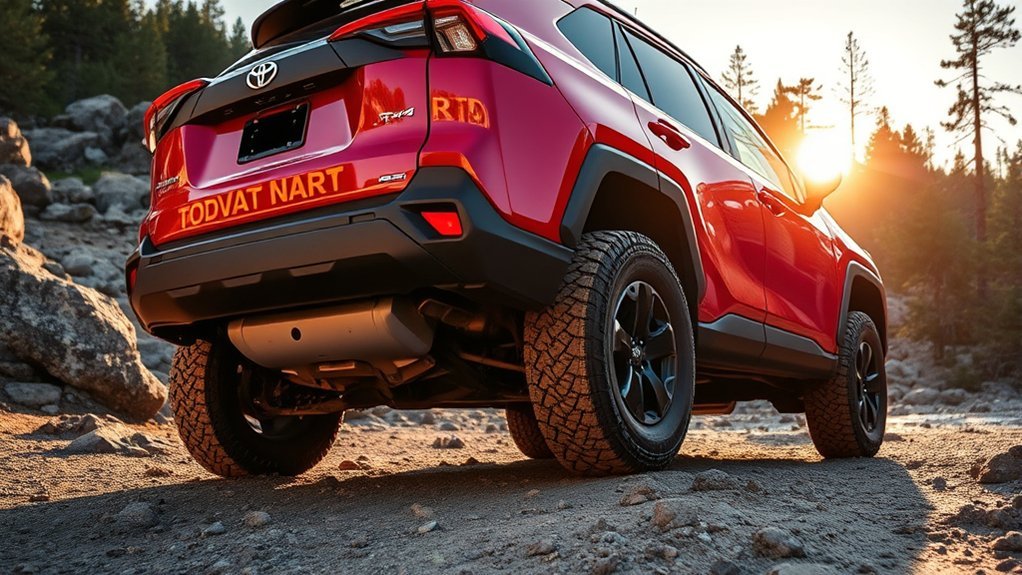
No—the U.S.-market Toyota RAV4 TRD Off-Road does not have a locking rear differential. The 2020–2024 TRD Off-Road uses Dynamic Torque Vectoring All-Wheel Drive with Rear Driveline Disconnect. It can vary drive torque between the left and right rear wheels, but it cannot mechanically lock both rear wheels together like the selectable rear locker used on some body-on-frame Toyota trucks.
Last updated: September 19, 2026. Scope: U.S.-market 2020–2024 RAV4 TRD Off-Road.
Quick Answer
No. U.S.-market RAV4 TRD Off-Road models sold for 2020–2024 do not have a driver-selectable locking rear differential. They use Dynamic Torque Vectoring AWD with Rear Driveline Disconnect, which can vary rear-wheel torque electronically. It improves traction, but it does not lock both rear wheels together like a true locker.
Key Takeaways
- The RAV4 TRD Off-Road has no selectable rear locker and no low-range transfer case.
- Toyota does not describe its rear axle as a conventional mechanical limited-slip differential.
- Dynamic Torque Vectoring AWD can send power rearward and vary torque between the left and right rear wheels.
- Its 8.6-inch ground clearance, all-terrain tires, skid plate, and TRD-tuned suspension suit maintained trails and rough access roads better than extreme rock crawling.
- The TRD Off-Road was offered in the United States for model years 2020–2024 and was dropped for 2025.
Note: This article covers the fifth-generation U.S.-market RAV4 TRD Off-Road. Toyota introduced it for 2020 and confirmed that the grade would not return for model year 2025. Used examples may differ slightly by year, package, tire replacement, or previous modification.
Does the Toyota RAV4 TRD Have a Locking Rear Differential?
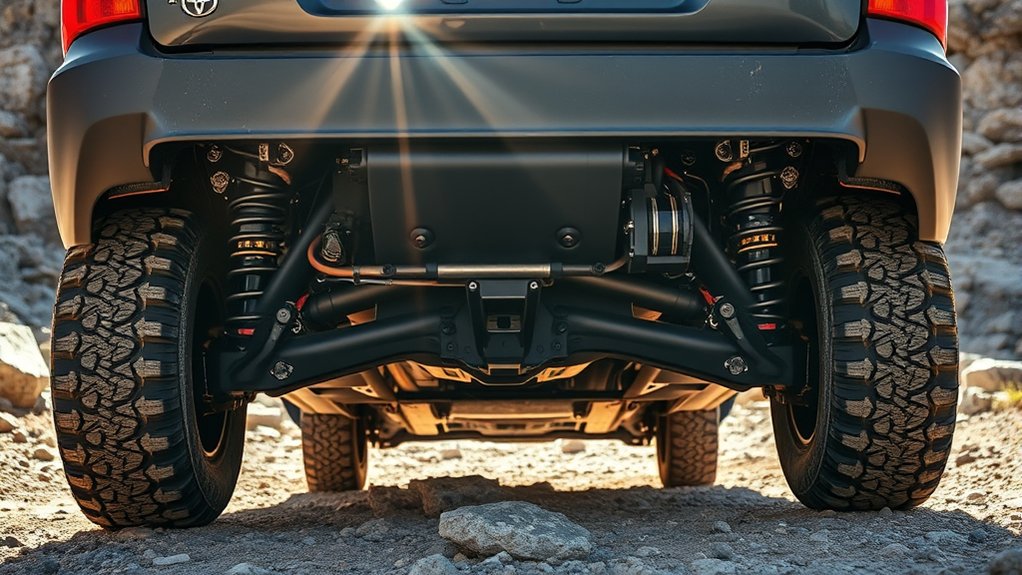
No. The Toyota RAV4 TRD Off-Road does not have a switch-operated or automatically locking rear differential. Toyota’s official 2024 RAV4 specifications identify its system as Dynamic Torque Vectoring All-Wheel Drive with Rear Driveline Disconnect.
The vehicle also should not be described as having a conventional mechanical limited-slip differential. Instead, its electronically controlled AWD hardware can vary how much drive torque reaches each rear wheel. That can imitate some of the traction benefits associated with an LSD, but the design, operation, and limitations are different.
The distinction matters when one rear wheel has little or no contact with the ground. A true locker mechanically forces both axle shafts to turn together. The RAV4’s system manages clutches, engine output, transmission behavior, and individual-wheel braking, but it cannot turn the rear axle into a permanently locked unit.
2024 RAV4 TRD Off-Road specification snapshot
| Feature | Verified specification |
|---|---|
| Locking rear differential | No |
| Conventional mechanical LSD | Not listed or described by Toyota |
| AWD system | Dynamic Torque Vectoring AWD with Rear Driveline Disconnect |
| Low-range gearing | No |
| Terrain modes | Mud & Sand, Rock & Dirt, and Snow |
| Ground clearance | 8.6 inches |
| Approach/departure angles | 19 degrees/21 degrees |
| Maximum towing capacity | 3,500 pounds when properly equipped |
| 2024 EPA fuel economy | 25 city/32 highway/27 combined mpg |
The absence of a locker does not make the RAV4 TRD ineffective. It simply places the vehicle in a different category. It is designed to retain the everyday handling, comfort, and efficiency of a crossover while offering more control on gravel, snow, washboard roads, and moderately uneven trails.
Toyota says Dynamic Torque Vectoring AWD can send up to 50% of engine torque to the rear wheels and then vary rear torque between the left and right sides.
What Is the Difference Between Limited-Slip and Locking Differentials?
A differential lets the wheels on one axle rotate at different speeds while turning. That is necessary because the outside wheel travels farther than the inside wheel. Different differential and traction-control systems manage wheel-speed differences in different ways.
Functionality of Differentials
| System | How it works | Main trade-off |
|---|---|---|
| Open differential | Allows unrestricted left-to-right wheel-speed differences. | A wheel with very little grip can spin unless traction control intervenes. |
| Limited-slip differential | Uses gears, clutches, fluid, or electronic control to limit excessive speed difference. | It still allows some differentiation and does not provide a guaranteed full lock. |
| Locking differential | Mechanically couples both axle shafts so the wheels rotate together. | It can bind or impair steering on firm surfaces and is normally reserved for low-speed, low-traction use. |
| RAV4 Dynamic Torque Vectoring AWD | Electronically varies front/rear and left/right rear torque while coordinating traction and stability controls. | It provides no mechanical rear-axle lock and no low-range crawl gearing. |
Calling the RAV4’s hardware a “limited-slip differential” makes the explanation sound simpler, but it creates the wrong expectation. Drivers cannot select a locked-axle mode, and there is no rear-lock indicator or locker switch.
Off-Road Performance Impact
On gravel, packed dirt, wet grass, snow-covered pavement, or a mildly uneven forest road, torque vectoring can react quickly and help keep the vehicle moving. It can also improve cornering stability by sending more rear torque to the side that helps the vehicle follow the driver’s intended path.
A locking differential becomes more valuable when the terrain creates large differences in available grip, such as a deep cross-axle rut that lifts one wheel, a slow rock ledge, or thick mud that leaves one side of the axle nearly unloaded. A locker guarantees that both rear wheels turn together; the RAV4 cannot provide that mechanical guarantee.
The RAV4 can combine torque redistribution with brake-based traction control during low-grip events. Toyota’s owner guidance warns that prolonged use of Mud & Sand or Rock & Dirt can overheat the brakes and temporarily stop Multi-Terrain Select brake control. If that warning appears, stop in a safe place and follow the owner’s-manual instructions rather than adding more throttle.
How Does the RAV4 TRD Off-Road Drivetrain Improve Traction?
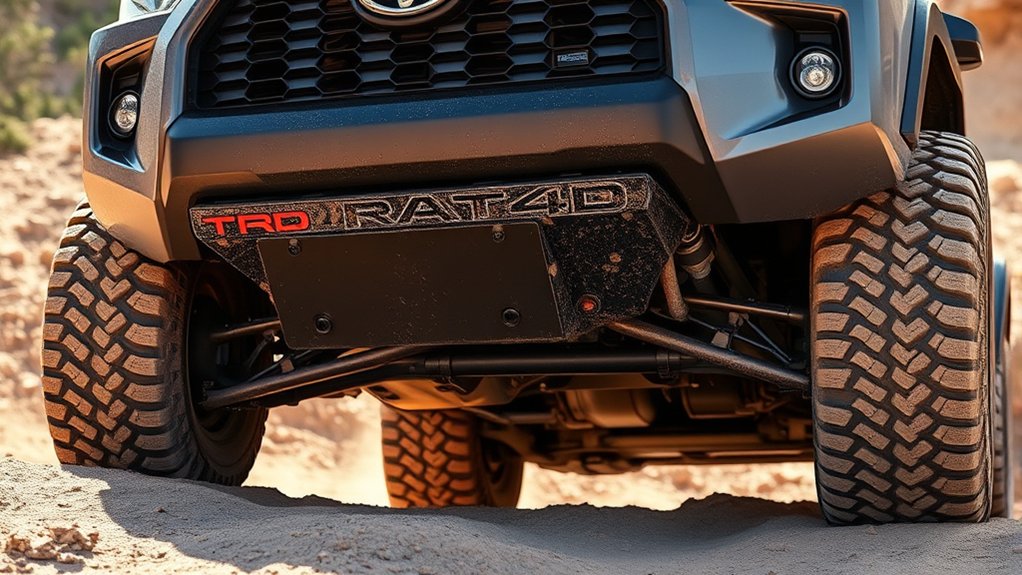
The RAV4 TRD combines several systems rather than relying on one locking component. Dynamic Torque Vectoring AWD, Multi-Terrain Select, individual-wheel braking, stability control, all-terrain tires, and the TRD-tuned suspension work together to improve traction and body control.
All-Wheel Drive System
Toyota’s Dynamic Torque Vectoring AWD system independently varies torque sent to the left and right rear wheels. When extra rear traction is unnecessary, Rear Driveline Disconnect can disengage portions of the rear driveline to reduce drag.
Toyota’s fifth-generation RAV4 technical preview adds an important hardware detail: the torque-vectoring rear drive unit uses independently controlled couplings for the two rear axle outputs rather than a conventional rear differential gearset. That is why the system can bias rear drive force side to side without being a mechanical limited-slip or locking differential.
The system’s practical benefits include:
- Improved launch traction: Rear torque can be added when the front tires approach their grip limit.
- Left-to-right rear control: The system can vary rear-wheel torque instead of relying only on front-to-rear distribution.
- On-road stability: Torque distribution can support more predictable cornering behavior.
- Automatic operation: The driver does not have to engage a transfer case or rear locker.
That automatic operation makes the RAV4 easy to drive, but it also means the driver cannot command a fixed 50:50 axle split or force both rear wheels to rotate at the same speed.
Multi-Terrain Select Modes
The Toyota RAV4 Quick Reference Guide explains that Multi-Terrain Select adjusts brake control, steering feel, and drive-force control for the selected surface.
- Mud & Sand: Intended for muddy, sandy, rough, or dirty surfaces where some controlled wheelspin may help maintain movement.
- Rock & Dirt: Intended for very bumpy roads, including unpaved forest roads, where slower and more deliberate traction control is useful.
- Snow: Adjusts response for slippery winter surfaces. It does not replace winter tires or increase braking grip.
Note: Multi-Terrain Select changes electronic control strategies. Selecting Rock & Dirt does not engage low-range gearing, and selecting Mud & Sand does not lock the rear axle.
Torque-Vectoring Benefits
Torque vectoring provides the most value when the tires still have usable contact with the surface. By varying rear torque, the system can reduce unnecessary wheelspin, help the vehicle rotate through a bend, and support forward progress across changing traction levels.
Its principal benefits are:
- More responsive torque distribution: The system can react without waiting for severe wheelspin.
- Better cornering balance: Left-to-right torque control can support the intended vehicle path.
- Improved mixed-surface traction: The rear wheels do not always have to receive equal torque.
- Everyday efficiency: Rear Driveline Disconnect reduces unnecessary driveline operation when AWD support is not required.
These benefits are useful on maintained trails and changing road surfaces, but they do not overcome insufficient ground clearance, inappropriate tires, deep mud, or an obstacle that leaves the vehicle high-centered.
RAV4 TRD Off-Road Suspension Features
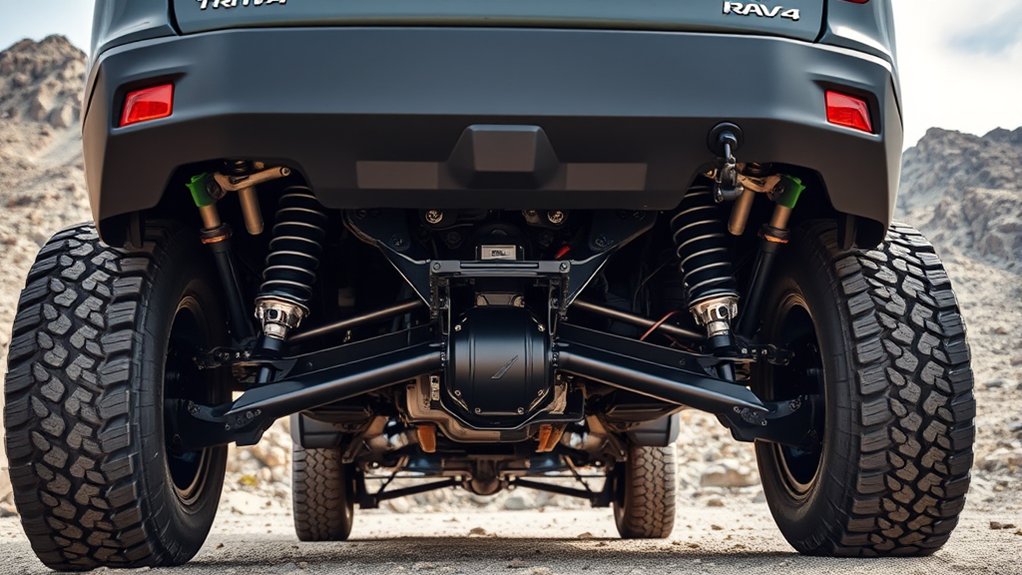
The RAV4 TRD Off-Road has a model-specific suspension, but it is not 1.5 inches taller than an ordinary RAV4. Toyota lists 8.6 inches of ground clearance, compared with 8.4 inches for several regular gas grades in the 2024 specification chart.
Toyota’s original TRD Off-Road launch information describes red coil springs, re-valved twin-tube shocks, internal rebound springs, and revised bump stops. The tuning is intended to improve body control and small-bump isolation on rough roads without turning the RAV4 into a long-travel rock crawler.
The TRD also uses 18-inch flow-formed alloy wheels with Falken Wildpeak all-terrain tires. Toyota’s launch specification described the tires as severe-snow-rated and used a tread and shoulder design intended to shed mud, snow, and debris while helping protect the tire from trail damage.
Its 19-degree approach angle and 21-degree departure angle remain modest compared with purpose-built off-road SUVs. Drivers must still watch steep ledges, abrupt ditch crossings, embedded rocks, and the center of the vehicle when cresting a mound.
The TRD suspension improves control and ride quality on rough surfaces; it does not provide a large suspension lift or the wheel articulation of a body-on-frame 4×4.
How Does Torque Vectoring Help the RAV4 TRD Off-Road?
During a turn, the outside wheels travel farther than the inside wheels. A torque-vectoring system can use that difference to improve stability and response rather than simply sending equal torque to both rear wheels.
On a loose bend, for example, the system may direct more rear torque to the wheel that best supports the intended path. On a straight mixed-grip surface, it may reduce torque to a slipping side while maintaining useful drive elsewhere. The exact response depends on steering angle, throttle position, wheel speed, yaw, vehicle speed, selected drive mode, and other sensor data.
This creates four practical advantages:
- Less unnecessary wheelspin when surface grip changes from one side to the other.
- More stable cornering on loose gravel or wet pavement.
- Faster automatic response than a driver manually engaging a part-time system.
- Smoother everyday operation because the system remains compatible with normal paved-road turning.
A locker serves a different purpose. It sacrifices differentiation to guarantee equal wheel speed during a difficult low-speed obstacle. Torque vectoring preserves variable control and road manners, but it cannot duplicate that guaranteed mechanical connection.
How Does the RAV4 TRD Compare With a 2023 Jeep Cherokee Trailhawk?
A fair comparison must identify the exact Cherokee trim. A regular front-wheel-drive or basic AWD Cherokee does not have the same hardware as a Trailhawk. The relevant historical competitor is the 2023 Jeep Cherokee Trailhawk equipped with Active Drive Lock.
| Capability feature | RAV4 TRD Off-Road | 2023 Cherokee Trailhawk |
|---|---|---|
| Rear locker | No | Rear electronic locker with Active Drive Lock |
| Low-range function | No | Yes; Active Drive Lock includes a 2.92:1 low-range ratio |
| Torque-vectoring rear control | Yes | Uses a different 4WD and locker strategy |
| Ground clearance | 8.6 inches | 8.7 inches minimum running ground clearance |
| Approach/departure angles | 19.0°/21.0° | 29.9°/32.2° |
| Best use | Daily driving, winter roads, gravel, and moderate trails | Slower and more technical trail situations requiring dedicated 4WD hardware |
The hardware difference is straightforward: the 2023 Cherokee Trailhawk pairs a mechanical rear locker with a 2.92:1 low range, while the RAV4 TRD Off-Road has neither. The RAV4 instead emphasizes automatic torque vectoring, normal-road manners, and moderate loose-surface capability. Which layout fits better depends on whether the route requires low-speed crawl gearing and a locked rear axle.
Not every driver needs a locker. A locker adds value only when the route regularly includes obstacles severe enough to overwhelm ordinary AWD traction management. For many camping, hiking, snow, and forest-road trips, tire grip, careful line choice, and sufficient clearance matter more often.
What Kind of Off-Road Driving Can the RAV4 TRD Handle?
The RAV4 TRD Off-Road is well suited to outdoor travel when the route matches its crossover-based design. Appropriate uses include maintained forest roads, gravel access routes, packed dirt, washboard surfaces, snowy roads, established campsites, and moderate trailheads.
Its useful capability features include:
- Dynamic Torque Vectoring AWD for changing traction conditions.
- 8.6 inches of ground clearance for modest rocks, ruts, and road crowns.
- Multi-Terrain Select for surface-specific control calibration.
- Falken Wildpeak all-terrain tires for better loose-surface grip than ordinary touring tires.
- A TRD-stamped front skid plate for additional front underbody protection.
- A 3,500-pound maximum towing rating when properly equipped.
Less suitable conditions include large rock ledges, severe cross-axle ruts, deep mud, unknown water crossings, soft dune sand, and trails that require sustained low-range crawling. The RAV4 also lacks the generous approach angles, recovery hardware, axle articulation, and underbody clearance of a dedicated off-road vehicle.
Warning: Off-road driving can cause injury or vehicle damage. Check the route, weather, fire restrictions, water depth, tire condition, and recovery options before leaving maintained roads. Never assume AWD will compensate for insufficient clearance, unsuitable tires, excessive speed, or an unsafe line.
Tips for Maximizing Your RAV4 TRD Off-Road Experience
Confirm the vehicle and equipment. A genuine TRD Off-Road should have the appropriate trim designation and factory equipment, but badges, wheels, and tires can be changed. Check the VIN, original window sticker, Toyota build information, or dealer records when evaluating a used vehicle.
Inspect the tires before a trip. Look for cuts, exposed cords, embedded objects, sidewall damage, and uneven wear. Set cold tire pressure to the driver-door placard unless a qualified off-road procedure and reinflation plan justify a temporary adjustment.
Select the appropriate terrain mode. Use Mud & Sand, Rock & Dirt, or Snow only for the conditions described in the owner’s manual. Return to the normal driving mode when the specialized calibration is no longer useful.
Use smooth throttle. Sudden wheelspin digs into sand, throws rocks, heats traction-control components, and can reduce steering control. Apply enough power to maintain movement without repeatedly forcing the system to intervene.
Protect the underside. Approach obstacles slowly, place the tires on the highest stable surfaces, and remember that the center of the vehicle may contact an obstacle even after both bumpers clear it.
Know when to turn around. A route requiring wheel placement beyond your visibility, a recovery winch, a spotter, deep-water knowledge, or sustained low-range crawling is probably beyond the RAV4’s intended use.
Follow the towing limits. Toyota lists a maximum rating of 3,500 pounds for the 2024 TRD Off-Road when properly equipped. Trailer weight, cargo, passengers, tongue weight, hitch equipment, and vehicle payload all count. Use the owner’s manual and certification labels for the exact vehicle.
Pro Tip: The safest traction upgrade is often the right tire for the season and terrain. AWD helps distribute drive torque, but the tires still determine how much accelerating, braking, and cornering force the surface can support.
For a broader system-level explanation, see how the Toyota RAV4 AWD system works and RAV4 mechanical AWD vs. e-AWD. Those guides cover the wider RAV4 lineup; this page stays focused on the TRD Off-Road’s rear-drive hardware and locker question.
Related Guides
Frequently Asked Questions
Can the RAV4 TRD Off-Road handle snow and ice?
Yes, it can provide useful acceleration traction in winter conditions through AWD, Snow mode, and its factory all-terrain tires. However, AWD does not shorten braking distance or create extra cornering grip. Dedicated winter tires provide a larger safety benefit in persistent snow and ice.
What tires came on the RAV4 TRD Off-Road?
Toyota equipped the TRD Off-Road with 18-inch flow-formed TRD wheels and Falken Wildpeak all-terrain tires. Toyota’s launch material described the tires as severe-snow-rated. A used vehicle may now have replacement tires, so inspect the actual sidewall markings.
How does the RAV4 TRD Off-Road perform on sand?
Mud & Sand mode can help on firm beach access roads and shallow loose sand. Deep, dry sand demands flotation, momentum, temperature management, and recovery preparation. The RAV4 can bog down or become high-centered, so local access rules and surface conditions should determine whether entry is sensible.
Is the RAV4 TRD Off-Road good for towing?
It is rated to tow up to 3,500 pounds when properly equipped, which is useful for a small camper, utility trailer, or certain recreational equipment. Confirm the exact model-year rating, hitch requirements, payload, tongue-weight limit, and trailer-brake requirements before towing.
What is the fuel economy of the RAV4 TRD Off-Road?
Toyota lists the 2024 RAV4 TRD Off-Road at an EPA-estimated 25 mpg city, 32 mpg highway, and 27 mpg combined. Ratings can differ by model year, and actual economy varies with speed, temperature, tires, cargo, towing, terrain, and driving style.
Does the RAV4 TRD have an AWD-lock button?
No. It has drive-mode and Multi-Terrain Select controls, but those controls do not mechanically lock the rear differential or permanently fix the front-to-rear torque split.
Is torque-vectoring AWD the same as a limited-slip differential?
No. Both can reduce unhelpful wheelspin, but they use different hardware and control strategies. Toyota identifies the RAV4 system as Dynamic Torque Vectoring AWD and does not list a conventional mechanical LSD in the TRD Off-Road specifications.
Does the RAV4 TRD Off-Road have low-range gearing?
No. The RAV4 TRD Off-Road uses an eight-speed automatic transmission and automatic AWD, but it does not have a two-speed transfer case or selectable low range. Multi-Terrain Select changes the vehicle’s control strategy; it does not create crawl gearing.
Which model years offered the RAV4 TRD Off-Road?
Toyota introduced the U.S.-market RAV4 TRD Off-Road for model year 2020. It remained available through 2024, and Toyota confirmed that it would not be offered for model year 2025.
Can a locking rear differential be added to a RAV4 TRD?
Toyota does not offer a factory rear-locker retrofit for the RAV4 TRD Off-Road. The AWD system is integrated with electronic controls, sensors, stability systems, and the rear driveline, so a custom conversion would not be a simple bolt-on modification. Treat aftermarket claims cautiously and consider a vehicle designed with a factory locker if that capability is essential.
Conclusion
The Toyota RAV4 TRD Off-Road does not have a locking rear differential, a conventional mechanical limited-slip differential, or low-range gearing. Its Dynamic Torque Vectoring AWD system instead manages front-to-rear and left-to-right rear torque electronically, giving the crossover useful traction and stability on gravel, snow, dirt roads, and moderate trails.
That system works well within the RAV4’s intended role, especially when combined with its TRD-tuned suspension, all-terrain tires, front skid plate, Multi-Terrain Select, and 8.6 inches of clearance. Drivers who regularly face severe ruts, rock ledges, deep mud, or routes requiring a locked axle should choose a vehicle equipped with a factory locker and dedicated low-range 4WD.
Sources
- Toyota 2024 RAV4 eBrochure — drivetrain, terrain modes, ground clearance, approach and departure angles, towing, tires, and EPA fuel-economy specifications.
- Toyota 2020 RAV4 TRD Off-Road introduction — original suspension, wheel, tire, towing, and Multi-Terrain Select details.
- Toyota Dynamic Torque Vectoring AWD technical overview — left-to-right rear torque distribution and system purpose.
- Toyota 2024 RAV4 Quick Reference Guide — Snow mode, Multi-Terrain Select operation, system limitations, and drive-mode guidance.
- Toyota 2025 RAV4 announcement — confirmation that the Adventure and TRD Off-Road grades were not offered for 2025.
- Toyota 2019 RAV4 New Model Technical Preview — torque-vectoring rear-drive-unit couplings and Rear Driveline Disconnect design.
- 2023 Jeep Cherokee specifications — Active Drive Lock, 2.92:1 low range, mechanical rear locker, ground clearance, and approach/departure angles.

