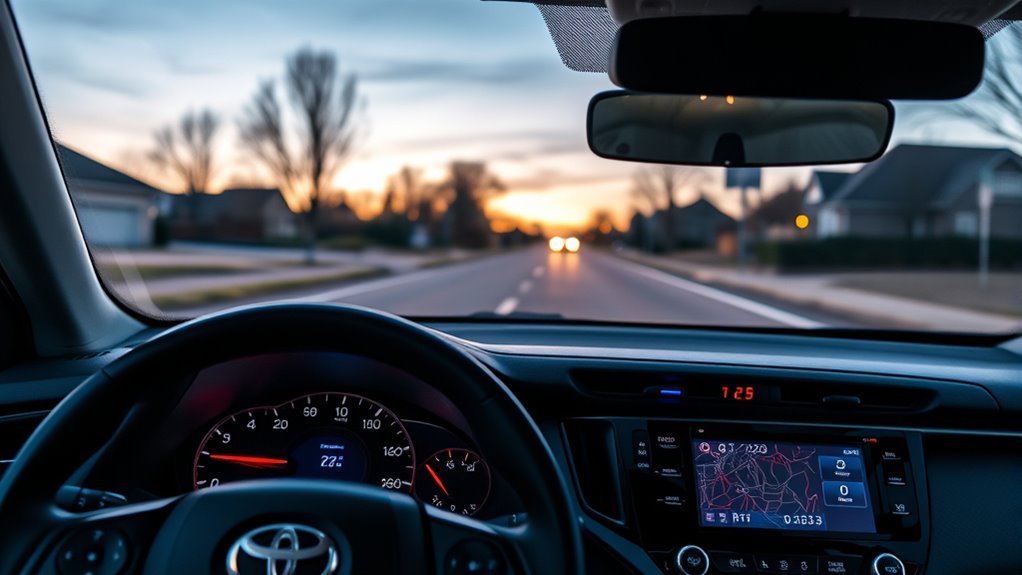
The RAV4 Hybrid miles to empty display estimates how far you can drive with the fuel remaining in the tank. It changes with your fuel economy and driving conditions. Although gasoline may remain after the reading reaches zero, Toyota does not specify a guaranteed distance you can drive beyond that point.
Quick Answer
The RAV4 Hybrid’s distance-to-empty display is an estimate based on remaining gasoline and average fuel consumption. Toyota’s 2025 manual states that the low-fuel warning activates at approximately 2.2 gallons or less. That does not mean 2.2 gallons remain when the display reaches zero. Refuel promptly instead of relying on an assumed reserve.
Key Takeaways
- The 2025 U.S. RAV4 Hybrid has a specified fuel tank capacity of 14.5 gallons.
- Zero miles to empty is not the same as a physically empty tank.
- Cold weather, highway speed, hills, tire choice, and vehicle load can change the range estimate.
- A small fuel top-off may not immediately update the displayed range.
- Certain 2019–2021 RAV4 Hybrids had documented fuel tank and fuel sender concerns covered by a Toyota customer support program.
What Does the RAV4 Hybrid Miles-to-Empty Mean?
Distance to empty (DTE) is the vehicle’s estimate of how far you can travel before refueling becomes necessary. It uses the remaining fuel and average fuel consumption to calculate the displayed mileage.
According to the 2025 Toyota RAV4 Hybrid owner’s manual, actual driving distance may differ from the displayed estimate.
For example, a range estimate calculated after efficient city driving may decrease faster during a subsequent high-speed highway trip. The vehicle has not necessarily lost fuel unexpectedly; its consumption has changed.
The fuel gauge and DTE display are related, but they serve different purposes:
- Fuel gauge: Indicates the approximate quantity of gasoline remaining.
- Distance to empty: Estimates the distance you may be able to drive with that gasoline.
- Low-fuel warning: Alerts you that the fuel level has reached a low threshold.
- Refuel message: Indicates that the remaining driving range can no longer be calculated reliably.
Toyota states that you should refuel immediately when the Refuel message appears.
Why the RAV4 Hybrid Range Changes
The estimated range changes because the RAV4 Hybrid does not consume gasoline at a constant rate. Traffic, temperature, terrain, vehicle load, and driving habits all affect fuel economy.
The display responds to consumption history rather than guaranteeing that every remaining mile will use the same amount of fuel.
Driving Conditions Matter
Driving conditions influence how efficiently the gasoline engine and electric motors work together. Smooth driving can improve fuel economy, while heavy acceleration and sustained high speeds generally increase consumption.
- Steep climbs require additional power and can reduce the displayed range.
- Stop-and-go traffic creates repeated acceleration demands, although regenerative braking helps recover some energy.
- Highway speeds increase aerodynamic resistance.
- Heavy cargo and repeated hard acceleration increase energy demand.
Unlike a conventional gasoline vehicle, a hybrid can recover braking energy and shut off its gasoline engine under suitable conditions. Therefore, moderate city driving may be more efficient than fast highway driving.
However, heavy congestion and aggressive acceleration can still reduce overall MPG.
Weather and Terrain Effects
Cold weather can substantially reduce hybrid fuel economy. The engine needs to warm up, cabin heating consumes energy, and the hybrid battery operates differently at low temperatures.
The U.S. Department of Energy’s cold-weather research reports that hybrid fuel economy can decrease by around 30% under the tested cold conditions. This is a general finding, not a guaranteed RAV4-specific percentage.
Hot weather can also increase fuel consumption when the air conditioning system works harder.
Terrain adds another variable. Climbing consumes additional energy, while downhill regenerative braking can recover some of it. The energy recovered does not fully replace what was used during the climb.
Consequently, a mountain trip can produce a different range estimate from a similar-distance trip on flat roads.
Tire and Maintenance Impact
Tires influence fuel economy through rolling resistance, inflation pressure, and construction. Different tire models can therefore change the RAV4 Hybrid’s range estimate over time.
For example, Cross Climate 2 tires may offer different grip and efficiency characteristics from the original equipment tires. The actual MPG difference depends on the tire specification, road conditions, and driving habits.
Proper maintenance also helps preserve the vehicle’s intended efficiency. Under-inflated tires, mechanical problems, and neglected servicing can increase fuel consumption.
How Much Reserve Fuel Is Left?
For the 2025 U.S. RAV4 Hybrid, Toyota specifies a low-fuel warning threshold of approximately 2.2 gallons (8.3 liters) or less. This figure describes the warning threshold, not the exact quantity remaining when DTE reaches zero.
The distinction matters because the fuel warning, fuel gauge, and calculated range are not interchangeable measurements.
Reserve Fuel Estimate
The 2025 RAV4 Hybrid has a specified fuel tank capacity of 14.5 gallons (55 liters). Its low-fuel warning is calibrated to alert the driver before the tank is completely empty.
Toyota’s warning-light guidance instructs drivers to refuel when the low-fuel indicator illuminates.
The original estimate of 2.5 gallons should not be treated as an exact reserve available at zero miles to empty.
- Specified tank capacity: 14.5 gallons for the 2025 U.S. RAV4 Hybrid.
- Low-fuel warning threshold: Approximately 2.2 gallons or less.
- Fuel remaining at zero DTE: Not guaranteed as a fixed quantity.
Fuel movement on slopes and variations in gauge readings can also affect what the dashboard indicates.
Distance After Zero
Some RAV4 Hybrid owners report driving beyond zero miles to empty. However, Toyota does not provide a universal post-zero mileage allowance that drivers should rely on.
The following table separates documented specifications from estimates and owner-reported experiences.
| Indicator | Typical value | Meaning |
|---|---|---|
| Low-fuel warning | Approximately 2.2 gal. or less | Toyota’s 2025 warning threshold |
| Zero miles to empty | 0 displayed miles | Estimated range has reached zero |
| Fuel remaining at zero | Not fixed or guaranteed | Cannot be calculated from the warning threshold alone |
| Reported additional distance | 35–40 mi. in some accounts | Owner experience, not a Toyota specification |
| Recommended action | Refuel promptly | Avoid relying on an uncertain reserve |
Driving conditions can change the remaining distance substantially. Even if the vehicle previously traveled beyond zero without difficulty, the same result cannot be assumed on another trip.
How Far Can a RAV4 Hybrid Go on Empty?
There is no reliable fixed mileage a RAV4 Hybrid can travel after displaying zero miles to empty. Some drivers report approximately 35 to 40 additional miles, while isolated accounts describe distances exceeding 80 miles.
These figures are owner-reported experiences, not manufacturer-certified reserve distances.
Actual distance depends on:
- How much gasoline remains when the display reaches zero.
- Recent and current fuel economy.
- Speed, traffic, terrain, and vehicle load.
- Temperature and climate-control demand.
- Fuel-level measurement accuracy.
Do not calculate a guaranteed post-zero range by multiplying the published warning threshold by your displayed MPG. The warning threshold does not establish how much gasoline remains at zero DTE.
Limited electric-only operation may be possible under suitable battery and driving conditions. However, the RAV4 Hybrid is not a plug-in electric vehicle, and its traction battery is not a dependable backup for an empty gasoline tank.
What Low Fuel Does to the RAV4 Hybrid
Low fuel does not automatically mean the RAV4 Hybrid has a mechanical problem. However, continuing to drive until gasoline is exhausted can interrupt fuel delivery and prevent normal hybrid operation.
The gasoline engine supports propulsion and battery charging. The hybrid system still depends on having enough fuel to operate correctly.
Warning: Do not deliberately test how far your RAV4 Hybrid can travel after zero miles to empty. Running out of gasoline can leave the hybrid system unable to restart, and attempting to continue driving on battery power is not a reliable emergency strategy.
Very low fuel levels can also create fuel-delivery problems during steep climbs, cornering, or other conditions that move gasoline around the tank.
Repeated operation near empty offers no practical benefit and increases the chance of an unexpected stop.
If the vehicle runs out of gasoline: Stop somewhere safe and add enough fuel before attempting to restart.
Toyota’s 2025 RAV4 Hybrid manual gives approximately 2.3 gallons (8.8 liters) as the standard refueling amount needed after running out of fuel on level ground. More may be necessary when the vehicle is inclined.
Toyota also explains that adding only a small amount may not be enough to restart the hybrid system. If the READY indicator does not illuminate after proper refueling and startup, seek assistance from a Toyota dealer or qualified repair service.
Does Driving Style Change the Estimate?
Yes. Driving style affects fuel consumption, which changes the RAV4 Hybrid’s estimated remaining range.
Rapid acceleration, unnecessary braking, and sustained high speeds generally increase gasoline use. Smooth acceleration and steady cruising help reduce avoidable consumption.
The U.S. Department of Energy’s driving-efficiency guidance explains that fuel economy generally declines as highway speed increases.
For better efficiency:
- Accelerate smoothly rather than using sudden throttle inputs.
- Maintain a steady, appropriate speed when traffic permits.
- Anticipate stops and allow regenerative braking to recover energy.
- Avoid carrying unnecessary weight.
- Use Eco mode when its smoother accelerator response suits the conditions.
Eco mode can help manage power delivery and climate-control demand, but it cannot create additional gasoline or guarantee extra mileage.
Always prioritize safe driving over trying to preserve a dashboard range figure.
How Tires and Maintenance Affect MPG
Tire condition and routine maintenance affect the RAV4 Hybrid’s fuel economy. Changes in rolling resistance or mechanical efficiency can alter the average MPG used by the distance-to-empty calculation.
Under-inflated tires increase rolling resistance. Maintaining the correct cold tire pressure helps preserve efficiency, tire life, and handling.
Check the pressure specification on your vehicle’s driver-door label rather than relying on the maximum pressure printed on the tire sidewall.
Tire selection matters, too. A replacement tire designed for greater traction may have different rolling resistance from the original equipment tire.
Proper tire inflation and routine maintenance support consistent MPG, but they cannot make the distance-to-empty estimate exact.
Follow Toyota’s recommended maintenance schedule, including oil changes and inspections. Address warning lights, unusual tire wear, and mechanical problems rather than assuming every MPG reduction comes from driving conditions.
Cold weather can also reduce tire pressure, so seasonal pressure checks are especially useful.
When to Refuel the RAV4 Hybrid
Refuel the RAV4 Hybrid before the low-fuel warning becomes an emergency. A practical planning habit is to stop near one-quarter tank, particularly before long trips or travel through areas with limited gas stations.
This is a conservative driving recommendation, not a Toyota requirement that the tank must always remain above one-quarter.
When the low-fuel warning appears, arrange to refuel promptly. Do not wait for the display to reach zero simply because fuel remained during a previous trip.
During refueling, follow Toyota’s RAV4 Hybrid refueling instructions. Turn the power switch off and allow the fuel system to complete its normal pressure-release process before opening the fuel cap.
A normal fill-up may require less gasoline than the published tank capacity because the tank was not completely empty.
Do not keep adding gasoline after the pump automatically stops in an attempt to force the tank to accept its full stated capacity.
What If the Range Does Not Update After Refueling?
Toyota explains that adding a small amount of gasoline may not immediately update the fuel gauge or distance-to-empty display. Refueling while the power switch remains on may also prevent an immediate update.
If the gauge and displayed range fail to update after a small top-off, the 2025 manual provides this procedure for vehicles equipped with the ODO TRIP switch:
- Park the vehicle on a level surface.
- Press ODO TRIP until the odometer is displayed.
- Turn the power switch off.
- Press and hold ODO TRIP while turning the power switch to ON.
- Continue holding the switch for approximately five seconds, then release it when the odometer begins flashing.
The update is complete when the odometer stops flashing and returns to its normal display.
Follow the instructions for your exact model year and instrument cluster. If the fuel gauge remains inaccurate after normal refueling, have the vehicle inspected.
What About the Earlier RAV4 Hybrid Fuel Tank Problem?
Certain 2019–2021 RAV4 Hybrids had documented fuel tank and fuel sender concerns. Toyota received reports of gauges failing to show full after refueling, unexpectedly small fill-up amounts, and lower-than-expected distance-to-empty readings.
Under Toyota Customer Support Program 20TE04, qualifying vehicles could receive repairs involving the fuel tank and fuel sender gauge.
Toyota’s documentation identifies fuel tank shape variation and possible fuel sender positioning as contributing factors.
The program applies to certain vehicles, not every RAV4 Hybrid from those model years. Eligibility depends on the specific vehicle and program conditions.
If your vehicle repeatedly refuses a normal fill-up or displays an unusually low range after refueling, ask a Toyota dealer to check its VIN and service history.
Note: A changing range estimate alone does not establish a defective fuel tank or sender. If the fuel gauge and actual refueling behavior repeatedly disagree, have a qualified technician diagnose the fuel system rather than attempting to measure the reserve by driving until empty.
Frequently Asked Questions
How Far Can a RAV4 Hybrid Go on Empty?
There is no guaranteed distance after the RAV4 Hybrid displays zero miles to empty. Some owners report approximately 35 to 40 additional miles, but actual range depends on remaining fuel and driving conditions. Toyota recommends refueling when the low-fuel warning appears rather than relying on an assumed reserve.
How Far Can You Drive on 0 Miles to Empty a Toyota?
The distance varies by Toyota model, fuel level, and driving conditions. Zero miles to empty is an estimated range reading, not a promise that a fixed quantity of gasoline remains. Different models have different fuel tank capacities and warning thresholds, so another Toyota’s reserve experience should not be applied to your RAV4 Hybrid.
What Is a Common Problem in a RAV4 Hybrid?
Some earlier RAV4 Hybrids experienced inaccurate fuel gauge readings and lower-than-expected distance-to-empty estimates. Toyota documented related fuel tank and sender concerns in certain 2019–2021 vehicles. Ordinary MPG changes caused by weather, tires, traffic, or driving style should not be confused with a confirmed fuel system defect.
How Accurate Is the Toyota Distance to Empty?
Toyota’s distance-to-empty display is a useful estimate, but it cannot predict your exact remaining driving distance. It uses average fuel consumption, so changes in speed, terrain, temperature, and vehicle load can make the actual distance different. Use the fuel gauge and plan to refuel before the estimate reaches zero.
Conclusion
The RAV4 Hybrid miles-to-empty display is a useful planning tool, not an exact measurement of how much farther you can drive. Toyota’s published low-fuel threshold does not establish a guaranteed reserve at zero miles. Use the fuel gauge, account for changing driving conditions, and refuel before an uncertain estimate becomes a roadside problem.
Sources
- Toyota: 2025 RAV4 Hybrid Owner’s Manual: Distance-to-empty calculation, average fuel consumption, display behavior, and refueling guidance.
- Toyota: Dashboard Warning Lights: Meaning of the low-fuel indicator and recommended action.
- U.S. Department of Energy: Effect of Cold Temperatures on Fuel Economy: Cold-weather fuel economy changes affecting hybrid vehicles.
- U.S. Department of Energy: Tips for Your Tank: Driving habits, vehicle load, and fuel-efficiency guidance.
- Toyota: RAV4 Hybrid Refueling Instructions: Fuel tank pressure-release process and refueling precautions.
- Toyota Customer Support Program 20TE04: Documented fuel tank and fuel sender concerns affecting certain 2019–2021 RAV4 Hybrids.
