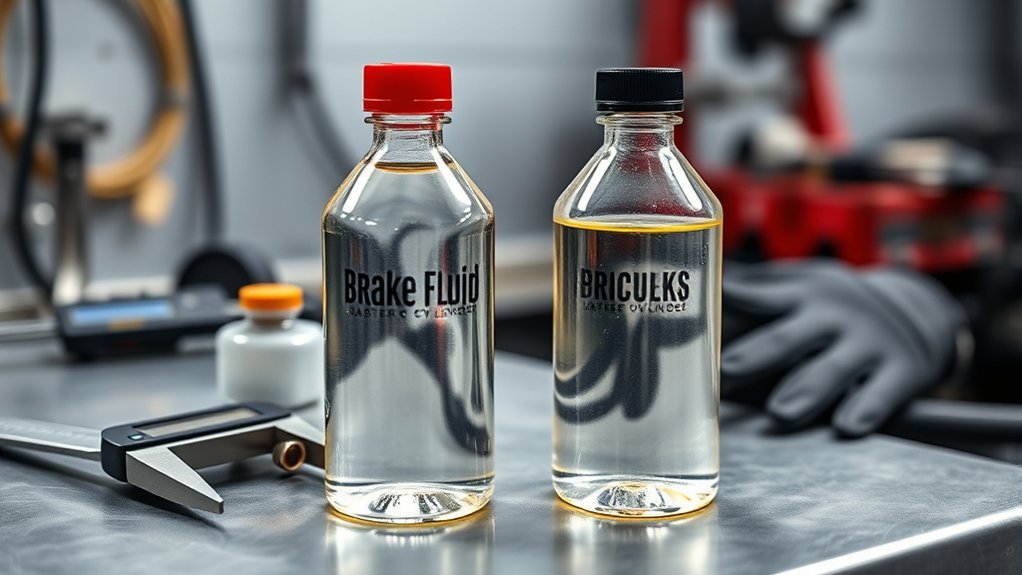
DOT 3 and DOT 4 are both widely used hydraulic brake fluids, but they are not interchangeable in every vehicle or situation. DOT 4 must meet higher minimum boiling-point requirements, while the correct choice ultimately depends on the exact specification listed in your owner’s manual, service information, or brake-fluid reservoir cap.
Quick Answer
Use the brake fluid specified by your vehicle manufacturer. DOT 4 has higher minimum dry and wet boiling points than DOT 3, but ABS alone does not determine which fluid you need. Do not downgrade a DOT 4 system to DOT 3, and never confuse glycol-based DOT 3 or DOT 4 with silicone-based DOT 5.
Key Takeaways
- DOT 3 must have a minimum dry boiling point of 401°F and wet boiling point of 284°F.
- DOT 4 must have a higher minimum dry boiling point of 446°F and wet boiling point of 311°F.
- Those figures are federal minimums. Many products exceed them.
- Choose fluid by the complete manufacturer specification, not only by vehicle age, ABS equipment, towing, or driving style.
- DOT 3 and DOT 4 are generally chemically compatible, but mixing them may reduce the performance of the higher-rated fluid.
- DOT 5 is silicone-based and must not be treated as a substitute for DOT 3, DOT 4, or DOT 5.1.
DOT 3 vs DOT 4 Brake Fluid at a Glance

The main regulatory difference between DOT 3 and DOT 4 is their required performance under heat. Under Federal Motor Vehicle Safety Standard No. 116, DOT 4 must withstand higher temperatures before boiling.
| Feature | DOT 3 | DOT 4 |
|---|---|---|
| Minimum dry ERBP | 401°F or 205°C | 446°F or 230°C |
| Minimum wet ERBP | 284°F or 140°C | 311°F or 155°C |
| General chemistry | Typically glycol-ether based | Typically glycol-ether and borate-ester based |
| Moisture behavior | Hygroscopic | Hygroscopic |
| Selection rule | Use only when permitted by the vehicle manufacturer | Use when the vehicle specifies DOT 4 or an approved equivalent |
Note: The listed boiling points are minimum standards, not the exact performance of every bottle. A premium DOT 3 or DOT 4 product may exceed its grade’s minimum values, but it still must match the specification required by your vehicle.
What DOT 3 and DOT 4 Ratings Mean
A DOT brake-fluid rating describes a group of required performance characteristics. Boiling point is the best-known difference, but the federal standard also addresses viscosity, chemical stability, water tolerance, corrosion, compatibility, fluidity, and effects on brake-system rubber components.
The rating does not identify one exact recipe. Two products carrying the same DOT grade can have different advertised boiling points, additive packages, low-temperature behavior, and manufacturer approvals.
For that reason, “DOT 4” alone may not be a complete specification. Some vehicles require a low-viscosity DOT 4 fluid or another manufacturer-defined standard for rapid operation of small valves in electronically controlled braking systems.
Warning: Do not select brake fluid only because it has a higher DOT number. Match the full specification in the owner’s manual or service information. Using the wrong viscosity or chemistry can affect braking-system operation and component compatibility.
Why Brake Fluid Boiling Points Matter
Brake components turn vehicle motion into heat. During repeated hard braking, long downhill driving, towing, or track use, some of that heat reaches the fluid inside the calipers and wheel cylinders.
Liquid brake fluid transfers hydraulic pressure effectively. If it becomes hot enough to boil, vapor bubbles can form. Vapor is much more compressible than liquid, so the pedal may travel farther and braking force may drop. This condition is often called vapor lock or fluid-related brake fade.
DOT 4 provides a larger minimum boiling-point margin than DOT 3, but the correct fluid is still the one approved for the vehicle.
Dry Versus Wet Boiling Point
The dry equilibrium reflux boiling point, or dry ERBP, is measured using new fluid under the standard’s test conditions. It is most relevant to unopened, uncontaminated fluid.
The wet ERBP is measured after the fluid has been conditioned with a defined amount of water under a laboratory procedure. It represents degraded performance after moisture exposure, but it is not a promise that every vehicle reaches that condition after a specific number of months or miles.
How Water Absorption Affects Brake Fluid
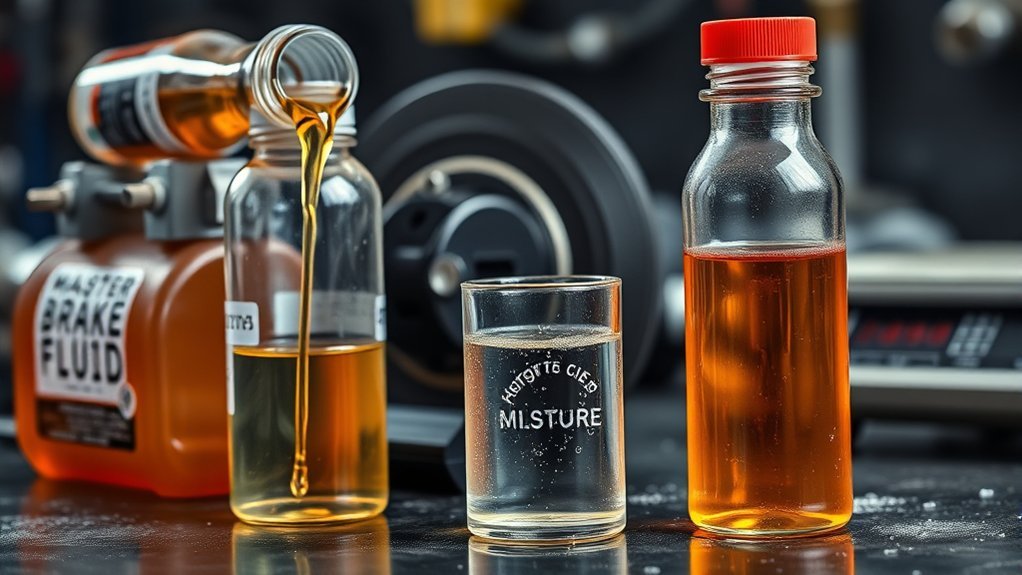
DOT 3 and DOT 4 fluids are hygroscopic, meaning they can absorb moisture. Moisture may enter gradually through hoses, seals, reservoir ventilation, and repeated exposure when a container or reservoir is opened.
As water content rises, the fluid’s boiling point generally falls. Moisture can also contribute to internal corrosion when fluid is neglected or contamination overwhelms the fluid’s protective additives.
Does DOT 4 Absorb Moisture Faster Than DOT 3?
You should not assume that every DOT 4 product absorbs moisture faster than every DOT 3 product. Actual moisture uptake and service life depend on the product formulation, vehicle design, climate, storage, maintenance history, and how often the hydraulic system is opened.
The higher wet boiling-point requirement for DOT 4 does not create a universal rule that DOT 4 must always be replaced sooner.
Why Moisture Testing Has Limits
A workshop may use an electronic moisture tester or a boiling-point tester to help evaluate fluid condition. Results should be interpreted using the equipment manufacturer’s instructions and the vehicle service procedure.
A reservoir test also may not perfectly represent fluid near the calipers, where temperatures are highest. Maintenance history, the vehicle’s specified interval, fluid condition, and test results should be considered together.
Can You Mix DOT 3 and DOT 4 Brake Fluid?
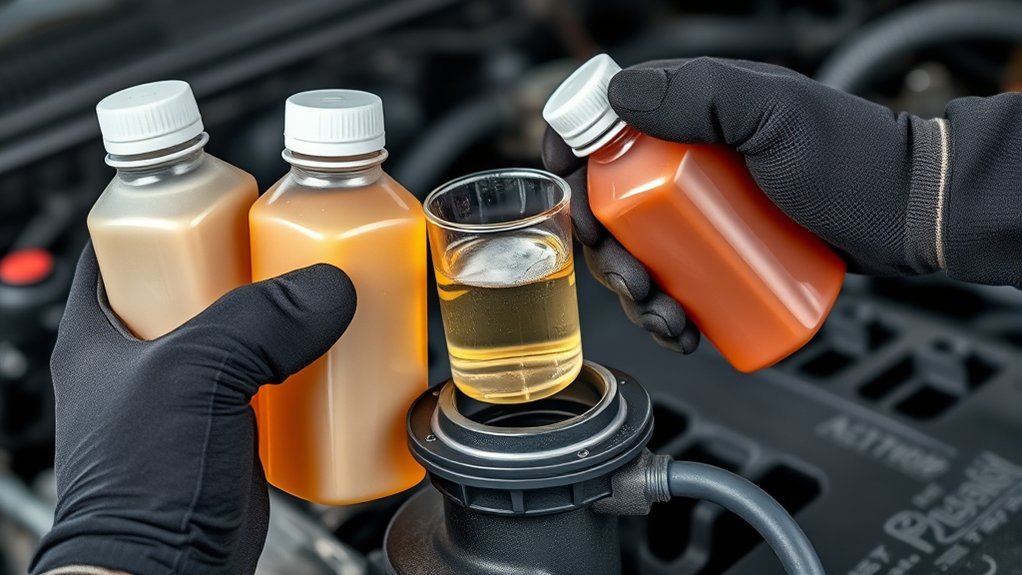
DOT 3 and DOT 4 are generally glycol-based fluids and are designed to meet compatibility requirements. However, chemical compatibility does not mean that intentional mixing is the best maintenance practice.
Adding DOT 3 to a system that requires DOT 4 may reduce the mixture’s boiling-point performance. You should not assume the final mixture still meets the complete DOT 4 or vehicle-specific requirement.
Adding DOT 4 to a vehicle that permits DOT 3 may be acceptable in some applications, but only when the vehicle manufacturer allows it and the product satisfies every required specification. A complete flush with the correct fresh fluid is preferable when changing specifications.
Note: Mixing DOT 3 and DOT 4 does not create a recognized fluid called “DOT 7.” It simply creates a mixture with performance that should not be assumed to equal the higher-rated product.
DOT 5 Versus DOT 5.1
DOT 5 and DOT 5.1 are not the same fluid:
- DOT 5 is a silicone-based brake fluid and is identified as such on the container.
- DOT 5.1 is a non-silicone fluid and is generally part of the glycol-based family.
Do not mix DOT 5 silicone fluid with a system designed for DOT 3, DOT 4, or DOT 5.1 unless the vehicle manufacturer provides a specific conversion procedure.
Warning: If silicone fluid, mineral oil, petroleum fluid, power-steering fluid, or another unknown liquid has entered the brake reservoir, do not drive the vehicle. Have the system evaluated by a qualified technician. Some contaminants can damage seals and may require more than a routine fluid flush.
Which Brake Fluid Should You Use?
Use this order of priority when choosing brake fluid:
- Read the owner’s manual. Look for the exact DOT grade, manufacturer standard, or approval.
- Check the reservoir cap or nearby label. It often states the minimum fluid specification, but the manual may contain additional requirements.
- Match the complete specification on the bottle. Do not rely only on front-label phrases such as “high performance” or “for ABS.”
- Confirm compatibility before upgrading. A higher boiling point does not override viscosity, seal, or manufacturer requirements.
- Use fresh fluid from a sealed container. Brake fluid begins absorbing moisture after the seal is opened.
When DOT 3 May Be Appropriate
DOT 3 remains appropriate for vehicles whose manufacturers specify DOT 3 and do not require another standard. This can include older and newer vehicles, depending on the braking-system design.
Normal commuting, vehicle age, or the absence of towing does not independently prove that DOT 3 is correct. The manufacturer specification is what matters.
When DOT 4 May Be Appropriate
DOT 4 is appropriate when the manufacturer specifies DOT 4 or an approved DOT 4-based fluid. Its higher minimum boiling points can provide additional heat resistance for systems designed around that specification.
Some vehicles exposed to repeated high brake temperatures may benefit from a product that exceeds standard DOT 4 minimums. Track use, competition, and severe towing may also justify shorter service intervals, but the fluid still must be compatible with the vehicle.
Does ABS Mean You Need DOT 4?
No. ABS, traction control, and stability control do not by themselves identify the correct DOT grade. Some ABS-equipped vehicles specify DOT 3, while others require DOT 4, low-viscosity DOT 4, DOT 5.1, or an OEM-approved fluid.
The electronically controlled valves in some systems make low-temperature viscosity especially important. This is why selecting fluid by the complete specification is safer than relying on an “ABS compatible” marketing statement.
How to Know When to Change Your Brake Fluid
There is no universal DOT 3 interval and separate universal DOT 4 interval that applies to every vehicle. Follow the maintenance schedule for your exact year, make, model, and braking system.
Brake-fluid service may be appropriate when:
- The manufacturer’s time or mileage interval is due.
- A qualified inspection or approved test indicates excessive moisture or degraded boiling performance.
- The hydraulic system has been opened for repairs and the service procedure calls for bleeding or replacement.
- The fluid contains visible debris, incompatible fluid, or other contamination.
- The vehicle has experienced unusually severe brake temperatures and the manufacturer or motorsport procedure recommends replacement.
- The maintenance history is unknown and a technician recommends establishing a known baseline.
Is Dark Brake Fluid Always Bad?
Fresh compliant DOT 3, DOT 4, and non-silicone DOT 5.1 fluids are generally colorless to amber. Used fluid may darken because of heat, age, dissolved material, or contamination.
Dark or cloudy fluid deserves inspection, but color alone cannot measure moisture content, boiling point, corrosion protection, or the condition of the entire hydraulic system.
Warning Signs That Need Immediate Inspection
Warning: Stop driving and arrange professional inspection if the brake pedal suddenly feels soft, sinks toward the floor, requires pumping, or is accompanied by a brake warning light, visible leak, or major loss of braking force. These symptoms can indicate air, a hydraulic leak, component failure, overheated fluid, or another serious problem.
Do not assume that topping up the reservoir will correct a low fluid level. The level can fall as brake pads wear, but an unexpected or rapid drop may indicate a leak.
Brake Fluid Maintenance Tips
- Use the original container. Federal labeling requires brake fluid to be stored in its original container and kept tightly closed.
- Keep fluid clean and dry. Dirt, water, petroleum products, and other contaminants can cause brake failure or expensive repairs.
- Avoid old open bottles. Use a newly opened container when practical, especially for a full flush or performance application.
- Protect painted surfaces. Glycol-based brake fluid can damage automotive paint. Clean spills immediately according to the product instructions.
- Do not let the reservoir run empty during bleeding. Introducing air can require additional bleeding and, on some vehicles, scan-tool activation of the ABS hydraulic unit.
- Use the approved bleeding procedure. Wheel sequence and electronic service steps vary by vehicle.
- Dispose of used fluid responsibly. Keep it separate from engine oil, coolant, fuel, and other automotive fluids, and use an approved local collection facility.
Pro Tip: Before opening the reservoir, clean dirt from the cap and surrounding area. This reduces the chance of introducing abrasive debris into the master cylinder and ABS hydraulic unit.
Final Thoughts on Choosing the Right Brake Fluid
The most important difference between DOT 3 and DOT 4 is that DOT 4 must meet higher minimum dry and wet boiling points. That does not make DOT 4 the automatic choice for every vehicle, and it does not make DOT 3 obsolete.
Start with the manufacturer’s specification, then consider operating temperature, product approvals, viscosity requirements, and service history. Avoid intentional mixing when a complete fill with the correct fresh fluid is possible.
Frequently Asked Questions
Should I use DOT 3 or DOT 4 brake fluid?
Use the exact fluid specified in your owner’s manual, service information, or reservoir label. DOT 4 has higher minimum boiling points, but that does not make it correct for every system. Match any additional viscosity or manufacturer-approval requirements.
Can I mix DOT 3 and DOT 4 brake fluid?
They are generally chemically compatible, but mixing can reduce the performance margin of the higher-rated fluid. Do not add DOT 3 to a system that requires DOT 4 unless the manufacturer explicitly permits it. A complete fill with the correct fresh fluid is the safer maintenance practice.
Can DOT 4 replace DOT 3?
It may be acceptable in some vehicles that specify DOT 3, but only when the manufacturer allows the substitution and the DOT 4 product meets every required specification. Do not assume that the higher grade is automatically approved.
What vehicles require DOT 4?
Many passenger cars, motorcycles, performance vehicles, and commercial vehicles specify DOT 4, but no broad vehicle category proves that it is required. Check the exact model’s manual or service information. Some systems require a low-viscosity or OEM-approved DOT 4 fluid.
Is DOT 3 or DOT 4 more corrosive?
Neither grade should be labeled universally more corrosive. Compliant DOT 3 and DOT 4 fluids must pass corrosion requirements. Corrosion risk rises when fluid absorbs moisture, becomes contaminated, loses protective additives, or remains in service beyond the vehicle’s maintenance requirements.
Are DOT 5 and DOT 5.1 interchangeable?
No. DOT 5 is silicone-based, while DOT 5.1 is labeled as non-silicone fluid. Do not add DOT 5 to a DOT 3, DOT 4, or DOT 5.1 system unless the manufacturer provides a specific conversion procedure.
Conclusion
DOT 4 offers higher federally required dry and wet boiling points than DOT 3, which can provide more resistance to fluid boiling under heat. The safest choice, however, is not simply the fluid with the higher number. Use the exact grade, viscosity, and approval specified for your vehicle, keep the fluid clean and sealed, and investigate any soft pedal, leak, warning light, or unexplained fluid loss immediately.
Sources
- Electronic Code of Federal Regulations, 49 CFR 571.116 — federal brake-fluid performance, boiling-point, compatibility, corrosion, labeling, color, and storage requirements.
- GovInfo published edition of 49 CFR 571.116 — official published version of the federal motor-vehicle brake-fluid standard.
- Cornell Legal Information Institute, 49 CFR 571.116 — accessible reference copy of the federal standard.