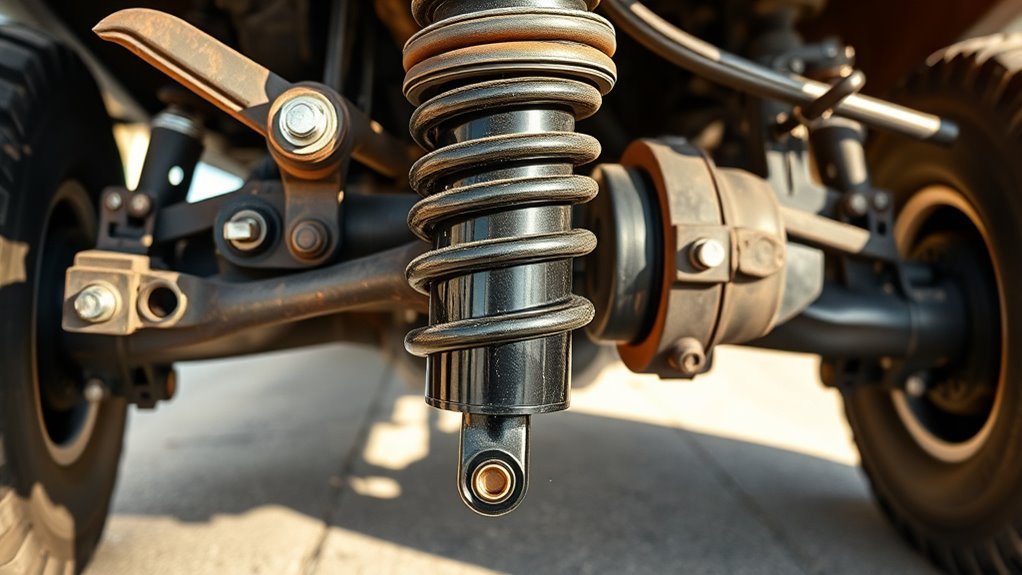
Yes, new front shocks can noticeably improve the ride and front-end control of a 2000 Ford F-250 Super Duty when the existing shocks are worn, leaking, underdamped, or mismatched to a lift or leveling setup. The biggest gains are usually less bouncing, better control after bumps, reduced nose dive, and more predictable steering. However, shocks cannot repair worn steering joints, ball joints, spring bushings, or other loose front-end parts.
Quick Answer
New front shocks can make a 2000 Ford F-250 feel more controlled if the old shocks are worn. Expect less bouncing, nose dive, and repeated suspension movement. The improvement depends on correct fitment, and a leveled truck needs shocks listed for its drivetrain and actual lift height.
Key Takeaways
- New front shocks can restore damping control when worn shocks allow excessive bounce, nose dive, sway, or poor recovery after bumps.
- A 2000 F-250 4×2 and 4×4 do not use identical front suspension layouts, so identify the drivetrain before ordering parts.
- Bilstein, KYB, FOX, Motorcraft, and other brands offer different shock designs; the correct application matters more than the brand name alone.
- A shock with too little extended travel can top out, while excessive compressed length can make the shock bottom internally before the suspension reaches its intended bump limit.
- Inspect steering, suspension, spring, stabilizer, and shock-mount components because new shocks cannot correct looseness elsewhere in the front end.
Do New Front Shocks Help Ride Quality?
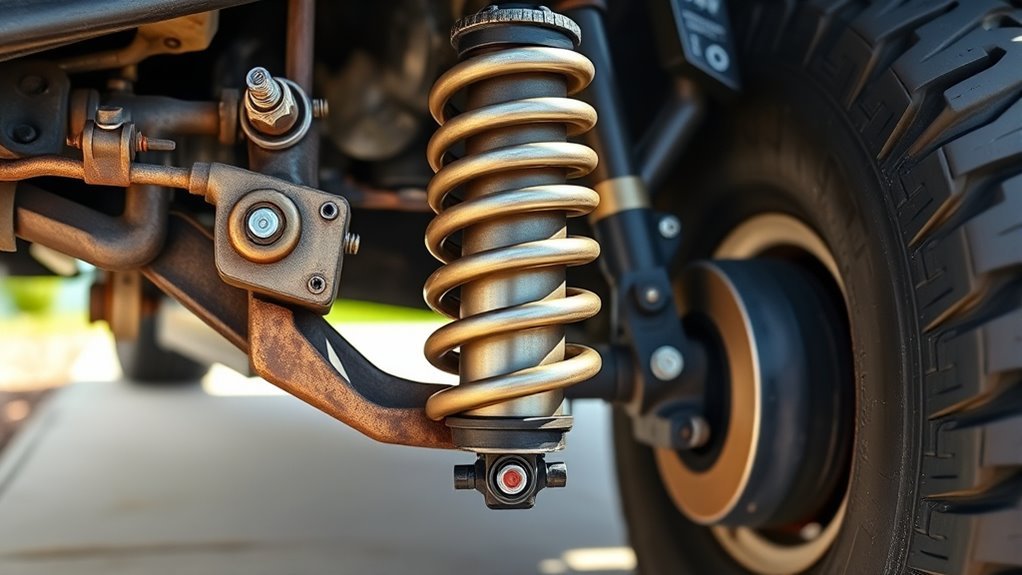
Yes. If the existing shocks have lost damping force, replacing them can materially improve ride control over bumps, dips, expansion joints, and uneven pavement. A healthy shock slows suspension compression and rebound so the truck settles instead of continuing to oscillate.
According to Monroe’s worn-shock guidance, excessive bouncing, nose dive during braking, body sway, steering changes, uneven tire wear, and fluid leakage can all accompany deteriorated ride-control components.
The main benefit of a good shock is controlled suspension motion: the truck should settle quickly after a bump instead of continuing to bounce or pitch.
That does not mean every new shock will make the truck feel softer. A performance-oriented shock can feel firmer over small road imperfections while still giving the driver better control over larger suspension movements. Ride quality also depends on tire pressure, tire construction, springs, bushings, vehicle load, and road conditions.
Shocks also do not normally determine the truck’s static ride height. Springs carry the vehicle’s weight and establish most of its ride height, while the shocks control how quickly that suspension moves.
What Bad Front Shocks Feel Like
Worn front shocks can produce several noticeable symptoms, but no single symptom proves that the shock itself is bad. The front suspension and steering system must be inspected as a whole.
| Symptom | What It May Indicate |
|---|---|
| Repeated bouncing after a bump | Weak damping or worn shocks |
| Excessive nose dive under braking | Reduced damping, although tires and other suspension faults can contribute |
| Floating or boating motion | Poor suspension control or shocks that are too soft for the application |
| Cupped or scalloped tire wear | Possible loss of wheel control; also check balance, alignment, and front-end wear |
| Visible hydraulic-fluid leakage | Possible shock seal failure |
| Clunking over bumps | Inspect shock mounts and hardware plus steering, stabilizer, spring, and suspension joints |
Note: Do not diagnose a bad shock from clunking alone. KYB notes that clunking can come from worn or loose shock mounting components, and other suspension parts can create similar noises.
Know Which 2000 F-250 Front Suspension You Have
Before choosing shocks or deciding which surrounding parts to inspect, confirm whether the truck is 4×2 or 4×4. The front-end hardware is not the same.
| Configuration | Important Front-End Items to Inspect |
|---|---|
| 4×2 | Twin I-Beam components, radius-arm bushings and brackets, ball joints, steering linkage, stabilizer links/bushings, coil springs, shock mounts, and wheel bearings |
| 4×4 | Monobeam/front axle components, front leaf springs and bushings, shackles and U-bolts, track-bar components, steering linkage, ball joints, stabilizer components, shock mounts, and wheel bearings |
This distinction is especially important when an older F-250 has been modified. A lift, leveling kit, replacement springs, altered shackles, or other suspension changes can affect which shock application is correct.
Best Front Shock Styles for a Leveled F-250
A leveled 2000 Ford F-250 should use a shock specifically listed for the truck’s drivetrain, front suspension, and lift range. Do not assume that every Bilstein 5100, FOX 2.0, KYB, or other truck shock has the correct travel simply because it fits another F-250.
A monotube shock can be a useful choice for a heavy truck that tows, hauls, runs larger tires, or sees rough roads because the design can provide consistent damping and good heat management. However, monotube construction alone does not guarantee better ride comfort. Valving and vehicle-specific tuning matter just as much.
BILSTEIN describes its B8 5100 line as an application-specific monotube shock offered for various lift heights. That application-specific point is more important than simply choosing the 5100 name.
FOX also offers performance shocks for specific 1999–2004 Super Duty applications, but the correct FOX unit depends on drivetrain and suspension height. Use the manufacturer’s application listing rather than buying by physical appearance or brand reputation.
Pro Tip: If the truck has been leveled or lifted, identify the actual suspension modification before ordering shocks. A previous owner may describe a truck as having a “2-inch level” even when replacement springs, shackles, blocks, or other components create a different effective shock requirement.
Bilstein vs. KYB Front Shocks
Bilstein versus KYB is not simply a monotube-versus-twin-tube comparison. Both companies offer different product families, and the exact shock design and valving must be matched to the truck.
BILSTEIN’s B8 5100 line uses a monotube design and is aimed at truck and SUV applications, including lifted applications where a specific fitment is available.
KYB also sells monotube truck shocks. For example, KYB Gas-a-Just is a high-pressure monotube design. KYB also offers other product families with different construction and ride targets, so describing all KYB shocks as softer twin-tube units is inaccurate.
| Priority | What to Look For |
|---|---|
| Factory-like replacement | A shock cataloged for the stock-height truck and intended to restore OE-style control |
| Towing, hauling, larger tires | A properly valved heavy-duty or monotube application designed for the additional control demand |
| Leveled or lifted suspension | A shock specifically cataloged for the actual lift range and drivetrain |
| Maximum comfort | Avoid assuming “firmer” means smoother; choose valving intended for your load and driving conditions |
The best choice is therefore the correctly tuned application for how the truck is configured and used, not a brand winner in isolation.
How Front Shock Length Affects Fitment
Shock length is an important fitment constraint, especially after a lift or leveling change, but the manufacturer’s vehicle application should normally be your starting point.
A shock must have enough extended length to allow the suspension to droop without the shock reaching full extension first. If the shock is effectively too short at full extension, it can top out and place excessive load on the shock or mounts.
At the other end of travel, the shock’s compressed length must not cause the damper to reach full internal compression before the suspension reaches its intended bump limit. A shock that is too long when fully compressed can bottom internally and damage the shock or mounting points.
- Confirm the exact year, F-250 Super Duty model, and 4×2 or 4×4 drivetrain.
- Determine whether the front suspension is stock height, leveled, or lifted.
- Identify the actual lift range rather than relying only on how the truck looks.
- Use the shock manufacturer’s application catalog to confirm position and lift range.
- Check upper and lower mounting styles against the existing truck.
- For a modified suspension, confirm adequate bump and droop travel before putting the truck into service.
Warning: Never work beneath an F-250 supported only by a hydraulic jack. Use correctly rated lifting equipment and secure jack stands at appropriate support points. If the suspension has been heavily modified or the correct shock travel cannot be confirmed, have the setup inspected by a qualified technician.
Why Front Shocks Change Handling
Front shocks affect handling because they control the rate of suspension movement. During braking, cornering, and driving over uneven pavement, the springs and tires move as load shifts through the vehicle. The shocks resist uncontrolled compression and rebound so the body and wheels settle more quickly.
When the shocks are worn, the front end may continue moving after a bump, dive more abruptly during braking, feel less settled during lane changes, or allow a tire to spend more time unloading and reloading over rough pavement.
Correctly matched shocks can therefore improve steering consistency and the driver’s sense of control. They do not, however, correct worn ball joints, loose steering linkage, incorrect alignment, damaged springs, or deteriorated bushings.
On a modified truck, a shock also cannot correct poor suspension geometry created by an improperly designed lift. Shock damping and suspension geometry are related to the overall driving result, but they are different functions.
What to Replace During a Front Shock Swap
Front shock replacement is a good opportunity to inspect the rest of the front end, particularly on a 2000 truck where multiple rubber joints, steering components, and spring hardware may have decades of service.
Start with components common to most configurations:
- Upper and lower shock mounts, bushings, sleeves, bolts, and brackets
- Ball joints
- Tie-rod ends and other steering linkage
- Stabilizer-bar links and bushings
- Wheel bearings and hub play
- Front tires for cupping, uneven wear, damage, and correct inflation
On a 4×2 Twin I-Beam truck, also inspect the radius-arm bushings and related pivot hardware. On a 4×4 truck, inspect the front leaf-spring bushings, shackles, U-bolts, track-bar components, and other axle-locating hardware.
Replace worn components rather than expecting stronger shocks to mask looseness. New shocks should also be installed as a matched pair on the same axle. KYB’s installation guidance recommends replacing shocks in pairs so damping remains balanced from side to side.
Use the correct fastener torque from applicable Ford service information or the shock manufacturer’s instructions. Do not use an impact wrench blindly on shock hardware when the manufacturer specifies a controlled torque procedure.
Do New Shocks Fix a Harsh Ride?
Sometimes, but not always. A worn shock can allow uncontrolled wheel and body movement, while a damaged or binding shock may also make the suspension feel poor. Replacing a defective unit can improve the ride significantly.
However, a harsh 2000 F-250 may also be caused by:
- Tire pressures that are excessive for the actual load
- Very stiff or heavy-duty replacement tires
- Worn or seized spring and suspension bushings
- Incorrect shocks or overly aggressive damping
- Modified or heavy-duty springs
- Suspension repeatedly contacting its bump stops
- Damaged or binding suspension hardware
For that reason, “new shocks” and “softer ride” are not automatically the same thing. The correct goal is controlled suspension movement with a shock matched to the truck and its use.
Common Front Shock Choices
There are several reasonable approaches for a 2000 F-250, depending on how the truck is configured.
Motorcraft: Ford describes Motorcraft shock absorbers as service parts engineered for original-equipment-style performance and application suitability. This can make a correctly cataloged Motorcraft shock a logical choice when the goal is to restore factory-like operation.
Bilstein: B8 5100 shocks use monotube construction and application-specific tuning. They are commonly offered in applications for lifted trucks, but the exact part and supported lift range must be verified before purchase.
KYB: KYB offers multiple shock families. Gas-a-Just is a monotube performance-oriented design, while other KYB families target different replacement needs. Choose by the specific application rather than assuming all KYB shocks have the same construction.
FOX: FOX 2.0 truck shocks can suit specific Super Duty configurations where the manufacturer lists a compatible application. They should not be treated as a universal fit for every 2000 F-250 or every lift height.
Regardless of brand, check the complete application: 2000 Ford F-250 Super Duty, drivetrain, front position, suspension height, mounting type, and any lift-range restriction.
Should You Get an Alignment After Replacing Front Shocks?
A shock-only replacement normally does not require changing the F-250’s alignment adjustments because the shock itself is not the component used to set normal wheel alignment angles on this suspension.
An alignment check is still sensible when the truck already pulls, the steering wheel is off-center, the tires show abnormal wear, a lift or leveling change has been made, or other steering and suspension components are replaced during the repair.
If worn ball joints, radius-arm components, axle-locating parts, or other geometry-related hardware are repaired, follow the applicable service procedure and check alignment afterward.
Frequently Asked Questions
Will new shocks make a 2000 F-250 ride smoother?
They can if the current shocks are worn or poorly matched. New shocks usually improve control first: less bouncing, pitching, and repeated movement. A performance shock may feel firmer rather than softer, so ride comfort depends on the shock’s valving, tires, springs, load, and road conditions.
What else should I inspect when replacing the front shocks?
Inspect shock mounts and hardware, ball joints, steering linkage, stabilizer links and bushings, wheel bearings, and tires. On a 4×2 truck, also inspect Twin I-Beam and radius-arm components. On a 4×4 truck, inspect front leaf-spring hardware, track-bar components, and other axle-locating parts.
What are two common symptoms of worn shock absorbers?
Two common signs are repeated bouncing after a bump and excessive nose dive during braking. Fluid leakage, sway, steering instability, and cupped tire wear can also justify a closer suspension inspection.
What brand replacement shocks does Ford recommend?
Ford offers Motorcraft shock absorbers as Ford-engineered service replacements. The original supplier on a particular 2000 truck can vary, so it is better to verify the correct Ford/Motorcraft application by vehicle specification rather than assume a particular outside brand was original equipment.
Will new shocks raise the front of my F-250?
Normally, no. Conventional shocks primarily control suspension movement; the springs establish most of the truck’s static ride height. If the front sits low, inspect the springs and suspension configuration rather than expecting ordinary replacement shocks to provide lift.
Can I use stock-length shocks after leveling the truck?
Only if the shock manufacturer specifically lists that stock-length application for the modified suspension. A level or lift can change the required working range, so confirm drivetrain, actual lift height, compressed and extended travel requirements, and the manufacturer’s application before ordering.
Conclusion
New front shocks can materially improve a 2000 Ford F-250 Super Duty when the existing dampers are worn or poorly matched to the suspension. The most noticeable changes are usually better control after bumps, less repeated bouncing, reduced nose dive, and a more settled front end.
The key is correct fitment. Identify whether the truck is 4×2 or 4×4, determine whether the suspension is stock or modified, and choose a shock specifically cataloged for that configuration and lift range. Do not expect new shocks to fix loose steering linkage, worn ball joints, damaged springs, deteriorated bushings, or incorrect alignment.
For a stock truck, an OE-style replacement may provide the most familiar ride. For towing, larger tires, rough roads, or a properly leveled suspension, an application-specific monotube shock can provide additional control. In every case, inspect the rest of the front end and replace the front shocks as a matched pair.
Sources
- Ford / Motorcraft Shock Absorber Information — Ford service-replacement shock design and application guidance.
- Monroe — Signs of Bad Shocks & Struts — symptoms including bounce, nose dive, sway, uneven tire wear, noise, and fluid leakage.
- KYB — Gas-a-Just Monotube Shocks — monotube construction and truck handling characteristics.
- KYB — Professional Installation Tips — pair replacement, dimensions, installation, and torque guidance.
- BILSTEIN — B8 5100 — application-specific tuning, monotube construction, and lift-height applications.
- FOX — Ford Super Duty 2.0 Performance Series Fitment — model-, drivetrain-, position-, and lift-specific FOX shock application information.
