Last updated: September 19, 2026
Secure firearm storage laws in the United States are primarily state-specific. As of January 14, 2026, Everytown Research’s state tracker lists 26 states as having adopted its secure-storage or Child Access Prevention policy category, while other legal and research sources may use somewhat different definitions and may count the District of Columbia separately.[1][2][3]
The rules differ sharply. Some states require a firearm to be locked whenever it is not carried or controlled by an authorized user. Others impose a duty when a minor is present or likely to gain access. Still others impose liability only after a child obtains or uses an improperly stored firearm. Age definitions, exceptions, penalties, and required locking methods also vary.
Quick Answer
There is no single nationwide household-storage rule that works the same way in every state. State CAP and secure-storage laws can require proactive locking, impose duties when minors or prohibited people are present, or create liability after unauthorized access. Federal law separately requires licensed sellers transferring a handgun to a nonlicensee to provide a secure gun-storage or safety device, but that is not a general federal household-storage mandate.[1][8]
Key Takeaways
- CAP and secure-storage laws use different legal triggers, age definitions, penalties, and exceptions.
- California, Illinois, and Virginia all have important storage provisions that became operative or were enacted in 2026.[9][10][11]
- A state may regulate storage before a child gains access, after access occurs, or only after specified conduct or harm.
- AAP guidance recommends storing household firearms unloaded and locked, with ammunition locked separately.[6]
- Legal compliance and safer-storage best practices are related but not identical; always check the current statute that applies where you live.
What Are Secure Firearm Storage and Child Access Prevention Laws?
Secure-storage laws regulate how firearms must be stored in specified circumstances. Child Access Prevention laws, often called CAP laws, focus on preventing unauthorized access by minors and may impose criminal or civil consequences when a firearm is stored in a way that allows or risks child access.
National counts can differ because organizations do not always classify the same laws in the same way. Everytown’s tracker, last updated January 14, 2026, lists 26 states as having adopted its secure-storage/CAP policy category. A 2026 University of Michigan research review states that, as of 2025, 26 states and the District of Columbia had negligent-storage CAP laws or broader safe-storage laws.[1][3]
Three broad legal patterns help explain the differences:
- Ongoing or proactive storage duty: The firearm must be secured whenever specified conditions exist, sometimes whenever it is not carried or controlled.
- Likely-access duty: The law applies when the owner knows or reasonably should know that a minor or another unauthorized person is likely to gain access.
- Access- or use-triggered liability: A penalty attaches only after a child or prohibited person actually obtains, carries, displays, discharges, or uses the firearm in a way specified by law.
The key legal question is not simply whether a state has a “CAP law,” but what event triggers the duty, who is protected by it, and what the statute considers secure storage.
What the research shows: A 2005 JAMA case-control study found that firearms involved in youth suicide attempts or unintentional shootings were less likely than control firearms to have been stored locked, unloaded, with ammunition locked, or with ammunition stored separately. Compared with firearms stored loaded and unlocked, those stored locked and unloaded had an adjusted odds ratio of 0.16 for involvement in a case shooting event. This is an association from a case-control study, not proof that storage alone caused the difference.[5]
Warning: This article provides general legal and safety information, not legal advice. Statutes, court decisions, regulations, and local rules can change. Check the current law in your state and locality before relying on any storage requirement.
How Do These Laws Affect Families and Firearm Owners?
- Storage duties differ by location: The same storage practice may satisfy one state’s statute but not another state’s more specific requirement.
- Legal triggers differ: Some states regulate storage before access occurs, while others attach penalties only after a minor or prohibited person gains access or uses the firearm in a specified way.[1][2]
- School and dealer notices can be part of compliance systems: Nevada, for example, requires school emergency plans to inform parents or guardians at least twice each academic year about state firearm-storage requirements, and Nevada licensed dealers must provide a locking device with firearm transfers.[15]
- Millions of children live in homes with firearms: The 2021 National Firearms Survey estimated that about 30 million U.S. children lived in households with firearms and that about 4.6 million lived in a household with at least one firearm stored both loaded and unlocked.[7]
- Safer-storage guidance is not identical to statutory compliance: AAP guidance recommends unloaded and locked firearms with ammunition locked separately, but a particular state statute may define compliant storage differently.[6]
Which States Have Adopted Secure-Storage or CAP Policies?
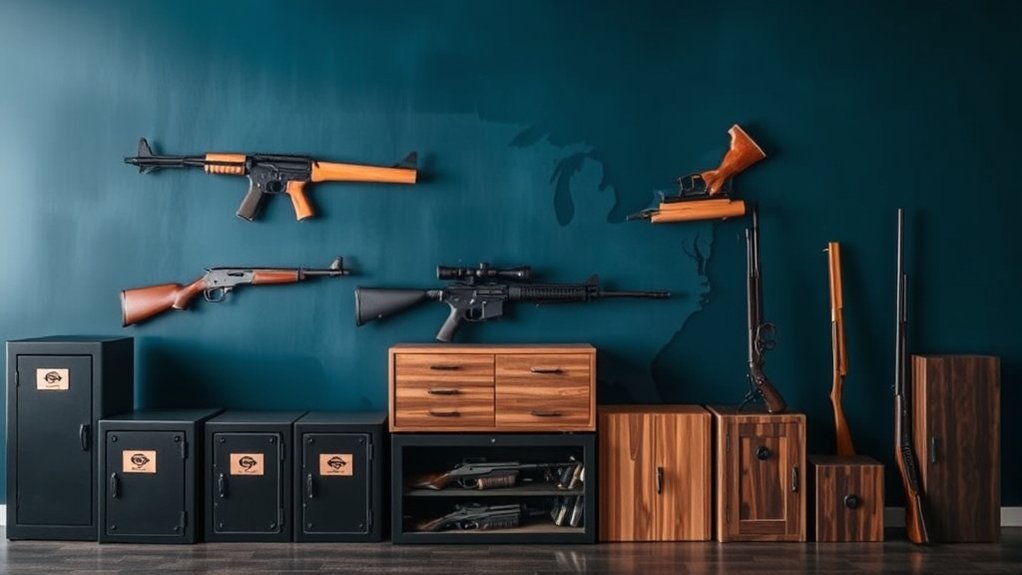
Everytown’s January 14, 2026 tracker lists 26 states as having adopted its secure-storage or Child Access Prevention policy category.[1] The table below highlights verified examples rather than attempting to replace the full text of each state statute.
|
State |
Current approach |
Key current detail |
|---|---|---|
|
California |
Proactive residential secure-storage rule |
Since January 1, 2026, a firearm possessed in a residence must be securely stored whenever it is not carried or readily controlled by the person or another lawful authorized user.[9] |
|
Florida |
Likely-access rule for loaded firearms |
The cited statute applies when a person knows or reasonably should know that a minor under 16 is likely to gain access to a loaded firearm, subject to statutory exceptions.[12] |
|
Illinois |
Likely-access secure-storage rule |
The Safe Gun Storage Act took effect January 1, 2026 and applies when a minor, at-risk person, or prohibited person is likely to gain access, unless the firearm is secured as the Act specifies or another exception applies.[10] |
|
Michigan |
Minor-present or likely-present rule |
Since February 13, 2024, unattended firearms generally must be unloaded and locked with a locking device or stored in a locked container when a minor is or is likely to be present.[13] |
|
Rhode Island |
General safe-storage rule plus child-access offenses |
The law generally requires a firearm that is stored or left to be in a locked container or secured with a qualifying safety device unless carried or readily carried by a lawful authorized user. The child-access provision defines a child as under 18.[14] |
|
Texas |
Child-access liability framework |
Penal Code §46.13 defines a child as a person younger than 17 and regulates making a readily dischargeable firearm accessible to a child under specified circumstances.[16] |
|
Virginia |
Residential secure-storage rule plus older child-endangerment provision |
A 2026 law requires specified secure storage in a residence when the possessor knows a minor under 18 or a prohibited person is present. Virginia also retains its older rule against recklessly leaving a loaded, unsecured firearm so as to endanger a child under 14.[11][17] |
|
Washington |
Liability after specified unauthorized access |
RCW 9.41.360 creates first- or second-degree community-endangerment offenses when a prohibited person obtains an unsafely stored firearm and specified injury, discharge, public display, or criminal-use conditions follow.[18] |
Which States Do Not Appear in the Current Secure-Storage/CAP Policy Category?
Everytown’s January 14, 2026 tracker identifies 24 states as not having adopted its secure-storage/CAP policy category. Examples shown as not adopted include Alabama, Alaska, Arizona, Arkansas, and Georgia.[1]
That classification should not be read as “no firearm law applies.” A state can have laws involving minors, reckless provision, dealer duties, schools, vehicles, civil liability, or other firearm conduct without meeting a particular tracker’s definition of a secure-storage/CAP policy.
Note: National policy maps use different definitions. For legal compliance, use the current statute and official state guidance rather than relying only on a map category.
How Do State Laws Define a “Child” or “Minor”?
Age thresholds can determine when a storage duty or penalty applies, but they are not uniform. A state may also use more than one age threshold across different firearm statutes.
- Florida: The cited safe-storage statute defines “minor” as a person under 16.[12]
- Texas: Penal Code §46.13 defines “child” as a person younger than 17.[16]
- Rhode Island: Its current child-access provision defines “child” as a person under 18.[14]
- Virginia: The 2026 residential-storage law defines “minor” as a person under 18 who is not otherwise authorized to use or possess a firearm under the referenced statute. A separate older Virginia provision still uses an under-14 threshold for recklessly leaving a loaded, unsecured firearm so as to endanger a child.[11][17]
- Nevada: NRS 202.300 regulates firearm possession by children under 18 and negligent storage where there is a substantial risk that a child prohibited under that section may obtain the firearm.[19]
How Are Secure-Storage Laws Enforced?
Enforcement varies by state. Depending on the statute, a violation can be a civil infraction, misdemeanor, felony-level offense after specified harm, or another criminal offense. Some states also pair storage rules with dealer notices, locking-device requirements, school communications, or public education.
- California: Penal Code §25145 establishes penalties for violations of the residential storage requirement and directs the Department of Justice to inform residents about the standards.[9]
- Indiana: The Department of Education, working with State Police, must provide firearm-storage best practices and educational materials to schools for annual distribution to parents.[20]
- Nevada: School plans must inform parents or guardians at least twice each academic year about state firearm-storage requirements. Licensed dealers must also provide a locking device with each firearm sold or transferred, subject to the law’s terms.[15]
- Texas: The statute focuses on making a readily dischargeable firearm accessible to a child younger than 17 and specifies when liability applies.[16]
- Washington: Criminal liability depends on an unauthorized person obtaining the firearm and one of the additional outcomes specified in RCW 9.41.360.[18]
Safety Note: AAP safer-storage guidance recommends keeping firearms unloaded and locked, with ammunition locked separately. A state may require a different or more specific storage method for legal compliance.[6]
What Does Research Say About CAP Laws and Safer Storage?
Research generally reports associations between stronger child-access or storage requirements and safer storage practices or lower rates of some youth firearm outcomes, but results vary by study design, law definition, population, and outcome.
A 2026 study using Behavioral Risk Factor Surveillance System data from 26,466 firearm owners with children across 24 states found that 7.0% of households in CAP-law states reported at least one loaded and unlocked firearm, compared with 11.8% in non-CAP states. After adjustment, the relationship between CAP laws and unsecured storage differed depending on the broader state firearm-policy environment. The authors concluded that additional research is needed to understand those differences.[4]
A separate 2026 University of Michigan-led analysis reported that people living in states with more stringent storage laws were less likely to report unsecured firearm storage, but the observed association also varied by county social vulnerability.[3]
Earlier studies have also reported associations between CAP laws and reductions in youth firearm deaths. Because much of this evidence is observational, the safest description is that the laws are associated with these outcomes rather than that any single statute alone proves causation.
What Are Some Important State-Specific Examples?
Notable Current Examples
- California: Since January 1, 2026, Penal Code §25145 requires secure storage of firearms possessed in residences whenever they are not carried or readily controlled by the person or another lawful authorized user.[9]
- Illinois: The Safe Gun Storage Act became effective January 1, 2026. It establishes a storage duty where specified minors, at-risk people, or prohibited people are likely to gain access.[10]
- Rhode Island: Current law generally requires stored or left firearms to be secured in a locked container or with a qualifying lock or safety device, subject to statutory exceptions. Its child-access provisions use an under-18 definition.[14]
- Michigan: The secure-storage law has been effective since February 13, 2024 and applies when a minor is or is likely to be present.[13]
- Virginia: A 2026 residential-storage law now applies when a minor under 18 or a legally prohibited person is present, while an older provision separately prohibits recklessly leaving a loaded, unsecured firearm so as to endanger a child under 14.[11][17]
- Maryland: Criminal Law §4-104 prohibits storing or leaving a loaded firearm where the person knew or should have known that an unsupervised minor has access, subject to statutory exceptions. Jaelynn’s Law took effect October 1, 2023 and also required development of a youth-suicide-prevention and firearm-storage guide.[21][22]
Why Do Legal Triggers Differ So Much?
CAP and secure-storage statutes developed at different times and use different legal models. One state may regulate storage whenever a firearm is unattended. Another may act only when a child is likely to gain access. A third may require actual access, use, injury, or public possession before a particular criminal penalty applies.
That is why a short statement such as “this state has a CAP law” does not fully explain the owner’s legal duty. The statute’s trigger, age definition, exceptions, storage-device definition, and penalty provisions all matter.
How Strong Is the Evidence?
The evidence is supportive for several youth-safety outcomes, but it is not uniform across every study or policy design. The 2026 University of Michigan review notes that research has generally associated CAP laws with reductions in youth firearm injury and death while also acknowledging studies that did not find protective effects.[3]
The newer 2026 storage-practices study adds an important qualification: the association between CAP laws and loaded-and-unlocked storage differed depending on the wider state policy environment.[4]
What Changed in 2026?
Three changes are especially important for keeping older guides current:
- California: SB 53’s residential secure-storage requirement became operative on January 1, 2026.[9]
- Illinois: The Safe Gun Storage Act took effect on January 1, 2026.[10]
- Virginia: The Commonwealth added §18.2-308.7:1 in 2026, establishing a residential storage requirement when a minor under 18 or prohibited person is present.[11]
These updates show why a storage-law article should be reviewed by effective date rather than refreshed by changing the year in the headline alone.
What Role Do Schools, Dealers, and Public Education Play?
Some jurisdictions pair legal duties with education or notice requirements. Nevada requires school plans to inform parents or legal guardians about state firearm-storage requirements at least twice each academic year. Indiana requires annual distribution of state-developed storage materials through schools.[15][20]
These education rules are distinct from the underlying storage offenses. A notice requirement can explain the law, while the actual legal duty and penalty are established by the relevant statute.
What Counts as Safer Firearm Storage?
Safer Storage Guidelines
The American Academy of Pediatrics identifies four core safer-storage practices for households with children: store the firearm unloaded, store it locked, store ammunition separately, and keep the ammunition locked separately from the firearm.[6]
- Store firearms unloaded when not in use.
- Use an appropriate locked safe, lockbox, cable lock, trigger lock, or other locking system.
- Store ammunition separately and locked when possible.
- Keep keys, combinations, and authorized biometric access away from children and unauthorized users.
- Check whether your state requires a particular type of device or storage condition.
- Review current state and local law when moving, traveling, or when household circumstances change.
Important: A locking method that improves safety does not automatically satisfy every state statute. California, for example, ties its current residential requirement to certified firearm safety devices or qualifying secure gun safes as defined by state law.[9]
Educational Resources Available
- The American Academy of Pediatrics publishes evidence-based safer-storage guidance for families with children.[6]
- ATF explains the federal definition of a secure gun-storage or safety device and the federal handgun-transfer locking-device requirement.[8]
- State legislatures and attorney-general or public-health websites provide the strongest source for current state-specific requirements.
- National trackers from Everytown and Giffords are useful for comparison, but the controlling statute should be checked before making a legal decision.[1][2]
Frequently Asked Questions
Which states have secure firearm storage or Child Access Prevention laws?
Everytown’s tracker, last updated January 14, 2026, lists 26 states as having adopted its secure-storage/CAP policy category. Other sources can produce slightly different totals because they classify negligent-storage, reckless-provision, general safe-storage, and District of Columbia laws differently.[1][3]
Is there a federal law requiring every firearm in a home to be locked?
There is no general federal household-storage mandate equivalent to the state laws described in this guide. Federal law does require a licensed importer, manufacturer, or dealer transferring a handgun to a nonlicensee to provide a secure gun-storage or safety device, subject to statutory exceptions.[8]
What is the safest way to store a firearm around children?
AAP guidance recommends storing firearms unloaded and locked, with ammunition locked and stored separately. State legal requirements may differ, so safer-storage guidance should be used alongside the applicable statute rather than as a substitute for it.[6]
Do all CAP laws use the same age for a child?
No. Age thresholds differ. Florida’s cited statute uses under 16, Texas uses younger than 17, Rhode Island’s current child-access provision uses under 18, and Virginia now has different thresholds in separate storage-related statutes.[12][14][16][11][17]
Do CAP laws apply before a child actually gets a firearm?
Some do and some do not. Certain states impose a storage duty when a child is present or likely to gain access, while other statutes require actual access, use, injury, public possession, or another triggering event before a particular penalty applies.[1][2]
Conclusion
Secure firearm storage and Child Access Prevention laws are not uniform across the United States. The most important differences are the legal trigger, who is considered a minor or unauthorized person, what storage method qualifies, which exceptions apply, and what happens after a violation.
For current legal compliance, start with your state statute and official state guidance. For household safety, pediatric guidance supports keeping firearms unloaded and locked with ammunition locked separately. Because several important state rules changed in 2026, older summaries should be checked against current law before they are relied upon.
References
- Everytown Research & Policy — Secure Storage/Child Access Prevention Required — state tracker, last updated January 14, 2026.
- Giffords Law Center — Child Access Prevention & Safe Storage — national law overview and legal-trigger comparisons.
- Oliphant et al. — Child Access Prevention Laws and Firearm Storage in the US — 2026 Preventive Medicine analysis.
- Lu & Berg — Child Access Prevention Laws and Firearm Storage Practices Among Households With Children — 2026 Preventive Medicine study.
- Grossman et al., JAMA — Gun Storage Practices and Risk of Youth Suicide and Unintentional Firearm Injuries — case-control study of storage practices.
- American Academy of Pediatrics — Firearm-Related Injuries and Deaths in Children and Youth — safer-storage guidance.
- Miller & Azrael, JAMA Network Open — Firearm Storage in US Households With Children — 2021 National Firearms Survey findings.
- ATF — Firearms Questions and Answers — federal secure-storage-device definition and handgun-transfer requirement.
- California Department of Justice — New and Amended Firearms/Weapons Laws — SB 53 storage requirement effective January 1, 2026.
- Illinois General Assembly — 430 ILCS 64/5, Safe Gun Storage Act — effective January 1, 2026.
- Code of Virginia §18.2-308.7:1 — 2026 residential firearm-storage requirement.
- Florida Statutes §790.174 — safe storage and under-16 definition.
- Michigan MDHHS — Secure Storage Law Two-Year Update — current Michigan guidance and effective date.
- Rhode Island General Laws §11-47-60.1 — safe storage and child-access provisions.
- Nevada SB 294, Chapter 464 — locking-device, school-notice, and public-education provisions.
- Texas Penal Code §46.13 — making a firearm accessible to a child.
- Code of Virginia §18.2-56.2 — reckless access/endangerment provision involving children under 14.
- Washington RCW 9.41.360 — community endangerment due to unsafe firearm storage.
- Nevada Revised Statutes §202.300 — child firearm possession and negligent-storage provision.
- Indiana Code §20-19-3-30.4 — firearm-storage educational materials and annual parent distribution.
- Maryland Criminal Law §4-104 — current child/minor access provision.
- Maryland General Assembly — SB 858 / Jaelynn’s Law — effective October 1, 2023.
