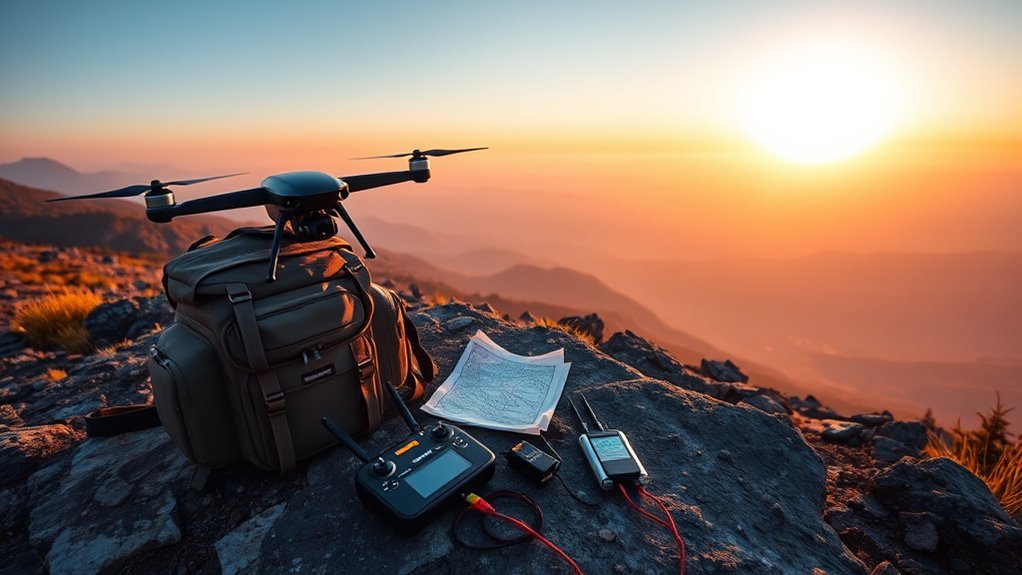
For long-distance FPV, the best system depends on the mission. DJI offers the sharpest video and strong range, but with more latency. Walksnail gives good image quality and low-light performance. HDZero favors lowest, most predictable latency, though at lower resolution. For control links, ExpressLRS is the most efficient long-range choice, while Crossfire remains very reliable. GPS rescue, antenna gain, and 900MHz can further improve range and recovery. More detail clarifies the trade-offs.
Key Takeaways
- For long-distance FPV, prioritize low latency, reliable GPS rescue, and a strong antenna setup for signal stability.
- DJI offers the best image quality and range, while Walksnail balances range and low-light performance.
- HDZero gives the lowest and most predictable latency, but with lower video resolution.
- ExpressLRS is the best long-range control link for low latency and efficient power use; Crossfire is also highly reliable.
- Use proper OSD data, battery reserves, and tuned antennas to maintain link quality and safely return home.
What Makes a Good Long-Range FPV System?
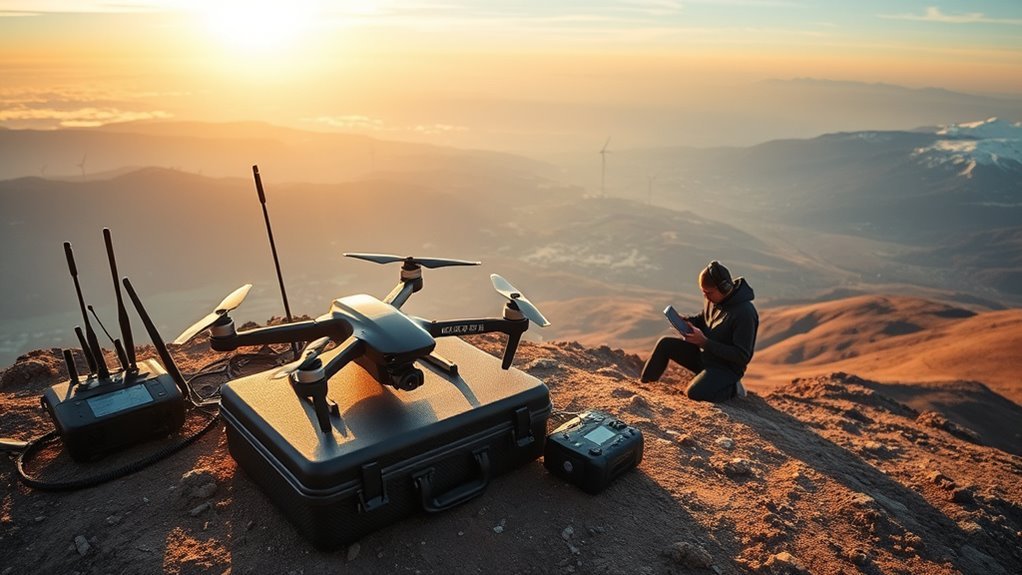
A good long-range FPV system combines low-latency transmission, reliable video, and strong recovery features to maintain control and situational awareness beyond 5 km.
In long-range FPV, transmission technology based on ExpressLRS or TBS Crossfire is favored for low latency and robust signal strength. Digital FPV systems improve video quality, delivering clearer 720p-plus images that support precise navigation.
Long-range FPV favors ExpressLRS or Crossfire for low latency, while digital systems deliver clearer 720p-plus navigation views.
Signal stability depends heavily on antenna setup, including high-gain antennas and a clean ground station layout. GPS features are not optional; GPS Rescue Mode adds a fail-safe return path when link quality drops or battery reserves fall below safe thresholds.
Battery management remains critical because endurance must cover outbound travel, loitering, and return. Telemetry gives the pilot real-time data on voltage, current draw, and distance, enabling disciplined energy use.
When these elements align, the aircraft gains technical autonomy and the operator gains practical freedom over distance.
DJI vs Walksnail vs HDZero for Long Range FPV
For long-range FPV, the choice between DJI, Walksnail, and HDZero depends on the priority assigned to image fidelity, latency, and link flexibility. The DJI FPV System delivers the highest image quality, with 4K-class video transmission and about 12 km of range capabilities, but its protocol is more constrained and latency is less suitable for aggressive FPV racing. Walksnail Systems balance strong low-light performance, up to 1200 mW output, and adaptable antennas, giving freer long-range FPV optimization. HDZero favors low, consistent latency and predictable control, making it the clearest option for racing-oriented pilots who value liberation through responsiveness.
| System | Strength | Tradeoff |
|---|---|---|
| DJI FPV System | image quality | higher latency |
| Walksnail Systems | range flexibility | less absolute clarity |
| HDZero | latency | lower resolution |
All three support telemetry, so selection is defined by flight mission, not features alone.
Is Analog FPV Still Worth It for Long Distance?
Analog FPV remains technically relevant for long-distance use because its low, consistent latency supports precise control when link margins are tight.
Its practical range can extend well beyond 20 km with appropriate antennas and power management, but the usable image degrades faster than digital as signal strength falls.
The tradeoff is clear: reduced visual fidelity is offset by lower cost, simpler hardware, and responsiveness that still suits many long-range pilots.
Analog Range Limits
Despite its popularity in racing and small-drone setups, analog FPV is generally constrained to roughly 1–5 kilometers of practical range, which makes it a weaker choice for true long-distance flying.
These analog range limits define the effective range of many FPV systems, especially when compared with digital systems built for long-distance flights. In open air, image quality declines as signal interference grows, and urban clutter compresses margins further.
- A pilot skimming a ridgeline.
- Static blooming across the screen.
- A transmitter fading behind buildings.
- A course shortened by caution.
Cost-effectiveness remains compelling, yet frequent repositioning can erase freedom. Lower latency still favors racing applications, but for extended exploration, analog often trades reach for economy.
Latency And Control
Range alone does not determine whether a system suits long-distance FPV; response behavior and pilot feedback matter just as much.
Analog FPV offers low, constant latency, giving direct control and predictable response times that many pilots value during long-distance flights. This stability supports precise corrections when terrain, wind, or signal degradation demand immediate action.
Digital FPV can extend range and improve image quality, but variable latency may slightly soften control authority, especially when rapid inputs are required.
For experienced pilots, reliability and immediate feedback often outweigh cosmetic clarity, because they preserve freedom of movement and decision-making under pressure.
Analog systems also remain less expensive, expanding access to long-range flying without surrendering the responsive handling that defines confident, liberated flight.
Image Quality Tradeoffs
When evaluating long-distance FPV platforms, image fidelity becomes a decisive tradeoff rather than a cosmetic preference.
Analog systems remain budget-friendly, typically costing half to one quarter of digital FPV, and they preserve low latency for direct control in long-distance flying. Yet their video transmission is fragile: as signal strength declines, image quality collapses into noise and breakup.
Digital FPV delivers cleaner image quality, often 720p or better, but communication protocol limits can cap range. For pilots seeking liberation from ground-bound constraints, the choice is strategic, not ideological.
- A mountain ridge with crisp digital detail.
- An analog feed fading into static over fields.
- A weak signal bar shrinking with distance.
- A pilot weighing cost, latency, and tradeoffs.
Ultimately, each system serves different operational priorities.
Which RC Link Is Best for Long Range FPV?
For long range FPV, the most capable RC link is typically either ExpressLRS or TBS Crossfire, depending on the priorities of the build.
In FPV, ExpressLRS suits pilots who value open-source control, very low latency, and efficient battery consumption. Its adaptive output power management and high range make it a strong long-range FPV option when freedom from vendor lock-in matters.
TBS Crossfire remains a proven RC link for demanding missions, with exceptional penetration and stable control in obstructed environments.
Both systems can reach extreme distances, and both benefit from careful packet rate tuning; lower rates improve sensitivity and effective range, though latency rises slightly.
Signal redundancy also matters: dual antennas and diversity receivers reduce loss during extended flights.
Increasing output power can extend range further, but it must be weighed against battery consumption and interference.
The best choice is thus mission-specific, not absolute.
2.4GHz vs 900MHz for Long Range Control
At the control-link level, long-range FPV systems usually center on either 2.4GHz or 900MHz, and the choice depends on the flight environment and performance priorities.
2.4GHz is common because it is widely supported and tends to offer lower latency, which benefits sharp control inputs and fast maneuvers. However, it is more exposed to interference from Wi‑Fi and other nearby devices in the same band.
900MHz, by contrast, provides stronger penetration through trees, buildings, and other obstructions, making it a better fit for missions where link reliability matters more than responsiveness.
In practice, long-range FPV pilots seeking liberated RC control weigh effective ranges against signal penetration and legal limits on power output regulations.
2.4GHz often delivers 5–10 km, while 900MHz can exceed 15 km, especially with higher power allowances.
- Open field: 2.4GHz racing line
- Forest edge: 900MHz cutting through cover
- Urban corridor: walls and reflections
- Distant horizon: extended range capabilities
GPS Rescue, Antennas, and OSD Setup for Long Range
GPS Rescue should be configured to initiate a controlled return to the takeoff point on signal loss or low battery, improving recovery probability during long-range flights.
Antenna performance depends on gain, placement, and orientation, with directional or helical designs offering stronger links when correctly aligned.
The OSD should present essential data such as battery voltage, GPS coordinates, link quality, and distance to support real-time flight decisions.
GPS Rescue Setup
When configured correctly, GPS Rescue provides an essential recovery layer for long-range FPV by directing the aircraft back to its launch point if radio link or battery reserve is lost.
A reliable GPS module must be integrated in the flight controller and assigned to GPS Rescue Mode with verified failsafe parameters. Antenna placement should support clean reception, while OSD setup should expose distance from home, battery voltage, and coordinates logging for immediate assessment.
Before long-range flights, testing and calibration should confirm that the system recognizes launch coordinates and responds predictably.
- A quad hovering above open terrain, awaiting rescue logic.
- A clean OSD reading showing voltage and range.
- A logged waypoint map tracing liberation from uncertainty.
- A calibrated craft turning home through clear sky.
Antenna Placement Tips
Proper antenna placement is critical in long-range FPV, with the onboard antennas mounted vertically and separated by at least 90 degrees to reduce polarization mismatch and mutual interference.
This Antenna Placement improves signal reception and preserves the control link during long-range FPV operations, especially when terrain and distance degrade margins.
A disciplined ground station setup should mirror this approach, using a stable receiving antenna and verified orientation to support telemetry data continuity.
GPS Rescue Mode must be configured and tested before deployment, so loss of link triggers a reliable return path.
OSD Setup should present essential telemetry data for altitude awareness and battery state, enabling obstacle avoidance near mountains or tree lines.
Precision in layout supports autonomous recovery and operational freedom.
OSD Data Essentials
Essential OSD data for long-range FPV centers on survival cues and navigational continuity: a correctly configured GPS Rescue Mode can automatically guide the aircraft back to launch after signal loss or critical battery decline, while a clean OSD layout keeps battery voltage, remaining flight time, GPS coordinates, and link status visible at a glance.
Effective OSD telemetry data supports rapid judgment, letting the pilot read signal strength and consumption trends without distraction.
- A compact screen showing battery voltage beside flight time.
- A map-like line of GPS coordinates over open terrain.
- High-gain antennas reinforcing a distant control link.
- Pre-configured OSD layouts freeing attention for precise long-range FPV decisions.
Antenna selection remains decisive; directional or patch high-gain antennas extend range and stabilize recovery confidence.
Choose the Right FPV System for Your Flying Style
Choosing the right FPV system depends on how far the aircraft must travel and how much video fidelity the pilot needs to maintain situational awareness.
For long-range FPV, digital FPV systems such as DJI and Walksnail deliver sharp imagery, low latency, and stronger range capability than analog links, which supports confident navigation.
Control-link choice is equally critical: ExpressLRS offers exceptional range capability with low power draw, and packet rate adjustments can be used to trade bandwidth for link robustness. This tuning is valuable when freedom from signal dropouts matters more than maximum update speed.
Reliable battery management must accompany these decisions, because reserve capacity determines whether the aircraft can return safely.
GPS rescue mode should be configured before departure to preserve the mission if control is lost.
The ideal setup thus aligns video quality, control distance, and recovery logic with the pilot’s intended envelope.
Frequently Asked Questions
Which Long-Distance FPV Drone Is the Best?
The iFlight Chimera7 Pro V2 appears best in FPV drone reviews: superior battery life, range testing, signal strength, flight time, video transmission, camera quality, build materials, antenna types, and user experiences support it.
Which Is Better, DJI or Walknail?
DJI is generally better; evidence suggests superior video quality and accessory availability, though Walksnail performance can offer lower latency issues and a better price comparison. Compatibility concerns, firmware updates, user experience, and signal range depend on mission priorities.
Is Long Range FPV Legal?
Long range FPV is legal only when long range regulations, FAA guidelines, international laws, drone licensing, frequency restrictions, public safety, airspace classifications, insurance requirements, local ordinances, and community standards are all satisfied.
Which FPV Simulator Is the Most Accurate?
VelociDrone is most accurate, a scalpel among simulators. Its physics simulation accuracy, FPV settings optimization, and feedback mechanics analysis surpass others; realism vs. fun stays balanced. Simulator hardware requirements, multiplayer capabilities comparison, software compatibility issues, user interface design, training effectiveness, community support resources remain strong.
Conclusion
In long-distance FPV, the best system is the one that balances range, latency, image quality, and link reliability like a tuned instrument. DJI delivers cinematic clarity, HDZero prioritizes low-latency control, Walksnail offers a versatile middle ground, and analog remains a rugged fallback. On the control side, 900MHz excels in penetration, while 2.4GHz stays agile. With GPS rescue, proper antennas, and disciplined OSD setup, the pilot can push farther with confidence.
