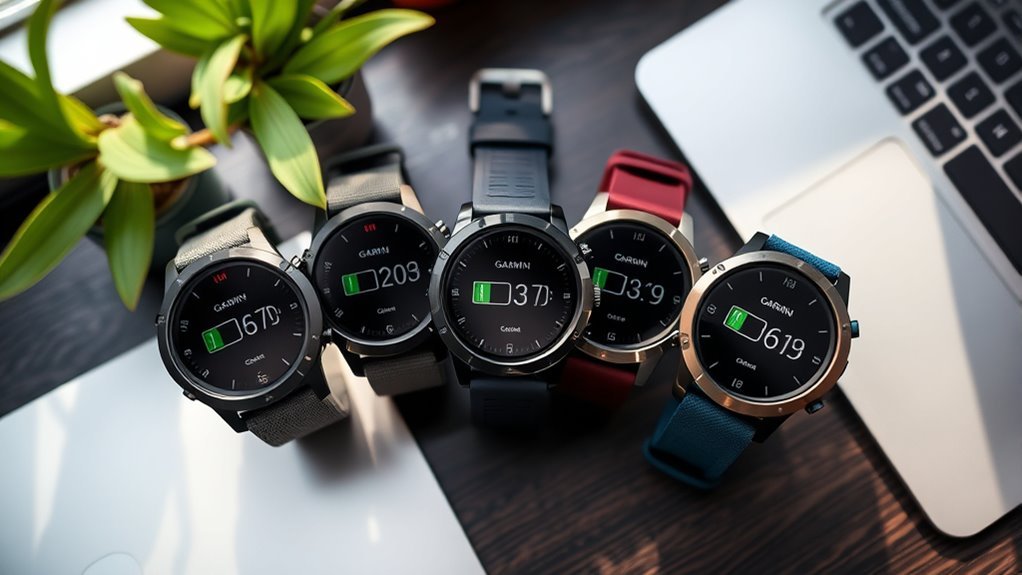
Garmin watch battery life varies dramatically by model, size, display type, GPS mode, and solar exposure. Rugged models such as the Instinct 3 Solar, Enduro 3, and fēnix 8 Solar can run for weeks between charges, while Forerunner, Venu, vívoactive, and vívomove models trade some endurance for brighter displays, compact designs, and everyday smartwatch features.
Quick Answer
Among Garmin’s rechargeable GPS watches, the Instinct 3 Solar 50 mm offers standout smartwatch endurance: up to 40 days normally and unlimited with sufficient solar exposure. Enduro 3 reaches up to 36 days, or 90 days with solar, while the fēnix 8 Solar 51 mm reaches up to 30 days, or 48 days with solar.
Garmin’s published figures are manufacturer-rated maximums under specific test conditions. GPS use, music, display brightness, always-on display, notifications, sensors, temperature, and solar exposure can change real-world battery life.
Key Takeaways
Key Takeaways
- Instinct 3 Solar 50 mm is one of Garmin’s longest-lasting rechargeable watches, rated for up to 40 days in smartwatch mode and unlimited runtime with sufficient daily solar exposure.
- Enduro 3 reaches up to 36 days normally or 90 days with solar and is particularly strong for long GPS activities.
- fēnix 8 Solar 51 mm reaches up to 30 days normally or 48 days with solar while adding mapping and advanced outdoor features.
- Forerunner 970 reaches up to 15 days, while the current Forerunner 570 reaches up to 11 days depending on size.
- Venu 4, vívoactive 6, and vívomove prioritize everyday smartwatch features, with maximum smartwatch ratings of roughly 5 to 12 days depending on model.
Which Garmin Watch Has the Best Battery Life?
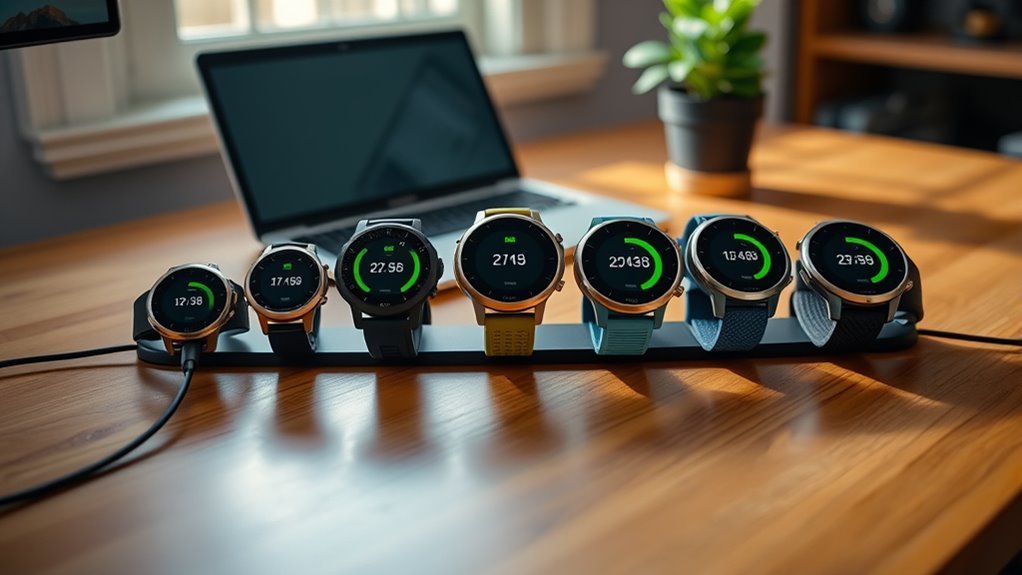
For current rechargeable Garmin GPS watches, the Instinct 3 Solar 50 mm is one of the strongest choices for maximum smartwatch-mode battery life. Garmin rates it for up to 40 days of typical smartwatch use and unlimited battery life with solar when its solar-use assumptions are met.
Those solar figures are conditional. Garmin assumes all-day wear with about three hours per day outdoors in 50,000-lux conditions for the unlimited smartwatch rating. It should not be interpreted as one short solar session permanently eliminating the need to charge.
The Enduro 3 is another endurance leader. Garmin rates it for up to 36 days of typical smartwatch use or 90 days with solar. It is especially impressive during long GPS activities, with up to 120 hours in GPS-only mode or 320 hours with qualifying solar exposure.
The fēnix 8 Solar 51 mm combines long battery life with mapping and premium outdoor features. Its smartwatch rating is up to 30 days under typical use or 48 days with solar. The smaller 47 mm Solar version is rated for up to 21 days normally or 28 days with solar.
| Garmin model | Smartwatch battery life | Best fit |
|---|---|---|
| Instinct 3 Solar 50 mm | Up to 40 days; unlimited with qualifying solar | Maximum everyday endurance and rugged outdoor use |
| Enduro 3 | Up to 36 days; 90 days with solar | Ultrarunning and long GPS activities |
| fēnix 8 Solar 51 mm | Up to 30 days; 48 days with solar | Maps, outdoor navigation, and multisport use |
| Forerunner 970 | Up to 15 days | Running and triathlon training |
| Forerunner 570 47 mm | Up to 11 days | Training features in a lighter running watch |
| Venu 4 45 mm | Up to 12 days | Health, fitness, and everyday smartwatch use |
| vívoactive 6 | Up to 11 days | Fitness tracking and everyday use |
| vívomove series | Up to 5 days | Hybrid-watch styling |
Note: Garmin’s vívofit jr. 3 is rated for up to one year of battery life, but it uses a replaceable coin-cell battery and is not directly comparable with rechargeable GPS smartwatches such as Instinct, Enduro, fēnix, or Forerunner.
Garmin Battery Life by Watch Series
Garmin battery life varies by series because each family is designed around a different balance of display technology, sensors, navigation, training features, case size, and power consumption.
Instinct and Enduro emphasize endurance. fēnix combines long runtime with maps and advanced outdoor functions. Forerunner focuses on running and triathlon. Venu and vívoactive emphasize AMOLED displays and everyday fitness features, while vívomove uses a hybrid analog-style design.
Forerunner and fēnix Battery
Current Forerunner models provide strong battery life for runners without matching the extreme endurance of Garmin’s largest solar outdoor watches. The Forerunner 970 is rated for up to 15 days in smartwatch mode, while the Forerunner 570 reaches up to 10 days in its 42 mm size and 11 days in its 47 mm size.
The fēnix family offers considerably longer maximum runtime in larger configurations. The fēnix 8 Solar 51 mm reaches up to 30 days of typical smartwatch use and 48 days with qualifying solar exposure.
| Model | Smartwatch mode |
|---|---|
| Forerunner 570 42 mm | Up to 10 days |
| Forerunner 570 47 mm | Up to 11 days |
| Forerunner 970 | Up to 15 days |
| fēnix 8 Solar 47 mm | Up to 21 days; 28 days with solar |
| fēnix 8 Solar 51 mm | Up to 30 days; 48 days with solar |
Forerunner is generally the better fit when low weight and training features matter more than maximum runtime. fēnix is designed for users who also want navigation, mapping, rugged construction, and longer intervals between charges.
Instinct, Venu, and Enduro
Instinct, Venu, and Enduro target very different users. Instinct 3 Solar prioritizes ruggedness and long battery life, while Enduro 3 is optimized for ultra-endurance activities. Venu 4 uses a bright AMOLED display and focuses more heavily on health, fitness, and everyday smartwatch features.
- Instinct 3 Solar 50 mm: up to 40 days in smartwatch mode and unlimited with qualifying solar exposure.
- Enduro 3: up to 36 days normally or 90 days with solar in smartwatch mode.
- Venu 4: up to 10 days on the 41 mm version or 12 days on the 45 mm version.
These numbers show why comparing Garmin watches only by product family can be misleading. Display type, physical size, GPS configuration, music use, and solar capability can change the result substantially.
Forerunner Battery Life for Runners and Triathletes
Garmin’s current Forerunner lineup combines training tools with battery life measured in days rather than hours during normal smartwatch use. The Forerunner 570 reaches up to 10 or 11 days depending on case size, while the premium Forerunner 970 reaches up to 15 days.
The Forerunner 970 is rated for up to 26 hours in GPS-only GNSS mode, 23 hours in Auto Select mode, and 21 hours with all-systems plus multi-band GNSS. Adding music reduces those figures further.
That difference matters for runners and triathletes because smartwatch-mode battery life does not tell you how long the watch will last during a GPS-recorded race. A watch capable of lasting two weeks between everyday charges may still need charging before a long race or multi-day GPS event.
Forerunner watches also support features such as wrist-based heart rate, activity tracking, phone notifications, training data, and GPS. The more frequently power-intensive functions are used, the further real-world runtime can fall below the published maximum.
fēnix, Enduro, and Instinct Battery Life
For outdoor-focused users, Garmin’s fēnix, Enduro, and Instinct families provide some of the company’s longest rechargeable-watch runtimes.
Garmin rates the Enduro 3 for up to 36 days of typical smartwatch use or 90 days with qualifying solar exposure.
- fēnix 8 Solar 51 mm: up to 30 days normally or 48 days with solar, plus maps and advanced outdoor navigation.
- Enduro 3: up to 36 days normally or 90 days with solar, with especially long GPS-mode endurance.
- Instinct 3 Solar 50 mm: up to 40 days normally and unlimited in smartwatch mode when Garmin’s solar assumptions are met.
Enduro 3 is particularly notable during long activities. Garmin rates it for up to 120 hours in GPS-only mode, 80 hours using all satellite systems, and 60 hours with all-satellite plus multi-band operation before solar extensions are considered.
The fēnix 8 Solar 51 mm reaches up to 95 hours in GPS-only mode, while the Instinct 3 Solar 50 mm reaches up to 60 hours before solar contribution. Exact battery life varies with settings and conditions.
Venu, Vívoactive, and Vívomove Battery Life
Garmin’s lifestyle and wellness watches use a different battery strategy. Their displays and smartwatch features can demand more power than low-power outdoor designs, but they still typically last several days between charges.
The current Venu 4 reaches up to 10 days on the 41 mm model or 12 days on the 45 mm model. The vívoactive 6 reaches up to 11 days, while Garmin lists the vívomove series at up to 5 days in smartwatch mode.
Venu Battery Performance
Venu 4 balances a bright AMOLED display with multi-day battery life. Garmin rates the 41 mm version for up to 10 days and the 45 mm version for up to 12 days in smartwatch mode.
Battery consumption increases when power-intensive features are used frequently. GPS activities, music playback, higher display activity, phone connectivity, and continuous sensor use can all shorten the interval between charges.
- Venu 4 41 mm: up to 10 days in smartwatch mode.
- Venu 4 45 mm: up to 12 days in smartwatch mode.
- GPS-only mode: up to 15 hours on the 41 mm or 20 hours on the 45 mm.
Vívoactive Battery Details
The current vívoactive 6 is rated for up to 11 days in smartwatch mode. It can also reach up to 21 hours in GPS-only mode or 17 hours using all satellite systems.
| Model | Maximum smartwatch battery |
|---|---|
| Venu 4 45 mm | Up to 12 days |
| vívoactive 6 | Up to 11 days |
| vívomove series | Up to 5 days |
For users who want fitness tracking without the bulk of an outdoor watch, vívoactive 6 offers a useful balance between AMOLED display quality, activity features, and battery endurance.
Vívomove Daily Longevity
Garmin’s vívomove watches combine traditional analog-style hands with hidden smart displays. Garmin lists the series at up to 5 days of smartwatch-mode battery life, although exact capabilities differ by individual vívomove model.
- Vívomove: hybrid styling and essential smart features with up to 5 days of smartwatch operation.
- Venu 4: brighter AMOLED smartwatch experience with up to 12 days on the 45 mm version.
- Vívoactive 6: fitness-focused AMOLED watch with up to 11 days.
Real-world runtime depends on how frequently the display, connected features, GPS, notifications, and sensors are used.
How Solar Charging Extends Garmin Battery Life
Solar charging can substantially extend battery life on compatible Garmin models, but Garmin’s solar ratings depend on specific light conditions rather than ordinary indoor exposure.
Solar is most effective on watches built around it rather than added as an option, since the lens and the power budget are designed together. Our Instinct comparison covers which versions carry the solar lens.
For the Instinct 3 Solar, Garmin’s unlimited smartwatch-mode rating assumes all-day wear with approximately three hours per day outdoors in 50,000-lux conditions. The 45 mm model is rated for up to 28 days without that solar contribution, while the 50 mm version reaches up to 40 days.
Enduro 3 uses a similar solar assumption for its smartwatch rating, increasing from up to 36 days of typical use to as much as 90 days with solar. The fēnix 8 Solar 51 mm rises from up to 30 days to 48 days.
Note: “Unlimited with solar” does not mean the watch instantly becomes self-sustaining after one sunny afternoon. It is a manufacturer rating based on recurring daily light exposure and specified usage assumptions.
Solar contribution is most useful for people who spend substantial time outdoors. Indoor lighting generally does not provide the same charging benefit as strong outdoor sunlight.
Which GPS Settings Drain Garmin Battery Fastest?
GNSS configuration can make a major difference to Garmin battery life. Within the same watch, modes that use more satellite systems or multi-band positioning generally consume more power than GPS-only operation.
The Forerunner 970 illustrates the difference clearly. Garmin rates it for up to 26 hours in GPS-only mode, 23 hours using Auto Select, and 21 hours using all satellite systems plus multi-band. With music playing, those ratings fall to 14, 13, and 12 hours respectively.
Enduro 3 shows an even larger spread: up to 120 hours in GPS-only mode, 80 hours with all satellite systems, and 60 hours using all satellite systems plus multi-band before solar extensions.
- GPS-only: usually the lower-power choice when basic positioning is sufficient.
- Auto Select / SatIQ: dynamically uses the satellite configuration needed for current conditions on compatible watches.
- All Systems + Multi-Band: prioritizes positioning performance in difficult environments but generally uses more battery.
- Max Battery GPS or UltraTrac: extends runtime by reducing power consumption and, depending on the device, reducing GPS sampling or other functions.
- Music playback: can substantially shorten activity-mode battery life.
There is no single universal GPS runtime for Garmin watches, so figures such as “14 hours of GPS” should not be applied across the entire lineup.
How to Make a Garmin Watch Battery Last Longer
If your priority is extending the time between charges, start with the settings that consume the most power rather than disabling every smartwatch feature.
- Use GPS-only or Auto Select/SatIQ instead of forcing multi-band GNSS when maximum precision is unnecessary.
- Turn off an always-on AMOLED display if your model supports gesture-based display activation.
- Lower display or backlight brightness when practical.
- Limit music playback during long GPS activities.
- Reduce unnecessary phone notifications and connected-sensor use.
- Use battery-saver or Max Battery GPS modes when maximum runtime matters more than full functionality.
- Keep watch software current if unexpected battery drain begins after normal use.
- Avoid prolonged exposure to extreme heat, which can accelerate lithium-ion battery degradation.
Pro Tip: Before a long race, hike, or trip, check the estimated battery remaining after selecting the exact activity and satellite mode you intend to use. Smartwatch-mode days do not predict GPS-activity runtime.
Frequently Asked Questions
What Is the Battery Life of Different Garmin Watches?
It varies widely. Current examples include up to 40 days on the Instinct 3 Solar 50 mm, 36 days on Enduro 3, 30 days on the fēnix 8 Solar 51 mm, 15 days on Forerunner 970, 12 days on Venu 4 45 mm, 11 days on vívoactive 6, and about 5 days on the vívomove series. Solar can extend compatible models further.
Which Garmin Watch Has the Longest Battery Life?
Among current rechargeable Garmin GPS watches, the Instinct 3 Solar 50 mm is a standout for smartwatch endurance. Garmin rates it for up to 40 days of typical use and unlimited operation with sufficient daily solar exposure under its specified conditions. Enduro 3 reaches up to 90 days with solar and is especially strong for extended GPS activities.
Which Garmin Watch Has the Best Battery Life?
For maximum smartwatch-mode endurance, Instinct 3 Solar is one of the strongest current choices. For ultra-endurance GPS activities, Enduro 3 offers exceptionally long activity runtimes. fēnix 8 Solar is a strong alternative when long battery life must be combined with advanced mapping and outdoor features.
How Many Years Should a Garmin Battery Last?
Garmin does not publish a universal 2-year, 3-year, or 5-year replacement interval. Garmin says its rechargeable batteries should retain approximately 80% of their original capacity after a few years of frequent charge and discharge cycles under normal operating conditions. Extreme temperatures and leaving a battery fully charged or fully discharged for long periods can accelerate capacity loss.
Does Garmin Solar Charging Mean You Never Need a Charger?
Not necessarily. “Unlimited with solar” applies only to certain models and operating modes when Garmin’s solar-exposure assumptions are met. Cloud cover, indoor use, GPS activity, music, sensors, and other power demands can still make wired charging necessary.
Why Is My Garmin Battery Draining Faster Than the Published Rating?
Published ratings use defined test assumptions. Frequent GPS use, multi-band positioning, music, an always-on AMOLED display, high brightness, notifications, connected sensors, temperature, and battery age can all reduce real-world runtime.
Conclusion
Garmin battery performance varies sharply by watch family, size, display, GPS configuration, and solar exposure. Instinct 3 Solar provides exceptional everyday endurance, Enduro 3 is built around ultra-long activity runtime, and fēnix 8 Solar combines long battery life with advanced navigation. Forerunner balances training features and endurance, while Venu, vívoactive, and vívomove prioritize everyday smartwatch design and features. Treat Garmin’s published numbers as maximum manufacturer ratings rather than guaranteed real-world results, and compare the exact mode you expect to use most often.
Sources
- Garmin — How Long Will My Garmin Smartwatch Battery Last? — current smartwatch-mode comparisons across Garmin product families.
- Garmin Instinct 3 Solar Owner’s Manual — smartwatch, GPS, multi-band, battery-saver, expedition, and solar battery ratings.
- Garmin Enduro 3 Owner’s Manual — smartwatch and GPS-mode battery specifications and solar assumptions.
- Garmin fēnix 8 Owner’s Manual — size-specific fēnix 8 Solar battery figures.
- Garmin Forerunner 970 Owner’s Manual — smartwatch, GPS-only, Auto Select, multi-band, and music battery figures.
- Garmin Support — Rechargeable Battery Life Expectancy — lithium-ion capacity degradation and battery-care guidance.
