Hand launching or hand recovering a drone can be useful when sand, snow, mud, tall grass, rocks, a small boat deck, or another unsafe surface makes a normal takeoff or landing difficult. It should still be a backup technique, not your default. The safest procedure depends on the exact aircraft because palm-control features, landing protection, vision sensors, and motor-stop behavior vary by model.
Last updated: September 11, 2026
Evidence note: This guide is based on current FAA recreational-flight guidance, NOAA/U.S. Coast Guard hand-launch and recovery guidance, and manufacturer documentation. It does not assume that one hand-launch procedure works for every drone model.
Quick Answer
Use a normal ground takeoff or landing whenever it is safer. If hand launching is necessary and your aircraft permits it, hold the drone from underneath, keep it level and away from your body, keep every finger clear of the propellers, and let the aircraft lift under its own power. For hand recovery, stabilize the aircraft first, initiate its normal landing sequence, and move your hand underneath only when the aircraft is controlled. Stop if wind, people, obstacles, low battery, poor footing, or unexpected aircraft behavior makes the maneuver unsafe.
Key Takeaways
- Treat hand launching and hand recovery as backup methods when a normal landing surface is unsuitable.
- Follow the manual for your exact drone; palm-control features and sensor behavior differ by model.
- Keep the aircraft level, away from your body, and clear of fingers, hair, loose clothing, and straps.
- Abort in gusty wind, around bystanders, with poor footing, or whenever the aircraft does something you did not expect.
- Do not use a catch-and-flip maneuver as a routine way to stop the motors.
At a Glance
| Time Required | No fixed safe duration; complete the pre-flight checks before starting the motors |
| Difficulty | Model-dependent; practice normal takeoffs and landings first |
| Tools Needed | Drone, controller if required by the model, charged battery, model manual, and an optional controller lanyard |
| Best Alternative | Clear, flat ground or a landing pad whenever either provides the safer option |
When Is a Hand Launch or Hand Recovery Worth the Risk?
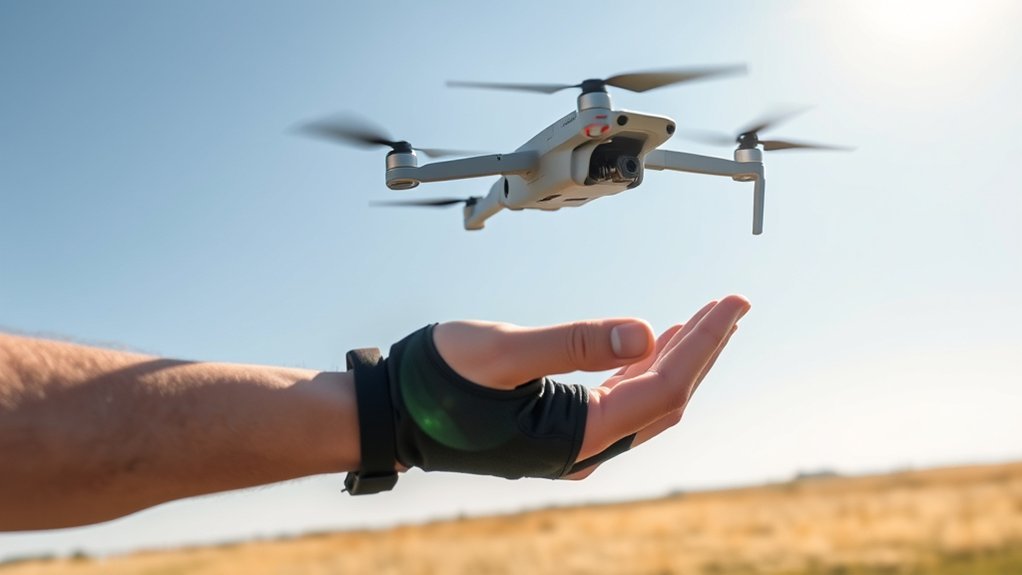
Consider a hand launch or hand recovery only when the normal surface creates a greater problem. Examples include loose sand that could enter motors, deep grass, mud, snow, sharp rocks, a cramped deck, or terrain where the aircraft cannot sit level.
NOAA/U.S. Coast Guard guidance for rotary-wing UAS recommends practicing the technique in a stable environment before using it in a difficult one. It also says to follow the manufacturer’s instructions whenever model-specific guidance is available.
A landing pad or a short move to clear, level ground is usually the lower-risk choice. The purpose of hand recovery is not convenience; it is to solve a situation where the normal method is less suitable.
Use the hand method because the normal surface is worse, not because hand catching looks faster.
Before committing, identify a second landing option. If the hand recovery becomes unstable, you should already know where you can put the aircraft down without reaching toward it.
Warning: Do not hand launch or recover a drone near children, pets, bystanders, traffic, power lines, moving obstacles, or anything that could enter the propeller area. If you cannot control the area, choose another landing point.
What Makes a Hand Launch Unsafe?
A hand maneuver becomes unsafe when you have to rush, stretch, chase the aircraft, stand on unstable footing, or divide your attention between several hazards. Gusts, unexpected sensor behavior, a low battery, nearby movement, and loose clothing can turn a controlled maneuver into a propeller-contact risk.
Keep the aircraft away from your face and torso. Tie back long hair and secure sleeves, backpack straps, camera straps, and anything else that can swing into a propeller.
Do not rely on gloves or propeller guards to make a bad situation acceptable. Protective equipment may add a layer of protection in specialized operations, but the safer response to an uncontrolled environment is to change the launch or landing method.
Use a Stop/Go Check Before the Motors Start
Before you start the motors, ask four questions: Is the aircraft behaving normally? Is the wind steady enough? Is the area clear? Can you complete the maneuver without changing your footing or reaching toward the propellers?
Also confirm the battery is seated, the propellers are undamaged, the controller is connected when required, and any home-point, GNSS, vision-system, or flight-mode status you plan to rely on is ready.
If you feel rushed, distracted, off balance, or surprised by the aircraft, the correct action is to stop the maneuver.
For U.S. recreational flying, hand launching does not change the normal FAA requirements. Recreational pilots still need to follow the applicable rules, including TRUST requirements, visual line of sight, applicable registration requirements, and airspace restrictions.
Secure the Controller Before You Handle the Aircraft
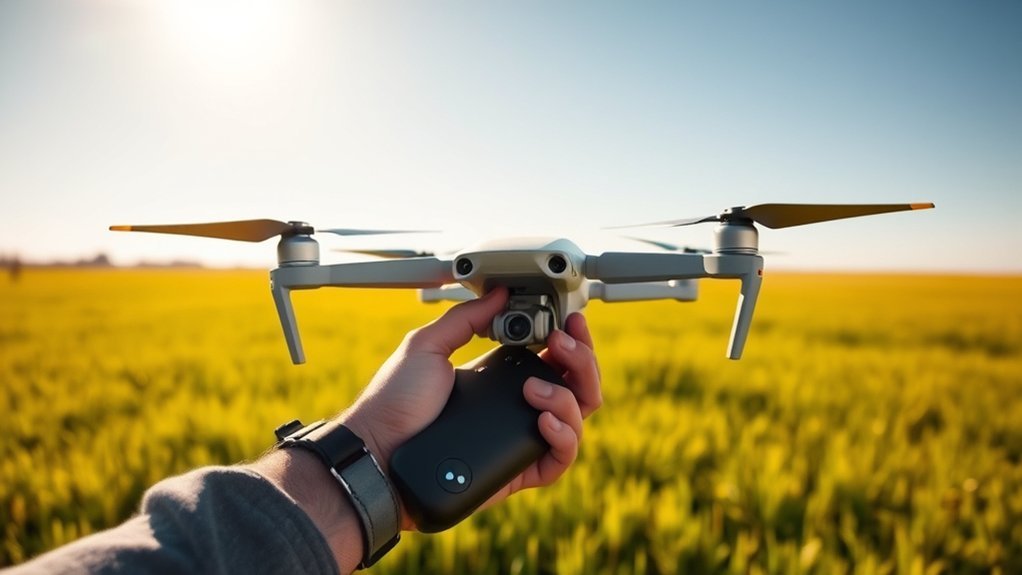
If your controller accepts a lanyard, securing it before the motors start can reduce the chance of dropping the controller while one hand is occupied. The controller should hang where you can reach the sticks or landing control without looking away from the aircraft for long.
A lanyard is an organization tool, not permission to perform a one-person catch that feels awkward. If you cannot keep stable control of both the aircraft and controller, use a second person or choose a ground landing.
Pro Tip: Set the lanyard length and controller position before powering the motors. Do not adjust straps while the aircraft is spinning in your hand.
Use Two People When the Situation Is Difficult
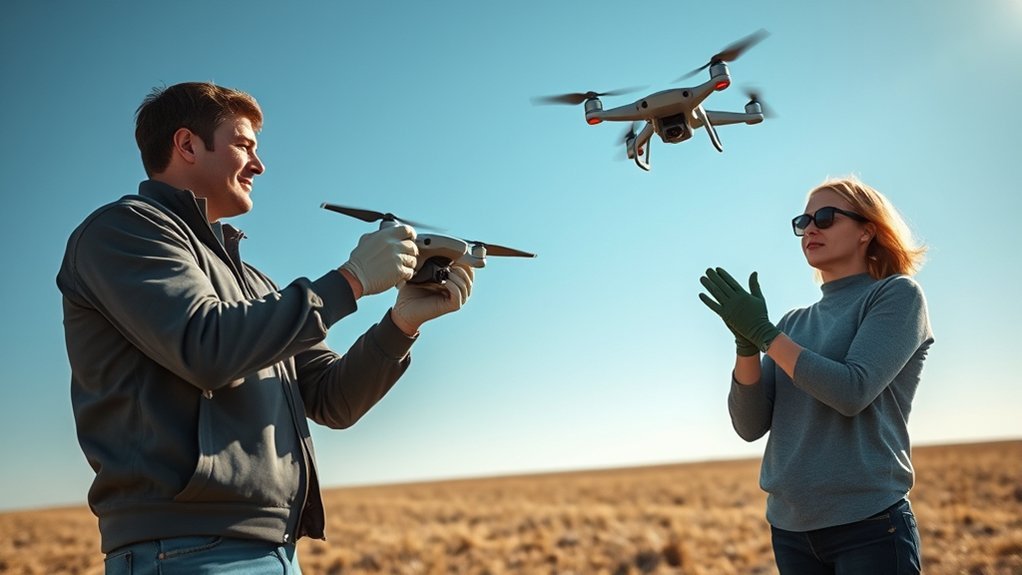
A two-person recovery separates aircraft control from physical handling. One person can remain the pilot while the second person concentrates on footing, hand position, the aircraft, and nearby hazards.
NOAA/U.S. Coast Guard guidance recommends a pilot and trained observer for difficult vessel hand-launch and recovery operations. It also advises practicing on land before attempting the maneuver on a vessel.
Agree on simple commands before the motors start: ready, landing, secure, and abort. The pilot should not power down until the catcher has a secure hold and the procedure for that aircraft calls for motor shutdown.
If you are alone and the maneuver requires awkward multitasking, move to a safer landing location instead of forcing a one-person catch.
Pre-Flight Safety Check Before a Hand Launch
A hand launch leaves less room for correcting a setup mistake because the aircraft is already close to your body. Complete the normal aircraft inspection first.
- Inspect the aircraft: Check the arms, body, propellers, guards, motors, battery, vents, and sensors for visible damage or debris.
- Confirm battery status: Make sure the battery is fully seated and has enough remaining charge for the flight and planned recovery.
- Confirm control: Verify the controller or approved control method is connected and responding normally.
- Check navigation status: Confirm any GNSS, home-point, positioning, vision, or flight-mode feature you intend to rely on is ready.
- Check the area: There is no universal hand-launch clearance distance. Use enough open space that an unexpected drift cannot put the aircraft into you, another person, vegetation, structures, vehicles, or other hazards.
- Check the wind: Do not continue if gusts make the aircraft difficult to hold level or could push it toward you.
- Plan the landing: Identify a safe alternative landing point before takeoff.
In the United States, check the applicable airspace before flight and follow the FAA rules for the type of operation you are conducting.
How Should You Hold a Drone for Hand Launch?
Follow the safe grip area shown in your aircraft manual. For a conventional rotary-wing hand launch, authoritative operational guidance recommends holding the aircraft from underneath, keeping it level and away from your body, and keeping every body part outside the propeller arc.
Do not assume a grip that works on one drone is safe on another. Sensors, cooling vents, batteries, folding arms, propeller paths, and palm-control designs differ.
Keep Fingers Outside the Propeller Arc
Before the motors start, confirm where the propeller tips will travel. Hold the aircraft only where your model provides enough separation between your hand and that path.
Keep the camera facing away from your body when the aircraft design and manufacturer procedure allow it. NOAA/U.S. Coast Guard guidance specifically recommends this orientation during a rotary-wing hand launch.
Once the motors are running, do not change from a safe grip to a different grip merely because the aircraft shifts slightly. If you lose a stable hold before takeoff, shut the motors down according to the manufacturer procedure and reset.
Open Palm or Secure Underside Grip?
The correct hand position depends on the aircraft. Some models are specifically designed for palm takeoff. Other drones require a secure approved grip underneath the fuselage until they generate enough lift to leave the hand.
DJI Neo, for example, has a manufacturer-supported Palm Control mode. DJI instructs the user to keep the palm straight and still and allows the aircraft to perform an automatic palm takeoff or landing. That feature should not be generalized to every DJI Mini, Mavic, or other consumer drone.
Practice the hand position with the motors off first. You should be able to hold the aircraft without putting a finger near a propeller, sensor, vent, or moving part.
How Wind Changes a Hand Launch or Recovery
Wind matters most when it changes suddenly. A small multirotor that is stable in your hand can move sideways as soon as it becomes airborne or as it descends toward your hand.
Use calm or light, steady conditions while learning. When practical, position yourself upwind of the aircraft so a gust is less likely to drive the aircraft toward your body. NOAA/U.S. Coast Guard guidance likewise places launch and recovery personnel upwind of the aircraft.
Be especially cautious around vessels, cliffs, buildings, ridges, trees, and other structures that can create changing airflow. If the aircraft tilts, fights your grip, or will not hold a predictable hover, abandon the hand maneuver.
Over water, do not assume downward vision sensors will behave exactly as they do over textured ground. DJI documentation for models such as the Mini 4 Pro warns that downward vision performance can be affected over water.
The useful wind limit is not one internet number. Stop when the aircraft can no longer remain predictable around your hand and body.
Let the Aircraft Lift and Descend Under Power
Do not turn a normal multirotor hand launch into a throw unless the manufacturer specifically designed that aircraft for a throw-launch procedure. For a conventional rotary-wing hand launch, keep the aircraft level and allow its own motors to lift it away.
A practical sequence is:
- Use the approved takeoff command: Follow the exact manufacturer procedure. Depending on the model, that may be an automated or manual takeoff.
- Hold steady: Keep the aircraft level, away from your body, and in the approved grip while lift builds.
- Release instead of pushing: Relax your grip when the aircraft is lifting cleanly and let it move away under its own power.
- Establish separation: Once airborne, move your hand away and let the aircraft reach a stable hover before flying away.
The same principle applies on recovery: use the aircraft’s landing behavior rather than trying to snatch a hovering drone out of the air.
Step-by-Step: How to Hand Launch a Drone
Use this sequence only after checking the manual for your exact model. A manufacturer-specific palm-launch or throw-launch feature takes priority over a generic procedure.
- Choose the safest available launch method: Use normal ground takeoff if a suitable surface is available.
- Clear the area: Keep people, pets, traffic, structures, vegetation, and loose objects away from the aircraft.
- Check the wind and your footing: Stop if you cannot stand securely or keep the aircraft stable.
- Secure the controller: If the model uses a controller, place it where the pilot can operate the controls without an awkward grip.
- Hold the aircraft in its approved safe area: For a conventional rotary-wing launch, hold it from underneath, level and away from your body.
- Keep the camera and propellers away from you: Confirm fingers, clothing, hair, and straps cannot enter the propeller path.
- Initiate the approved takeoff: Use the manufacturer’s normal hand-launch, automatic-takeoff, or manual-takeoff procedure for that model.
- Let the aircraft lift itself: Do not shove it upward. Release only when it is producing stable lift.
- Move your hand away: Once the aircraft is clear, lower your arm and establish safe separation.
- Check the hover: Confirm normal response before continuing the flight.
If the aircraft tilts unexpectedly, produces an abnormal motor sound, reports a sensor or battery problem, or does not respond as expected, stop the operation rather than improvising around spinning propellers.
How to Hand Recover a Drone Safely
A hand recovery should begin with a controlled aircraft, not with your hand reaching toward a moving one. Bring the drone back with enough battery to avoid a rushed landing and establish a stable hover in a clear area.
For a conventional two-person rotary-wing recovery, NOAA/U.S. Coast Guard guidance recommends positioning the aircraft above and slightly downwind of the catcher, with the camera facing away. The pilot should initiate the aircraft’s landing sequence before the catcher moves a hand beneath it.
The catcher should have solid footing, keep the arm away from the body, approach from underneath, and keep fingers outside the propeller path. Once the aircraft is securely held, the pilot can shut down the motors using the normal procedure.
For a one-person consumer drone, follow the exact manufacturer instructions. A model with manufacturer-supported palm landing may descend automatically onto an open hand, while another aircraft may use landing protection or downward sensors that change its response.
Note: Do not disable a sensor merely because an online tutorial tells you to. First check whether your exact aircraft allows that setting and what the manufacturer says it changes.
Common Hand-Launch and Recovery Mistakes
Most avoidable problems start before the aircraft reaches the hand. Watch for these patterns:
- Treating every drone the same: Palm-control, landing-protection, sensor, and motor-stop behavior differ by model.
- Throwing a normal multirotor: Use a throw only when the aircraft has a manufacturer-approved throw-launch procedure.
- Reaching from the side or top: This can move fingers or an arm toward the propeller arc.
- Chasing the aircraft with your hand: Back away and regain flight control instead.
- Changing footing during recovery: Establish a stable stance before initiating the landing.
- Waiting until the battery is critically low: Return with enough margin to choose another landing method if needed.
- Ignoring sensor behavior: Landing protection and downward vision can change how some aircraft descend near a hand.
- Practicing in gusts: Learn the procedure in calm, controlled conditions first.
- Assuming a hand catch makes a crowded location safe: It does not remove the risk to nearby people.
A good hand recovery should be slow enough that you can abandon it before touching the aircraft.
Why You Should Avoid the Catch-and-Flip Method
The catch-and-flip technique involves grabbing a hovering or recently caught drone and rotating it sharply so its flight controller stops the motors. Some aircraft may react that way, but it is not a good general recovery method.
NOAA/U.S. Coast Guard hand-recovery guidance specifically says not to flip the UAV after it has been caught. The guidance notes both increased injury risk and possible motor damage.
Flipping also moves your wrist and forearm closer to the propellers while the aircraft may still be actively trying to correct its attitude. A model can respond differently after a firmware change, a sensor change, or a different flight mode.
Use the manufacturer’s normal landing and motor-stop procedure instead. If the aircraft does not behave as expected, keep body parts away from the propellers and move to the safest available landing option.
What to Do If the Hand Recovery Goes Wrong
If the aircraft drifts, climbs, drops, rotates, or moves toward you, pull your hand away. Do not chase it or attempt a fast grab.
If you still have flight control, move the drone away from people and obstacles and re-establish a stable hover. Then choose a normal landing surface or make a second recovery attempt only if the conditions that caused the problem have been resolved.
If low battery or another aircraft problem removes that option, prioritize avoiding injury and nearby people over protecting the drone from a rough landing.
After a propeller strike, hard landing, or contact with clothing or another object, power the aircraft down and inspect the propellers, motors, arms, battery, gimbal, and sensors before flying again.
Related Guides
Frequently Asked Questions
How do you catch a drone with your hand?
First confirm that your exact drone can be recovered by hand. Stabilize it in a clear area, follow its normal landing procedure, and approach only from the safe direction specified by the manufacturer. For a conventional two-person recovery, keep the aircraft slightly downwind of the catcher, initiate landing first, then place the hand underneath while keeping fingers outside the propeller path. Shut the motors down only through the approved procedure.
How do beginners launch a drone by hand?
Beginners should learn normal ground takeoffs, hovering, landings, and emergency responses first. If hand launching is later necessary, practice the hand position with the motors off, use calm conditions and a clear area, follow the exact model manual, and let a conventional rotary-wing aircraft lift itself instead of throwing it.
What clearance is required to hand launch a drone?
There is no universal 10-foot, 15-foot, or other single clearance distance for every hand launch. Follow the operating limits for your aircraft and use enough open space that an unexpected drift cannot put the drone into you, another person, vegetation, a structure, a vehicle, or another hazard. Increase your safety margin when conditions are less predictable.
How do you launch and land a DJI Mini from your hand?
Do not assume that every DJI Mini has the same hand-launch or hand-landing procedure. Check the manual and DJI support information for your exact Mini model because landing protection, vision sensing, controller behavior, and motor shutdown can differ. DJI explicitly supports Palm Control on models such as DJI Neo, but that feature should not be treated as a universal DJI Mini procedure.
Is hand catching a drone safe?
It adds propeller-contact risk and should be used only when it is safer than the available ground-landing options. The risk is lower when the aircraft procedure is known, the area is controlled, the wind is steady, footing is secure, and the pilot can abort without reaching toward the propellers.
Should you wear gloves when catching a drone?
Protective gloves can add a layer of protection in some professional or difficult recovery situations, but they do not make an unsafe hand catch acceptable. Proper aircraft positioning, clear propeller separation, stable conditions, and the model-specific recovery procedure matter more.
Conclusion
Hand launching and hand recovery are useful backup skills when sand, snow, rough terrain, a vessel, or another unsuitable surface makes a normal landing difficult. They are not one-size-fits-all procedures.
Start with the manual for your exact aircraft. Keep the drone away from your body, keep fingers outside the propeller arc, use calm and controlled conditions, and let a conventional aircraft take off or descend through its approved flight controls rather than forcing it with your hand.
If the aircraft behaves unexpectedly, withdraw your hand and use another landing method. Protecting yourself and nearby people is more important than protecting the drone from a rough landing.
Sources
- FAA Recreational Flyers & Community-Based Organizations — current U.S. recreational-flight requirements including TRUST, visual line of sight, registration, altitude, and airspace responsibilities.
- FAA B4UFLY — supports checking airspace restrictions and flight-location information before recreational operations.
- NOAA / U.S. Coast Guard UAS Guidance and Training — supports hand-launch grip, two-person recovery, landing sequence, wind positioning, protective precautions, and the recommendation not to use catch-and-flip.
- DJI Neo Support — supports manufacturer-designed Palm Control and palm takeoff/landing guidance for DJI Neo.
- DJI Mini 4 Pro Downloads & User Manual — supports model-specific landing protection, downward vision-system behavior, and the need to consult the exact aircraft documentation.
