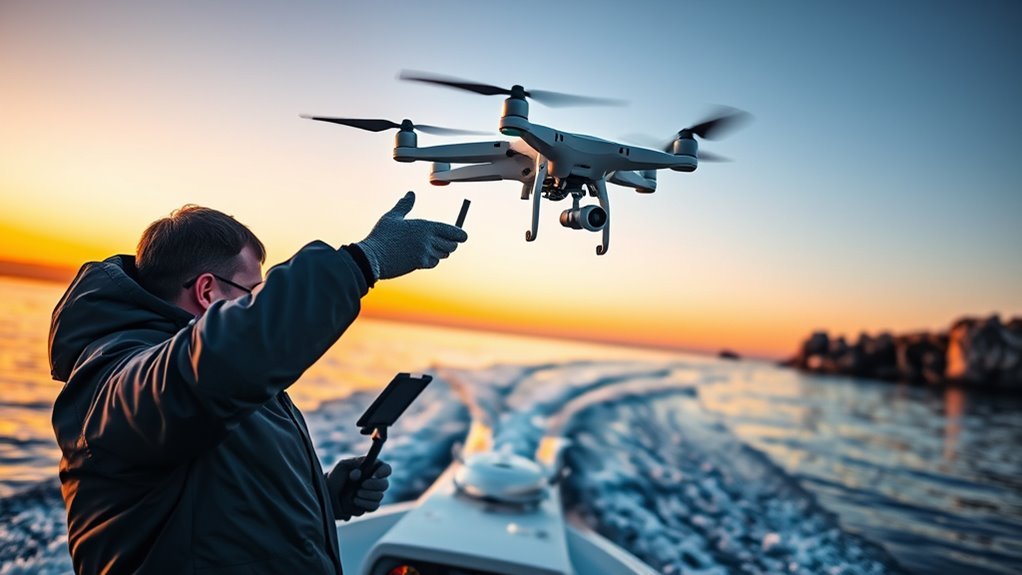
Before any launch, the drone should be calibrated and the home point confirmed while the boat remains still. Takeoff is usually safest from the stern, where airflow and obstacles are easier to manage. Landing is more demanding, since the vessel can drift and the deck can move under the aircraft. The catch technique may solve that problem, but only if timing, grip, and position are controlled.
Set Home Point and Compass First
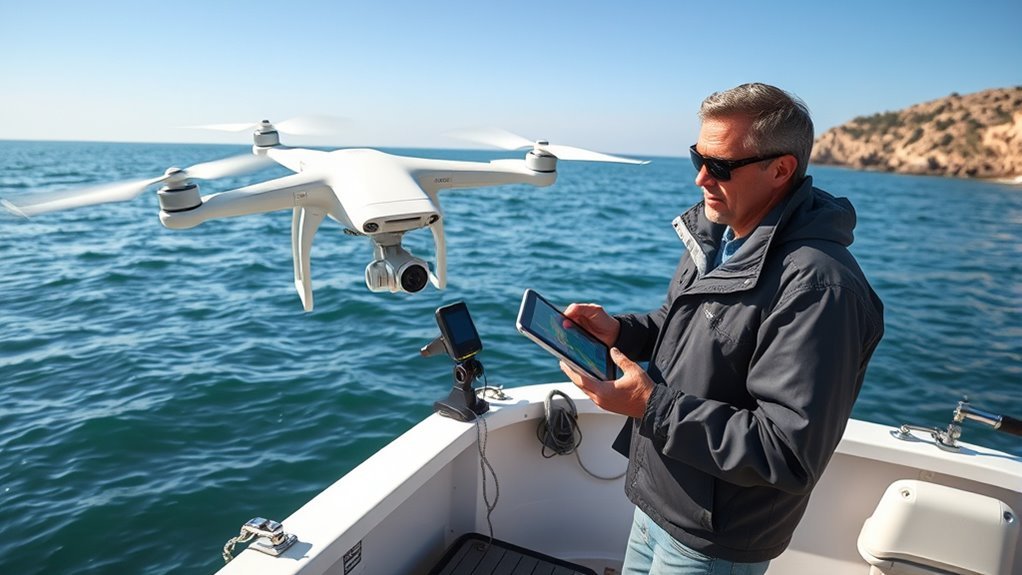
Before launching, the drone’s compass should be calibrated to eliminate navigation errors, especially over water where reference points are limited. The operator should keep the aircraft and boat stationary, then set the home point at the vessel’s current position. This step anchors return-to-home behavior to the actual launch site and reduces the risk of drift-induced failure.
A strong GPS signal should be confirmed before recording the home point, because weak satellite lock can compromise accuracy. Compass calibration requires rotating the drone horizontally and vertically until the software confirms completion.
In a detached point of view, this sequence is not optional; it is the system’s first defense against disorientation. When executed correctly, the craft gains a reliable recovery coordinate, supporting safe autonomy and greater freedom of movement.
Precision here protects the mission, preserves the platform, and allows the flight to proceed with disciplined confidence and minimal navigational uncertainty.
Launch the Drone Safely From the Stern
Launching from the stern gives the drone a safer, more stable release point and reduces the chance of contact with the boat. This method supports drone stability techniques by placing the aircraft in clean air and giving the operator a clear, controlled handoff.
Before release, the launch preparation checklist should confirm that the home point is set, the compass check is complete, and surrounding traffic is assessed. The drone should be held with one hand on the vertical leg to improve grip and limit unwanted motion.
Before release, confirm the home point, complete the compass check, and assess surrounding traffic.
Throttle up until the aircraft tries to lift, then release it smoothly so ascent remains controlled. Collision avoidance strategies require constant awareness of masts, rigging, and nearby vessels, because a brief distraction can create a hazardous drift.
Repeated practice refines timing, strengthens confidence, and helps the operator launch with disciplined freedom.
Choose the Right Boat Position for Takeoff
For takeoff, the stern remains the preferred position because it offers the most stable platform and reduces the chance of contact with the boat. This placement improves boat stability by keeping the launch area clear and by separating the drone from rails, gear, and passengers.
Before lift-off, the vessel should remain stationary; even minor drift can disturb alignment and complicate a controlled departure. The operator should assess water conditions and choose open water that preserves drone visibility throughout ascent and departure. A clear horizon also helps the pilot monitor heading and confirm that the home point is set accurately after compass orientation.
An assistant should steady the aircraft above head level until the motors are ready, then release it smoothly into free air. With the stern positioned correctly, the launch becomes disciplined, efficient, and compatible with a liberated workflow at sea.
Land the Drone With the Catch Technique
Landing with the catch technique requires the boat to move toward the drone rather than forcing the aircraft to close the final gap, reducing exposure to drift and impact.
The pilot should guide the aircraft toward the stern, where it can hover with controlled drone stability if the catch must be delayed. Before contact, the deck area should remain clear, and the operator should keep full awareness of lines, railings, and passengers to preserve landing precision.
When the craft reaches arm’s length, an open palm grip should secure the body from below, limiting torsion and improving control during recovery. These safety protocols support a clean handoff and reduce the chance of propeller contact.
After each attempt, the operator should record whether the catch succeeded, note wind behavior, and identify any handling difficulties. Systematic documentation strengthens future judgment, allowing disciplined crews to recover the aircraft efficiently while maintaining freedom of movement on the water.
Avoid Common Boat Landing Mistakes
Common errors during boat landings usually come from forcing the drone to close the gap on its own, which increases drift, impact risk, and loss of control. A safer method is to move the boat toward the drone, reducing relative motion and preserving drone stability.
Operators should avoid landing from the bow, where wind and deck movement often amplify landing errors; the stern offers a more controlled recovery zone. During launch, keeping one hand on the aircraft improves control and prevents unstable roll or yaw as power increases.
If alignment degrades, the drone should be held in a stable hover at a safe altitude until the platform is reset. These safety protocols protect both equipment and crew while allowing a clean touch down.
Every attempt should be documented, including mistakes and successful corrections, so technique improves through evidence rather than guesswork. That disciplined process supports safer, freer operations on open water.
Frequently Asked Questions
Is It Legal to Fly a Drone From a Boat?
Yes, it is generally legal to fly a drone from a boat, provided drone regulations are followed and boating safety is not compromised.
In the United States, FAA rules still apply, including registration for drones over 0.55 pounds and maintaining visual line of sight.
Local maritime restrictions, controlled airspace limits, and airport proximity may require permissions.
Used correctly, boat-based aerial photography remains a legitimate, liberated operational option.
What Is the 1:1 Rule for Drones?
The 1:1 rule for drones is a compass for safe flight: for every foot of altitude, the aircraft should remain at least one foot from obstacles.
This vertical and horizontal buffer supports drone safety, improves flight stability, and helps compensate for changing water conditions.
In practice, a drone at 100 feet should keep 100 feet clear of structures, trees, and hazards, preserving control, visibility, and operational freedom.
What Is the Best Drone to Fly From a Boat?
The DJI Mavic Air 2 is often the best drone to fly from a boat because it combines strong drone stability, compact size, and reliable boat compatibility.
It is easy to store, launch, and recover in confined decks.
The Autel EVO Lite+ is a strong alternative for higher image quality, while the DJI Mini 2 suits beginners.
Weather considerations should always guide selection, especially wind, spray, and visibility conditions.
Is It Legal for My Neighbor to Fly a Drone Over My House?
Yes, it is generally legal for a neighbor to fly a drone over a house if FAA airspace rules are followed and the flight remains within visual line of sight.
Property rights do not usually extend to stopping lawful overflight, but drone privacy, noise concerns, and unsafe behavior may trigger complaints.
State laws can add restrictions, especially around recording.
Affected owners should document incidents and review local rules.
Conclusion
Like a pilot balancing on a moving deck, safe boat drone operations depend on precision before motion. He or she should confirm compass calibration and a stable home point while the vessel is still. Takeoff from the stern remains the most controlled option, and landing is safest when the boat moves toward the drone and the catch technique is used carefully. With steady hands and clear awareness, the flight ends as securely as it begins.