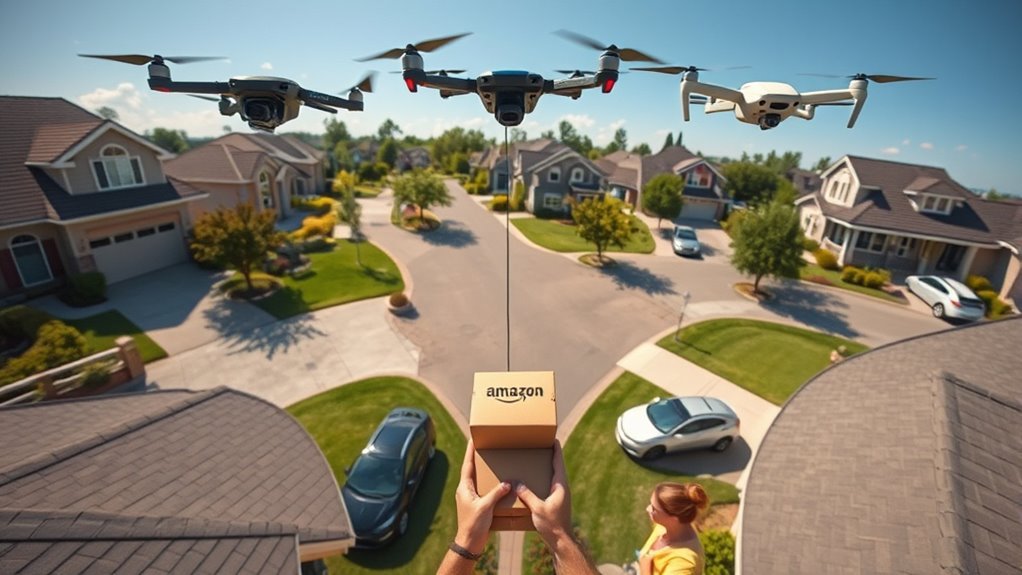
In 2026, U.S. drone delivery is no longer experimental. Amazon Prime Air, Wing, and Zipline each run distinct systems shaped by FAA rules, route limits, and payload constraints. Amazon focuses on small parcels and fast suburban drops, Wing relies on BVLOS corridor operations, and Zipline uses high-volume autonomous networks with precise delivery methods. The mechanics differ, but the core question remains: which model is actually scaling, and why?
Which Companies Deliver by Drone in the U.S.?
In the U.S. drone delivery market, a small number of operators dominate the landscape. The drone delivery sector is led by Amazon Prime Air, Wing, and Zipline, each scaling under FAA regulations.
Amazon Prime Air is pushing commercial deliveries into more US metro areas, with expansion toward nearly 500 cities and towns by late 2026.
Wing operates as a delivery operator in Dallas-Fort Worth and Canberra, using beyond visual line of sight authorization for suburban last-mile delivery.
Zipline remains the largest autonomous delivery operator globally, with more than 2 million deliveries completed by January 2026. Its network is anchored in healthcare and retail, and by May 2026 it had partnerships with Walmart and Cleveland Clinic.
Together, these firms define the current U.S. field. Their competition is concentrated, capital intensive, and strategically shaped by regulation, infrastructure access, and the demand for faster, more autonomous distribution.
How Drone Delivery Works Today
Today’s U.S. drone delivery systems are built around a few operational models that balance autonomy, regulatory limits, and route efficiency. In practice, delivery networks use drone fleets for point-to-point service, with FAA oversight shaping where commercial deliveries can occur.
Zipline represents high-volume autonomous delivery, combining long-range routing with Platform 1 parachute drops and Platform 2 tethered precision in metro areas. Amazon Prime Air focuses on lighter package delivery, using the MK30 to move sub-five-pound parcels in roughly 30 minutes while expanding operations.
Wing runs BVLOS routes in markets such as Dallas-Fort Worth, using nest locations to reduce turnaround time and widen coverage. The common logic is straightforward: place inventory near demand, fly beyond visual line of sight when approved, and cut dependence on slow ground transport.
In Texas, pricing near $0.99 plus a service fee shows the economic gap versus traditional delivery, which keeps adoption attractive where speed and access matter.
What Happens During a Drone Dropoff?
A drone dropoff begins with the aircraft holding within a controlled altitude band, typically 150 to 375 feet, to reduce conflict with crewed aviation while preserving delivery accuracy.
In drone delivery, this hover state supports airspace management and BVLOS rule compliance. Zipline’s Platform 2 can pause near 300 feet, then lower a tethered droid that compensates for wind and targets within 3 feet of the drop zone.
Amazon Prime Air’s MK30 uses a lower hover and releases small orders, usually under five pounds, to improve delivery precision.
Zipline’s Platform 1 may use a parachute drop, extending operational range to routes as long as 120 miles round trip.
Throughout the dropoff, onboard systems run more than 500 safety checks per second, reflecting the tight control expected in commercial drone operations.
The sequence is designed to move cargo swiftly, limit exposure, and preserve orderly access to the sky.
How Much Does Drone Delivery Cost?
Drone delivery pricing depends on the operator, route, and business model, but the cost structure is often lower than conventional last-mile service.
In Texas, Zipline applies a $0.99 delivery fee plus a capped 20% service fee, with a maximum of $6 per order. The company’s CEO has said flight cost can approach $1 at scale, indicating strong economic benefits in high-volume delivery operations.
McKinsey estimates ground delivery costs at $9 to $11, so drone delivery can undercut standard courier economics.
In healthcare, Cleveland Clinic uses Zipline prescription service at no cost to patients, shifting value from fees to access.
Prime Air uses a different model: $2.99 for smaller Prime orders and $4.99 for non-Prime customers, encouraging larger baskets.
Across commercial deliveries, pricing reflects FAA Part 135-compliant operations, aircraft utilization, and labor substitution rather than distance alone.
Where Is Drone Delivery Legal?
As of 2026, drone delivery is legal in all 50 states, because FAA approval of commercial BVLOS operations has opened the airspace to nationwide deployment by operators such as Zipline, Amazon Prime Air, and Wing.
In the US, the legal status is federal first: the FAA certifies aircraft, pilots, and operating waivers, while states and cities mainly control ground infrastructure, hub placement, and local conditions.
This split matters because drone delivery can now scale without a patchwork of bans, even as municipalities negotiate flight paths, landing zones, and noise limits.
Zipline established the first US BVLOS delivery in November 2023, proving the model for healthcare and retail.
Amazon Prime Air has since expanded into multiple metro areas, including Greater Houston, where it competes with Wing.
The pending Part 108 rule should further standardize low-altitude commercial operations, making legal access simpler, more predictable, and more available.
Frequently Asked Questions
How Does Zipline Drone Delivery Work?
Zipline drone delivery works by using Zipline technology to launch fixed-wing aircraft that maintain drone safety through constant onboard checks.
It then releases packages via parachute or a tethered droid for precise drops. This supports delivery efficiency in healthcare logistics, despite regulatory challenges and urban infrastructure limits.
Flight range varies by platform, while operational costs stay low, improving customer experience.
Future innovations may expand autonomy and broader service access.
How Does Amazon Drone Delivery Work?
Amazon drone delivery works by using MK30 drone technology to autonomously navigate, sense obstacles, and drop small parcels at designated sites.
Its delivery logistics prioritize package safety, limited payload capacity, and short flight range, while urban infrastructure and regulatory challenges shape routes and expansion.
The customer experience is fast, often within an hour.
Environmental impact is reduced relative to road transport, strengthening Amazon’s competitive landscape through efficient, near-free liberation of access.
How Much Do Amazon Drone Drivers Make?
Amazon drone drivers, or remote pilots, typically earn $50,000 to $80,000 annually—apparently, even machines need middle managers.
Drone salaries rise with delivery logistics complexity, job requirements, and FAA training programs. Market demand, tech advancements, and safety regulations shape pay, while employee benefits improve retention.
Competition analysis suggests wages may climb as expansion accelerates. The future outlook remains upward for skilled operators seeking liberation from stagnant labor markets.
In Which Cities Is Amazon Prime Drone Delivery Available?
Amazon Prime Air drone delivery is available in ten U.S. metro areas, including Arizona, Florida, Kansas, Louisiana, Michigan, Nebraska, and Texas.
Its rollout reflects drone regulations, delivery speed, and urban logistics priorities. Technology advancements support customer experience, safety measures, and environmental impact goals, while market competition and operational costs shape expansion.
Public perception remains important as the service scales, with five new markets planned by late 2026.
Conclusion
In 2026, U.S. drone delivery is no longer experimental but an operational logistics channel led by Amazon Prime Air, Wing, and Zipline. Amazon targets parcels under five pounds, Wing scales suburban BVLOS routes, and Zipline handles high-volume precision drops. One notable statistic: Amazon has reported deliveries in under 30 minutes, illustrating the speed advantage now shaping customer expectations. As FAA-compliant networks expand, drone delivery is becoming a measurable, economically viable alternative to ground transport.