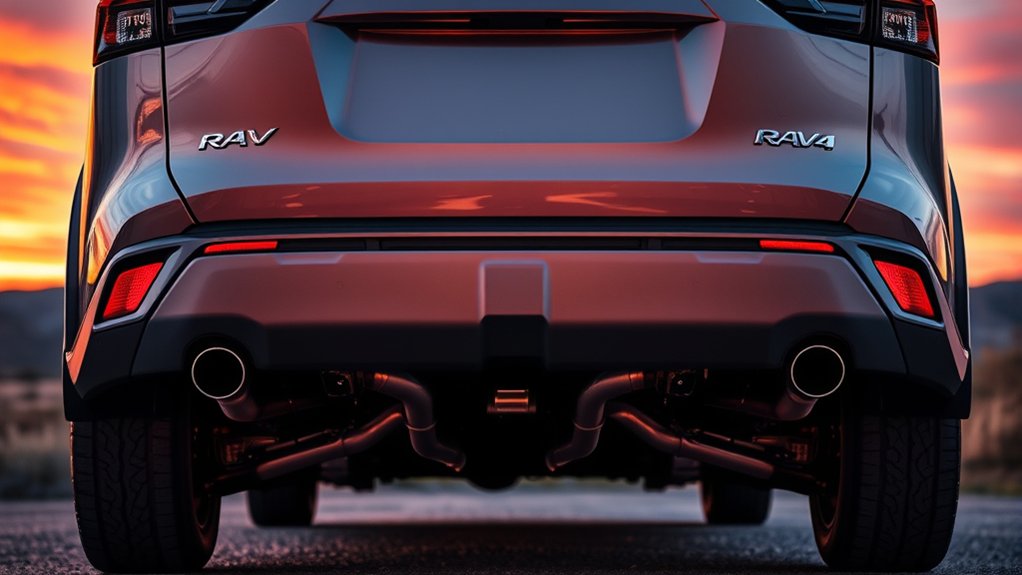
A Toyota RAV4 does not have one universal catalytic-converter count. Depending on the model year, engine, drivetrain, build market, and emissions certification, its exhaust may contain one, two, or more catalytic-converter assemblies. The reliable way to identify your RAV4’s layout is to check its VIN and under-hood emissions label.
Quick Answer
Many four-cylinder RAV4s use a close-coupled manifold catalyst and a second downstream catalyst. The 2006–2012 3.5-liter V6 uses separate converters for its two exhaust banks and may include additional downstream catalyst material. Hybrid and Plug-in Hybrid layouts also vary, so verify the exact count by VIN and emissions test group.
Key Takeaways
- A generation-only chart cannot identify every RAV4 catalytic-converter configuration.
- Four-cylinder models commonly use a manifold converter plus a downstream converter, but exceptions exist.
- The 2006–2012 3.5-liter V6 has two exhaust banks and uses separate bank-specific converter assemblies.
- RAV4 Hybrid and Plug-in Hybrid models should not automatically be treated as one-converter vehicles.
- Use the VIN, engine family or test group, and Toyota parts information before ordering a replacement.
- Diagnose misfires, exhaust leaks, fuel-control faults, and oxygen-sensor problems before condemning a converter.
Overview of Catalytic Converters in Toyota RAV4 Models
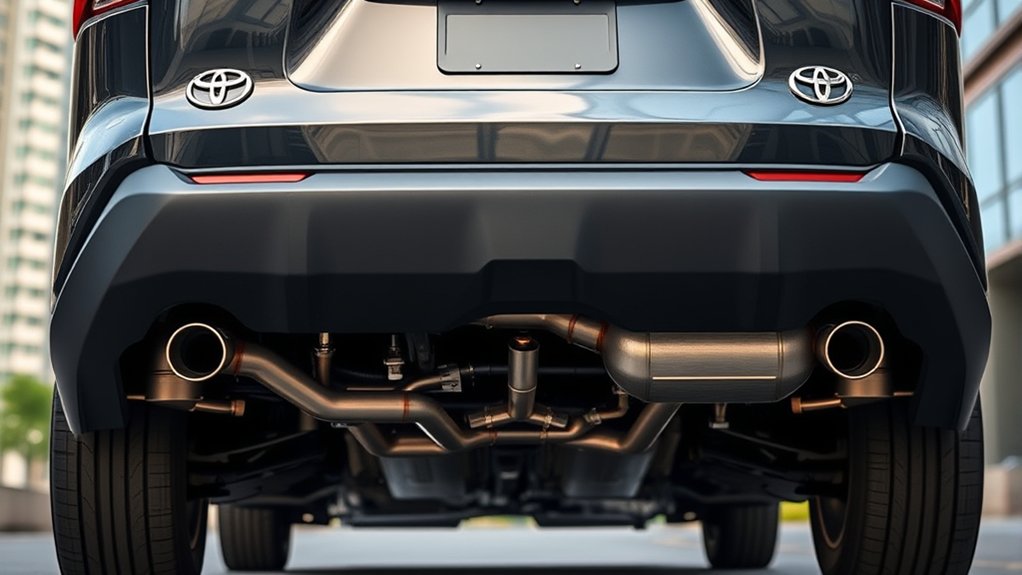
A catalytic converter is part of the RAV4’s emissions-control system. It uses catalyst materials inside the exhaust stream to reduce hydrocarbons, carbon monoxide, and nitrogen oxides before the gases leave the tailpipe.
RAV4 exhaust systems may use a close-coupled or manifold converter near the engine, a downstream converter in the front pipe, or both. A V6 can also have separate converters for the left and right exhaust banks.
Parts terminology can make the count confusing. Toyota may sell a component as an exhaust manifold, front pipe, intermediate pipe, or converter-and-pipe assembly even when a catalytic substrate is built into it.
Note: One metal assembly can contain more than one catalyst substrate, while two separate assemblies may each contain one substrate. When comparing parts or repair estimates, ask whether the count refers to catalyst bricks, converter housings, or complete exhaust assemblies.
The exact RAV4 catalytic-converter layout follows the vehicle’s certified emissions configuration, not just its generation or trim name.
Variations by Engine Type: Four-Cylinder vs. V6 Configurations
Four-Cylinder RAV4 Models
Most RAV4s use an inline four-cylinder engine with one exhaust bank. Many later four-cylinder configurations place one converter close to the engine and another farther downstream in the front exhaust pipe.
That pattern is common, but it is not universal across every year or market. Federal and California-certified versions can use different part numbers, catalyst capacities, oxygen-sensor positions, and pipe assemblies.
For example, Toyota’s U.S. information for the 2015 RAV4 identifies a 2.5-liter four-cylinder engine. Trim level did not create a separate V6 exhaust layout for that model year.
2006–2012 RAV4 V6 Models
The available 3.5-liter V6 has two cylinder banks and two exhaust paths near the engine. Its OEM parts layout includes left- and right-side exhaust manifold assemblies with integrated catalytic converters.
For that reason, describing a V6 RAV4 as having one main catalytic converter is inaccurate. Depending on the exact drivetrain and emissions package, a downstream pipe assembly may also contain catalyst material.
Bank-specific diagnostic trouble codes also matter on a V6. A technician must determine which bank, sensor, converter assembly, or exhaust section is involved before recommending replacement.
How Many Catalytic Converters Are in Different RAV4 Generations?
The table below describes common layouts to investigate. It is not a substitute for a VIN-based parts lookup because configurations can change within the same model year.
| Model Years | Common Layout Pattern | What You Must Verify |
|---|---|---|
| 1996–2000 | Inline-four engine with a single exhaust bank and a comparatively simple exhaust layout. | Check whether the certified system uses a manifold-mounted catalyst, an underfloor catalyst, or a specific regional arrangement. |
| 2001–2005 | Inline-four layouts may place catalyst material in the manifold, front pipe, or separate assemblies. | Confirm the engine, drivetrain, production specification, and federal or California emissions package. |
| 2006–2012 | Four-cylinder models commonly use close-coupled and downstream catalyst sections. The 3.5-liter V6 has separate left- and right-bank manifold converters. | Identify the four-cylinder or V6 engine and check whether a downstream assembly also contains catalyst material. |
| 2013–2018 | Many 2.5-liter configurations use an integrated manifold converter and a downstream front-pipe converter. Hybrid models joined the lineup for 2016. | Verify gas or Hybrid powertrain, drivetrain, build origin, emissions package, and applicable part numbers. |
| 2019–2025 | Gas, Hybrid, and RAV4 Prime configurations use different exhaust assemblies. Manifold and downstream catalyst sections are common. | Check whether the vehicle is gas, Hybrid, or Prime and whether it was built in Japan or North America. |
| 2026 and newer | The sixth-generation U.S. lineup uses Hybrid and Plug-in Hybrid powertrains. Toyota documentation lists manifold-converter and front-pipe-converter categories. | Use current Toyota information for the exact model year, powertrain, emissions certification, and VIN. |
This generation guide is more useful for understanding the possible layouts than for ordering parts. Two RAV4s that look identical can require different converter assemblies because their engine-family numbers or certified emissions standards differ.
How Hybrid Models Influence Catalytic Converter Design
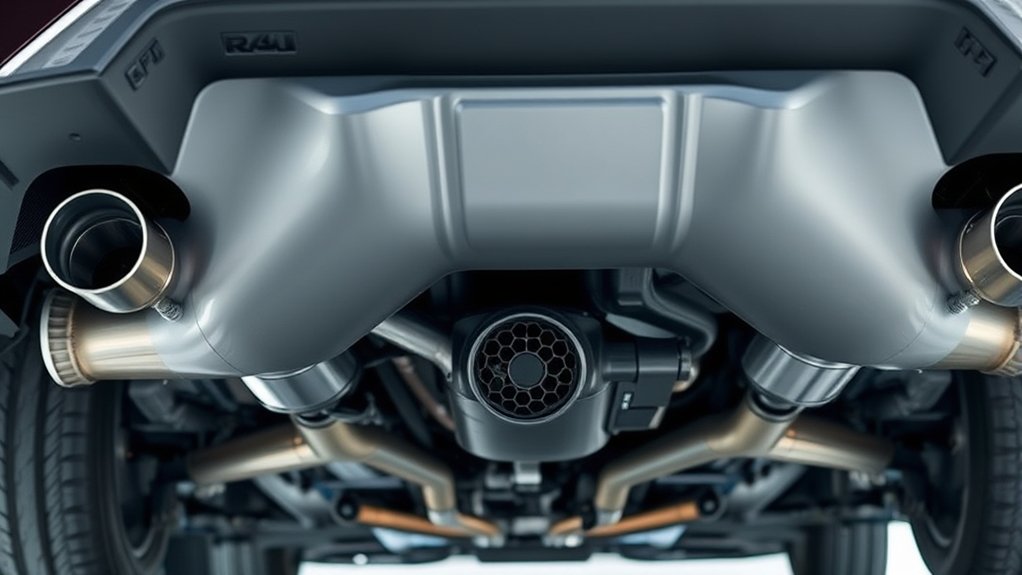
A RAV4 Hybrid still has a gasoline engine and an exhaust after-treatment system. The electric motors can move the vehicle while the engine is off, but that does not mean the exhaust contains only one converter.
Hybrid operation affects catalyst temperature because the gasoline engine starts and stops more frequently. Toyota can use close-coupled catalyst placement and additional downstream treatment to control emissions during warm-up and intermittent engine operation.
The 2026 RAV4 Hybrid Warranty and Maintenance Guide separately identifies an exhaust front pipe that includes a catalytic converter and an exhaust manifold that includes a manifold converter. This is why “all hybrids have one converter” is not a safe rule.
RAV4 Prime and newer RAV4 Plug-in Hybrid models also need VIN-specific verification. Their engine, exhaust routing, production origin, and emissions certification may differ from a standard Hybrid.
How to Verify Your RAV4’s Exact Catalytic-Converter Count
- Record the full 17-digit VIN. You can find it at the lower driver-side corner of the windshield, on the driver-door label, or on the registration.
- Find the under-hood emissions label. Look for the engine family or test-group number and whether the vehicle meets federal or California emissions standards.
- Confirm the engine and powertrain. Identify whether the vehicle has an inline-four, the 2006–2012 3.5-liter V6, a Hybrid system, or a Plug-in Hybrid system.
- Run a VIN-based Toyota parts lookup. Review the exhaust-manifold, catalytic-converter, front-pipe, and intermediate-pipe diagrams.
- Compare the diagram with the vehicle. Follow the exhaust from the engine toward the rear and identify heat-shielded converter housings, oxygen sensors, flanges, and pipe joints.
- Confirm the replacement application. Match the part to the VIN, engine family, emissions certification, drivetrain, and build origin before purchasing it.
Pro Tip: Take a clear photo of the emissions label and the complete exhaust layout before contacting a parts supplier. The test-group number is often more useful than a description such as “2018 RAV4 Limited.”
Do not count every widened exhaust component as a converter. A resonator reduces sound, and a muffler controls exhaust noise. Neither part should be counted as a catalytic converter unless the vehicle-specific diagram identifies catalyst material inside that assembly.
Diagnosing a RAV4 Catalytic-Converter Problem
A check-engine light or catalyst-efficiency code does not automatically prove that the converter has failed. Exhaust leaks, incorrect fuel control, misfires, oil burning, coolant contamination, damaged wiring, and biased oxygen or air-fuel-ratio sensors can produce similar symptoms.
A complete diagnosis may include:
- Scanning current, pending, and history trouble codes
- Checking misfire counts and fuel-trim data
- Inspecting for exhaust leaks before and near the oxygen sensors
- Testing upstream and downstream sensor operation
- Checking for excessive oil or coolant consumption
- Measuring exhaust backpressure when restriction is suspected
- Inspecting the converter for impact damage, melting, theft, or loose internal material
P0420 generally relates to catalyst efficiency on bank 1, while P0430 relates to bank 2. An inline-four RAV4 has only one cylinder bank, while the 3.5-liter V6 has two. The code identifies the monitored bank, not necessarily the failed component.
Warning: Stop driving and arrange an inspection if the converter glows red, the engine misfires heavily, power drops suddenly, or you smell extreme heat. Unburned fuel can overheat the converter and create a fire risk. Exhaust components also remain hot long after the engine is switched off.
Maintenance Tips for Ensuring Catalytic Converter Functionality
A catalytic converter does not have a normal scheduled replacement interval. It may last for the life of the vehicle when the engine and fuel-control systems remain healthy, or it may fail early when exposed to misfires, oil, coolant, physical damage, or an incorrect air-fuel mixture.
Use these practices to protect the system:
- Repair misfires promptly. Raw fuel entering the exhaust can overheat and melt the catalyst.
- Use the fuel specified by Toyota. Do not use leaded fuel or unapproved fuel additives.
- Monitor oil and coolant use. Internal engine leakage can contaminate the catalyst.
- Repair exhaust leaks. Outside air entering the exhaust can distort oxygen-sensor readings and catalyst-monitor results.
- Diagnose sensor faults correctly. Test the sensor, wiring, heater circuit, and exhaust system before replacing parts.
- Inspect after an impact or theft attempt. Damage to the converter, oxygen sensors, wiring, pipes, or nearby heat shields can create safety and emissions problems.
Toyota’s owner guidance warns that running out of fuel, persistent misfires, ignition faults, and fuel-system problems can place an excessive heat load on the converter. Keeping the engine in good operating condition is the most effective form of converter maintenance.
Replacement Laws, Warranty, and Aftermarket Parts
Check warranty coverage before paying for a converter. Toyota warranty guides identify the catalytic converter as a major emissions component that may receive federal coverage for eight years or 80,000 miles, subject to the vehicle’s applicable warranty terms and in-service date.
Federal law prohibits removing or disabling a catalytic converter without installing an approved replacement. The U.S. Environmental Protection Agency treats converter removal without an approved replacement as emissions tampering.
An aftermarket converter must be approved for the vehicle and installed only when there is a legitimate need for replacement. The replacement should match the original configuration and should not move, eliminate, or defeat required oxygen sensors.
California has additional rules. A replacement aftermarket converter must have a valid CARB Executive Order and list the exact vehicle application. CARB advises using the make, model year, engine size, and test-group number to select the correct converter.
Note: Emissions rules differ by state. A converter advertised as “federal compliant” may not be legal for a California-certified RAV4 registered in a state that applies California emissions requirements.
Related Guides
Frequently Asked Questions
How many catalytic converters does a four-cylinder Toyota RAV4 have?
Many four-cylinder RAV4s use two catalyst sections: one integrated with or near the exhaust manifold and one in a downstream pipe. Some years or emissions packages differ, so confirm the count with the VIN and engine-family number.
How many catalytic converters does a V6 RAV4 have?
The 2006–2012 3.5-liter V6 has two exhaust banks and uses separate left- and right-bank manifold converter assemblies. Some configurations may also contain catalyst material in a downstream assembly, so a VIN lookup is still required.
How many catalytic converters does a RAV4 Hybrid have?
The count varies by model year, production specification, and emissions package. Modern Toyota documentation identifies both manifold-converter and front-pipe-converter components, so you should not assume that every RAV4 Hybrid has only one.
Can I install an aftermarket catalytic converter on my RAV4?
Yes, when there is a legitimate need for replacement and the converter is approved for your exact vehicle. It must meet applicable federal requirements. In California, it must also have a valid CARB Executive Order that lists your year, engine, and test group.
How do I know if my catalytic converter is failing?
Possible signs include reduced power, poor acceleration, rattling from the converter, unusual heat, sulfur-like odors, failed emissions testing, or a check-engine light. These symptoms can have other causes, so test the exhaust, sensors, fuel control, and ignition system before replacing the converter.
Does a P0420 or P0430 code always mean the converter is bad?
No. The code means the vehicle detected catalyst-efficiency results outside the expected range for a bank. Exhaust leaks, misfires, fuel-control faults, sensor problems, oil burning, and wiring faults should be checked before the converter is condemned.
What is the average lifespan of a RAV4 catalytic converter?
Toyota does not specify a routine replacement age. A converter can last for the vehicle’s life, but misfires, oil or coolant contamination, incorrect fuel control, road impacts, or theft damage can shorten its service life.
What are the symptoms of a clogged catalytic converter?
A severe restriction can cause weak acceleration, loss of power under load, excessive exhaust heat, hard starting, stalling, or poor high-speed performance. A technician can confirm a restriction with backpressure, vacuum, temperature, and scan-data tests.
Conclusion
Your Toyota RAV4 may have one, two, or more catalytic-converter assemblies, depending on its certified exhaust configuration. Four-cylinder models commonly use manifold and downstream catalysts, while the 2006–2012 V6 has separate converter assemblies for its two exhaust banks. Hybrid and Plug-in Hybrid models also require vehicle-specific verification.
Before buying a converter, record the VIN, photograph the emissions label, identify the engine family, and check the Toyota exhaust diagrams. If a warning light is on, diagnose misfires, leaks, sensors, fuel control, and engine condition before replacing an expensive emissions component.
Sources
- Toyota 2026 RAV4 Hybrid Warranty and Maintenance Guide — emissions component listings and federal warranty coverage.
- Toyota 2005 RAV4 Owner’s Manual — converter-overheating precautions and maintenance guidance.
- California Air Resources Board: Aftermarket Catalytic Converters — California approval and application requirements.
- California Air Resources Board: Locating the Test Group or Engine Family — identifying the certified emissions configuration.
- U.S. Environmental Protection Agency Transportation FAQ — federal catalytic-converter tampering guidance.
- EPA Aftermarket Catalytic Converter Guidance — replacement conditions and installer requirements.

