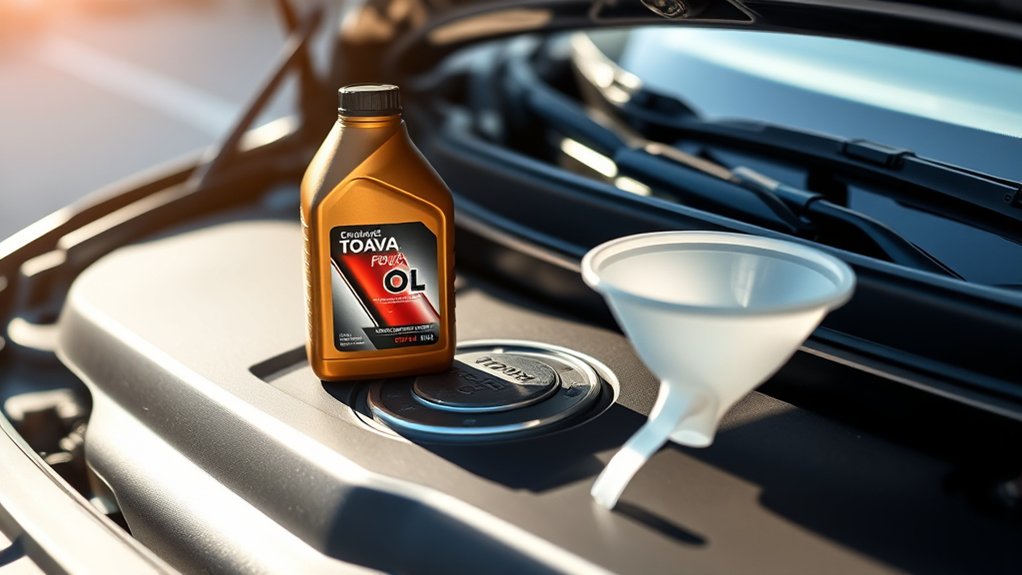
To add engine oil to a Toyota RAV4 safely, park on level ground, follow the oil-check timing in the owner’s manual for your exact model year, read the dipstick twice, and add only the specified oil in small amounts. Toyota’s recent RAV4 guidance calls for warming the engine, shutting it off, waiting about five minutes for oil to drain back into the pan, then checking the level before topping off.
Last updated: September 19, 2026 — Toyota oil-check timing, current API oil categories, source links, and FAQ guidance rechecked.
Quick Answer
Park your RAV4 on level ground and use the timing in your exact owner’s manual. For recent RAV4s, Toyota says to warm the engine, shut it off, wait about five minutes, then pull, wipe, reinsert, and reread the dipstick. If the oil is below or near the low mark, add the specified oil slowly, rechecking the dipstick so you do not exceed the upper mark.
Key Takeaways
- Check oil on level ground using the timing in your exact owner’s manual; recent Toyota guidance says to warm the engine, shut it off, and wait about five minutes.
- Use the oil grade printed on the oil cap or listed in the owner’s manual for your exact RAV4 year and engine.
- Add oil slowly in small amounts, then recheck the dipstick before adding more; do not use the full drain-and-refill capacity as a top-off target.
- Do not drive if the oil pressure warning light is on, the dipstick shows no oil, or the engine is knocking.
- Dispose of used oil and oil containers through a recycling center, auto parts store, or repair shop that accepts used motor oil.
At a Glance
| Time Required | 5 to 10 minutes |
| Difficulty | Easy |
| Tools Needed | Clean rag or paper towel, funnel, correct engine oil, gloves if preferred |
| Cost | Usually one quart or less of the correct engine oil for a simple top-off; price varies by oil |
How to Check and Add Engine Oil in Your RAV4
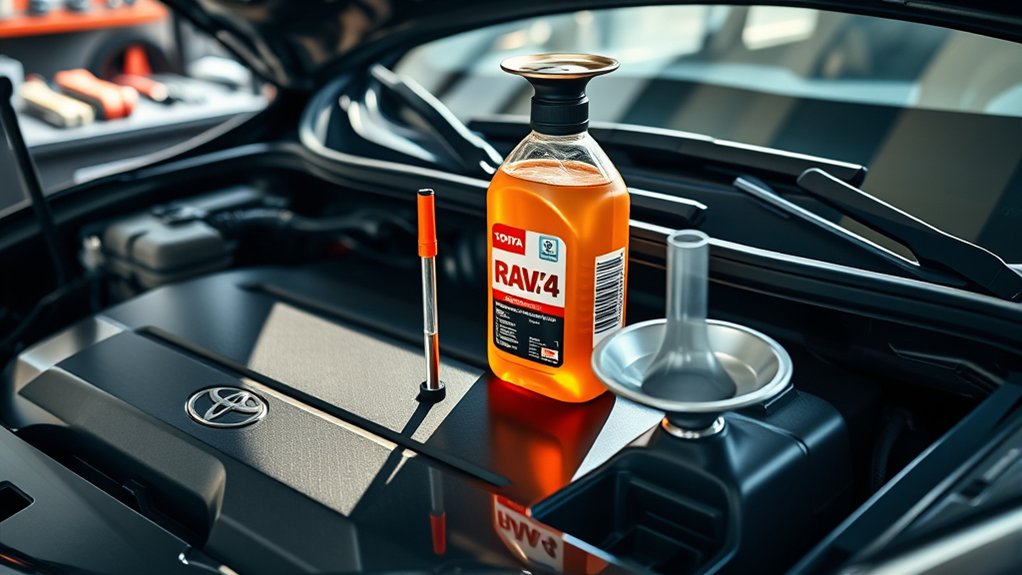
Start with your RAV4 parked on level ground. Follow the timing in the owner’s manual for your exact year and powertrain. Toyota’s 2024 U.S. RAV4 manual says to warm the engine, turn it off, wait about five minutes, and then check the dipstick. Earlier Toyota manuals commonly use similar wording and may specify waiting more than five minutes.
Open the hood and find the engine oil dipstick. On many RAV4 models, the dipstick has a yellow or brightly colored handle. Pull it out, wipe it clean with a lint-free rag or paper towel, then slide it fully back into the tube.
Pull the dipstick out again and look at the oil film near the end. The oil level should sit between the low and full marks, holes, dots, or crosshatched area on the dipstick.
If the level is below or near the low mark, remove the engine oil filler cap on top of the engine. Place a clean funnel in the opening and add a small amount of the correct oil. Wait briefly for the oil to reach the pan, then recheck the dipstick before adding more.
Keep adding small amounts until the oil level is near the full mark, but not above it. After you finish, remove the funnel, wipe any spills, and tighten the oil filler cap securely.
Pro Tip: Do not use the engine’s published drain-and-refill capacity to decide how much to add during a top-off. Add slowly and let the dipstick determine the final level. Toyota warns against filling above the upper mark because overfilling can damage the engine.
How to Read the RAV4 Dipstick
Your RAV4 dipstick shows a safe operating range, not a single exact fill line. The lower mark indicates the low end of the range, and the upper mark is the refill limit or full mark, depending on model-year wording. Keep the reading within the marked range and never above the upper mark.
A dipstick reading above the full mark is not “extra protection.” Too much oil can be as harmful as too little oil.
If the oil is below or near the low mark, add the specified oil before normal driving. If no oil shows on the dipstick, do not assume the engine only needs a routine top-off. Add only enough of the correct oil to restore a readable safe level, then check for an active leak or abnormal oil consumption before continuing normal use.
Also look at the oil’s condition while the dipstick is out. Dark oil by itself does not prove the oil is bad, but a milky appearance, visible contamination, an unusually thick texture, or a strong burnt smell can justify further inspection.
Warning: Do not keep driving if the oil pressure warning light stays on, the engine knocks, oil is leaking quickly, smoke appears, or the dipstick shows no oil after topping off. Stop safely and get professional help.
How to Safely Add Engine Oil to Your RAV4
Use this simple process when your dipstick shows the oil level is low. Work slowly and recheck often.
| Step | Action | Why It Matters |
|---|---|---|
| 1 | Park on level ground and shut the engine off. | A tilted vehicle can give you a false dipstick reading. |
| 2 | Follow the manual’s wait time; recent RAV4 guidance is about 5 minutes after shutdown. | This lets oil drain back into the pan so the dipstick reading is meaningful. |
| 3 | Pull, wipe, reinsert, and reread the dipstick. | The second reading is cleaner and more accurate. |
| 4 | Confirm the correct oil grade on the oil cap or in the owner’s manual. | RAV4 oil requirements vary by year, engine, and market. |
| 5 | Add oil through a funnel in small amounts. | Slow filling prevents spills and overfill. |
| 6 | Recheck the dipstick and tighten the oil cap. | A loose oil cap can cause oil mist, smells, mess, and warning lights. |
What Oil Should You Use for Your RAV4?
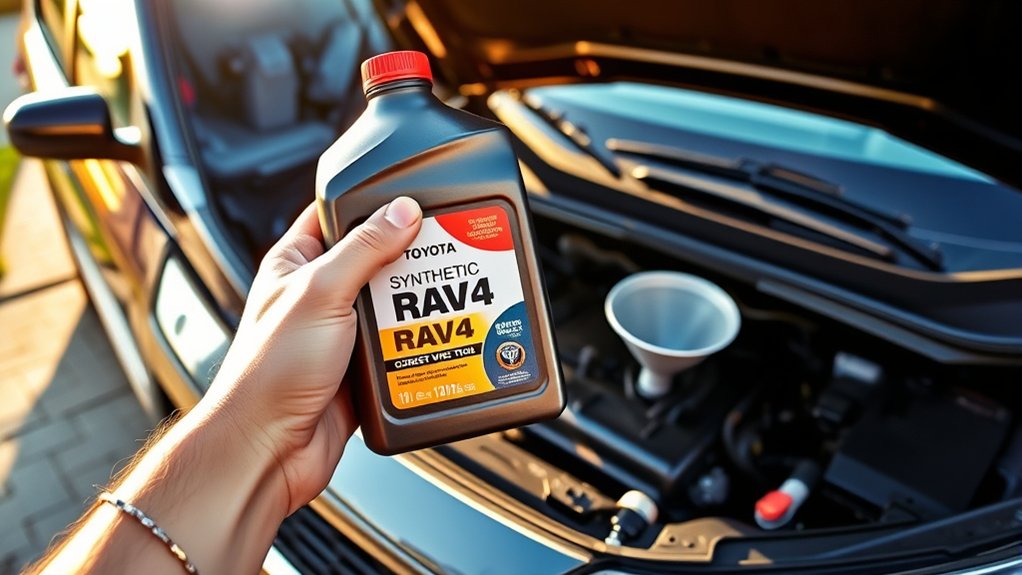
The safest answer is simple: use the engine oil viscosity and performance specification listed for your exact RAV4 in the owner’s manual and confirm any under-hood labeling that applies to your vehicle. Toyota provides model-specific owner manuals through its Manuals and Warranties page.
RAV4 oil requirements vary by generation, engine, hybrid system, market, and model year. For example, Toyota specifies SAE 0W-16 for the 2024 U.S. RAV4 2.5-liter engine, while older RAV4s may specify 0W-20, 5W-30, or another grade. Do not apply one model year’s oil recommendation to every RAV4.
Also check the oil’s performance category. The American Petroleum Institute Motor Oil Guide says vehicle owners should follow the manufacturer’s recommendation. As of September 2026, API SQ and ILSAC GF-7A/GF-7B are the newest gasoline-engine standards, while earlier categories can still be relevant when your owner’s manual specifies them.
Note: If you are away from home and cannot find the exact oil, use only an emergency substitute allowed by your owner’s manual. Then return to the correct oil at the next service.
Is the RAV4 Oil-Pressure Warning the Same as a Low Oil Level?
No. A low engine oil pressure warning is an urgent pressure warning, not a routine dipstick-level reminder. Toyota says a red low-engine-oil-pressure warning requires immediate attention. A very low oil level can cause low pressure, but the warning can also appear when the oil level is normal and another problem is present.
If the warning appears while driving, stop safely and switch the engine off. Do not keep driving just because you plan to add oil at the next stop. After the engine has been off for the wait time in your manual, check the dipstick. If the level is low, add the specified oil only to the safe range. If the warning remains or returns, or the level was already normal, arrange professional diagnosis instead of continuing to drive.
Important: The oil-pressure warning and a maintenance reminder are different. A maintenance reminder tells you scheduled service is due; a red oil-pressure warning can indicate an immediate lubrication problem.
What If You Add Too Much Oil?
If the dipstick reads above the full or refill-upper-limit mark, do not ignore it. Toyota warns that overfilling can damage the engine. Excess oil can also become aerated and contribute to poor lubrication, smoke, or leaks.
If the level is only slightly above full, recheck after the vehicle sits on level ground for several minutes. If it is clearly overfilled, remove the excess oil before driving. A repair shop can drain or extract the extra oil safely.
Do not try to solve overfill by driving until the engine “uses up” the oil. That can turn a small mistake into a costly repair.
Top Mistakes to Avoid When Adding Oil to Your RAV4
A few common mistakes cause most topping-off problems. Avoid these before you open the oil bottle.
- Checking oil on a slope: Park on level ground so the dipstick reading is accurate.
- Reading the dipstick only once: Wipe it first, reinsert it fully, then read it again.
- Adding too much at once: Add small amounts, especially when the level is close to the safe range.
- Using the wrong oil grade: Check the oil cap or owner’s manual for your exact RAV4.
- Forgetting the oil cap: Tighten the cap before closing the hood.
- Ignoring leaks or repeat low readings: If the oil level keeps dropping, schedule an inspection.
When to Schedule Service Instead of Just Adding Oil
Adding oil is a short-term fix when the level is low. It is not a replacement for an oil change, leak repair, or engine diagnosis.
Schedule service if your RAV4 needs frequent top-offs, leaves oil spots where you park, smells like burning oil, smokes from the exhaust, shows a warning light, or has oil that looks milky or gritty.
Follow the factory maintenance schedule for your exact RAV4 year, powertrain, market, and driving conditions. Toyota’s Maintenance Schedule page says many Toyota vehicles have maintenance visits every 5,000 miles or six months, but the work performed at each visit varies. Use the model-specific maintenance guide for the actual oil-and-filter interval.
Related Guides
Frequently Asked Questions
Should I check RAV4 oil when the engine is hot or cold?
Follow the owner’s manual for your exact RAV4. Recent Toyota RAV4 guidance says to warm the engine, shut it off, park on level ground, wait about five minutes, then read the dipstick. Do not use a generic “always cold” rule when your manual gives a different procedure.
Is the RAV4 oil-pressure light the same as a low oil-level warning?
No. Toyota identifies the red oil-can warning as a low engine oil pressure warning. Stop safely and switch the engine off if it appears while driving. Check the dipstick after the proper wait time, but do not keep driving if the warning remains or returns.
How often should I change my RAV4 engine oil?
Use the maintenance guide for your exact RAV4 year, powertrain, market, and driving conditions. Do not assume every 5,000-mile maintenance visit includes an oil change. For a deeper interval breakdown, see How Often Does a Toyota RAV4 Need an Oil Change?.
Can I mix different oil brands?
Mixing brands is usually less important than matching the correct viscosity and performance specification. For topping off in an emergency, use oil that meets your owner’s manual requirements. For best consistency, use one correct oil type at your next full oil change.
What happens if I overfill the oil?
Too much oil can foam, raise internal pressure, cause leaks, create smoke, and reduce lubrication quality. If the dipstick reads clearly above the full mark, have the extra oil drained or extracted before driving normally.
Is synthetic oil better for my RAV4?
Use the viscosity and performance specification required by your owner’s manual. The word “synthetic” by itself does not prove an oil is correct for your RAV4. Match the required SAE grade and applicable API, ILSAC, or other manufacturer-specified standard.
How do I dispose of old engine oil?
Take used oil to a recycling center, auto parts store, repair shop, or local collection site that accepts used motor oil. The U.S. EPA says used oil should be collected in a leak-proof container and taken for proper recycling.
Why does my RAV4 keep getting low on oil?
A repeat low-oil reading can come from leaks, oil burning, long service intervals, the wrong oil, or normal consumption on a high-mileage engine. If you need to add oil often, schedule a leak and consumption check instead of only topping it off.
Conclusion
Checking and adding engine oil to your Toyota RAV4 is straightforward when you use the model-specific procedure. Park level, follow the manual’s warm-up and wait-time instructions, read the dipstick twice, use the exact oil specification for your vehicle, and add oil in small amounts.
Stop and get help if the oil pressure light is on, the dipstick shows no oil, the engine makes noise, or the oil level keeps dropping. A careful top-off can protect your engine, but the right oil and regular maintenance schedule matter just as much.
Sources
- Toyota 2024 RAV4 Maintenance Data — official oil-check timing, oil capacity context, and 0W-16 specification for the 2024 U.S. RAV4.
- Toyota Manuals and Warranties — model-specific owner manuals for other RAV4 years and powertrains.
- Toyota Warning Lights — official explanation of the low engine oil pressure warning.
- Toyota Maintenance Schedule — factory maintenance-schedule context.
- American Petroleum Institute Motor Oil Guide — current gasoline-engine oil categories and owner-manual guidance.
- U.S. EPA: Managing, Reusing, and Recycling Used Oil — safe handling and recycling guidance for used motor oil.
