
A flat tire can leave you wondering whether your Toyota RAV4’s spare will get you home or only to the nearest repair shop. The answer depends on whether you have a compact temporary spare, a matching full-size spare, or another limited-use wheel. Your spare tire’s sidewall and your model-year Toyota owner’s manual always take priority over a general mileage rule.
Quick Answer
For a Toyota RAV4 with a compact temporary spare, treat 50 miles and 50 mph as maximums, not targets. The tire sidewall and your model-year owner’s manual control. Drive gently to the nearest tire shop, avoid towing and heavy loads, and stop immediately if the vehicle vibrates, pulls, or feels unstable.
Key Takeaways
- Use a compact RAV4 spare only long enough to reach the nearest safe tire-repair facility.
- Do not exceed the speed printed on the spare. Compact temporary spares are commonly limited to 50 mph.
- Many T-type compact spares require 60 psi when cold, but you must verify the pressure on the tire or in your owner’s manual.
- Do not tow a trailer with a compact spare installed unless your exact Toyota manual specifically permits it.
- A full-size spare has normal driving capability only when it truly matches the required size, load rating, construction, and rolling circumference.
- Check the spare’s pressure, condition, DOT manufacture date, wheel, valve stem, jack, and wrench before a long trip.
Toyota RAV4 Spare Tire Limits at a Glance
| Spare Type | Typical Use | Main Limit |
| Compact temporary spare | Emergency trip to the nearest tire facility | Commonly no more than 50 mph and about 50 miles; follow the tire label and manual |
| Matching full-size spare | Temporary replacement that may support normal driving | Must match Toyota’s size, load, speed, construction, and rolling-circumference requirements |
| Nonmatching full-size temporary spare | Limited emergency use | Follow its sidewall label and the owner’s manual; do not assume normal speed or distance |
| Tire mobility kit | Temporary sealing of certain tread punctures | Cannot safely fix every puncture, sidewall cut, wheel failure, or blowout |
Understanding Spare Tire Types for Your Toyota RAV4
RAV4 equipment varies by model year, trim, drivetrain, and sales region. Some models carry a spare beneath the rear cargo deck, while other configurations may use different emergency equipment. Toyota’s 2024 RAV4 Quick Reference Guide shows the spare and tools under the rear deck, but it also directs owners to the full manual for the correct jacking and tire-changing procedure.
Use the Toyota owner’s manual lookup to confirm what came with your vehicle. You can also inspect the sidewall of the spare for markings such as “Temporary Use Only” or a tire size beginning with the letter T.
Compact Temporary Spare
A compact temporary spare, often called a donut, is smaller and lighter than a normal road tire. Its shallow tread, reduced load capacity, different handling, and higher inflation pressure make it suitable only for short emergency use.
Do not treat a compact spare as a replacement road tire. Install it correctly, drive to the nearest suitable tire facility, and restore a standard wheel and tire as soon as possible.
Matching Full-Size Spare
A matching full-size spare uses a tire that meets the same size, construction, load-rating, and speed-rating requirements as the other road tires. It may support normal driving when properly inflated and undamaged.
However, tread depth also affects rolling circumference. On an AWD RAV4, a new full-size spare paired with three heavily worn tires may still create an undesirable difference. A tire professional should confirm compatibility before you use it for an extended period.
Nonmatching Full-Size Spare
A tire can look full size without being a permanent match. The wheel design, tire construction, speed rating, tread pattern, or overall diameter may differ. Follow any warning label and your manual instead of assuming that normal highway speed is safe.
Note: “Full size” describes the general dimensions, not guaranteed compatibility. Confirm the complete tire specification before treating a spare like a normal road tire.
How Far Can You Drive on a Temporary Spare Tire?
Plan to drive no more than about 50 miles on a compact temporary spare unless the tire label or your Toyota manual gives a lower limit. This is an upper planning limit, not a distance you should try to use fully.
Your real goal is the nearest safe repair location. A shop five miles away is a better destination than driving another 45 miles simply because the spare has not reached the commonly quoted limit.
Heat, vehicle load, road surface, ambient temperature, speed, and aggressive maneuvers can reduce how far a temporary tire can operate safely. If the only available repair facility is beyond the stated limit, call roadside assistance or arrange a tow.
Warning: Do not continue driving merely because you have not reached 50 miles. Stop as soon as it is safe if you notice vibration, pulling, thumping, rubbing, smoke, unusual noise, loss of pressure, or unstable handling.
How Fast Can You Drive on a Spare Tire?
Maximum Speed Limit
Do not exceed the speed printed on the spare tire. Compact temporary spares are commonly limited to 50 mph, and Michelin advises drivers not to exceed 50 mph on a compact spare.
Fifty mph is a maximum, not a target. Drive more slowly when the road is wet, icy, rough, steep, crowded, or affected by strong wind. Leave extra following distance and avoid sudden acceleration, hard braking, sharp turns, potholes, and abrupt lane changes.
A matching full-size spare does not have an automatic 70-mph limit. Its safe use depends on its tire rating, condition, compatibility, inflation, applicable speed limit, and Toyota’s instructions. A nonmatching full-size temporary spare may still have a lower restriction.
Risks of Exceeding Speed
A compact spare has less tread and a smaller contact area than a normal RAV4 tire. Excessive speed increases heat and reduces the time available to react when traction or stability changes.
Driving too fast may also interfere with predictable braking, steering, traction-control, and stability-control behavior. The difference becomes more noticeable during emergency maneuvers or on slippery roads.
A temporary spare is designed to help you leave an emergency, not continue a normal trip.
What to Check Before Driving on the Spare
Before moving the RAV4, complete these checks:
- Read the sidewall: Find the temporary-use warning, maximum speed, tire size, and required inflation pressure.
- Confirm cold pressure: Many T-type temporary spares require 60 psi, but use the pressure specified for your tire and vehicle.
- Inspect the tire: Look for cracks, bulges, cuts, exposed cords, deformation, or sidewall separation.
- Inspect the wheel: Do not drive with a bent, cracked, heavily corroded, or damaged spare wheel.
- Check installation: Make sure the wheel sits flush and the wheel nuts or bolts are installed in the correct sequence.
- Secure the flat tire and tools: Loose equipment can become dangerous during sudden braking.
- Reduce the load: Remove unnecessary cargo and avoid carrying a full passenger or cargo load when possible.
- Choose a direct route: Avoid high-speed roads, rough surfaces, steep grades, and long detours.
Use only the jacking points, tools, tightening procedure, and torque specification provided for your exact RAV4. If the roadside location is unsafe, remain away from moving traffic and request professional assistance instead of attempting the tire change.
RAV4 AWD, Hybrid, and Drivetrain Considerations
An AWD or electronic AWD system depends on compatible tire dimensions and wheel-speed information. A compact spare naturally rotates at a different rate from the normal tires, which is one reason Toyota limits its use.
Do not extend a trip, drive off-road, or continue using a compact spare after the immediate emergency. Restore the correct tire promptly to minimize abnormal driveline operation and to return the stability and traction systems to their intended conditions.
Do not guess which axle should receive the compact spare. Placement instructions can vary by vehicle design, drivetrain, and the location of the flat tire. Follow the tire-changing section of your model-year manual or obtain roadside assistance.
The tire-pressure warning light may stay illuminated after the spare is installed. The vehicle may still be monitoring the flat road tire, or the spare may not provide the same pressure data. Check the spare manually with a gauge and restore the repaired road tire before resetting or reinitializing the system.
Driving in Rain, Snow, or Ice
You may use a temporary spare to reach safety in wet or snowy conditions, but traction and handling will be worse than with four matching road tires. Slow down well below the spare’s maximum speed, increase following distance, and avoid steep or untreated roads when another safe route is available.
Do not install a tire chain on a compact spare unless your exact Toyota manual specifically permits it. A chain may not fit the smaller tire or may contact the suspension, brakes, wheel well, or body.
If conditions are severe enough that you cannot maintain control at a low speed, stop in a safe location and request a tow. The need to reach a repair shop does not override unsafe weather conditions.
Essential Maintenance Tips for Your Spare Tire
Regular Pressure Checks
Check the spare tire at least once a month and before a long trip. NHTSA recommends checking every tire, including the spare, monthly when cold.
A tire is considered cold when the vehicle has been parked long enough for the tire to return close to ambient temperature. Do not release air from a warm tire simply because the pressure has risen during driving.
Many compact T-type spares require 60 psi cold. Verify the number on the tire and in the owner’s manual. Add air in small amounts because pressure rises quickly inside a small temporary tire.
Inspect for Damage
Inspect the tire, valve stem, wheel, and retaining hardware whenever you check the pressure. Replace or professionally evaluate the spare if you find cracks, bulges, blisters, cuts, exposed material, bead damage, severe corrosion, or an inability to hold air.
Check the tire’s age using the final four digits of its DOT Tire Identification Number. For example, a code ending in 2522 means the tire was manufactured during the 25th week of 2022.
No universal eight-year replacement rule applies to every spare. NHTSA notes that some vehicle and tire manufacturers recommend tire replacement between six and ten years regardless of tread. Follow Toyota’s guidance and the spare-tire manufacturer’s stated service-life limit.
Pro Tip: Ask a tire shop to inspect the spare, wheel, valve stem, jack, wrench, and hold-down hardware during routine tire service. This helps prevent discovering a flat spare or missing tool during an emergency.
Store the Spare and Tools Correctly
Keep the spare secured in its factory storage position. Moisture, loose cargo, spilled chemicals, and damaged retaining hardware can harm the tire or wheel.
Confirm that the jack, handle, wheel-nut wrench, wheel-lock key, towing eyelet, and other model-specific equipment are present. Test access to the tools at home instead of learning the storage arrangement beside a busy road.
Addressing Common Concerns About Full-Size Spare Tires
A matching full-size spare offers better braking, stability, and handling than a compact temporary tire. However, it is only a true match when it meets the required specifications and is in serviceable condition.
Check all of the following before using it as a normal road tire:
- The tire size matches Toyota’s approved size.
- The load index meets or exceeds the vehicle requirement.
- The speed rating is suitable for the vehicle.
- The wheel has the correct diameter, width, offset, bolt pattern, and seating surface.
- The tire has no age-related or physical damage.
- The inflation pressure is correct.
- The overall rolling circumference is compatible with the other tires.
If the spare differs in size, tread depth, construction, or wheel specification, use it only under the restrictions supplied with it. Do not rely on a universal 100-mile or 70-mph allowance.
What to Do If You Have Spare Tire Issues
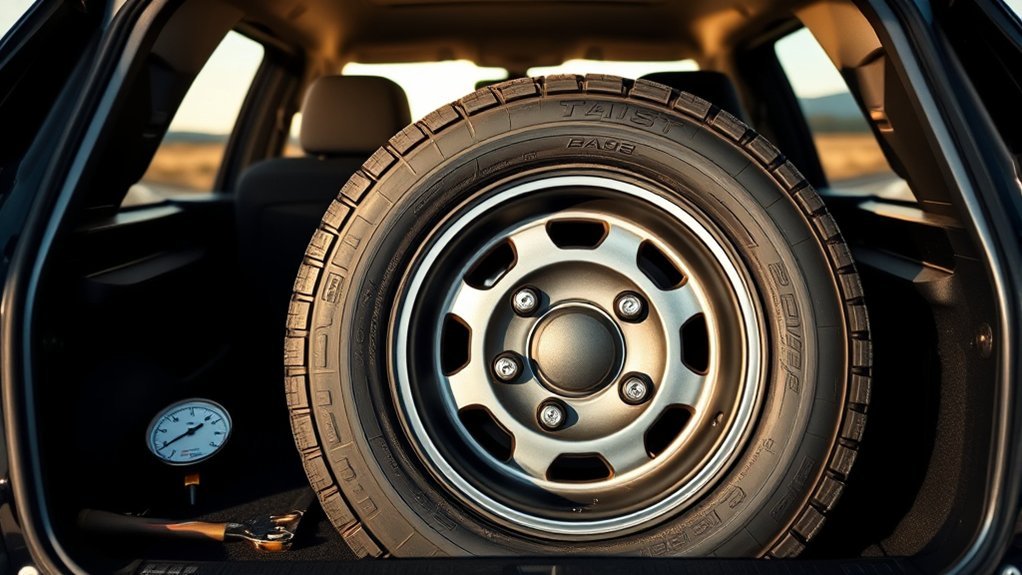
If the spare is damaged, flat, badly aged, or unable to hold its specified pressure, do not install it. Move away from traffic when possible and contact roadside assistance.
After installing a serviceable spare, begin at low speed and pay attention to steering, noise, and vibration. Pull over safely if the RAV4 pulls strongly, shakes, produces a repeating thump, or displays a new warning that affects safe operation.
Recheck the spare visually after a short distance when it is safe to stop. If the wheel appears loose, the tire is losing pressure, or the sidewall is deforming, do not continue.
If a repair shop is farther away than the tire or manual permits, arrange a tow. Driving more slowly does not automatically make an excessive distance safe.
Warning: Do not tow a trailer with a compact temporary spare installed. Disconnect the trailer in a safe location and arrange assistance unless your exact model-year Toyota manual provides different instructions.
When You Should Not Drive on the Spare
Do not drive the RAV4 on the spare when:
- The tire is visibly cracked, bulged, cut, separated, or deformed.
- The spare cannot reach or maintain its specified cold pressure.
- The wheel is bent, cracked, or heavily corroded.
- The spare rubs against the brakes, suspension, body, or wheel well.
- The wheel nuts or bolts cannot be installed and tightened correctly.
- The spare is not approved for your RAV4.
- The vehicle is towing a trailer.
- The load exceeds the tire, axle, or vehicle rating.
- Road or weather conditions make controlled low-speed driving impossible.
- The vehicle shakes, pulls, smokes, or becomes difficult to control.
Related Guides
Frequently Asked Questions
Can I use a Toyota RAV4 spare tire in snow or wet conditions?
You can use a serviceable spare to reach safety, but drive slower than the marked maximum, leave extra following distance, and avoid sudden steering or braking. Compact spares provide less traction than normal tires. Request a tow when snow, ice, standing water, or steep roads prevent controlled driving.
What happens if I exceed the mileage limit on a spare tire?
You increase heat, wear, handling compromises, and the risk of tire or vehicle damage. A spare that appears normal can still develop internal damage. Do not plan to exceed the tire or owner-manual limit. Arrange roadside assistance when the nearest repair facility is too far away.
How do I know if my spare tire is properly inflated?
Check it with an accurate gauge while the tire is cold. Use the pressure printed on the tire or specified in your Toyota manual. Many T-type compact spares require 60 psi, but you should not assume that number without checking your tire.
Is it safe to drive with a full load on a compact spare?
Avoid a full passenger or cargo load when possible. Extra weight increases heat and stress while reducing the temporary tire’s operating margin. Never exceed the vehicle, axle, wheel, or tire load rating, and do not tow a trailer with a compact spare installed.
Can I repair a damaged temporary spare tire?
Do not attempt a DIY repair. Compact temporary tires have specialized construction and limited service requirements. Have a qualified tire professional inspect the tire under its manufacturer’s policy. Replacement is the safer response when the tire has sidewall damage, structural damage, severe aging, or questionable prior use.
Why is the RAV4 tire-pressure warning still on after installing the spare?
The system may still detect the flat road tire, or the temporary spare may not provide the same pressure signal. Check the spare manually and do not assume the warning is false. Restore the repaired standard tire and follow your owner’s manual before resetting or reinitializing the system.
Conclusion
A compact Toyota RAV4 spare is an emergency tool, not a normal road tire. Treat 50 miles and 50 mph as upper limits unless the tire or your owner’s manual states a lower restriction, and aim for the nearest safe tire facility.
Check the pressure and condition before driving, avoid towing and heavy loads, and use extra caution on wet or slippery roads. A matching full-size spare may offer normal capability, but only when its complete specification and rolling circumference are compatible with the vehicle.
Sources
- Toyota Manuals and Warranties — model-year owner’s manuals and vehicle-specific instructions
- 2024 Toyota RAV4 Quick Reference Guide — spare-tire and tool location
- NHTSA TireWise — tire pressure, inspection, aging, tread, and spare-tire maintenance
- Michelin: Driving on a Spare Tire — compact-spare speed and driving precautions
- Mastercraft Tires: How to Care for Your Spare — temporary-spare pressure, inspection, and use restrictions
- U.S. Tire Manufacturers Association Tire Care Guide — T-type spare inflation and maintenance guidance