The Toyota RAV4 EV needs model-specific charging information because it is not the same vehicle as the newer RAV4 Prime or RAV4 Plug-in Hybrid. This guide applies to the U.S.-market 2012–2014 RAV4 EV. Its factory charging system uses an SAE J1772 inlet and supports Level 1 and Level 2 AC charging only.
Quick Answer
To charge a Toyota RAV4 EV, park and switch it off, connect the Toyota 120-volt cord or a compatible SAE J1772 Level 2 station, then insert the connector until it clicks. A depleted battery takes about 44–52 hours at 120 volts or 5–15 hours at 240 volts, depending on amperage and charge mode.
Key Takeaways
- The factory 2012–2014 RAV4 EV supports SAE J1772 Level 1 and Level 2 AC charging, not DC fast charging.
- Toyota lists approximately 44–52 hours on the supplied 120V/12A cable and 5–15 hours on 240V equipment.
- Normal mode charges to approximately 80% and is Toyota’s preferred everyday setting when maximum range is unnecessary.
- Use only sound, approved charging equipment. Do not use an extension cord, multiplug adapter, or damaged outlet.
- The RAV4 EV’s former Entune charge-management and remote services stopped being supported in November 2022.
At a Glance
| Time Required | About 2–3 minutes to connect; approximately 5–52 hours to charge from depleted, depending on voltage, amperage, temperature, and charge mode |
| Difficulty | Easy for routine charging; professional installation required for new Level 2 electrical equipment |
| Tools Needed | Toyota Level 1 charging cable or a listed SAE J1772 Level 2 EVSE, a suitable electrical supply, and the vehicle key |
| Cost | Electricity or public-station fees, plus installation costs if your home needs a dedicated 240V circuit or Level 2 EVSE |
Understanding Charging Levels for the RAV4 EV
The factory RAV4 EV has two usable charging levels. Level 1 uses the Toyota-supplied 120V/12A cable. Level 2 uses a compatible 208V or 240V SAE J1772 charging station.
The vehicle does not have a factory DC fast-charging inlet. A station labeled CCS1, CHAdeMO, NACS, Supercharger, or DC Fast is not compatible with the stock charging system, even when an adapter appears to fit part of the connector.
Toyota’s RAV4 EV Owner’s Manual provides the following estimates for charging a depleted battery. Real charging time may increase in very hot or cold weather, during pre-climate use, after a power interruption, or when the 12-volt battery is weak.
| Power source | Normal mode | Extended mode |
|---|---|---|
| 40A at 240V | About 5 hours | About 6 hours |
| 30A at 240V | About 6.5 hours | About 8 hours |
| 16A at 240V | About 12 hours | About 15 hours |
| 12A at 120V | About 44 hours | About 52 hours |
Normal Versus Extended Charge Mode
The RAV4 EV has two charge modes. Normal mode charges to approximately 80% and is the factory default. Toyota recommends using it when you do not need the vehicle’s maximum possible range.
Extended mode charges to approximately 100% of the vehicle’s usable charging range. It provides more driving range but takes longer. Use it before trips that require the additional capacity rather than treating it as the automatic everyday setting.
Pro Tip: Set an Extended charge close to your departure time when you need maximum range. Avoid leaving the vehicle at its highest state of charge longer than necessary.
How to Charge a Toyota RAV4 EV Step by Step
- Park safely. Stop on a stable surface, apply the parking brake, select Park, and switch the EV system off.
- Inspect the equipment. Check the outlet, plug, charging cable, connector, and vehicle charging port for damage, dirt, water, snow, or ice.
- Connect the power source. For Level 1, plug the Toyota charging cable directly into a dedicated 120V NEMA 5-15R or 5-20R receptacle. For Level 2, activate the compatible J1772 station as directed.
- Test the Level 1 CCID. Press the charging cable’s test button and confirm that the error indicator responds. Press Reset before continuing. Stop if the unit does not pass its self-test.
- Open the charging port. Pull the charging-port door lever inside the vehicle, then open the port cap.
- Insert the connector. Align the J1772 connector and push it straight into the port without pressing the latch-release button. Continue until it clicks.
- Confirm charging. Check the plug-in and charging indicators. A stored departure schedule may delay charging until the calculated start time.
- Select immediate charging when needed. If the vehicle is waiting for a schedule, use the in-vehicle EV menu and Charging & Pre-Climate Setup screen to select the immediate-charge option.
- Check the estimated completion time. Use the vehicle’s charge-summary or multi-information display rather than assuming a fixed charging duration.
Warning: Stop charging if the cable, plug, outlet, CCID, or charging port is damaged, unusually hot, wet, or showing a persistent error. Do not disassemble the charging equipment or any high-voltage vehicle component.
How to Unplug the RAV4 EV
- Press the connector’s latch-release button and pull the connector straight out of the vehicle.
- Replace the connector cap if your cable has one.
- Close the vehicle’s charging-port cap until it is secure, then close the outer door.
- If you are using the portable Level 1 cable and will store it, hold the wall plug by its body and remove it from the outlet.
- Coil and store the charging cable where it will remain dry and protected from damage.
Disconnecting the vehicle-side connector first follows Toyota’s manual instructions and helps stop the charging session through the equipment’s normal control system.
Which Charging Level Is Right for You?
Level 1 can work when you drive only a few miles per day, have long parking periods, or need an emergency backup. However, a depleted RAV4 EV may need almost two days to reach Normal mode and more than two days to complete an Extended charge.
Level 2 is the practical choice for regular use. A 40A/240V station can complete a depleted Normal charge in about five hours or an Extended charge in about six hours under expected conditions. Lower-current Level 2 equipment will take longer.
For most RAV4 EV owners, a properly installed 240V SAE J1772 station provides the best balance of charging speed, convenience, and factory compatibility.
| Option | Best use | Main limitation |
|---|---|---|
| 120V Level 1 | Occasional top-ups, low daily mileage, or backup charging | Very long full-charge time |
| 240V Level 2 at 16A–30A | Overnight charging where electrical capacity is limited | Slower than the vehicle’s maximum AC input |
| 240V Level 2 at 40A | Routine home charging and the shortest factory AC charge time | May require panel capacity, permits, wiring, and professional installation |
Why Level 3 DC Fast Charging Does Not Apply
The stock 2012–2014 RAV4 EV cannot use Level 3 DC fast charging. Its round J1772 inlet receives alternating current, which the vehicle’s onboard charger converts for the traction battery.
CCS1, CHAdeMO, and NACS DC equipment sends direct current through additional high-power contacts that the factory RAV4 EV does not have. A Tesla Supercharger therefore is not a normal charging option for this vehicle.
Note: Aftermarket charging conversions may exist, but they are not part of Toyota’s factory charging system. This guide covers an unmodified RAV4 EV.
Setting Up Your At-Home Charging Station
You can use the Toyota Level 1 cord with an appropriate dedicated 120V receptacle, but Level 2 is better suited to routine charging. The U.S. Department of Energy’s home-charging guidance recommends evaluating the home electrical system and using qualified installation for Level 2 equipment.
Choosing the Charging Cable or EVSE
The original portable cable was designed for 120V/12A use. Do not assume it supports 240V simply because newer portable Toyota equipment may be dual-voltage.
For Level 2, choose listed charging equipment with an SAE J1772 connector. The vehicle can use up to a 40A/240V AC supply, but a lower-current station is also compatible and will charge more slowly.
Choose a cable long enough to reach the vehicle without stretching across a walkway. The connector should hang securely when not in use, and the cable should not be crushed, sharply bent, or driven over.
Installing a Home Charging Station
Have a licensed electrician inspect the panel, circuit capacity, wiring path, receptacle or hardwired connection, grounding, and local permit requirements. The circuit and protective devices must be sized for the selected EVSE and applicable electrical code.
Outdoor charging equipment and receptacles must be rated and installed for outdoor use. Keep the plug connection protected from water and avoid placing the EVSE where its cable creates a tripping hazard.
Warning: Do not charge through an extension cord, multiplug adapter, power strip, loose receptacle, or improvised voltage adapter. The Electrical Safety Foundation International advises using manufacturer-provided or approved charging equipment without extension cords.
Charging Controls and Station-Finding Options
The RAV4 EV originally offered Entune functions for charge management, remote climate control, station searches, and vehicle information. Those features should not be confused with the current Toyota app services offered on newer vehicles.
Toyota states that affected Entune and connected features for the 2012–2014 RAV4 EV stopped being supported on November 1, 2022 following the 3G network retirement. The navigation system itself was not disabled, but connected data and remote functions may no longer operate.
Charging Station Locator
Use a current station locator and filter specifically for J1772 Level 2. The U.S. Department of Energy Alternative Fueling Station Locator is one option. Charging-network apps can provide availability, access instructions, and payment details.
Do not rely only on an old in-vehicle station listing. Confirm the connector, operating status, access hours, parking rules, and payment method before driving to the site.
Charging Progress Monitoring
Use the vehicle’s charging indicators, state-of-charge gauge, charge-summary screen, and estimated completion time. When charging begins correctly, the vehicle displays the appropriate plug-in and charging status.
If a departure schedule is active, the vehicle may remain connected without immediately drawing power. Review the Charging & Pre-Climate Setup screen before assuming the station or cable has failed.
Renewable Energy Tracking
The former RAV4 EV app should not be used as the basis for renewable-energy tracking. Instead, check whether your electric utility offers a renewable-energy plan, off-peak EV rate, time-of-use billing, or a web portal that shows hourly electricity consumption.
You can estimate charging energy by comparing utility use before and after a session or by reviewing data from a connected home EVSE. Treat EVSE energy figures and the vehicle’s displayed battery percentage as different measurements because charging losses occur between the wall and battery.
Finding Public Charging Stations Near You
Public charging is practical when the station provides an SAE J1772 Level 2 connector. Network branding alone does not determine compatibility. A ChargePoint, EVgo, municipal, workplace, hotel, or shopping-center site may contain compatible J1772 equipment, incompatible DC equipment, or both.
Filter by connector before looking at charging speed or amenities. Then confirm that the parking space is available to the public and that your planned parking time is long enough for meaningful Level 2 charging.
| Station connector | Stock RAV4 EV compatibility | What to know |
|---|---|---|
| SAE J1772 Level 2 | Yes | Primary public-charging option |
| 120V outlet | Yes, with permission | Use the Toyota Level 1 cord only where outlet use is expressly allowed |
| CCS1 DC fast charger | No | The factory inlet lacks CCS DC contacts |
| CHAdeMO | No | Different connector and charging system |
| NACS or Tesla Supercharger | No factory DC compatibility | Do not plan a trip around Supercharger access |
What to Know Before Charging at Public Stations
Check the station before leaving home. A listing that says “fast charging” may refer only to incompatible DC equipment, while a slower J1772 plug at the same location may be the connector you need.
Charging Station Types
| Charging type | Compatible? | Typical use |
|---|---|---|
| J1772 Level 2 | Yes | Workplaces, hotels, parking garages, retail sites, and destination charging |
| Permitted 120V outlet | Yes | Long parking periods where the property owner permits EV charging |
| DC fast charger | No | Not usable by the factory-equipped RAV4 EV |
Payment Methods Available
Payment varies by network and location. A station may accept a credit card, contactless payment, a network app, an RFID card, or an account created before the session. Some workplace and hotel stations are free for authorized users, while others charge for electricity, connection time, parking time, or idle time.
Review the station screen and posted parking signs before connecting. End the session and move the vehicle after charging so another driver can use the space.
Connector Compatibility Check
- Look for the round SAE J1772 connector.
- Confirm the listing says Level 2 rather than DC fast charging.
- Check whether the J1772 connector is available and operational.
- Confirm access hours, gate restrictions, parking fees, and maximum stay.
- Do not force a connector or use an unapproved adapter.
How to Keep an Eye on Your Charging Progress
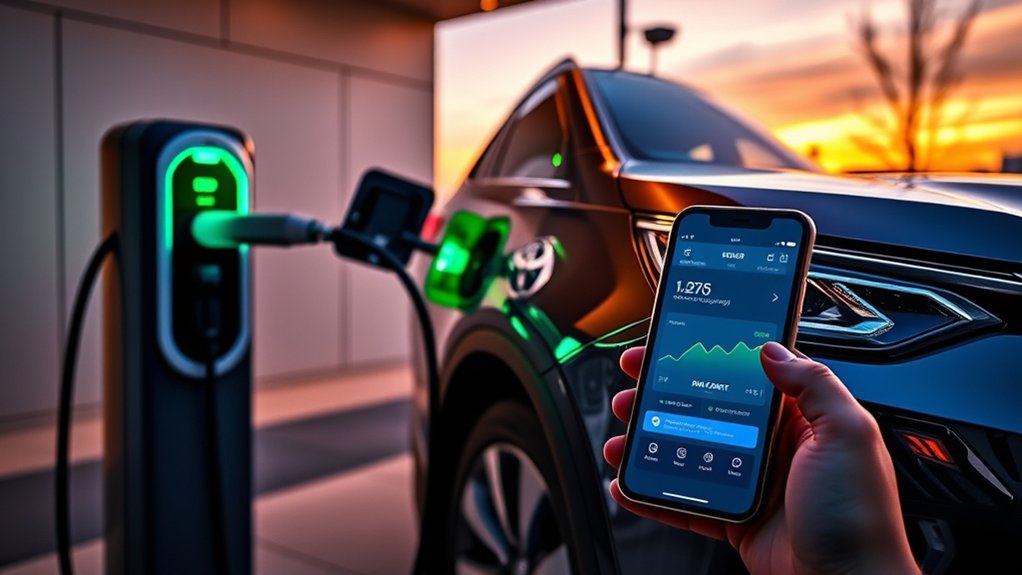
The charging indicators provide the fastest confirmation that the connector is seated and the vehicle is accepting power. The charge-summary display can show the remaining charge time, while the state-of-charge gauge shows the battery’s approximate status.
If the connector is attached but charging has not begun, check whether a departure schedule is controlling the start time. Select the immediate-charge function when you need charging to begin as soon as the connector is inserted.
Charging time may increase during extreme temperatures, pre-climate operation, reduced supply voltage, a power interruption, or a low 12-volt battery. A longer estimate does not automatically indicate traction-battery failure.
Note: After an interrupted session, the EV system may need several seconds before it can start or shift out of Park. Wait briefly, then try again after the connector has been removed correctly.
RAV4 EV Charging Safety Features
The portable Toyota charging cable includes a CCID, or Charging Circuit Interrupting Device, with power, error, test, and reset controls. Test it as directed before Level 1 charging and stop if it cannot complete the self-test.
The vehicle also uses charging interlocks. Connecting the charging cable while the EV system is on turns the system off, and the vehicle normally prevents shifting out of Park while the cable remains connected.
- Inspect the cable, connector, plug, port, and outlet before every session.
- Insert and remove connectors by holding their bodies rather than pulling on the cable.
- Do not charge with the cable tightly bundled, sharply bent, crushed, or under a heavy object.
- Do not touch connector terminals or insert objects into the port.
- Keep the wall plug and receptacle dry.
- Close the charging-port cap and door securely after unplugging.
- Keep children and pets away from connected charging equipment.
Charging in Rain, Snow, and Cold Weather
You may charge outdoors with equipment and receptacles designed for outdoor use, but the connection area must remain safe. Remove snow or ice from the charging port and confirm that water has not collected inside it.
Use an appropriate outdoor receptacle with a weather-resistant while-in-use cover for Level 1 charging. Do not connect or disconnect the wall plug with wet hands, and do not use an outlet submerged in water or covered by snow.
Do not charge during weather that may produce lightning. If thunder begins during charging, follow the owner’s manual and shut off the circuit at the breaker without touching the vehicle or charging equipment.
Below-freezing temperatures can slow or prevent 120V charging. Toyota recommends 240V charging in extremely cold conditions. If only 120V is available, charging during the warmest part of the day and sheltering the vehicle from wind may help.
Renewable Energy Options for RAV4 EV Charging
The original RAV4 EV connected services no longer provide a dependable path for Clean Assist enrollment or app-based renewable tracking. Use programs offered by your electric utility instead.
| Step | Action | Potential benefit |
|---|---|---|
| Check utility plans | Ask about renewable-energy, EV, or time-of-use rates | May align charging with cleaner or lower-cost electricity |
| Set a departure schedule | Use the vehicle’s in-dash charging schedule | Can shift charging away from peak periods |
| Review energy use | Use utility or connected-EVSE data | Helps estimate charging cost and consumption |
Troubleshooting a RAV4 EV That Is Not Charging
Start with simple checks before assuming the traction battery or onboard charger has failed.
| Symptom | Possible cause | What to do |
|---|---|---|
| No lights on the Level 1 CCID | Outlet has no power, breaker has tripped, or the cable is damaged | Stop, check the circuit safely, and try a known suitable dedicated outlet |
| CCID error light stays on | Leakage protection has operated or equipment has a fault | Disconnect, inspect, reset once as directed, and stop if the error returns |
| Connector is attached but charging waits | A departure schedule is active | Select Charge Immediately or revise the stored schedule |
| Charging indicators do not illuminate | Connector is not fully seated or the latch button is being pressed | Remove and reinsert the connector straight until it clicks |
| Charging is much slower than expected | Low-current EVSE, extreme temperature, pre-climate use, low voltage, or weak 12V battery | Confirm station amperage and allow for temperature-related delays |
| Charging indicators flash rapidly | Charging-system fault | Read the vehicle warning message, stop charging, and contact a Toyota dealer |
Do not repeatedly reset a breaker or CCID that continues to trip. Persistent protection-device operation can indicate a problem with the outlet, wiring, EVSE, charging cable, or vehicle.
What to Do If the Traction Battery Is Fully Depleted
The RAV4 EV cannot continue driving after the usable traction-battery charge is exhausted. Move to a safe location before the remaining range reaches zero whenever possible.
If the vehicle stops where no approved charging source is available, request roadside assistance or towing. Tell the operator that the vehicle is a battery-electric RAV4 EV and follow the towing instructions in the owner’s manual.
Do not attempt to open the traction battery, bypass the charging system, tow-charge the vehicle, or connect improvised power equipment. The high-voltage system requires trained service personnel.
Related Guides
Frequently Asked Questions
How long does it take to fully charge a Toyota RAV4 EV?
Toyota lists approximately 44 hours in Normal mode or 52 hours in Extended mode with the supplied 120V/12A cable. Level 2 estimates range from about five to 15 hours, depending on whether the station supplies 16A, 30A, or 40A and which charge mode you select.
Can the RAV4 EV use a DC fast charger or Tesla Supercharger?
No, not with its factory charging system. The stock 2012–2014 RAV4 EV accepts SAE J1772 Level 1 and Level 2 AC charging. It does not have factory CCS, CHAdeMO, or NACS DC-fast-charging hardware.
Can I charge the RAV4 EV in rain or snow?
Yes, when the charging equipment and receptacle are properly rated for outdoor use and the connection remains dry. Remove water, snow, and ice from the port, use dry hands, and do not charge during lightning or through a submerged or snow-covered outlet.
Is it safe to leave the RAV4 EV charging overnight?
Overnight charging is appropriate when you use undamaged, approved equipment connected to a sound electrical supply. Level 2 charging is especially suitable for overnight use. Stop immediately if the outlet, plug, cable, or connector becomes damaged or shows a persistent error.
Can I use a regular extension cord to charge my RAV4 EV?
No. Plug the Toyota Level 1 cable directly into a suitable dedicated receptacle. Do not use an extension cord, power strip, multiplug adapter, or improvised voltage adapter for EV charging.
Why does the RAV4 EV not start charging immediately?
A stored departure schedule may be delaying the session. Check the in-vehicle Charging & Pre-Climate Setup screen and select Charge Immediately when needed. Also confirm that the connector is fully seated and that the station or outlet has power.
Can the current Toyota app monitor a 2012–2014 RAV4 EV?
Do not depend on it. Toyota ended support for the affected RAV4 EV Entune charge-management and remote features on November 1, 2022. Use the vehicle’s displays and a current station-network or government locator instead.
Conclusion
Charging a factory-equipped Toyota RAV4 EV is straightforward once you use the correct vehicle specifications. Connect it to a dedicated 120V supply with the Toyota cable or, preferably, a compatible SAE J1772 Level 2 station.
Plan for approximately 44–52 hours at 120V or 5–15 hours at 240V, depending on current and charge mode. Do not plan around DC fast chargers, Tesla Superchargers, or retired Entune app functions. Safe equipment, a sound electrical circuit, and the vehicle’s own charging indicators are the keys to dependable charging.
Sources
- Toyota RAV4 EV Owner’s Manual — charging equipment, charge modes, charging times, procedures, indicators, troubleshooting, and safety precautions
- Toyota: The All-Electric 2012 RAV4 EV First Drive — original 120V cable and 240V/40A charging-equipment specifications
- Toyota 3G Network Retirement FAQ — discontinued RAV4 EV Entune and connected-service functions
- U.S. Department of Energy Alternative Fuels Data Center: Charging at Home — Level 1 and Level 2 home-charging guidance
- U.S. Department of Energy Alternative Fuels Data Center: Public Charging — public Level 2 and DC charging distinctions
- Electrical Safety Foundation International: EV Charging Safety — cable inspection, approved equipment, and extension-cord precautions

