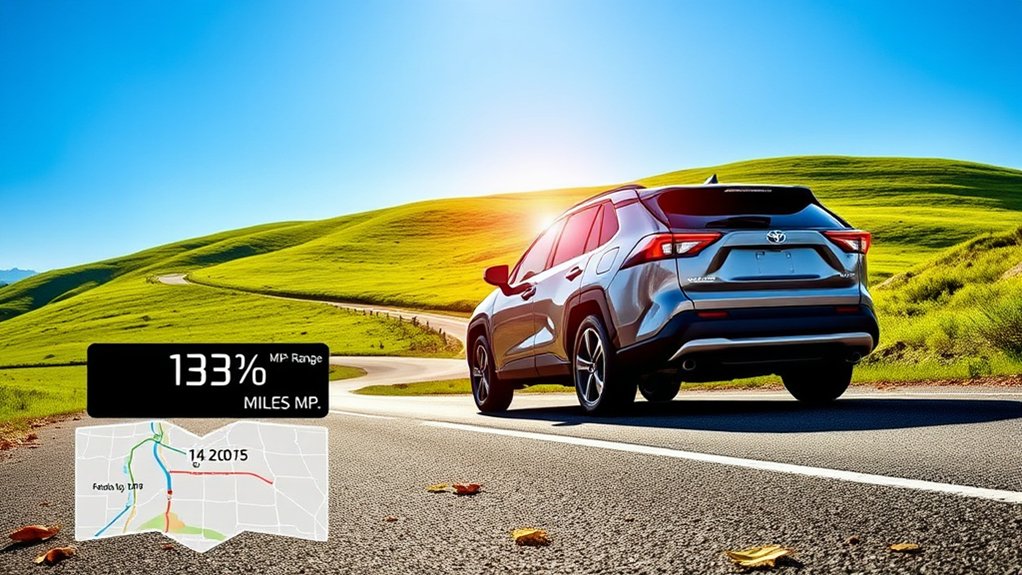
How far your Toyota RAV4 can travel on a full tank depends on its model year, trim, drivetrain, and powertrain. A current RAV4 Hybrid can theoretically cover roughly 550 to 625 miles using its combined fuel-economy rating, while older gasoline models usually cover less. Weather, speed, tire pressure, cargo, and driving habits can reduce the distance you actually see.
Quick Answer
A 2026 Toyota RAV4 Hybrid can theoretically travel about 551 to 624 miles on a full 14.5-gallon tank, depending on the trim’s combined MPG rating. A 2025 gas RAV4 is closer to about 420 to 435 miles. Your dashboard range will normally be lower because it allows for reserve fuel and recent driving conditions.
Key Takeaways
- The 2026 U.S. RAV4 lineup includes Hybrid and Plug-in Hybrid models rather than a conventional gas-only model.
- Toyota lists combined estimates of about 38 to 43 MPG for the 2026 RAV4 Hybrid, depending on trim and drivetrain.
- The 2026 RAV4 Plug-in Hybrid SE has an EPA-estimated electric range of up to 54 miles before it continues operating as a hybrid.
- Multiplying tank capacity by MPG gives a theoretical maximum, not a guaranteed distance-to-empty reading.
- Correct tire pressure, moderate speed, smooth driving, and removing unused roof cargo can improve real-world efficiency.
How Far Can a Toyota RAV4 Go on a Full Tank?
You can estimate a RAV4’s theoretical gasoline range with a simple formula:
Fuel-tank capacity × combined MPG = theoretical miles per tank.
Recent U.S. RAV4 models use a nominal fuel-tank capacity of approximately 14.5 gallons. The exact specification and fuel-economy rating can vary by model year and trim, so confirm both through the official Toyota RAV4 specifications or your owner’s manual.
| Model | Combined Rating | Theoretical Gasoline Range | Important Context |
|---|---|---|---|
| 2026 RAV4 Hybrid FWD | Up to 43 MPG | About 624 miles | Toyota lists 47 city, 40 highway, and 43 combined MPG for the FWD configuration. |
| 2026 RAV4 Hybrid AWD | About 38 to 42 MPG | About 551 to 609 miles | Ratings vary with trim, tires, ride height, and equipment. |
| 2026 RAV4 Plug-in Hybrid | About 36 to 40 MPG in hybrid operation | About 522 to 580 gasoline miles | A charged battery can provide additional electric driving. The SE has an EPA-estimated 54-mile electric range. |
| 2025 gas RAV4 | About 29 to 30 MPG combined for common configurations | About 421 to 435 miles | This conventional gas powertrain does not continue into the 2026 U.S. lineup. |
Note: These are mathematical estimates, not guaranteed travel distances. Your RAV4 normally warns you to refuel before all nominal tank capacity is consumed, and its range display adjusts to recent MPG, temperature, accessory use, and driving conditions.
Current RAV4 Hybrid and Plug-in Hybrid Mileage
Toyota moved the U.S. RAV4 to a fully electrified lineup for the 2026 model year. You can choose a standard Hybrid or a Plug-in Hybrid, but not a conventional gas-only powertrain. Exact ratings still vary by trim. Toyota’s detailed figures should remain the final reference for the vehicle you are considering.
2026 RAV4 Hybrid Fuel Economy
The 2026 RAV4 Hybrid uses a 2.5-liter four-cylinder engine with Toyota’s fifth-generation hybrid system. Front-wheel-drive models produce 226 net combined horsepower, while all-wheel-drive models produce 236 net combined horsepower.
Toyota lists the following manufacturer-estimated city, highway, and combined ratings:
- FWD: 47 city, 40 highway, and 43 combined MPG
- LE and SE AWD: 45 city, 39 highway, and 42 combined MPG
- XLE Premium AWD: 45 city, 38 highway, and 41 combined MPG
- Woodland Hybrid: 41 city, 35 highway, and 38 combined MPG
You can review Toyota’s current powertrain and rating details in the 2026 RAV4 model announcement.
2026 RAV4 Plug-in Hybrid Mileage
The Plug-in Hybrid combines a gasoline engine, electric motors, and a battery that you can charge from an external power source. Toyota lists 324 net combined horsepower for the 2026 model.
The SE and XSE are rated at 40 combined MPG when operating as hybrids. The Woodland is listed at 37 combined MPG, while the GR Sport is listed at 36 combined MPG. Toyota also lists an EPA-estimated electric range of up to 54 miles for the SE.
See the current trim figures on Toyota’s 2026 RAV4 Plug-in Hybrid page.
MPG, MPGe, and Electric Range Are Different Measurements
- MPG measures how far the vehicle travels on one gallon of gasoline.
- Electric range estimates how far a plug-in model can travel using stored battery energy before normal hybrid operation becomes necessary.
- MPGe compares electricity consumption with the energy contained in one gallon of gasoline. It is not the same as gasoline MPG.
The EPA explains that MPGe uses 33.7 kilowatt-hours as the energy equivalent of one gallon of gasoline and includes charging losses in the label calculation. You can read the testing explanation on the EPA fuel-economy and EV-range testing page.
What About 2025 and Older RAV4 Models?
Many RAV4s already on the road use specifications that differ from the current model. Avoid applying 2026 ratings to an older vehicle.
Gasoline RAV4 Models
The 2025 conventional gas RAV4 used a 2.5-liter four-cylinder engine producing 203 horsepower. Toyota listed up to 35 highway MPG for gas models. A common front-wheel-drive configuration was rated near 27 city, 35 highway, and 30 combined MPG.
Using a 14.5-gallon nominal tank, 30 combined MPG produces a mathematical estimate of approximately 435 miles. An AWD trim rated near 29 combined MPG would produce an estimate closer to 421 miles.
2025 RAV4 Hybrid
A 2025 RAV4 Hybrid could reach approximately 41 city, 38 highway, and 40 combined MPG in an efficient configuration. Multiplying 40 MPG by 14.5 gallons gives a theoretical range of approximately 580 miles.
2025 RAV4 Plug-in Hybrid
Toyota listed the 2025 RAV4 Plug-in Hybrid with a manufacturer-estimated 42-mile electric range and 38 combined MPG in hybrid operation. Those figures remain relevant to the 2025 vehicle but should not replace the current 2026 specifications.
Review older powertrain information in Toyota’s 2025 RAV4 model release.
How Fuel Tank Capacity Affects Driving Range
A larger tank can increase the distance between fuel stops, but tank size does not improve fuel economy. MPG tells you how efficiently the vehicle uses fuel. Tank capacity tells you how much fuel it can carry.
For example:
- 30 MPG × 14.5 gallons = 435 theoretical miles
- 40 MPG × 14.5 gallons = 580 theoretical miles
- 43 MPG × 14.5 gallons = approximately 624 theoretical miles
You should not expect to travel those exact distances before refueling. The fuel gauge, warning light, and distance-to-empty display are estimates. Manufacturers also design the system so drivers are encouraged to refuel before every drop of usable fuel is consumed.
Warning: Do not intentionally drive until the engine stops from lack of fuel. Running extremely low can leave you stranded and may place unnecessary stress on fuel-system components. A Plug-in Hybrid also needs gasoline available for normal hybrid operation.
Key Factors Influencing Toyota RAV4 Fuel Efficiency

Your EPA or manufacturer rating is a standardized comparison figure. Your personal result can be higher or lower because everyday driving introduces conditions that a single rating cannot predict.
| Factor | How It Affects Mileage | What You Can Do |
|---|---|---|
| Tire pressure | Underinflation increases rolling resistance. | Check all tires cold at least monthly and use the driver-side door-jamb specification. |
| Acceleration and braking | Rapid speed changes waste energy and reduce opportunities for efficient hybrid operation. | Accelerate smoothly, look ahead, and brake gradually when traffic allows. |
| Highway speed | Aerodynamic drag rises quickly as speed increases. | Use a safe, steady speed and avoid unnecessary high-speed driving. |
| Roof cargo | A roof box can create substantial aerodynamic drag, especially at interstate speeds. | Remove roof boxes and crossbars when you do not need them. |
| Cargo and towing | Added weight and trailer drag require more energy. | Remove unnecessary cargo and stay within Toyota’s load and towing limits. |
| Temperature and short trips | A cold engine, battery conditioning, cabin heating, and repeated short trips can lower efficiency. | Combine errands and precondition a plugged-in PHEV when practical. |
| Mechanical condition | Alignment problems, brake drag, warning-light faults, or incorrect oil can reduce efficiency. | Follow the maintenance schedule and investigate sudden changes. |
The U.S. Department of Energy estimates that correct tire inflation improves gas mileage by about 0.6% on average and by as much as 3% in some cases. It also estimates that a large roof box can reduce economy by 10% to 25% at interstate speeds, depending on the vehicle and box.
Replacing a clogged air filter remains worthwhile for engine protection and performance. However, the Department of Energy says it does not normally improve MPG on a modern computer-controlled, fuel-injected vehicle.
Why Regular Unleaded Gasoline Is Usually Right for a RAV4
Use the octane grade required in the owner’s manual for your exact RAV4. Recent U.S. RAV4 models are generally designed for regular unleaded gasoline, but specifications can differ by market and model year.
Buying premium gasoline does not automatically improve MPG or performance. The U.S. Department of Energy states that using a higher octane than required provides little or no benefit for most vehicles during normal driving. Any small severe-duty benefit usually does not recover the higher fuel cost.
You can review the government guidance on the FuelEconomy.gov octane page.
Tips for Maximizing Your RAV4’s Fuel Efficiency
- Check tire pressure monthly. Measure the tires when cold and use the pressure on the door-jamb label. Do not inflate them to the maximum pressure printed on the tire sidewall.
- Accelerate progressively. Smooth pedal inputs help both gas and hybrid RAV4 models use energy more efficiently.
- Leave more braking distance. Looking farther ahead reduces unnecessary acceleration and hard braking. In a hybrid, gradual braking also gives regenerative braking more time to recover energy.
- Control highway speed. A small reduction in cruising speed can produce a noticeable efficiency improvement when conditions allow.
- Remove unused roof equipment. Empty roof boxes, baskets, and some crossbars add drag even when they carry nothing.
- Reduce unnecessary weight. Remove heavy items that you do not need, but never remove safety equipment.
- Use the recommended oil. Follow the viscosity and specification listed in the manual and service information for your exact model.
- Address warning lights promptly. A check-engine light may indicate a fault that affects fuel economy or emissions even when the RAV4 seems to drive normally.
- Combine short trips. One longer trip usually allows the engine and hybrid system to operate more efficiently than several cold starts.
- Charge a Plug-in Hybrid regularly. A PHEV provides its greatest electric-driving benefit when you begin suitable trips with useful battery charge.
Pro Tip: Compare mileage over at least three to five full tanks instead of judging one trip. One fill can be distorted by pump shutoff differences, weather, towing, idling, or an unusual route.
How to Measure Your Actual RAV4 MPG
The dashboard average is useful, but a fill-to-fill calculation gives you another way to track gasoline use.
- Fill the tank and reset a trip odometer.
- Drive normally until your next fill.
- Fill the tank again, preferably at the same pump and with the vehicle parked in a similar position.
- Divide the trip miles by the gallons shown on the fuel receipt.
For example, if you drove 465 miles and added 12 gallons, your calculated economy would be 38.75 MPG.
Repeat the process across several tanks and calculate the average. Do not keep topping off after the pump automatically stops.
A Plug-in Hybrid requires more detailed tracking because gasoline MPG does not include the electricity used during charged driving. For a complete cost comparison, record gasoline, charging energy, charging price, and total miles.
Troubleshooting Lower-Than-Expected RAV4 Mileage
A small seasonal change is normal. A sudden or persistent decline deserves attention.
- Check cold tire pressure and look for uneven wear.
- Consider recent temperature changes and increased heater or air-conditioner use.
- Remove an unused roof box, basket, or heavy cargo.
- Compare your recent routes with your normal driving. Short trips and stop-and-go traffic can change results quickly.
- Check whether replacement tires have a different size, tread design, or rolling resistance.
- Watch for pulling, vibration, or a wheel that feels unusually hot, which may point to alignment or brake problems.
- Confirm that the correct engine oil was used.
- Have a check-engine or hybrid-system warning inspected instead of clearing it without diagnosis.
Contact a qualified technician if mileage drops sharply without an obvious change in weather, route, load, or driving style. Fuel leaks, strong gasoline odors, overheating, warning lights, or abnormal noises require prompt inspection.
Real-World RAV4 Mileage: What to Expect
EPA and manufacturer estimates are best used to compare vehicles under standardized conditions. They are not promises that every driver will reproduce the same result.
Your RAV4 may exceed its label rating on a mild day with moderate speeds, light traffic, and no external cargo. It may fall below the rating during cold weather, short trips, high-speed driving, towing, steep climbs, or heavy climate-control use.
The distance-to-empty display also learns from recent use. A high-speed trip, cold week, or towing session may cause the next full-tank estimate to fall. Several efficient trips may cause it to rise again. This does not necessarily mean the tank changed size or the vehicle developed a fault.
Frequently Asked Questions
What warranty covers a Toyota RAV4 fuel-system problem?
Coverage depends on the failed component, model year, mileage, location, and cause. Toyota’s 2026 basic warranty is 3 years or 36,000 miles, while the powertrain warranty is 5 years or 60,000 miles. Hybrid components are covered for 8 years or 100,000 miles, and the hybrid battery is covered for 10 years or 150,000 miles. Emissions warranties may cover certain parts for different periods. Check the warranty booklet for the vehicle’s VIN before assuming a repair is covered.
Can I use premium gasoline in my Toyota RAV4?
Premium gasoline normally will not harm a RAV4 designed for regular fuel, but it usually offers little or no benefit during everyday driving. Use the octane rating required in the owner’s manual for your exact model year and market.
How does driving style affect RAV4 fuel efficiency?
Rapid acceleration, hard braking, unnecessary idling, and high highway speeds increase energy use. Smooth inputs, steady legal speeds, and looking ahead in traffic usually improve efficiency. Gradual braking also helps a hybrid recover more energy through regenerative braking.
What modifications can improve RAV4 fuel efficiency?
No modification can guarantee better MPG. The safest improvements are keeping the original recommended tire size, choosing a suitable low-rolling-resistance replacement tire, maintaining alignment, and removing unused roof equipment. Engine tunes, oversized wheels, suspension changes, and nonstandard tire sizes may reduce efficiency or affect emissions compliance and warranty coverage.
Are specific tires better for RAV4 MPG?
A low-rolling-resistance tire in the correct size, load rating, and speed rating may help efficiency. However, compare wet grip, winter capability, tread life, comfort, and noise before choosing. Never improve MPG by overinflating a tire beyond Toyota’s cold-pressure specification.
Why does my RAV4 show a different range after each fill-up?
The distance-to-empty display estimates future range from recent fuel use and current conditions. Weather, speed, short trips, idling, towing, and climate-control use can change the estimate even when the same amount of fuel is added.
Can I trust tank capacity multiplied by MPG?
The calculation is useful for comparison, but it is only a theoretical estimate. You normally refuel before consuming the full nominal capacity, and real MPG changes with driving conditions. Use the dashboard display and fuel warning for trip planning rather than trying to consume every calculated mile.
Does Eco mode increase RAV4 MPG?
Eco mode can soften accelerator response and reduce some climate-control demand, which may make efficient driving easier. It does not overcome high speed, hard acceleration, underinflated tires, cold weather, or heavy loads. Your driving behavior remains the larger factor.
Conclusion
A Toyota RAV4 can cover roughly 420 to more than 620 theoretical gasoline miles per tank, but the correct estimate depends on its year, trim, drivetrain, and powertrain. Current 2026 Hybrid models generally provide the longest gasoline-only range, while the Plug-in Hybrid can complete many shorter trips using stored electricity before operating as a hybrid.
Use your exact Toyota or EPA rating, treat tank-capacity calculations as estimates, and track several fill-ups before judging performance. Correct tire pressure, smooth driving, moderate speed, limited roof cargo, and timely diagnosis of mechanical problems will give you the best chance of reaching your RAV4’s expected mileage.
Sources
- Toyota USA Newsroom: 2026 RAV4 — current lineup, hybrid ratings, horsepower, and warranty information
- Toyota: 2026 RAV4 Plug-in Hybrid — current electric range, horsepower, MPG, and MPGe figures
- Toyota USA Newsroom: 2025 RAV4 — prior gas and hybrid powertrain context
- U.S. Environmental Protection Agency — MPG, MPGe, and EV-range testing methods
- U.S. Department of Energy and EPA: Driving More Efficiently — speed, cargo, weight, idling, and driving-habit effects
- National Highway Traffic Safety Administration TireWise — tire-pressure, size, inspection, and maintenance guidance

