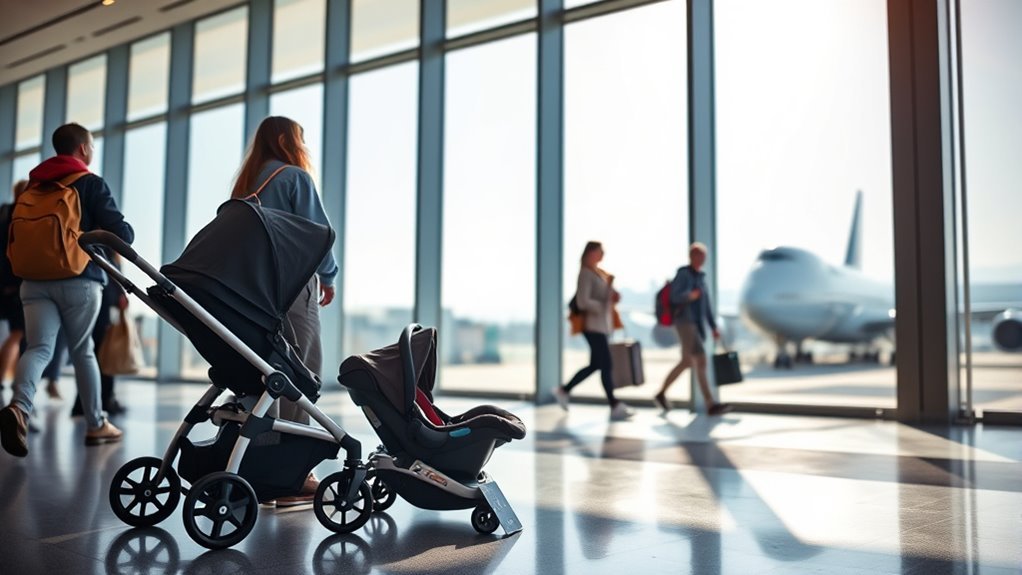
Wondering whether it costs extra to gate check a car seat and stroller? Most major U.S. airlines transport these child travel items free, but their rules differ on where you can check them and collect them after landing. Knowing the details before your flight helps you avoid unexpected fees, protect your equipment, and keep your stroller available when you need it.
Quick Answer
Gate checking a car seat and stroller is generally free on major U.S. airlines, including American, Delta, Southwest, JetBlue, and Alaska. Frontier and Allegiant also allow free checking of these child items. However, American normally requires one item at the ticket counter if you bring both. Size restrictions and return locations also vary.
Last checked: September 28, 2026. Airline policies and key safety information were verified against official sources.
Key Takeaways
- Free child-item checking does not always mean both items can be checked at the boarding gate.
- American Airlines permits one stroller and one car seat free, but only one can normally be checked at the gate.
- Southwest may send gate-checked equipment to baggage claim unless you request jet-bridge collection.
- Oversized strollers and stroller wagons may have different acceptance rules from standard folding strollers.
- An FAA-approved car seat used in a purchased aircraft seat provides better child restraint protection than holding a young child on your lap.
How Much Does Gate Checking a Car Seat and Stroller Cost?
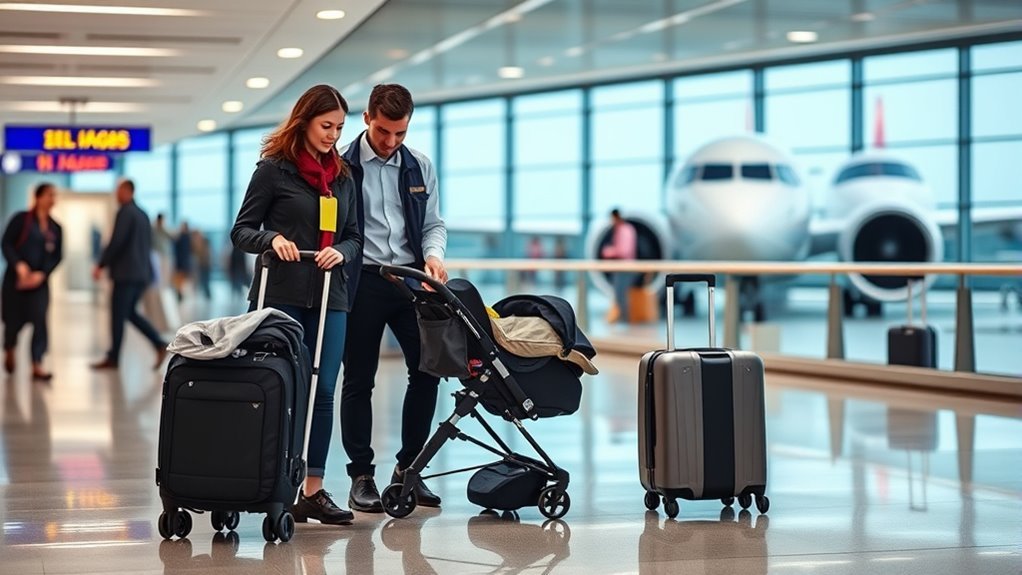
Gate checking a stroller or car seat generally costs $0 on the major U.S. airlines covered in this guide. These items usually receive a separate allowance rather than counting against your standard checked-baggage limit.
The important distinction is between free transportation and permission to check an item at a particular location. An airline might transport both items free while requiring one to be surrendered at the ticket counter.
For example, American Airlines allows a ticketed customer traveling with a child to check one stroller and one car seat free. However, if both items are checked, only one can normally be taken to the boarding gate.
Free checking does not guarantee that every stroller and car seat can travel all the way to the boarding gate.
A protective travel bag is an optional purchase rather than a standard gate-check fee. Extra equipment, such as a portable crib or another stroller, may fall under regular baggage rules.
Which Airlines Let You Gate Check a Car Seat and Stroller for Free?
American, Delta, Southwest, JetBlue, Alaska, Frontier, and Allegiant publish free checking allowances for child travel equipment. The main differences involve how many items can reach the gate, stroller restrictions, and where equipment is returned.
The following comparison summarizes their published policies as checked in September 2026.
| Airline | Free child-item allowance | Important gate-check rule |
|---|---|---|
| American Airlines | One stroller and one car seat | One item at the gate and one at the counter, or both at the counter. |
| Delta Air Lines | Strollers and child safety seats | Check at curbside, the ticket counter, or the gate. |
| Southwest Airlines | One stroller and one car seat per ticketed customer traveling with a child | Request jet-bridge return if you want the items before baggage claim. |
| JetBlue | Strollers and car seats outside the standard baggage allowance | Counter checking and gate checking are available. |
| Alaska Airlines | A child’s car seat and stroller | Check with regular baggage or wait until reaching the gate. |
| Frontier Airlines | Strollers and car seats | Strollers may be used through the airport and gate-checked free. |
| Allegiant Air | One stroller and one car seat per fare-paying passenger | Both may be gate-checked and collected at the gate or loading bridge. |
Airline Free Gate-Check Rules
Major airlines do not all use the same gate-check procedure, even when the service is free. Their official policies explain the exceptions that matter most to families.
American Airlines: The American Airlines child-travel policy allows one stroller and one car seat to be checked free. Both may be checked at the ticket counter, or one at the gate and the other at the counter.
Non-collapsible strollers and stroller wagons without built-in child safety straps must be checked at the counter. Other strollers should be checked at the gate before boarding.
Delta Air Lines: Delta’s children and infant baggage policy allows strollers and child safety seats to be checked free at curbside, the ticket counter, or the boarding gate.
Southwest Airlines: The stroller and child-items policy provides free checking of one stroller and one car seat per ticketed customer traveling with a child.
Southwest normally directs gate-checked items to baggage claim at the final destination. Tell the gate agent if you want your stroller or car seat returned at the jet bridge during a connection or upon arrival.
JetBlue: Its traveling with kids guidance confirms that strollers and car seats do not count toward standard carry-on or checked-baggage allowances. Families may check them at the airport or gate.
Alaska Airlines: The airline’s child-item baggage policy provides free checking for a child’s stroller and car seat. Families can check them with other baggage or wait until reaching the gate.
Frontier Airlines: Frontier’s published stroller policy confirms that strollers and car seats can be checked free. Strollers may also be gate-checked and returned at the destination.
Allegiant Air: Its traveling with children policy allows one stroller and one car seat per fare-paying passenger to be checked or gate-checked free.
Stroller and Car Seat Policies
A stroller’s free baggage allowance and a car seat’s permission to travel inside the aircraft are separate rules. This matters if your child has a purchased seat or your stroller folds small enough for the cabin.
A car seat used onboard must be approved for aircraft use and installed correctly. If you are not using it during the flight, you can check it under the carrier’s child-item allowance.
Some compact strollers may travel in the overhead bin if they meet the airline’s carry-on requirements. However, a stroller advertised as cabin-size is not automatically accepted on every aircraft.
Gate-checked equipment travels in the cargo hold, not inside the passenger cabin. A gate-check tag identifies the item and helps staff direct it to the correct collection point.
What Changes Gate Check Fees?
The cost depends mainly on whether an airline treats your equipment as an eligible child travel item or ordinary baggage. Item count, size, design, and the operating carrier can affect that decision.
A regular folding stroller and a child car seat usually qualify for free transportation on the airlines listed above. Additional equipment may not receive the same exemption.
Airline Policy Differences
Airline policy differences affect where you surrender your equipment, how much you can check, and where it is returned. A free allowance does not override an airline’s handling or safety requirements.
American’s one-item gate-check restriction is a useful example. Southwest’s baggage-claim return procedure is another.
If your itinerary includes a partner or connecting airline, the operating carrier’s procedures may differ from those of the airline that sold your ticket.
Travelers with lap infants should also distinguish the child’s equipment allowance from the child’s ticket status. An infant traveling on an adult’s lap does not automatically have an assigned aircraft seat.
Weight and Size Limits
Stroller dimensions and design can affect whether an airline accepts the item at the gate. Heavy jogging strollers, double strollers, and stroller wagons deserve particular attention.
There is no single 50-pound or 40-inch gate-check rule shared by every U.S. airline.
For example, Alaska Airlines publishes specific stroller-wagon conditions: eligible wagons must be designed to carry children and fold to under 90 linear inches and 35 pounds.
Larger wagons, wagons not designed for children, or wagons brought in addition to a stroller fall under Alaska’s standard baggage rules.
American requires non-collapsible strollers and certain stroller wagons to be checked at the ticket counter.
Measure your stroller when folded, including its wheels and attached accessories. Ask your operating airline about the exact model if it is unusually large or cannot fold.
Bag and Handling Fees
Free child-item transportation does not mean every related piece of equipment travels free. A portable crib, playpen, extra wagon, or additional stroller may count as standard checked baggage.
The main cost and handling considerations are:
- Whether the stroller and car seat qualify for the airline’s free child-item allowance.
- Whether extra equipment counts as ordinary checked baggage.
- Whether an oversized or non-collapsible item must be checked at the ticket counter.
- Whether you choose to purchase a protective stroller or car seat travel bag.
Do not assume a travel bag is required or that buying one removes an oversize fee. A bag protects the equipment but does not change its dimensions or the airline’s allowance.
Loyalty status and baggage benefits may affect ordinary luggage charges, but the free child-item allowances described here do not require those benefits.
How Do You Protect a Car Seat or Stroller?
Use a durable, properly fitted travel bag to help protect a stroller or car seat from dirt, moisture, and handling damage. Remove loose accessories, label the equipment, and inspect it before and after the flight.
A bag can reduce exposed surfaces and keep removable parts together. However, it cannot guarantee protection from impact or structural damage.
| Protection step | Purpose | Notes |
|---|---|---|
| Durable bag | Reduces exposure to dirt and moisture | Choose reinforced fabric and a secure closure |
| Label clearly | Helps identify and return equipment | Include your name and contact number |
| Inspect after travel | Identifies visible damage | Check the frame, shell, wheels, harness, and attachments |
How to Prepare Your Equipment Before Boarding
A short preparation routine makes gate checking easier and reduces the chance of losing small parts.
- Photograph the stroller and car seat before handing them over.
- Remove toys, loose organizers, cup holders, and other detachable accessories.
- Fold the stroller completely and secure its folding latch.
- Place the equipment inside its protective bag, if using one.
- Attach identification to the bag or equipment.
- Obtain the airline’s gate-check tag and confirm the destination.
Keep your child’s essentials and any items you need during the flight in your carry-on rather than inside the checked equipment.
Warning: A car seat can have damage that is not obvious at first glance. If you discover cracks, broken components, damaged harness parts, or other signs of impact after checking, stop using it until the manufacturer confirms whether it remains safe.
What Should You Do if an Airline Damages Your Equipment?
Inspect your items as soon as they are returned. If something is broken, photograph the damage and report it to the airline before leaving the airport whenever possible.
The U.S. Department of Transportation’s damaged baggage guidance explains that passengers should file claims promptly. Airline liability depends on applicable rules and the circumstances of the damage.
Keep the baggage tag, claim number, purchase documentation, and photographs until the issue is resolved.
For a damaged car seat, contact its manufacturer about continued use or replacement. Do not assume that a damaged seat is safe simply because its harness still fastens.
Is Gate Check Better Than Counter Check?
Gate checking is often more convenient for a stroller because you can use it while moving through the airport. Counter checking can be easier when you want to carry less equipment through security and the terminal.
Neither method guarantees protection against damage or immediate equipment return.
| Consideration | Gate check | Counter check |
|---|---|---|
| Airport use | Keep using the stroller until boarding. | Surrender equipment during check-in. |
| Security screening | Bring equipment through security. | Less bulky equipment to handle at security. |
| Arrival collection | Jet bridge or baggage claim, depending on the airline and tag. | Normally baggage claim. |
| Damage risk | Handling damage remains possible. | Handling damage remains possible. |
If you are traveling alone with a baby, keeping the stroller until boarding may make carrying your child and belongings easier.
If your stroller is large, difficult to fold, or unnecessary inside the airport, counter checking may be more practical.
Should You Bring a Car Seat on the Plane?
Using an approved car seat in the aircraft cabin is generally safer for a young child than traveling on an adult’s lap. It also keeps the car seat in your possession rather than placing it in the cargo hold.
The Federal Aviation Administration’s child safety guidance strongly recommends an approved child restraint system or device, particularly for children under two.
The American Academy of Pediatrics also supports using an appropriate aircraft-approved child restraint for young children.
Check the Car Seat’s Aircraft Approval
Look for a certification label stating that the restraint is approved for use in motor vehicles and aircraft.
Make sure the car seat fits your child’s height and weight, and follow its installation instructions.
The FAA generally recommends installing car seats in window seats so they do not obstruct another passenger’s exit path. Car seats cannot be used in emergency exit rows.
Not every seat or cabin configuration accommodates every child restraint, so confirm compatibility with your airline.
Does Your Child Need a Separate Ticket?
Buying a separate aircraft seat guarantees space for an approved car seat. If your infant travels on your lap, an available empty seat may sometimes be used, but you cannot count on one.
Children aged two and older generally need their own ticket and aircraft seat.
A car seat that is allowed onboard as a child restraint is different from an ordinary carry-on bag. Airlines may transport an approved seat being used by a ticketed child without counting it against the standard carry-on allowance.
Note: If you are unsure whether your car seat is approved for aircraft use, consult the manufacturer’s instructions and ask your airline before departure. A certified child passenger safety technician can help with questions about safe car seat use and installation.
What Airline Rules Should Parents Know?
Parents should confirm three things before flying: whether their equipment qualifies for free checking, where it must be surrendered, and where it will be returned. These details matter most when you have a connection or need your stroller immediately after landing.
How Do You Gate Check a Stroller or Car Seat?
The process is straightforward once you know your airline’s allowance and return procedure.
- Confirm the equipment is eligible for gate checking before traveling.
- Bring the stroller or car seat through airport security.
- Visit the gate agent before boarding and request a gate-check tag.
- Confirm whether the item will return at the jet bridge or baggage claim.
- Remove loose accessories and prepare the equipment for transport.
- Attach the tag and hand over the item at the designated location.
- Collect the equipment where the agent instructed after landing.
For connecting flights, ask whether you must collect and recheck the equipment at the intermediate airport.
Pro Tip: Before surrendering your stroller, photograph its gate-check tag. Keep the claim portion of the tag until the equipment is returned. This makes it easier to identify the correct item if you need help after landing.
What Happens at Airport Security?
You must remove your child from the stroller or car seat during screening. Strollers, child seats, and other child-related equipment are screened separately.
Items that fit through the X-ray machine are normally screened there. Oversized equipment may require a visual or physical inspection.
Keep feeding supplies, medication, and other essentials accessible so they can be screened without unpacking the entire stroller.
Can a Baby Qualify for Faster TSA Screening?
Traveling with a baby does not automatically let your family skip the TSA security line. Some airports provide family screening assistance, but availability and procedures vary.
Children aged 12 and younger can accompany an eligible parent or guardian through TSA PreCheck screening.
Children aged 13–17 may join an eligible adult when traveling on the same reservation if the TSA PreCheck indicator appears on their boarding pass. The TSA PreCheck enrollment guidance explains these conditions.
If you need help managing a stroller and baby during screening, ask the security staff rather than assuming a dedicated family lane is available.
Frequently Asked Questions
Can I Gate Check Both a Car Seat and a Stroller?
Yes, several U.S. airlines allow both items to be gate-checked free. However, American Airlines requires one item to be checked at the ticket counter when checking both. Check your operating airline’s item allowance and gate-check procedure before traveling.
Does It Cost to Check a Car Seat and Stroller?
Usually no. American, Delta, Southwest, JetBlue, Alaska, Frontier, and Allegiant publish free checking allowances for eligible child travel equipment. Additional items and equipment that falls outside the airline’s child-item rules may be subject to ordinary baggage charges.
Does a 3-Year-Old Need a Ticket to Fly?
Yes. A three-year-old needs a ticket and their own aircraft seat. Lap-infant arrangements generally apply only to children younger than two. You may use an approved car seat in the purchased aircraft seat if it meets the airline’s safety and installation requirements.
Can You Skip the TSA Line With a Baby?
No, having a baby does not automatically qualify you to bypass security. Some airports offer family screening assistance. If a parent or guardian is eligible for TSA PreCheck, children aged 12 and younger may accompany them through the expedited screening lane.
Will My Gate-Checked Stroller Be Returned During a Connection?
It depends on the airline and the instructions attached to your gate-check tag. Some items return at the jet bridge, while others continue to baggage claim. Southwest asks passengers to request jet-bridge return if they need their equipment during a connection.
Can I Bring a Foldable Stroller Inside the Aircraft Cabin?
Yes, some airlines allow compact strollers in the cabin if they meet carry-on dimensions and fit in the available storage space. Acceptance depends on the stroller’s folded size, aircraft configuration, and airline rules. A stroller marketed as cabin-size is not guaranteed to qualify on every flight.
Conclusion
Gate checking a car seat and stroller is generally free on major U.S. airlines, but item limits and collection procedures differ. Before flying, confirm whether both items can reach the gate, whether your stroller meets the carrier’s requirements, and where the equipment will be returned.
For better child protection during the flight, consider using an aircraft-approved car seat in a purchased seat. If you check your equipment instead, use a protective bag, keep the claim tags, and inspect everything after landing.
Sources
- American Airlines — Traveling With Children: Free stroller and car seat allowance, counter-check restrictions, and child ticketing.
- Delta Air Lines — Children and Infant Baggage: Complimentary child-item checking and available check-in locations.
- Southwest Airlines — Stroller and Child Items Policy: Free allowances and jet-bridge collection requests.
- JetBlue — Traveling With Kids: Free checking and child restraint information.
- Alaska Airlines — Child-Item Baggage Policy: Complimentary checking and stroller-wagon restrictions.
- Frontier Airlines — Stroller Fee Policy: Complimentary stroller and car seat checking.
- Allegiant Air — Traveling With Children: Free gate checking and return procedures.
- Federal Aviation Administration — Kids’ Corner: Aircraft-approved child restraints, safety recommendations, and installation guidance.
- U.S. Department of Transportation — Lost, Delayed, or Damaged Baggage: Reporting damage and airline baggage liability.
- TSA PreCheck Enrollment Help Center: Children’s eligibility for accompanied expedited screening.
