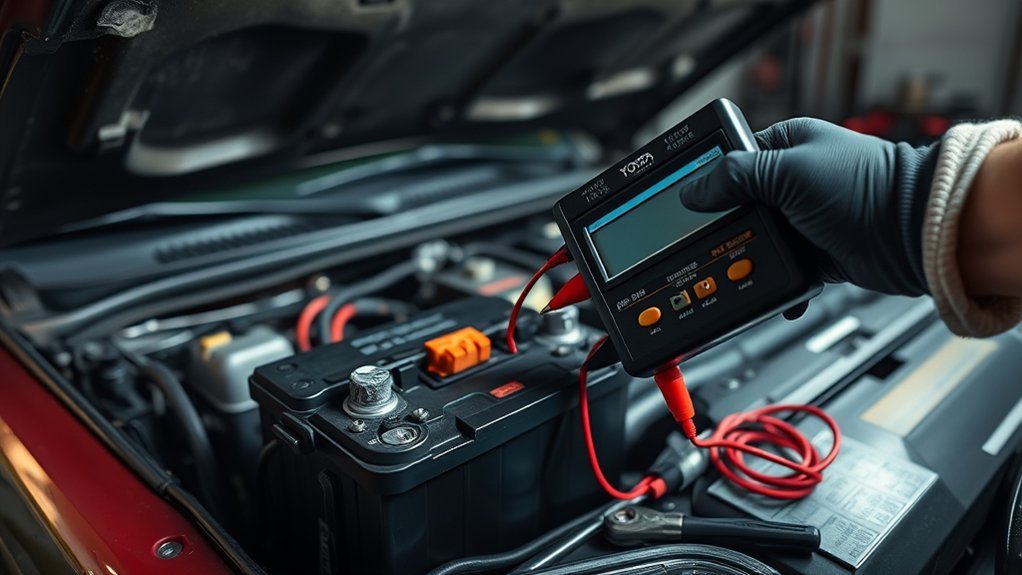
To find a parasitic battery drain on a Toyota Tacoma, first fully charge and test the 12-volt battery, then measure stabilized key-off current after the truck’s electronic modules have gone to sleep. As general automotive guidance, a settled draw below about 50 milliamps is commonly considered normal and more than about 100 milliamps is suspect, but those numbers are not a universal Toyota Tacoma specification. Compare the final reading with service information for your exact model year and equipment before condemning a circuit.
Last updated: September 11, 2026 — diagnostic guidance, Toyota resources, safety notes, and Tacoma-specific troubleshooting information were rechecked.
Quick Answer
Fully charge and test the battery first. Then connect a fused multimeter in series with the negative battery cable, keep the Tacoma’s doors, keys, and accessories from waking its modules, and wait for the reading to stabilize. Fluke’s general automotive guidance recommends allowing roughly 10–45 minutes for modules to enter sleep mode and treats less than about 50 mA as normal and more than about 100 mA as suspect. These are screening values, not a universal Tacoma specification. If the settled draw remains above the applicable limit for your truck, isolate the affected circuit with fuse voltage-drop testing or careful one-at-a-time fuse checks.
Key Takeaways
- Test the battery and charging system before assuming the Tacoma has a parasitic drain.
- Use the correct fused current input and highest suitable DC-amp range specified by your multimeter’s manual.
- Wait for electronic modules to enter sleep mode before evaluating the final reading.
- A fuse that causes the reading to drop identifies the affected circuit, not automatically the failed component.
- Use Toyota information for your exact model year because fuse layouts and acceptable key-off loads vary.
At a Glance
| Time Required | About 30–90 minutes, including the module sleep period; intermittent problems may take longer |
| Difficulty | Intermediate |
| Tools Needed | Fused digital multimeter or low-current DC clamp, wrench or socket that fits the battery-terminal clamp, fuse puller, safety glasses, gloves, and the correct fuse diagram |
| Cost | No additional cost if you already own the tools; professional diagnosis may be needed for module or intermittent faults |
Warning: Never crank or start the engine while a standard multimeter is connected in series with the battery. Starter current can greatly exceed the meter’s rating and may blow its fuse, damage the meter, create heat, or cause arcing. Keep sparks and flames away from the battery, and wear eye and hand protection.
Understanding Parasitic Battery Drain in Your Tacoma
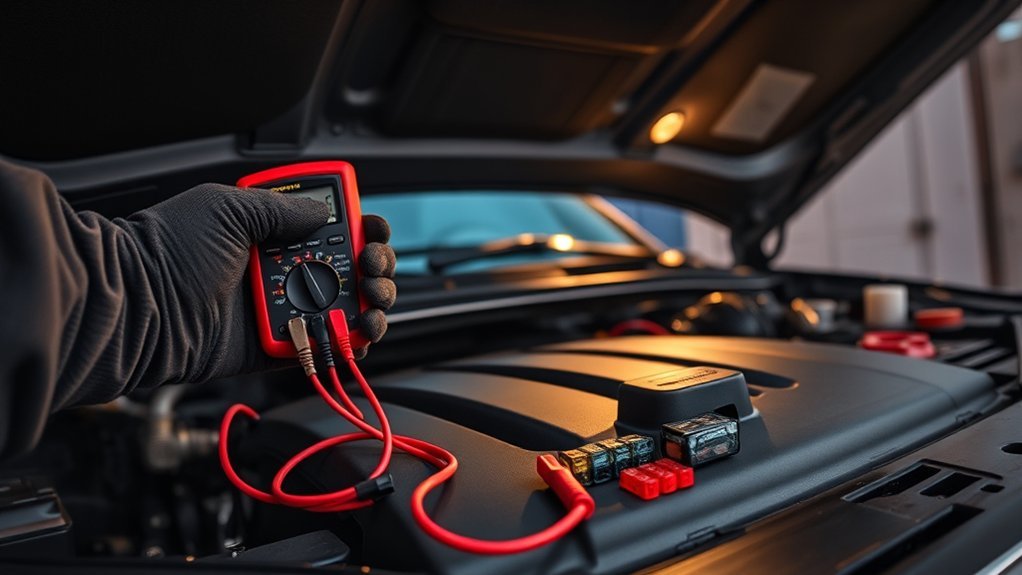
Your Tacoma continues using a small amount of battery power after you switch it off. Memory circuits, alarm systems, wireless-key receivers, clocks, and control modules may all require power while the truck is parked.
This normal key-off load becomes a parasitic drain when a circuit remains active longer than intended or consumes more current than the vehicle allows. A stuck light, failed relay, damaged wire, aftermarket accessory, alternator fault, or control module that refuses to sleep can discharge the battery.
Do not apply one universal milliamp limit to every Tacoma. Acceptable key-off current can vary by model year, equipment, alarm system, connected services, and installed accessories. Use the Toyota manuals portal and model-specific service information when a precise specification is available.
As a general screening rule after the vehicle is asleep, Fluke lists less than about 50 milliamps as normal and more than about 100 milliamps as suspect. These values are not a universal Toyota Tacoma specification.
Newer vehicles can require time for their electronic modules to shut down. The reading may initially be high and then fall in stages. Fluke recommends roughly 10–45 minutes as general automotive guidance, but the correct wait for a Tacoma depends on its year and equipment. Evaluate the final stabilized current rather than the first number shown on the meter.
Note: If your Tacoma is a hybrid model, this procedure applies only to its 12-volt auxiliary system. Do not touch orange high-voltage cables, connectors, battery components, or covers. Use the manual for your exact vehicle and obtain professional service for high-voltage concerns.
Recognizing Symptoms of Battery Drain
A parasitic drain often appears after the Tacoma has been parked for several hours or days. Common warning signs include:
- A slow or labored engine crank after the truck sits.
- A clicking sound from the starter with insufficient power to crank the engine.
- Dim interior, dashboard, or exterior lights before starting.
- A battery that repeatedly needs a jump-start.
- A battery that tests well after charging but becomes discharged while parked.
- An aftermarket accessory that remains warm, illuminated, or active after shutdown.
Battery voltage alone cannot prove that a parasitic drain exists. Fluke’s battery-voltage guidance lists about 12.6 volts as fully charged and about 12.2 volts as roughly 50% charged for a conventional 12-volt battery at rest. Low voltage may result from a weak battery, inadequate charging, short-trip use, cold weather, loose connections, or an electrical drain, so voltage should be treated as a state-of-charge clue rather than a complete battery-health diagnosis.
Battery age is also not a diagnosis. A battery that is more than two years old may still be healthy, while a newer battery can fail because of damage, repeated deep discharge, heat, or a manufacturing defect. Test its condition instead of relying on age alone.
Get Ready to Test: Tools You’ll Need
Gather the following equipment before disconnecting the battery:
- Digital multimeter: It must measure DC current and have an intact fuse in its high-current input circuit.
- Low-current DC clamp meter: Optional, but useful because it can measure current without opening the battery circuit.
- Battery-terminal wrench or socket: Use the size that fits your exact terminal clamp. A 10mm tool is common on many Tacomas, but verify the fastener before applying force.
- Fuse puller or insulated fuse pliers: Use the tool supplied in the fuse box when available.
- Fuse diagram: Consult the cover diagram and information for your exact Tacoma year and configuration.
- Battery charger and battery tester: Useful for confirming that the battery begins the procedure fully charged and serviceable.
- Safety glasses and gloves: Protect your eyes and skin while working around the battery.
- Notebook or phone: Record the initial reading, fuse positions, current changes, and affected circuits.
Inspect the meter before use. Confirm which jack accepts high current, the maximum current rating, how long that range may be used, and whether the meter requires a different lead position for milliamp measurements.
Rule Out Battery and Charging Problems First
A parasitic-current test should not be your first step when the battery is already discharged. Start with these checks:
- Inspect the battery: Look for a swollen case, leakage, cracked terminals, loose clamps, or heavy corrosion.
- Charge it fully: Use a charger suitable for the battery type rather than relying on a short drive.
- Test battery health: Use a conductance or load test to confirm that the battery can retain charge and supply starting current.
- Check charging performance: Verify that the charging system replenishes the battery while the engine runs.
- Inspect connections: Clean and tighten the battery terminals, grounds, and accessible charging-system connections.
If testing confirms that the battery itself has failed, see the Toyota Tacoma battery replacement guide. If the charging-system tests point toward the alternator, use the Tacoma alternator guide to understand the next diagnostic and replacement steps before buying parts.
Corroded or loose connections can cause slow cranking and incomplete charging, but they do not automatically create a key-off parasitic load. Treat connection resistance and parasitic current as separate diagnostic possibilities.
Connect the Multimeter for Testing
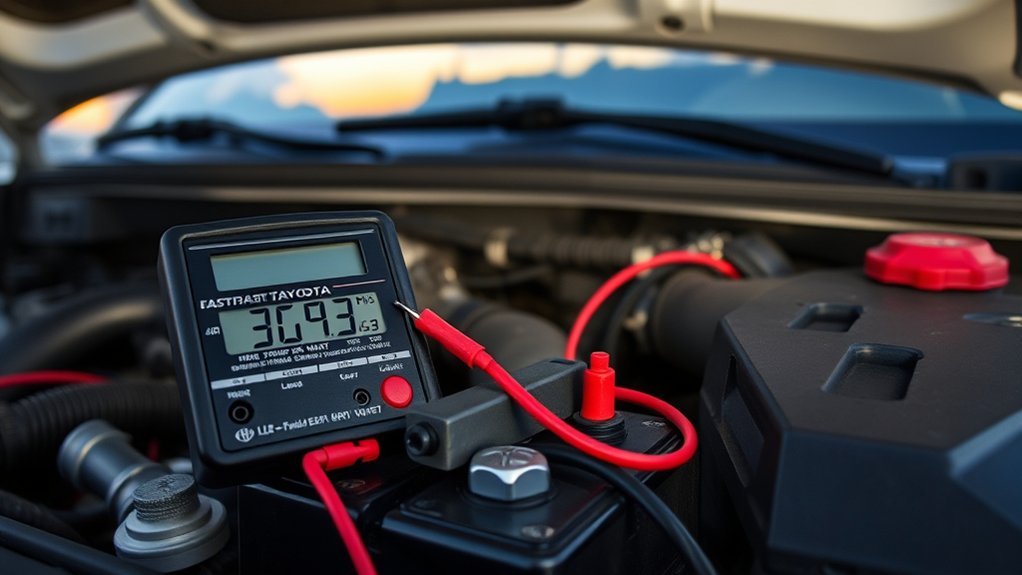
Once the battery is charged and known to be healthy, prepare the Tacoma so its modules can shut down without being disturbed.
- Turn everything off. Switch off the ignition, lights, climate controls, audio system, chargers, dashcams, and aftermarket accessories.
- Remove the key from the area. Keep smart keys and connected devices far enough away that they do not repeatedly wake the vehicle.
- Prepare door and hood switches. Close the doors, or manually latch their switches while leaving access to the fuse boxes. Make sure interior and bed lights remain off.
- Lower a window first. This gives you access if the doors lock after the battery is disconnected.
- Set up the meter. Place the black lead in the common jack and the red lead in the meter’s fused high-current input. Select its highest suitable DC-current range according to the meter manufacturer’s instructions.
- Disconnect the negative cable. Use the correctly sized wrench without allowing the tool to bridge the battery terminals or contact grounded metal unnecessarily.
- Connect the meter in series. Attach one meter lead to the negative battery post and the other to the disconnected negative cable. Polarity affects only whether the display shows a minus sign.
- Keep the connection stable. A loose lead can disconnect power, reset modules, and force you to restart the sleep period.
- Wait for the current to settle. Do not open doors, press the brake, operate switches, reconnect accessories, or move the key near the truck.
Pro Tip: A fused bypass jumper can maintain the battery connection while you install the meter. After the meter is securely connected, remove the bypass so current flows through the meter. This can reduce inrush current and prevent modules from resetting. A suitable low-current DC clamp meter provides another non-invasive option.
Fluke gives roughly 10–45 minutes as a general sleep-period range for automotive testing. Some Tacomas may settle sooner or later depending on model year, smart-key activity, connected services, and accessories. Watch for the reading to stop dropping and remain consistent. If opening a door or reinstalling a fuse wakes a module, allow the current to stabilize again.
Choose the Right Parasitic-Draw Test Method
| Method | Best use | Main caution |
|---|---|---|
| Multimeter in series | Accurately measuring the total key-off current when it is within the meter’s protected range | Opening the battery circuit can reset modules; high-current loads can blow the meter fuse |
| Low-current DC clamp meter | Watching current without disconnecting the battery or resetting modules | The clamp must have enough low-current resolution and must be zeroed correctly |
| Voltage drop across installed fuses | Locating an active fused circuit without repeatedly pulling fuses and waking modules | Requires a sensitive meter and the correct fuse-type conversion chart |
How to Interpret the Current Reading
Judge the Tacoma only after its key-off current has stabilized. An initially high reading is expected while electronic modules finish their shutdown routines.
| Meter behavior | Likely meaning | Next step |
|---|---|---|
| High at first, then gradually falls | Modules are completing shutdown tasks | Continue waiting without disturbing the truck |
| Stable and within model-specific limits | No constant excessive draw is present during the test | Investigate battery health, charging performance, or an intermittent drain |
| Stable and above the applicable specification | A circuit may be remaining active | Begin isolating fused circuits |
| Repeatedly rises and falls | A module, accessory, timer, network, or intermittent fault may be waking | Record the pattern and consider professional data logging |
If your meter displays amperes, convert the value before comparing it with a milliamp specification. For example, 0.050 amp equals 50 milliamps. Do not move the red lead to a lower-current jack until you know the current is safely below that jack’s fuse and range limit.
How Much Battery Capacity Does the Draw Use Per Day?
A continuous draw becomes easier to understand when you convert it to amp-hours consumed in 24 hours. These figures are simple current × time calculations; they do not predict the exact number of days until a no-start because battery capacity, temperature, state of charge, battery health, and required cranking power all vary.
| Continuous draw | Equivalent current | Charge used in 24 hours |
|---|---|---|
| 50 mA | 0.050 A | 1.2 Ah |
| 100 mA | 0.100 A | 2.4 Ah |
| 250 mA | 0.250 A | 6.0 Ah |
| 500 mA | 0.500 A | 12.0 Ah |
Testing Fuses and Circuits for Battery Drain
After confirming a stable excessive draw, isolate the affected circuit. On vehicles with many networked modules, measuring the small voltage drop across installed fuses can be less disruptive than repeatedly pulling them because it reduces the chance of waking modules. Fluke lists fuse voltage-drop testing as an alternative isolation method. Use the pull-fuse method below when it is appropriate for your meter, vehicle, and service procedure.
- Photograph the fuse box and confirm every fuse location before removing anything.
- Begin with aftermarket accessory fuses when they are separately installed.
- Remove one fuse while watching the meter.
- Record the fuse name, position, original current, and new current.
- Reinstall the fuse before moving to the next one unless the diagnostic procedure for your model says otherwise.
- If the current drops substantially, identify every component powered by that fuse.
- Allow the truck to settle again if removing or reinstalling the fuse wakes a control module.
A current drop identifies the problematic circuit, not necessarily the failed part. One fuse may supply several lights, switches, modules, outlets, relays, or accessories. Use a wiring diagram and disconnect devices on that circuit one at a time to narrow the fault.
Technicians may also measure the small voltage drop across an installed fuse and convert that measurement to current using fuse-specific charts. This method avoids removing the fuse and can reduce module wake-ups, but it requires a sensitive meter, the correct chart, and careful interpretation.
Note: If no interior fuse changes the reading, continue with the engine-compartment fuse box and charging circuit. Do not disconnect high-current or high-voltage components unless you have the correct service procedure and training.
Troubleshooting Common Causes of Battery Drain
Once you identify the affected circuit, inspect the components it powers. Common causes include:
| Possible cause | Useful clue | What to inspect |
|---|---|---|
| Dome, map, vanity, glove-box, console, or bed light | Light remains on, glows faintly, or feels warm | Lamp switch, door switch, latch, wiring, and bulb assembly |
| Aftermarket radio or amplifier | Unit remains warm or amplifier fails to shut down | Remote-turn-on wire, constant-power connection, and ground |
| Dashcam, charger, USB adapter, or OBD device | Accessory stays powered while parked | Parking-mode settings, power adapter, and chosen fuse tap |
| Remote starter, alarm, tracker, or trailer accessory | Drain began after installation or repair | Installation harness, relay, controller, and splices |
| Stuck relay | Relay or connected component remains warm | Relay contacts, control signal, socket, and powered load |
| Alternator diode leakage | Draw remains after ordinary accessory circuits are eliminated | Charging circuit and alternator, using an approved diagnostic procedure |
| Damaged or corroded wiring | Problem changes with vibration, moisture, or harness movement | Trailer wiring, under-dash additions, door harnesses, grounds, and rubbed insulation |
| Control module that does not sleep | Current cycles or remains elevated with no obvious load | Diagnostic trouble codes, network activity, software updates, and module inputs |
Tacoma-specific example: Southeast Toyota Distributors issued SET-TSB-16-002 for certain 2012–2014 Tacomas equipped with its LF10 accessory fog-light system. The bulletin describes a parasitic-draw concern related to that accessory harness and specifically says it does not apply to factory-installed fog lamps or systems from other manufacturers. If your Tacoma fits that exact configuration, confirm the accessory through VIN or installation history before assuming the bulletin applies.
Check components in a logical order instead of replacing the battery repeatedly. A new battery may temporarily hide the symptom, but it will also discharge if the underlying load remains.
Effective Strategies to Prevent Future Battery Drain
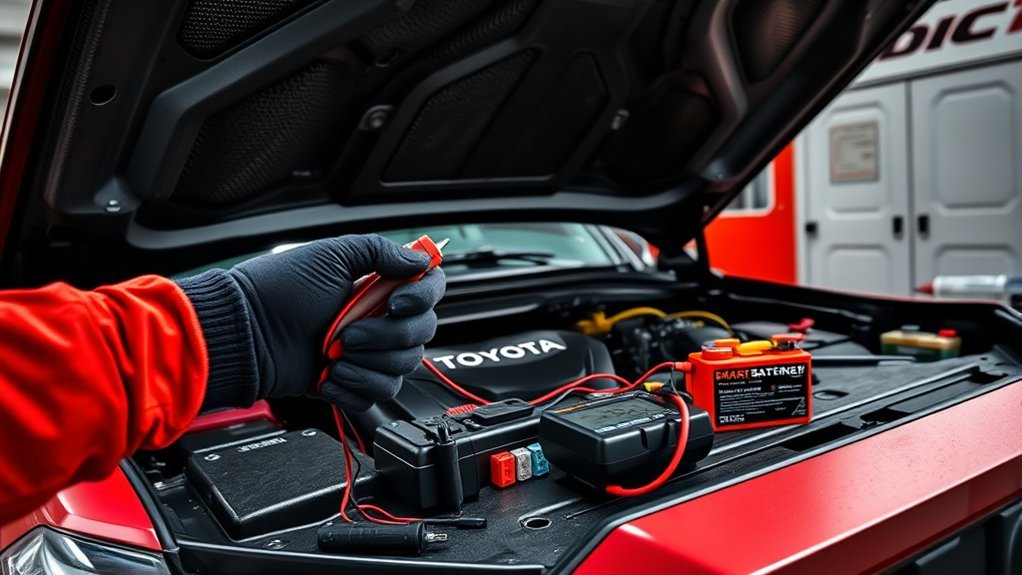
Good battery care and careful accessory installation can reduce the chance of another unexpected no-start condition.
Regular Battery Maintenance Tips
- Inspect the battery case, terminals, clamps, and hold-down during routine maintenance.
- Clean corrosion using an appropriate battery-terminal cleaning method and protect the connections after reassembly.
- Keep the battery fully charged, especially when the truck is driven infrequently or only on short trips.
- Test battery condition when starting performance changes rather than relying only on its age.
- Use a compatible maintenance charger when the Tacoma will remain parked for an extended period.
Inspect Electrical Connections Often
Loose or corroded battery connections can restrict starter current and prevent proper charging. Damaged wiring can also create shorts or unintended current paths. Inspect accessible grounds, fuse seating, accessory splices, trailer wiring, and harnesses near sharp or moving parts.
| Task | Suggested frequency | Purpose |
|---|---|---|
| Inspect battery terminals | Monthly and before long trips | Maintains reliable starting and charging connections |
| Check accessory wiring and fuses | During routine service or after electrical work | Finds loose connections, damaged insulation, and incorrect fuse taps |
| Verify lights and accessories shut down | After installation, repair, or settings changes | Prevents unnecessary key-off loads |
| Test battery condition | When symptoms appear and during seasonal service | Separates battery deterioration from an electrical drain |
Limit Aftermarket Additions Carefully
Aftermarket equipment can work reliably when it is installed with the correct switched-power source, fuse protection, wire size, ground, and shutdown control. Problems often begin when a device is connected to constant battery power without an effective sleep or low-voltage cutoff.
- Measure each accessory’s key-off load instead of assuming that every device should remain below one universal current limit.
- Use a switched circuit, relay, timer, or approved low-voltage cutoff when the equipment does not need constant power.
- Fuse added wiring close to its power source.
- Avoid unidentified fuse taps, twisted-wire splices, and undersized wiring.
- Retest total key-off current after installing a radio, amplifier, dashcam, tracker, remote starter, lighting system, or trailer accessory.
When to Get Professional Help
Stop the DIY test and contact a qualified automotive electrical technician when:
- The current exceeds your meter’s safe range.
- The meter fuse repeatedly opens.
- The battery becomes hot, swollen, damaged, or begins leaking.
- The drain is intermittent and does not occur during a short test.
- Removing fuses does not isolate the load.
- A control module repeatedly wakes without an obvious cause.
- The suspected circuit includes the alternator, main fusible links, hybrid equipment, or high-current wiring.
- You need wiring diagrams, scan-tool network data, software updates, or extended current logging.
A technician may use a low-current clamp, oscilloscope, scan tool, thermal camera, fuse voltage-drop measurements, or overnight data logging to locate a drain that a basic test misses.
Frequently Asked Questions
What is a normal parasitic draw for a Toyota Tacoma?
There is no single published current limit that should be applied to every Tacoma generation and configuration. As general automotive screening guidance, Fluke lists less than about 50 milliamps after sleep as normal and more than about 100 milliamps as suspect. Compare the stabilized reading with Toyota service information for your exact model year, equipment, smart-key system, connected services, and accessories before diagnosing a fault.
Can I do a parasitic draw test myself?
Yes, if you understand your multimeter’s current limits and can safely disconnect the 12-volt battery. Fully charge and test the battery first, wear eye protection, and never crank the engine while the meter is connected in series. Seek professional help if the current exceeds the meter’s range or the circuit cannot be isolated safely.
How can I find a parasitic battery drain with a test light?
A test light connected between the negative battery post and disconnected negative cable may show that current is flowing, but it cannot tell you the amount accurately. Normal memory loads may also illuminate it. Use it only as a rough screening tool, then confirm the result with a properly fused ammeter or suitable low-current clamp.
How do I use a multimeter to test for parasitic drain?
Connect the meter in series between the negative battery post and disconnected negative cable. Begin on the meter’s highest fused DC-current range, keep all loads off, prevent doors and keys from waking the truck, and wait for the current to stabilize. Compare the final reading with model-specific information before isolating circuits.
How do I find what is draining my battery so quickly?
First confirm that the battery and charging system are healthy. Measure stabilized key-off current, then test fused circuits for a substantial change. When a fuse or fuse voltage-drop test identifies an active circuit, inspect every light, module, relay, outlet, accessory, and wire powered by that circuit.
How long should I wait before reading the meter?
Wait until the current stops falling and remains stable. Fluke gives roughly 10–45 minutes as general automotive guidance, but shutdown time can vary with the Tacoma’s year, equipment, key system, connected services, and installed accessories. Any action that wakes a module may restart the waiting period.
Can a bad alternator cause a parasitic battery drain?
Yes. A failed alternator rectifier diode can create a reverse-current path after the engine is switched off even if the alternator appears to charge while the engine is running. If ordinary accessory circuits do not isolate the draw, test the charging circuit using the approved procedure for your Tacoma or have a qualified technician diagnose it. Do not disconnect high-current alternator wiring casually while performing an in-series meter test.
What if the battery dies but the current draw looks normal?
The battery may be weak, the charging system may not be replenishing it, or the drain may occur only intermittently. Timed accessories, temperature changes, moisture, module wake events, and damaged wiring can create a drain outside the test window. Extended current logging may be required.
Conclusion
Finding a parasitic battery drain on a Toyota Tacoma requires more than connecting a meter and immediately pulling fuses. Start with a fully charged, tested battery, verify the charging system, protect the meter from excessive current, and give the truck enough time to enter sleep mode.
When the stabilized draw remains above the applicable limit, isolate one fused circuit at a time or use fuse voltage-drop testing to avoid unnecessarily waking modules. Once you identify the circuit, inspect every component it powers. This method helps you locate the actual fault instead of repeatedly replacing a battery that is being discharged by another problem.
Sources
- Toyota Manuals and Warranties — model-specific owner information, warnings, features, and fuse documentation.
- Toyota Technical Information System — Toyota service information and model-specific diagnostic procedures.
- Who Killed My Parked Car? — research discussing parked-vehicle controller sleep, listening, and wake behavior that can affect battery consumption.
- Fluke: How to Find Parasitic Battery Drain with a Multimeter — current-measurement, sleep-period, screening-threshold, and circuit-isolation guidance.
- SET-TSB-16-002: Tacoma Fog Light Parasitic Draw — Tacoma-specific bulletin covering certain 2012–2014 trucks equipped with the applicable Southeast Toyota accessory fog-light system.
