If your Toyota Tacoma battery dies overnight, start by separating three possibilities: a weak or undercharged 12-volt battery, a charging-system problem, or excessive key-off current after the truck is parked. Fully charge and test the battery first, inspect the terminals and grounds, verify charging performance, and only then measure parasitic draw after the vehicle has entered its normal sleep state.
Last updated: September 19, 2026 — rechecked battery-test guidance, parasitic-draw thresholds, 2024+ i-FORCE MAX scope, external sources, and schema.
Quick Answer
A Toyota Tacoma that dies overnight usually has a weak or undercharged 12-volt battery, a charging-system fault, or excessive key-off electrical draw. Fully charge and test the battery first. If it passes, let the truck reach sleep mode, measure stabilized current, and isolate the active circuit with fuse, relay, wiring, light, module, accessory, and charging-system checks.
2024+ i-FORCE MAX scope: This guide covers diagnosis on the Tacoma’s 12-volt electrical system. Do not probe, disconnect, remove, or service orange high-voltage wiring or hybrid components. Use Toyota’s model-specific hybrid service information for charging-system diagnosis. For powertrain context, see the Toyota Tacoma i-FORCE MAX hybrid system guide.
Key Takeaways
- Test and fully charge the battery before diagnosing a parasitic draw.
- Acceptable key-off current and sleep time vary by Tacoma model year, trim, modules, and installed accessories.
- A multimeter used in amp mode must be connected in series, never directly across the battery terminals.
- Dash cameras, alarms, trackers, USB adapters, lights, relays, alternator diodes, and modules that fail to sleep are common areas to inspect.
- Intermittent drains or modified wiring may require extended current logging, wiring diagrams, a scan tool, or professional diagnosis.
- On 2024+ i-FORCE MAX models, keep DIY diagnosis on the 12-volt side and use Toyota hybrid-specific service information for charging-system tests.
At a Glance
| Time Required | About 30–90 minutes for basic checks, plus enough time for the truck’s electrical modules to enter sleep mode |
| Difficulty | Intermediate; professional help is recommended if you are unfamiliar with current measurements |
| Tools Needed | Battery charger or maintainer, battery tester, fused digital multimeter or low-amp DC clamp meter, fuse puller, basic hand tools, and model-specific service information |
| Cost | Basic diagnosis may require no repair parts if you already own the tools; battery, wiring, component, and shop costs vary |
Why Does a Toyota Tacoma Battery Die Overnight?
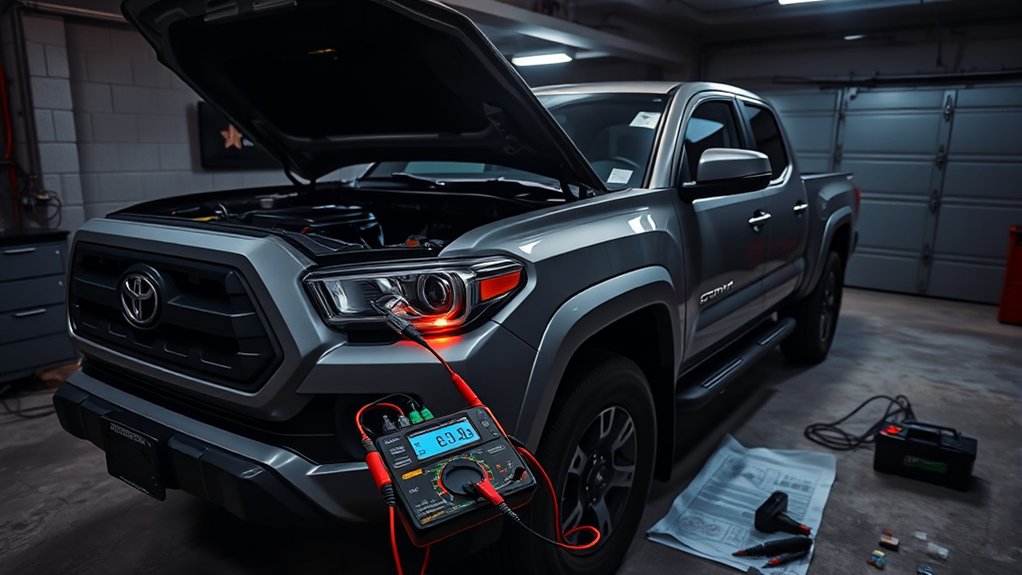
Your Tacoma’s battery supplies power when the engine is off and supports starting when you turn the key or press the start button. Some electrical current after shutdown is normal because security, memory, keyless-entry, and control systems may remain active.
A problem develops when the battery loses more usable charge than the truck can tolerate before the next start. That can happen because the battery started undercharged, has lost capacity, is not being recharged correctly, or is supplying an excessive key-off load.
Common warning signs include slow cranking, repeated jump-starts, dim lights before startup, electrical settings that reset, or a battery that tests low after the truck sits. These symptoms do not prove a parasitic draw by themselves.
Low battery voltage does not prove that the truck has a parasitic draw. Charge and test the battery before chasing individual circuits.
Is It the Battery, Charging System, or Parasitic Draw?
Use a logical sequence instead of replacing parts based on symptoms. Start with the battery, continue to the cables and charging system, and test key-off current only after those items pass.
| Possible Problem | Typical Clue | Best First Check |
|---|---|---|
| Discharged battery | Battery improves after a complete charge | Charge it fully, let it rest, and retest |
| Weak battery | Voltage appears acceptable, but starting capacity is poor | Conductance or load test |
| Charging-system fault | Battery repeatedly becomes undercharged during normal use | Charging-output and voltage-drop tests |
| Cable or ground resistance | Slow cranking, heat at a connection, or intermittent electrical behavior | Loaded voltage-drop test |
| Parasitic draw | A charged, healthy battery loses substantial charge while parked | Stabilized key-off current test |
Check Rested Battery Voltage
Charge the battery completely before judging its condition. After the charger is disconnected and the surface charge has dissipated, a conventional fully charged 12-volt lead-acid battery often reads about 12.6 to 12.8 volts at rest. GS Yuasa’s battery guidance gives the same general range. Temperature and battery design affect the reading, so voltage estimates state of charge; it does not prove the battery can deliver starting current.
A battery may display reasonable open-circuit voltage and still lack the capacity needed to crank the engine. Use a conductance tester or have the battery load-tested if slow cranking continues. If testing confirms the battery itself has failed, use the Toyota Tacoma battery replacement guide for the next step.
Inspect Terminals, Cables, and Grounds
Check both battery terminals for looseness, corrosion, damaged clamps, or swollen cables. Inspect the negative cable where it connects to the body and engine. Also inspect the positive cable and connections at the starter and under-hood fuse area.
Hidden resistance can cause slow cranking and charging problems even when the outside of a connection looks clean. A loaded voltage-drop test is more reliable than a visual inspection alone. Fluke’s automotive voltage-drop guide explains why poor grounds and hidden connection resistance can produce confusing symptoms.
Verify Charging Performance
Start the engine only after completing any key-off current test and returning the meter leads to their normal voltage-measurement positions. Check charging performance with the engine running and with appropriate electrical loads applied.
Do not rely on one universal running-voltage number. Charging strategy can change with temperature, battery state, electrical demand, powertrain, and model year. Compare your results with the service information for your exact Tacoma. On a conventional alternator-equipped truck, the Toyota Tacoma alternator guide explains the symptoms and checks that should come before replacement.
What Commonly Drains a Toyota Tacoma Battery?
Once the battery, terminals, grounds, and basic charging performance have been checked, inspect the systems that can continue using power after shutdown.
Common Electrical Issues
- Door, hood, or cargo-light switches: A switch or latch signal may keep a light or body circuit active.
- Glove-box, vanity, or interior lights: A lamp can remain on even when it is difficult to see from outside the truck.
- Sticking relays: A relay may continue supplying a component after the ignition is switched off.
- Control modules: A fault, network message, or repeated wake-up event can prevent normal sleep operation.
- Smart keys: A key stored close to the truck may contribute to repeated proximity-system activity on equipped models.
- Trailer and bed accessories: Lighting, brake controllers, inverters, bed outlets, and added wiring can create unintended loads.
Use the wiring diagram and fuse information for your model year. Fuse names and circuit assignments can change between Tacoma generations and configurations.
Faulty Battery Components
A weak battery does not automatically create a vehicle-side parasitic draw. Instead, it may have reduced capacity, excessive internal self-discharge, or poor acceptance of charge. That means a small normal load can leave it unable to start the truck by morning.
| Component or Condition | Possible Effect | Recommended Test |
|---|---|---|
| Weak or sulfated battery | Cannot store enough usable energy for reliable starting | Full charge followed by conductance or load testing |
| Loose or corroded connection | Restricted charging or cranking current | Loaded voltage-drop test |
| Alternator or regulator fault on an alternator-equipped model | Battery remains undercharged | Charging-output test under controlled conditions |
| Leaking alternator diode on an alternator-equipped model | Key-off current leakage, poor charging, or excessive AC ripple | Key-off current, diode, and AC-ripple testing |
| Faulty switch or module | A light or network remains active after shutdown | Current monitoring, fuse isolation, and scan-tool data |
Aftermarket Device Problems
Aftermarket equipment is a frequent place to look because it may connect directly to constant battery power or bypass factory power-management controls. Inspect anything added after the truck left the factory, including:
- Dash cameras and parking-mode hardwire kits
- Alarm systems, remote starters, and GPS trackers
- Audio amplifiers and powered subwoofers
- Trailer brake controllers and towing accessories
- OBD-II adapters, insurance monitors, and scan devices
- USB chargers, power inverters, and auxiliary outlets
- Aftermarket lighting, switches, and relay panels
Temporarily disconnect one device at a time only when doing so is safe and will not damage its wiring. Never remove a fuse or disconnect a control unit merely because it is nearby. Confirm the circuit with a diagram and current-test result.
How Do You Test a Toyota Tacoma for Parasitic Draw?
A parasitic-draw test measures the electrical current leaving the battery after the truck is switched off and its modules have settled into their normal parked state. Prepare the vehicle carefully because opening a door, pressing a remote button, or reconnecting the battery can wake several systems.
Warning: Never place a multimeter set to amps directly across the battery terminals. For a series test, begin on the meter’s highest fused current range. Do not start or crank the engine, switch on the headlights, operate the blower, or activate another high-current load while the meter is in series. Doing so can blow the meter fuse, damage the meter, create arcing, or interrupt vehicle electronics. Use a low-amp DC clamp meter or hire a technician if you are unsure.
Prepare the Truck for Testing
- Fully charge the battery and confirm that it can pass an appropriate battery test.
- Switch off all accessories and unplug removable chargers or devices.
- Remove the key and keep smart keys away from the truck.
- Lower a window before closing the doors so you can reach the interior without waking the vehicle.
- Confirm that the hood, door, and cargo-light circuits will recognize a closed condition.
- Do not press the remote, open a door, move the seat, or operate another electrical device once stabilization begins.
- Consult Toyota Technical Information System for model-specific testing conditions and circuit information.
Note: Sleep time and acceptable key-off current vary by model year, trim, connected services, smart-key equipment, accessories, and vehicle condition. Fluke’s parasitic-drain guide notes that some vehicles can take up to about 45 minutes to enter sleep mode. Do not condemn a circuit from a reading taken immediately after shutdown or battery reconnection.
Method 1: Use a Low-Amp DC Clamp Meter
A low-amp DC clamp meter can measure current around one battery cable without disconnecting it. This helps preserve module memory and avoids the wake-up event caused by breaking and restoring battery power.
- Zero the clamp according to its instructions.
- Clamp it around one battery cable, not both cables together.
- Confirm the direction and units shown on the display.
- Allow the truck to remain untouched until the reading stabilizes.
- Record the stabilized current and watch for periodic wake-up spikes.
The tool must have enough low-current resolution for automotive sleep-current work. A general high-current clamp meter may not resolve small milliamp changes accurately.
Method 2: Connect a Fused Multimeter in Series
Use this method only with a meter, leads, and current input rated for the expected load.
- Switch the meter to its highest fused DC-current range.
- Place the black lead in the COM terminal and the red lead in the correct high-current input.
- With the truck off, disconnect the negative battery cable.
- Connect one meter lead to the negative battery post and the other lead to the removed negative cable. The meter now completes the circuit in series.
- Maintain secure connections and avoid moving the leads while the modules settle.
- Wait until the reading stabilizes. This may take longer than a few minutes.
- Record the reading before pulling any fuse.
If the starting current exceeds the meter’s rating, stop the test. Do not move the red lead to a lower-current input until you know the remaining current is below that input’s fused limit.
Pro Tip: A low-amp clamp meter or fuse voltage-drop test usually disturbs the vehicle less than disconnecting the battery. Avoid repeatedly breaking the circuit because each reconnection may restart module timers and delay sleep mode.
Monitor Fuse and Relay Circuits
After confirming that the stabilized draw is excessive for your exact vehicle, identify the circuit responsible.
- Photograph the fuse-box layout and note each fuse’s original position.
- Remove one fuse at a time while watching the current reading.
- Reinstall the fuse before moving to the next one unless the service procedure says otherwise.
- Look for a repeatable drop that brings current close to the expected vehicle baseline.
- Use the fuse chart and wiring diagram to list every component supplied by that circuit.
- Test those components, connectors, relays, and branches individually.
A current change identifies a circuit, not necessarily the failed part. One fuse can supply several modules, lights, switches, and splice points.
Method 3: Use Fuse Voltage-Drop Testing
A sensitive millivolt measurement across an installed fuse can reveal whether current is flowing through that fuse without removing it. This method can prevent module wake-ups, but it requires accurate meter resolution and a fuse-type conversion chart.
Measure only after the truck has entered its parked state. A voltage difference across a fuse indicates current flow, but the value must be interpreted using the fuse design, rating, temperature, and an appropriate chart. Use professional service information if you are unfamiliar with the method.
Toyota Tacoma Battery Drain Diagnosis: 8-Step Order
- Confirm the complaint: Note how long the truck sits, ambient conditions, recent repairs, and which accessories remain connected.
- Charge the battery: Begin with a fully charged battery so a low state of charge does not distort the results.
- Test battery capacity: Use a conductance or load test instead of relying on voltage alone.
- Inspect cables and grounds: Clean and tighten connections, then perform loaded voltage-drop tests when symptoms continue.
- Verify charging performance: Check the charging system under the conditions specified for the exact Tacoma.
- Measure stabilized key-off current: Use a suitable clamp meter or a safely connected series ammeter.
- Isolate the circuit: Check fuses, relays, and branches while monitoring the current.
- Confirm the repair: Repeat the test under the same conditions and verify that the battery remains charged after a comparable parking period.
Understand the Current Reading
Do not treat one universal milliamp value as a Toyota specification. As a general screening guide, Fluke describes a sleeping draw below about 50 mA as normal and a steady draw above about 100 mA as suspect. Those are not universal Tacoma factory limits, so compare the stabilized reading with Toyota service data for your model year and installed equipment.
| Stabilized Key-Off Draw | General Screening Meaning |
|---|---|
| Below about 50 mA | Common general benchmark after sleep; still confirm the exact Tacoma specification. |
| About 50–100 mA | Gray area; check equipment, telematics, periodic wake-ups, battery condition, and model-specific service data. |
| Above about 100 mA | Commonly treated as suspect after full sleep; isolate the active circuit before replacing parts. |
Source for the general screening ranges: Fluke, “How to Find Parasitic Battery Drain with a Multimeter.”
You can also estimate the energy removed during parking:
Current in amperes × time in hours = amp-hours consumed
| Steady Draw | Energy Used in 24 Hours |
|---|---|
| 50 mA (0.05 A) | 1.2 Ah |
| 100 mA (0.10 A) | 2.4 Ah |
| 200 mA (0.20 A) | 4.8 Ah |
| 500 mA (0.50 A) | 12 Ah |
For example, a steady 0.20-amp draw for 12 hours removes about 2.4 amp-hours. Whether that prevents starting depends on the battery’s actual usable capacity, temperature, state of charge, and engine cranking demand. A healthy battery may tolerate a small draw that leaves a weak or undercharged battery unable to start.
Periodic spikes do not always indicate a fault. Some systems wake briefly and return to sleep. A repeating event that prevents the current from settling deserves further investigation.
How Do You Identify the Circuit Causing the Drain?
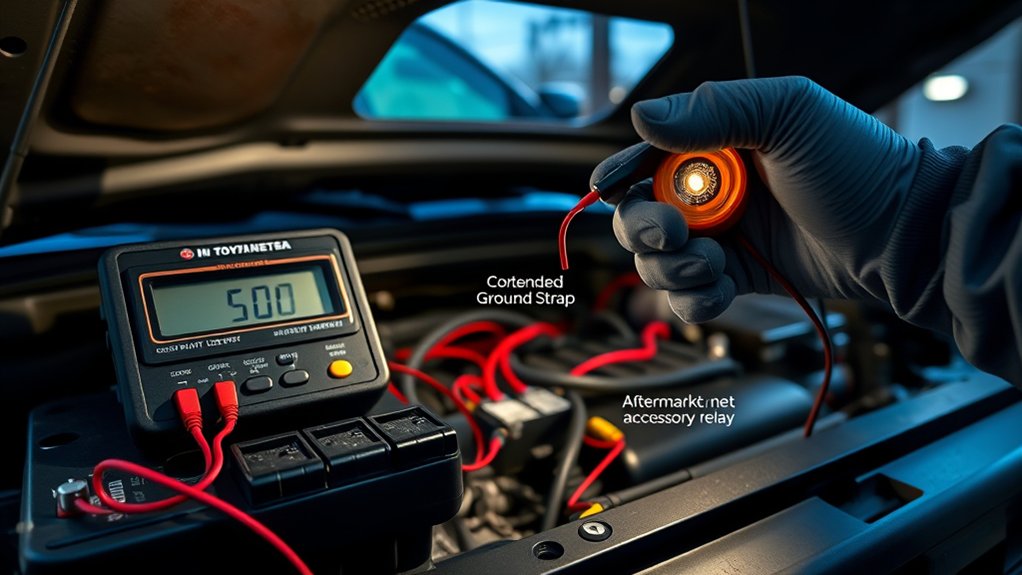
Once fuse testing identifies the affected circuit, inspect every load on that branch. Avoid replacing the first component listed on the fuse-box cover.
| Component | Possible Symptom | How to Confirm It |
|---|---|---|
| Door, hood, or cargo switch | Light or body circuit remains active | Check switch status, lamp operation, and scan data where available |
| Alternator | Undercharging, AC ripple, or current leakage with the engine off | Charging, ripple, and key-off leakage tests |
| Aftermarket device | Current drops when its fuse or power feed is disconnected | Inspect wiring and verify switched versus constant power |
| Sticking relay | A component stays powered after shutdown | Test relay control, contacts, and downstream load |
| Control module | Network repeatedly wakes or never reaches normal sleep current | Scan-tool data, network testing, service bulletins, and extended logging |
Check the Alternator for Key-Off Leakage Where Applicable
A failed alternator diode can affect charging and may also provide a path for current when the engine is off. Do not disconnect the alternator output cable casually because it remains connected to battery power and can short against ground.
A technician can compare key-off current before and after safely isolating the charging circuit, then perform diode and AC-ripple tests. Disconnect the battery according to the service procedure before removing or isolating an alternator cable. On i-FORCE MAX models, use Toyota’s hybrid-specific procedure rather than assuming this alternator test applies unchanged.
Inspect Relays and Modules
A relay may stick mechanically, receive an unintended control signal, or power a component that has failed internally. A control module may remain awake because of a fault in another module, a damaged switch input, or repeated network messages.
If pulling one fuse causes a large current drop but several modules share that circuit, scan-tool communication and wiring diagrams are usually more useful than replacing modules one at a time.
How Does Heat Affect a Tacoma Battery?
High under-hood temperatures accelerate battery aging and can reduce the amount of reserve capacity available when the truck is parked. A battery weakened by heat may fail overnight even when the key-off load has not recently changed.
- Test battery condition before periods of extreme heat or cold.
- Keep the battery securely mounted and the top surface clean and dry.
- Clean corrosion and correct its cause instead of coating over a poor connection.
- Use the battery type, physical size, terminal layout, and rating specified for your Tacoma.
- Recharge the battery when repeated short trips do not replace the energy used during starting.
- Do not replace a battery based only on age. Use its test results, symptoms, service history, and physical condition.
How Should You Use Tacoma Owner Reports?
Owner reports can help you identify patterns worth checking, but they cannot prove that your truck has the same fault. Frequently discussed areas include interior or cargo lights, hardwired dash cameras, alarms, trackers, OBD-II devices, charging problems, and batteries with reduced capacity.
Use forum experiences as diagnostic clues, not as substitutes for testing. Record your Tacoma’s model year, trim, battery type, installed accessories, parking duration, measured voltage, and stabilized current before comparing your results with another owner’s experience.
You can also search for recalls, investigations, complaints, and manufacturer communications through the NHTSA recall and safety-issue database. A VIN search can identify applicable unrepaired safety recalls, but it does not display every service campaign or previously repaired recall.
How Can You Prevent Toyota Tacoma Battery Drain?
Preventing battery drain starts with a fully charged, healthy battery and accessories that shut down as intended.
- Confirm that interior, vanity, glove-box, cargo, and aftermarket lights switch off.
- Unplug OBD-II adapters, USB chargers, and portable accessories when they are not needed.
- Configure dash-camera parking mode with an appropriate low-voltage cutoff.
- Have aftermarket alarms, remote starters, audio equipment, and trackers installed with correct switched and constant-power feeds.
- Keep smart keys away from the truck when it is parked at home.
- Test the battery and charging system when cranking speed changes.
- Use a maintainer suitable for the installed battery when the truck sits for extended periods.
- Confirm accessory-timer behavior in the owner’s manual for your exact model year instead of assuming every circuit shuts off after the same period.
When to Call a Professional
Stop DIY testing and contact a qualified technician when:
- You do not have a fused meter or do not know its current limit.
- The initial current exceeds the meter’s safe range.
- The draw is intermittent and does not occur during a short test.
- Several modules repeatedly wake and sleep.
- The suspected circuit includes safety, immobilizer, airbag, or network-control systems.
- The truck has extensive aftermarket wiring or previous electrical repairs.
- Fuse removal identifies a circuit but not the individual load.
- The alternator output cable or another unfused high-current connection must be isolated.
- The battery continues to discharge after the measured key-off current appears normal.
A technician may use extended current logging, a scan tool, oscilloscope, thermal imaging, wiring diagrams, or module-network analysis to capture a fault that occurs only occasionally.
Frequently Asked Questions
What causes your battery to drain overnight?
Possible causes include a weak or undercharged battery, charging-system trouble, a light that remains on, a sticking relay, alternator diode leakage, a module that fails to sleep, or an improperly wired aftermarket device. Test the battery and charging system before measuring key-off current.
How can you check for parasitic drain without disconnecting the battery?
Use a low-amp DC clamp meter around one battery cable, or measure millivolt drop across installed fuses with an appropriate conversion chart. Both methods reduce the chance of waking modules or resetting memory. The tool must have enough resolution for low-current automotive testing.
Which fuse causes battery drain on a Toyota Tacoma?
There is no single Tacoma fuse that causes every battery drain. The affected fuse depends on the model year and the circuit that remains powered. A repeatable current drop after checking a fuse identifies the circuit to inspect, not necessarily the failed part, so use the exact fuse chart and wiring diagram before disconnecting components.
What is draining my Toyota battery?
You cannot identify the source from battery voltage alone. Fully charge and test the battery, verify the charging system and cable voltage drop, measure stabilized key-off current, and then isolate the responsible fuse circuit. Inspect every component on that circuit before replacing a part.
What is a normal parasitic draw for a Toyota Tacoma?
The correct sleep-current specification depends on the model year, trim, installed modules, connected services, and accessories. Below about 50 milliamps is a common general screening benchmark, while a steady draw above about 100 milliamps is commonly treated as suspect after full sleep. These are not universal Toyota specifications; compare the stabilized reading with service information for the exact truck.
How long should you wait for a Tacoma to enter sleep mode?
Wait until the current reading stabilizes under the conditions specified for your model. Do not assume five or ten minutes is always enough. Battery reconnection, door activity, key proximity, connected services, or a fault can extend the time or cause periodic wake-ups.
Can a bad alternator drain the battery while the truck is off?
Yes, on an alternator-equipped truck. A failed diode can provide a current-leakage path after shutdown and may also cause poor charging or excessive AC ripple. Confirm the fault with proper charging, ripple, and key-off leakage tests before replacing the alternator. On i-FORCE MAX models, use the hybrid-specific Toyota procedure for the exact year and equipment.
Will replacing the battery fix a parasitic drain?
Only if the battery itself is the failed part. A new battery can temporarily hide a key-off electrical draw, but it will discharge again if a circuit stays active. Charge and test the battery, verify the charging system, and measure stabilized key-off current before replacing parts.
Does this parasitic-draw test apply to Tacoma i-FORCE MAX models?
Yes, but only on the 12-volt electrical side and only with the correct Toyota procedure for the exact model year. Do not probe, disconnect, remove, or service orange high-voltage wiring or hybrid components. If diagnosis points toward the hybrid charging system, stop DIY testing and use Toyota service information or a qualified hybrid technician.
Conclusion
An overnight battery failure in your Toyota Tacoma does not automatically mean the battery or alternator needs replacement. Begin with a complete battery charge and capacity test, inspect the terminals and grounds, verify charging performance, and then measure stabilized key-off current safely.
If the draw is excessive, use fuse, relay, wiring, and component tests to locate the actual circuit. Model-specific Toyota service information should control the final specification and procedure. Seek professional diagnosis when the drain is intermittent, the wiring has been modified, testing involves high-current connections or vehicle networks, or an i-FORCE MAX diagnosis reaches the hybrid system.
Sources
- Toyota Tacoma Owner’s Manual through Toyota TIS — official model-specific operating and safety information.
- Toyota Tacoma Owner’s Manual through Toyota TIS — official information for a later Tacoma manual edition.
- Fluke: Diagnosing Voltage Drops — electrical troubleshooting, connection resistance, and ground-circuit testing.
- National Highway Traffic Safety Administration Recall Lookup — VIN-specific recall checks and manufacturer communications.
- Who Killed My Parked Car? Exploring Parking-Mode Automotive Battery Drain — research on parked-vehicle electronic control-unit sleep and wake behavior.
- Fluke: How to Find Parasitic Battery Drain with a Multimeter — supports safe in-series testing, fuse isolation, general sleep-current screening ranges, and sleep-time context.
- GS Yuasa: General Battery Questions — supports the general 12.6–12.8-volt fully charged resting range for a 12-volt battery.
- Toyota USA Newsroom: 2026 Toyota Tacoma i-FORCE MAX — confirms the current Tacoma hybrid powertrain lineup.
- Toyota T-SB-0021-24: Battery Inspection and Maintenance During PDS — distinguishes the 12-volt battery from the high-voltage battery in Toyota electrified vehicles.
