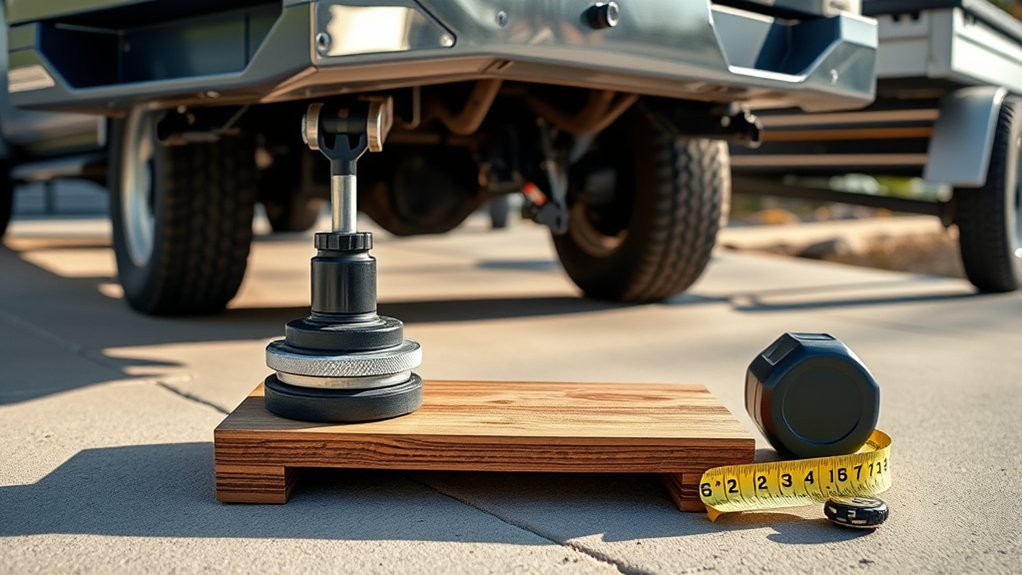
To measure tongue weight on a Toyota Tundra, load the trailer exactly as it will travel, park on firm level ground, chock the wheels, and measure the full downward load at the coupler at normal towing height with a properly rated tongue-weight scale. Toyota’s 2024 Tundra owner’s manual specifies 9–11% of gross trailer weight for conventional towing and 14–16% kingpin weight for fifth-wheel or gooseneck towing, but your exact model-year manual and the lowest applicable truck, tire, hitch, axle, and trailer rating still control. This guide covers dedicated scales, a bathroom-scale lever, and platform-scale measurements.
Last updated: September 22, 2026 — reviewed against Toyota Tundra owner-manual towing guidance, Toyota’s 2026 Tundra specifications, CAT Scale axle-placement guidance, and CURT’s tongue-weight measurement procedure.
Method note: This article is a manufacturer- and scale-guidance synthesis. It does not claim hands-on testing with every Tundra, trailer, hitch, or scale.
Affiliate disclosure: This page may contain monetized product links. If you buy through them, we may earn a commission at no extra cost to you.
Quick Answer
Load your trailer exactly as it will be towed, park on level ground, and measure the downward load at the coupler with a properly rated tongue-weight scale. You can also use a correctly arranged bathroom-scale lever or two platform-scale weighings. Compare the result with your exact Tundra owner’s manual and all truck, tire, hitch, and axle ratings.
Key Takeaways
- Do not automatically apply a generic 10–15% rule to every Tundra. Recent Tundra manuals specify 9–11% for conventional towing, while other towing types can use different ranges.
- Measure the trailer in its real travel condition, including batteries, propane, water, equipment, food, and cargo.
- A bathroom-scale reading is multiplied by three only when the supports are positioned in the correct two-foot and one-foot lever arrangement.
- Use separate CAT Scale readings to calculate actual tongue weight, and release weight-distribution hitch tension during that calculation.
- Tongue weight must fit within the truck’s payload, GVWR, GAWR, tire, receiver, ball mount, hitch, and trailer limits.
Related Tundra towing checks: verify your truck-specific payload capacity, review GVWR, GAWR, and GCWR, and use the separate Tundra tongue-weight percentage guide when your main question is the target percentage rather than the measurement method.
At a Glance
| Time Required | About 10–30 minutes, depending on the measurement method |
| Difficulty | Easy with a dedicated scale; moderate with a lever or platform scale |
| Tools Needed | Wheel chocks and either a tongue-weight scale, a bathroom scale with a strong board and supports, or access to a platform scale |
| Cost | Free if you already own the required equipment; platform-scale fees and dedicated scale costs vary |
What Is Tongue Weight and Why Does It Matter for Towing?
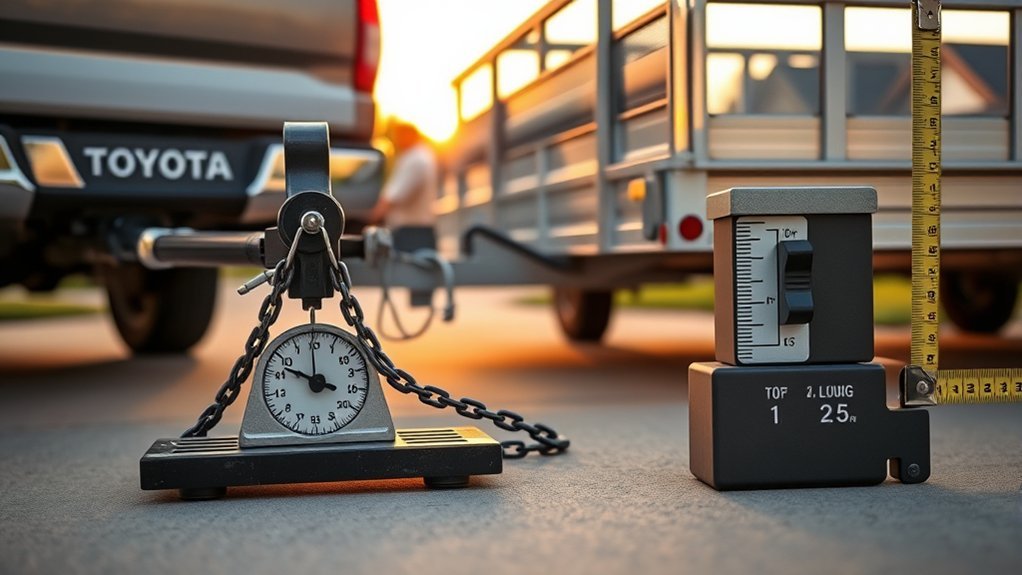
Tongue weight is the downward force that a conventional trailer’s coupler places on the Tundra’s hitch ball. It affects steering, braking, rear-axle load, and the trailer’s resistance to sway.
Too little tongue weight can make a trailer unstable. Too much can overload the truck’s rear axle, tires, receiver, suspension, or available payload. The correct result must satisfy both the trailer’s required weight distribution and every applicable rating on the truck and towing equipment.
Note: Do not treat 10–15% as a universal Toyota Tundra specification. The 2024 Toyota Tundra Owner’s Manual specifies 9–11% tongue weight for conventional towing and 14–16% kingpin weight for fifth-wheel or gooseneck towing. Check the manual for your exact model year before setting a target.
Tongue-weight percentage formula:
Tongue weight ÷ loaded gross trailer weight × 100 = tongue-weight percentage
Using Toyota’s 9–11% conventional-towing guidance, a loaded 6,500-pound trailer would have a calculated target range of 585–715 pounds, subject to all vehicle, tire, hitch, and axle limits.
Fifth-wheel and gooseneck trailers place weight in the truck bed rather than on a rear receiver ball. Their downward load is normally called kingpin or pin weight, and their target percentage can differ from conventional tongue weight.
How Can You Measure Tongue Weight on a Toyota Tundra?
You can measure tongue weight with a dedicated scale, a bathroom-scale lever, or a certified platform scale. The best method depends on the expected load, available equipment, and whether you also need axle and gross combination weights.
| Method | Best Use | Main Caution |
|---|---|---|
| Dedicated tongue-weight scale | Direct measurements at home | The scale must be rated for the expected load and placed at the correct support point. |
| Bathroom-scale lever | A lower-cost check when the direct load exceeds the bathroom scale’s capacity | The multiplier is valid only when the lever distances are measured correctly. |
| CAT or other platform scale | Tongue weight plus truck, trailer, and individual axle checks | The truck’s occupants, cargo, fuel, and hitch equipment must remain consistent between weighings. |
Which method should you use? Use a dedicated tongue-weight scale when you want the simplest repeatable home check. Use a platform scale when you also need front-axle, rear-axle, trailer-axle, GVWR, GAWR, or GCWR data. Use the bathroom-scale lever only when the expected divided load stays safely within the scale’s capacity and every board, pipe, and support is rated and stable.
Prepare the Trailer for a Real-World Measurement
An unloaded or partly prepared trailer will not provide the number you need for highway travel. Before weighing, place the trailer in its normal towing condition.
- Install the normal battery, propane cylinders, spare tire, and hitch equipment.
- Load food, tools, camping gear, vehicles, or other cargo in their normal positions.
- Set fresh-water, waste, and fuel tanks to the levels you expect during travel.
- Secure every movable item so it cannot shift after measurement.
- Load the Tundra with the usual passengers, bed cargo, accessories, and hitch hardware when checking axle and vehicle ratings.
- Inflate the truck and trailer tires according to their applicable labels and manufacturer instructions.
Because tanks and cargo can sit ahead of or behind the trailer axle, filling or emptying them may materially change tongue weight. Remeasure after any major loading change.
Step-By-Step Guide to Using a Tongue Weight Scale
A dedicated tongue-weight scale provides a direct reading when it is correctly rated and positioned. Follow the scale manufacturer’s instructions because approved support points and operating procedures can differ.
Selecting the Right Scale
Choose a scale whose maximum capacity is greater than your expected tongue weight. Do not attempt to use a scale at or beyond its stated limit.
Check whether the scale manufacturer instructs you to place it beneath the coupler, beneath the tongue jack, or beneath a supplied adapter. A measurement taken under a jack positioned behind the coupler can differ slightly from a measurement taken at the hitch-ball location.
For the closest representation of the load applied to the hitch, measure at the center of the coupler and at the trailer’s normal towing height whenever the scale instructions allow it.
Proper Setup Procedure
- Park on firm, level ground. Avoid a sloped driveway, soft soil, loose gravel, or a surface that allows the supports to sink.
- Chock the trailer wheels. Place suitable chocks so the trailer cannot roll in either direction.
- Load the trailer for travel. Include cargo, batteries, propane, liquids, and equipment in their normal positions.
- Level the trailer. Set the coupler to approximately the same height it has when connected to the Tundra.
- Disconnect the trailer from the Tundra. A dedicated coupler-scale reading is taken with the tow vehicle removed so the scale supports the full static tongue load. If you use the platform-scale method later in this guide, keep the trailer connected but release the weight-distribution spring-bar tension for the untensioned weighing.
- Position the scale. Place it under the coupler or use the scale manufacturer’s approved pipe or adapter.
- Lower the coupler slowly. Transfer the complete tongue load to the scale without allowing the tongue jack or another support to carry part of the weight.
- Record the stable reading. Raise the tongue and repeat the measurement at least once to confirm consistency.
Warning: Never work beneath an unsupported trailer tongue. Use wheel chocks, stable supports, and equipment rated above the expected load. Stop if the scale, board, pipe, jack, or ground begins to shift, bend, sink, or tilt.
Reading the Measurement Correctly
Divide the measured tongue weight by the trailer’s actual loaded gross weight, then multiply by 100. Compare the result with the guidance in your exact Tundra manual and the trailer manufacturer’s loading instructions.
A percentage inside the recommended range does not automatically make the combination safe. Confirm that the measured tongue weight also fits within:
- The Tundra’s available payload after passengers and cargo are loaded
- The truck’s GVWR
- The front and rear GAWR
- The load capacity of each truck tire
- The receiver, hitch head, ball mount, and hitch-ball ratings
- The trailer coupler and frame ratings
- The Tundra’s GCWR and configuration-specific trailer weight rating
For the truck-side calculation, use the payload value on your exact vehicle’s label and subtract occupants, cargo, accessories, hitch hardware, and measured tongue weight. See the Toyota Tundra payload calculation guide for a worked truck-load example.
The lowest applicable rating controls. Never use a higher rating from another Tundra trim, cab, drivetrain, hitch, or model year.
Alternative Measurement Techniques: Bathroom and Vehicle Scales
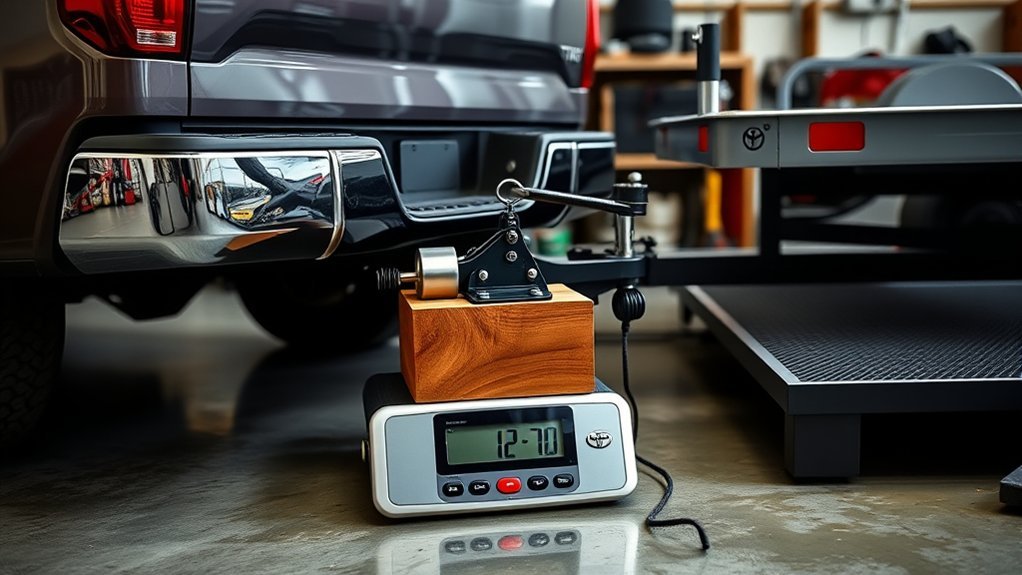
A bathroom scale can measure a light trailer directly or a heavier tongue through a properly constructed lever. A platform scale requires more travel but provides the most complete view of the truck, trailer, and axle loads.
Bathroom Scale Setup
If the expected tongue weight is comfortably below the bathroom scale’s capacity, you can place the coupler load directly on the protected scale. Keep the coupler at normal towing height and make sure the complete tongue load is supported by the scale.
For a heavier tongue, use the lever arrangement described by CURT’s tongue-weight measurement guide:
- Park the loaded trailer on firm, level ground and chock the wheels.
- Use a straight, undamaged board at least 3½ feet long and strong enough for the expected load.
- Place a bathroom scale under one end of the board and a solid block of equal support height under the opposite end.
- Place a horizontal pipe between the board and scale, and another horizontal pipe between the board and block.
- Position the scale-side pipe exactly two feet from the point where the trailer tongue will press on the board.
- Position the block-side pipe exactly one foot from the tongue’s support point on the opposite side.
- Place a vertical pipe or approved support beneath the coupler and lower the full tongue load onto the marked point.
- Wait for the scale reading to stabilize, then multiply that reading by three.
Formula for this exact arrangement:
Bathroom-scale reading × 3 = estimated tongue weight
For example, a 220-pound reading would represent an estimated 660 pounds of tongue weight. The scale must safely support the divided reading, and every board, pipe, block, and contact point must safely support the forces applied to it.
Note: Do not multiply a direct bathroom-scale reading by three. The multiplier applies only to the exact lever arrangement described above. Different distances create a different multiplier.
Vehicle Scale Process
A certified platform scale can show whether the loaded combination remains within its axle, vehicle, trailer, and combination ratings. On a standard CAT Scale, place the Tundra’s front axle on the steer platform, its rear axle on the drive platform, and the trailer axle or axles on the trailer platform.
Use the following procedure to calculate actual tongue weight:
- Load the Tundra and trailer for travel. Keep the same passengers, truck cargo, trailer cargo, hitch hardware, and approximate fuel level throughout the process.
- First weighing, truck only: Weigh the loaded Tundra without the trailer. Leave removable hitch hardware installed if it will remain on the truck during the combination weighing. Record the front and rear axle weights.
- Second weighing, truck and trailer: Connect the loaded trailer, but release the weight-distribution spring-bar tension. Place the front, rear, and trailer axles on their separate platforms. Record all three readings.
- Calculate tongue weight: Add the attached truck’s front and rear axle weights. Subtract the truck-only front and rear total.
- Calculate gross trailer weight: Add the measured tongue weight to the trailer-axle weight from the combination ticket.
- Calculate the percentage: Divide tongue weight by gross trailer weight and multiply by 100.
CAT Scale formulas:
Tongue weight = attached truck axle total − truck-only axle total
Gross trailer weight = trailer-axle weight + tongue weight
Tongue-weight percentage = tongue weight ÷ gross trailer weight × 100
Illustrative platform-scale example:
- Loaded Tundra by itself: 7,000 lb on the truck axles
- Tundra with trailer attached and weight distribution released: 7,600 lb on the truck axles
- Trailer axle reading on the combination ticket: 5,400 lb
- Calculated tongue weight: 7,600 − 7,000 = 600 lb
- Calculated gross trailer weight: 5,400 + 600 = 6,000 lb
- Calculated tongue-weight percentage: 600 ÷ 6,000 × 100 = 10%
These figures are a math example only, not a rating for any Tundra configuration.
After calculating actual tongue weight, you can make a third pass with the weight-distribution hitch tensioned. Compare that ticket with the truck-only and untensioned tickets to evaluate how the hitch redistributes load.
The 2024 Tundra manual instructs owners using a weight-distribution hitch to return the front axle to its pre-trailer weight. If the axle cannot be weighed directly, Toyota allows front fender height to be used according to the manual’s procedure. Do not adjust the hitch so the front axle becomes heavier or the front fender becomes lower than it was before trailer connection.
A different method can be used on a suitable single-platform vehicle scale: weigh the loaded truck alone, then weigh the loaded truck with the trailer attached while the trailer axles remain completely off the platform. Subtract the first reading from the second. Use this method only when the scale facility permits the setup and all truck axles fit fully on the weighing platform.
Measuring Accuracy Considerations
Small setup changes can produce noticeably different results. Improve repeatability by checking the following:
- Use the same level surface for repeated home measurements.
- Keep the coupler at normal hitch-ball height.
- Support the load at the same point each time.
- Make sure no stabilizer jack or tongue jack is carrying part of the load.
- Keep passengers, cargo, hitch hardware, and tank levels consistent between platform-scale passes.
- Release weight-distribution tension when calculating actual tongue weight.
- Repeat a home-scale reading two or three times.
- Inspect the scale and support equipment for damage or deformation.
Pro Tip: Mark the trailer’s normal coupler height and your usual cargo positions after finding a safe setup. These reference points make future loading checks faster, but you should still remeasure after changing equipment, tank levels, batteries, cargo locations, or rear-mounted accessories.
Top Mistakes in Measuring Tongue Weight and How to Avoid Them
- Using a generic percentage instead of the Tundra manual. Recent Tundra manuals use a narrower conventional-towing range than many general towing guides.
- Measuring an empty trailer. Batteries, propane, water, tools, food, and cargo can substantially change the final result.
- Measuring on a slope. A sloped surface changes the load carried by the tongue and trailer axles.
- Using the wrong bathroom-scale multiplier. Multiplying by three requires the exact two-foot and one-foot support arrangement.
- Leaving weight-distribution bars tensioned. This transfers part of the load and prevents a straightforward calculation of actual tongue weight from axle totals.
- Measuring only at the jack without checking the scale instructions. A jack located behind the coupler can produce a different reading.
- Checking only the advertised tow rating. Toyota advertises up to 12,000 pounds of towing and up to 1,850 pounds of payload for the 2026 Tundra, but those are maximum figures for qualifying configurations. Your truck’s manual, model code, labels, and actual loaded weights control.
- Ignoring hitch and tire ratings. The receiver, ball mount, hitch ball, tires, and trailer components may have lower limits than the truck.
- Allowing cargo to shift. Unsecured cargo can change tongue weight while driving and contribute to instability.
- Trusting one unusual reading. Repeat the setup if the result changes sharply or does not match the trailer’s handling and loading pattern.
If repeat measurements disagree, confirm that the ground is level, the scale is not overloaded, the coupler height is unchanged, the wheels are securely chocked, and no other jack or support is carrying weight. Check the bathroom-scale distances again before trusting the multiplier.
Tips for Adjusting Tongue Weight for Safe Towing With Your Tundra
Correct tongue weight by changing the trailer’s actual load distribution, not by relying on a weight-distribution hitch to hide an overload.
If tongue weight is too low:
- Move secured cargo forward in small increments.
- Remove cargo mounted far behind the trailer axle when practical.
- Check whether rear tanks, racks, generators, or spare tires are reducing tongue weight.
- Remeasure after every meaningful adjustment.
If tongue weight is too high:
- Remove unnecessary cargo.
- Move suitable cargo closer to the trailer axle.
- Move cargo slightly rearward only in small, controlled increments.
- Do not place heavy items at the far rear simply to reach a percentage.
- Confirm that the truck remains within payload, GVWR, rear GAWR, tire, and receiver limits.
Warning: A weight-distribution hitch does not increase the Tundra’s payload, GVWR, GAWR, GCWR, tire capacity, receiver rating, or trailer rating. Do not use hitch adjustment as a substitute for correcting an overloaded truck or trailer.
After the actual trailer load is within the required range, reconnect and adjust the weight-distribution hitch according to the Toyota and hitch-manufacturer instructions. Then recheck the front, rear, and trailer axle weights. For the setup sequence, see the Toyota Tundra weight-distribution hitch setup guide.
Finding the Right Tongue Weight for Your Tundra
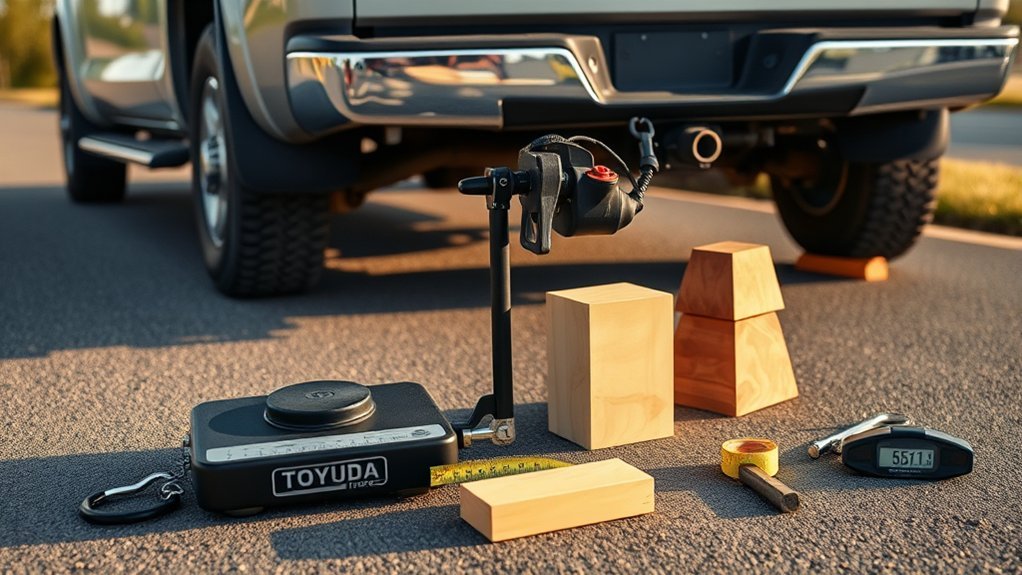
A Toyota Tundra does not have one universal tongue-weight number. The correct figure depends on the loaded trailer, towing type, model year, truck configuration, and the ratings of every component in the towing system. This page focuses on measuring that load; for a deeper model-specific explanation of the target percentage, use the Toyota Tundra tongue-weight percentage guide.
- Identify the towing type. Conventional trailers use tongue weight. Fifth-wheel and gooseneck trailers use kingpin or pin weight.
- Read the exact model-year manual. Use Toyota’s percentage and hitch instructions rather than a general internet rule.
- Find the loaded gross trailer weight. Use a scale rather than the trailer’s unloaded or dry weight.
- Calculate the target range. Multiply loaded gross trailer weight by the manual’s lower and upper percentages.
- Measure the actual downward load. Use a dedicated scale, correct bathroom-scale lever, or platform-scale calculation.
- Check the truck’s loaded ratings. Include passengers, bed cargo, accessories, hitch equipment, and tongue or pin weight.
- Adjust cargo and remeasure. Continue until the load distribution and all ratings are acceptable.
For example, using the 2024 Tundra manual’s 9–11% conventional-towing range:
- Loaded gross trailer weight: 6,500 pounds
- Lower calculation: 6,500 × 0.09 = 585 pounds
- Upper calculation: 6,500 × 0.11 = 715 pounds
- Calculated target: 585–715 pounds
This mathematical range does not override a lower receiver, ball mount, hitch, payload, GVWR, GAWR, tire, or trailer limit.
| Rating or Term | What It Means |
|---|---|
| GTW | The trailer’s actual loaded weight, including all cargo and installed equipment |
| TW | The downward force a conventional trailer applies at the hitch ball |
| Payload | The available capacity for passengers, truck cargo, accessories, hitch equipment, and tongue or pin weight |
| GVWR | The maximum permitted loaded weight of the Tundra |
| GAWR | The maximum permitted load on the front or rear axle |
| GCWR | The maximum permitted combined loaded weight of the truck and trailer |
| Hitch rating | The maximum trailer and vertical load permitted by the receiver, ball mount, hitch ball, and related hardware |
The safest number is not simply the percentage calculation. It is a measured tongue weight that falls within Toyota’s required range while keeping every loaded vehicle, axle, tire, hitch, and trailer rating within its limit.
Frequently Asked Questions
How do you accurately measure tongue weight?
Load the trailer as it will be towed, park on firm level ground, chock the wheels, and measure the full coupler load at normal hitch-ball height with a properly rated tongue-weight scale. Repeat the reading and compare it with the loaded gross trailer weight and your exact owner’s manual.
What is the tongue weight of a Toyota Tundra?
A Tundra does not have one fixed tongue-weight number. The actual load depends on the loaded trailer. Recent Tundra manuals specify 9–11% for conventional towing, but you must confirm the requirement and maximum ratings in the manual for your exact model year and configuration.
Are tongue-weight scales accurate?
A properly rated scale can provide a useful direct measurement when used according to its manufacturer’s instructions. Accuracy can be affected by overload, calibration, uneven ground, incorrect coupler height, unstable supports, or measuring at a different point on the tongue.
What is the rule of thumb for tongue weight?
General towing guides often publish ranges around 10–15%, but that is not a substitute for manufacturer instructions. Toyota’s 2024 Tundra manual specifies 9–11% for conventional towing and a different range for fifth-wheel or gooseneck towing.
Should a weight-distribution hitch be connected while measuring tongue weight?
Release the weight-distribution spring-bar tension when measuring actual tongue weight from platform-scale axle totals. After confirming the real tongue weight and all ratings, reconnect the system and perform another axle check to adjust weight distribution.
Does a weight-distribution hitch reduce tongue weight?
No. It redistributes some of the load carried by the truck’s rear axle to the front axle and trailer axles. It does not remove the trailer’s actual tongue weight or increase the truck’s payload, GVWR, GAWR, tire, receiver, or towing ratings.
How often should you remeasure tongue weight?
Remeasure after changing cargo position, batteries, propane cylinders, tank levels, rear racks, generators, spare tires, or other equipment. You should also recheck when switching trailers or when the combination begins handling differently.
Can you measure Toyota Tundra tongue weight at a CAT Scale?
Yes. Weigh the loaded Tundra by itself, then weigh the same loaded truck with the trailer attached and the weight-distribution spring bars released. Subtract the truck-only axle total from the attached truck axle total to calculate tongue weight. Add that tongue weight to the trailer-axle reading to calculate loaded gross trailer weight.
Conclusion
Accurate tongue-weight measurement starts with the trailer loaded exactly as it will travel. A dedicated tongue-weight scale offers the simplest direct method, while a correctly arranged bathroom-scale lever or a multi-pass platform-scale calculation can provide dependable alternatives.
Use the percentage stated in your exact Toyota Tundra owner’s manual, not a universal rule. Record the measured tongue weight, loaded trailer weight, cargo layout, and tank levels, then confirm that the loaded truck remains within its payload, GVWR, GAWR, GCWR, tire, receiver, and hitch limits. Adjust the actual trailer load before setting up a weight-distribution hitch, then verify the final axle weights before towing.
Sources
- 2024 Toyota Tundra Owner’s Manual — conventional tongue-weight range, fifth-wheel and gooseneck kingpin range, ratings, and weight-distribution adjustment
- 2022 Toyota Tundra Hybrid Digital Owner’s Manual — conventional tongue-weight guidance
- 2026 Toyota Tundra Specifications — current advertised maximum towing and payload figures
- CAT Scale: How to Weigh — correct placement of truck and trailer axles on multi-platform scales
- CURT: How to Measure Tongue Weight — dedicated scale, bathroom-scale lever, and vehicle-scale procedures
- National Highway Traffic Safety Administration — tongue-weight definition and manufacturer-specific range guidance