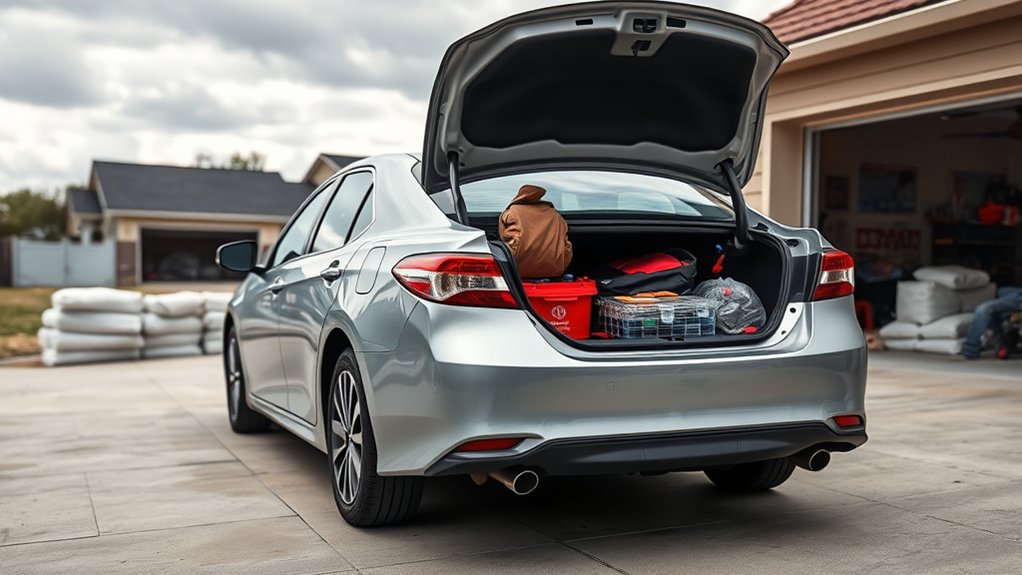
To prepare a Toyota Camry for a hurricane or flood, refuel early, check the tires, fluids, 12-volt battery, lights, and wipers, pack evacuation supplies, and plan an official route before conditions worsen. Park above expected flood levels when it is safe and legal, never drive through floodwater, and do not start a flood-exposed Camry until it has been inspected. The steps below cover pre-storm checks, evacuation driving, parking, flood exposure, hybrid-specific risks, and post-storm insurance documentation.
Last updated: September 11, 2026. Safety guidance reviewed against current CDC, National Weather Service, NHTSA, Toyota, and Insurance Information Institute sources.
Quick Answer
Prepare your Toyota Camry by filling the fuel tank, checking cold tire pressure, tread, fluids, the 12-volt battery, lights, and wipers, packing an emergency kit, and planning an official evacuation route. Park in a secure above-ground garage or on high ground. Never enter floodwater or start a flood-exposed car.
Key Takeaways
- Prepare before tropical-storm-force winds, flooding, fuel shortages, or evacuation traffic begin.
- Use the cold tire pressure on the driver-side doorjamb label, and check tread, damage, and the spare or repair kit.
- Park in a secure above-ground garage or legally on high ground, away from flood zones, trees, utility poles, and loose objects.
- Follow official evacuation routes, keep a paper-map backup, and turn around whenever water covers the road.
- If floodwater reaches the cabin, engine area, or electrical systems, do not switch the Camry on. Document the damage, contact your insurer, and arrange a tow.
At a Glance
| Time Required | Varies by vehicle condition and available supplies; complete checks, refueling, and shopping before conditions become hazardous |
| Difficulty | Basic visual checks are straightforward; use a qualified technician for safety faults, warning lights, or any flood exposure |
| Tools Needed | Tire pressure gauge, flashlight, phone charger or power bank, cleaning cloth, and emergency supplies |
| Cost | Little or no cost if you already own the supplies; fuel, batteries, food, water, and missing kit items add to the total |
How to Prepare a Toyota Camry for a Hurricane or Flood
Start as soon as a hurricane watch, flood watch, or local emergency notice gives you reason to prepare. The CDC recommends making a plan, gathering supplies, getting your car ready, and following evacuation instructions. Waiting until the last hours can leave you facing fuel shortages, heavy traffic, closed roads, or unsafe weather.
When Should You Prepare a Toyota Camry for a Hurricane?
Start at the watch stage, not the warning stage. The National Weather Service says a hurricane watch is generally issued about 48 hours before the expected onset of tropical-storm-force winds, while a hurricane warning is generally issued about 36 hours before that onset. Those are planning windows, not permission to wait: prepare sooner if local officials, flood forecasts, storm-surge alerts, or your evacuation needs require more time. Finish outdoor vehicle checks before strong winds arrive, and leave when authorities direct your evacuation zone to go.
What Should You Check on a Toyota Camry Before Evacuation?
- Fuel and warning lights: Fill the tank before demand rises. On a Camry Hybrid, confirm that the vehicle enters READY mode normally and that no hybrid-system, charging-system, or other serious warning light is present. The traction battery is managed by the vehicle; do not try to service or externally charge it.
- Tires: Check all tires when cold. Use the pressure on the driver-side doorjamb label. NHTSA says to use the vehicle manufacturer’s pressure, not the number molded on the tire. Inspect tread, cuts, bulges, punctures, and the spare tire or tire-repair equipment. For Camry-specific pressure guidance, see Toyota Camry recommended tire pressure.
- Fluids: Check engine oil, coolant, brake fluid, and windshield-washer fluid according to your Camry owner’s manual. Never open a hot cooling system.
- 12-volt battery: Look for corrosion, repeated no-start or no-READY problems, dim or erratic electrical behavior, a battery or charging warning, or an unknown service history. Have a weak battery tested before evacuation rather than relying on a last-minute jump-start. If the vehicle has not been flood-exposed and the 12-volt battery is simply discharged, follow the model-year procedure in How to Jump-Start a Toyota Camry Safely.
- Visibility: Test headlights, brake lights, turn signals, hazard lights, wipers, washer spray, and the windshield defogger. Replace damaged wiper blades before the storm.
- Brakes and controls: Address grinding, pulling, a soft brake pedal, steering problems, or serious dashboard warnings before travel. Do not begin an evacuation in a Camry with a known safety fault. If you are unsure what a warning means, use the Toyota Camry dashboard warning lights guide and the owner’s manual before deciding whether the car is safe to move.
- Roadside readiness: Confirm that the spare tire or tire-repair equipment, jack, wheel-lock key, emergency contact numbers, and towing information are available for your model year.
Camry equipment, lift points, jump-start procedures, towing methods, and maintenance instructions vary by model year and powertrain. Check the correct Toyota owner’s manual before adding fluids, lifting the car, jump-starting it, or using emergency equipment.
Camry model-year note: Toyota made the U.S.-market 2025 Camry exclusively hybrid, and the 2026 Camry continues as an all-hybrid lineup with a lithium-ion traction battery. Older Camrys include gasoline and hybrid versions, so give the model year and VIN to a tow operator or repair facility after flood exposure.
How Should You Plan a Camry Evacuation Route?
Enable local emergency alerts, identify your evacuation zone, choose a destination, and review at least one official route plus a safe alternate approved by local authorities. Tell an out-of-area contact where you plan to go.
Pack for the people and animals traveling with you: medications, mobility needs, child restraints, and pet supplies. Keep your phone charged, download offline maps, and carry a paper map because cell service and navigation apps can fail.
Pro Tip: Photograph the Camry from every side, including the roof, wheels, cabin, odometer, and existing damage. Save the photos, VIN, registration, insurance card, policy number, and insurer’s claims contact in secure cloud storage and a waterproof pouch.
Where Should You Park a Toyota Camry During a Hurricane?
A secure, above-ground garage is usually the best available location before the storm. Park away from garage doors or windows when possible, shift into Park, set the parking brake, close every window and the sunroof, lock the car, and remove valuables. Never leave the engine or hybrid system running inside a garage.
If no secure garage is available, choose the highest legal parking area you can reach before conditions become hazardous. Stay away from low spots, drainage channels, shorelines, underground garages, trees, utility poles, signs, construction materials, and objects that could fall or blow into the vehicle. Do not block emergency access or park on a bridge, median, shoulder, sidewalk, or evacuation lane.
Warning: Do not rely on a loose outdoor car cover in hurricane winds. A poorly secured cover can tear, rub the paint, collect debris, or become airborne. Use a cover only when its manufacturer specifically permits the expected conditions and it can be secured without delaying evacuation.
Parking the car is never a reason to delay an evacuation. If officials tell you to leave, follow the order and prioritize people, medications, pets, and essential documents over vehicle protection.
What Should You Pack in a Toyota Camry Hurricane Emergency Kit?
Pack the kit in a sturdy, easy-to-carry container. Adjust the contents for the number of passengers, expected trip length, climate, health needs, children, older adults, disabilities, and pets.
| Essential Item | Why You Need It |
|---|---|
| Drinking water and nonperishable food | Covers delays, traffic, and service interruptions |
| Prescription medicines and basic first aid | Supports routine and urgent health needs |
| Flashlight, spare batteries, and reflective vest | Improves visibility without draining the car battery |
| Charged power bank and charging cables | Keeps phones available during outages and traffic delays |
| Battery-powered or hand-crank weather radio | Provides alerts when mobile service is unavailable |
| Paper maps, written contacts, and small bills | Provides backup navigation, contact details, and payment when networks fail |
| Copies of identification, registration, and insurance | Helps with travel, shelter access, and claims |
| Tire gauge, inflator, jumper pack, and basic tools | Handles minor roadside problems when conditions are safe and the manual permits their use |
| Whistle, work gloves, and an automotive-rated fire extinguisher | Supports signaling and minor emergency response when stored and used correctly |
| Blanket, rain gear, sturdy shoes, and hygiene items | Protects against exposure and long delays |
| Child, older-adult, disability, and pet supplies | Covers needs that a general shelter may not provide |
Review the kit at the start of hurricane season and before any evacuation. Replace expired food, medicines, and batteries. Secure the container and keep heavy items low so they cannot become projectiles during sudden braking. Do not store loose fuel containers in the passenger compartment.
How Should You Drive a Toyota Camry During Hurricane Conditions?
The safest choice during hurricane conditions is often not to drive. Leave early when officials recommend evacuation, and use the roads they identify even when traffic is heavy. An unofficial shortcut may be flooded, blocked by debris, or unavailable to emergency crews.
- Buckle every passenger, use the correct child restraint, and secure loose cargo before moving.
- Slow down smoothly and leave extra following distance.
- Turn on the headlights so other drivers can see you. Do not rely only on daytime running lights.
- Avoid sudden steering, hard braking, cruise control, and distractions on wet roads.
- Watch for standing water, downed lines, damaged pavement, debris, and traffic signals without power.
- Avoid exposed bridges, coastal roads, and tree-lined routes when strong winds or official closures make them unsafe.
- Never drive around a barricade or through water covering the road.
- If visibility becomes too poor to continue, leave the travel lane and stop in a safe location away from trees, flood-prone areas, and moving traffic. Keep the hazard lights on when appropriate.
The National Weather Service reports that more than half of flood-related drownings occur after a vehicle is driven into hazardous floodwater, and it warns that 12 inches of rushing water can carry away most cars.
Warning: Follow the National Weather Service rule: Turn Around, Don’t Drown. Water can hide a washed-out road, debris, electrical hazards, or a current strong enough to move the Camry. You cannot judge safe depth from the driver’s seat.
What Should You Do if Rising Water Traps the Camry?
Call 911 if possible and follow local responder instructions. National Weather Service guidance depends on how the water is moving: if floodwater rises around a stopped vehicle and you can safely reach higher ground without entering fast-moving water, leave the vehicle and move up. If the Camry is trapped in rapidly moving water, stay inside. If water begins rising inside a vehicle trapped in fast-moving water, move to the roof and signal for help. Never enter moving floodwater merely to save the car.
What to Do if Floodwater Reaches Your Camry
Do not enter moving floodwater to reach the car. Wait for authorities to say the area is safe. If water reached the floor, dashboard, air intake, engine compartment, 12-volt electrical system, or hybrid components, do not start the engine, press the power button, switch the ignition on, or attempt a jump-start. Energizing a water-exposed vehicle can worsen mechanical or electrical damage and may create a shock or fire hazard.
Photograph the waterline, exterior, interior, and surrounding area from a safe location. Contact your insurer for instructions, then arrange a tow to a qualified repair facility. Tell the tow operator the Camry’s model year, whether it is gasoline or hybrid, and how high the water reached. Hybrid models may require a specific towing method, so follow the owner’s manual and qualified-tow guidance.
What Extra Precautions Apply to a Flooded Camry Hybrid?
Do not touch exposed wiring, damaged electrical parts, the traction battery, or high-voltage components. NHTSA warns that flooded hybrid and electric vehicles can present high-voltage shock and fire hazards. If you notice smoke, heat, sparks, hissing, popping, or an unusual chemical odor, move away and call 911.
For a damaged vehicle with a lithium-ion traction battery, NHTSA advises against parking it in a garage or within 50 feet of structures, other vehicles, or combustibles. Battery chemistry varies by Camry model year, so give the VIN and model year to the dealer, tow operator, insurer, and emergency responders.
Note: A Camry may look normal after the water recedes while moisture, silt, salt, sewage, or other contamination remains in connectors, brakes, restraint systems, fluids, and cabin materials. A professional inspection is safer than a driveway restart.
Post-Storm Actions: Check Your Car for Damage and Insurance Tips
Return only after officials give the all-clear. Watch for unstable trees, downed power lines, sharp debris, contaminated water, and weakened pavement. If the Camry was not flooded and the area is safe, inspect it before driving.
- Walk around the car: Check glass, lights, mirrors, tires, body panels, roof, and the area beneath the vehicle.
- Look for water exposure: Note waterlines, damp carpet, condensation inside lamps, mud, silt, odors, or water in the trunk and spare-tire well.
- Document before cleanup: Take wide and close photos, record the date and location, and keep damaged items until your insurer gives instructions.
- Contact the insurer promptly: Ask whether your policy covers flood, wind, falling objects, or storm debris. Coverage, exclusions, deductibles, limits, and claim procedures vary.
- Keep records: Save the claim number, adjuster’s name, towing bills, storage fees, repair estimates, photos, and all messages.
- Use a qualified repair facility: Request inspection of brakes, fluids, electrical systems, safety restraints, wheel bearings, and hybrid components when relevant.
- Drive only after it is cleared: If the car had no flood exposure and no visible damage, test steering and brakes at very low speed in a safe area. Stop immediately if a warning light appears or the car pulls, vibrates, smells unusual, or brakes poorly.
Do not assume that a normal start or short drive proves the car is safe. Flood damage can affect braking, electrical reliability, corrosion, airbags, seat-belt pretensioners, and cabin sanitation.
In the United States, comprehensive auto coverage commonly includes flood and other non-collision hazards, while liability-only coverage generally does not pay for damage to your own car. Insurance terms differ by state, province, country, and policy, so the contract and insurer’s instructions control the claim.
Frequently Asked Questions
How do you prepare a Toyota Camry for a hurricane?
Fill the fuel tank, check cold tire pressure and tread, inspect fluids, test the 12-volt battery, lights, wipers, washer, and defogger, pack an emergency kit, photograph the car, and plan an official evacuation route. Finish before strong winds, flooding, or evacuation traffic makes travel unsafe.
How early should you prepare the Camry?
Begin when a hurricane or flood watch, local emergency notice, or forecast gives you reason to prepare. Refuel and buy missing supplies early. Complete outdoor work before tropical-storm-force winds arrive, and leave when officials direct your evacuation zone to go.
Where should you park a Camry during a hurricane?
Use a secure, above-ground garage when available. Otherwise, park legally on high ground away from flood zones, trees, utility poles, loose objects, shorelines, drainage channels, and underground garages. Never delay an evacuation simply to find a better parking place.
How can you protect a car that must stay outside?
Choose the highest safe legal location available, close and lock all openings, remove valuables, and keep the car away from trees, poles, signs, construction materials, and loose debris. Avoid an unsecured cover in high winds. No outdoor location can guarantee protection from flooding or flying objects.
How much floodwater can move a car?
The National Weather Service warns that about 12 inches of rushing water can carry away most cars. Do not use that number as a safe driving depth: water can hide a washed-out road, debris, or a stronger current, so turn around whenever water covers the roadway.
Should you shut all interior doors during a hurricane?
That advice mainly concerns rooms inside a home, not a vehicle. For your Camry, close every door, window, and the sunroof. Lock the car, but keep the keys with you in case an evacuation order requires you to leave quickly.
Can you start a Toyota Camry after it has been flooded?
Do not start it or switch it on when water reached the cabin, engine area, air intake, electrical systems, or hybrid components. Photograph the damage, contact your insurer, and have the car towed for inspection. Starting or jump-starting it may worsen engine, electrical, or hybrid-system damage.
What should you do if a Camry Hybrid is flooded?
Do not press the power button, jump-start the car, touch exposed wiring, or approach a smoking, hot, hissing, or sparking battery area. Move away, call 911 for signs of fire or battery damage, contact the dealer and insurer, and use a tow operator familiar with hybrid vehicles.
Does car insurance cover hurricane or flood damage?
It depends on the policy and jurisdiction. In the United States, comprehensive auto coverage often applies to non-collision losses such as flooding, wind, falling objects, or storm debris, subject to exclusions, limits, and a deductible. Liability-only coverage generally does not pay for damage to your own car.
Conclusion
Prepare your Toyota Camry early, but keep the priorities in the right order: follow official alerts, evacuate when told, avoid flooded roads, and protect people before property. A full tank, sound tires, working lights and wipers, a practical emergency kit, safe parking, and a planned route can make an evacuation more manageable. Before the next storm alert, save your official evacuation route, check the driver-door tire placard, and verify the model-year owner’s manual. After the storm, document damage and never switch on a flood-exposed Camry before inspection.
Sources
- CDC: Preparing for Hurricanes or Other Tropical Storms — planning, car preparation, supplies, evacuation, and flooded-road guidance
- National Weather Service: Turn Around Don’t Drown — vehicle-related flood deaths, water-depth hazards, barricades, and road safety
- NHTSA TireWise — cold tire pressure, doorjamb-label guidance, tread, damage, and tire maintenance
- NHTSA: Electric and Hybrid Vehicle Safety — high-voltage flood hazards, towing precautions, and damaged lithium-ion battery separation
- Toyota Manuals and Warranties — model-year-specific Camry operation, maintenance, jump-starting, and towing information
- Insurance Information Institute: Collision and Comprehensive Auto Insurance — comprehensive coverage for flood and other non-collision losses, subject to policy terms
- National Weather Service: Flood Safety — what to do if a vehicle is trapped in rapidly moving or rising floodwater
- Toyota: 2025 Camry Hybrid Launch — 2025 U.S. Camry hybrid-only lineup
- Toyota: 2026 Camry — 2026 all-hybrid lineup and lithium-ion traction battery
