If your Toyota Camry trunk won’t open, first unlock the car and try every release method your model year provides: the cabin opener, key fob, exterior release, or mechanical key where fitted. If you hear a click but the lid stays shut, suspect latch pressure, ice, corrosion, or misalignment. If every electronic release is silent, check the 12-volt battery, security or lockout settings, fuse, switch, wiring, and actuator before replacing parts.
Last updated: September 22, 2026
Quick Answer
Unlock the car and try each release method fitted to your Camry. A click with no opening usually points toward latch pressure, ice, corrosion, a binding latch, or alignment. Silence from every electronic release points more toward a weak 12-volt battery, a security or lockout condition, a fuse, switch, wiring, connector, or actuator fault. A loose mechanical lever points instead toward its cable or attachment.
Key Takeaways
- Camry trunk controls, mechanical keys, lockout features, seat releases, and repair procedures vary by model year and trim.
- No response from the release system suggests a different problem than a latch that clicks but remains closed.
- Do not pry the lid, drill the lock, short wires, or pull an unidentified cable with pliers.
- Clean and lubricate an accessible latch only after the trunk is open, using a compatible automotive product sparingly.
- Check the VIN for recalls or service campaigns before paying for a repair.
At a Glance
| Time Required | Basic release, power, and visible-latch checks are brief; trim removal, cable inspection, electrical diagnosis, or alignment work can take substantially longer. |
| Difficulty | Easy for release, battery, and visible-latch checks; moderate to advanced for trim removal, cable replacement, or electrical diagnosis. |
| Tools Needed | Owner’s manual, flashlight, clean cloth, compatible automotive latch lubricant, trim tool and basic hand tools if the correct service procedure requires them. |
| Cost | Low for cleaning, lubrication, or a battery; potentially higher for a lock cylinder, cable, latch, actuator, wiring repair, trim labor, or body alignment. |
Warning: Park safely, select Park, apply the parking brake, and keep hands clear of the hinges and latch. Do not pry the trunk lid, drill the lock, crawl into the trunk, close the lid while testing, or manipulate unidentified cables or wires. Use a locksmith, roadside service, repair shop, or Toyota dealer when approved access methods fail.
Why Won’t My Toyota Camry Trunk Open?
The best first clue is what happens when you operate the release. Listen for a click, notice whether the cabin lever feels normal, and check whether one release method works while another does not.
Model-year reality check: Toyota’s 2026 Camry owner information lists the trunk opener, Smart Key entry function when equipped, and wireless remote as normal opening methods, while older Camrys can use different mechanical levers, key cylinders, and luggage-security arrangements. Use the Toyota manual for your exact model year before removing trim or ordering parts.
| Symptom | Likely areas to check | Best next step |
|---|---|---|
| No click or sound from any electronic release | Vehicle battery, trunk-opener lockout, switch, fuse, connector, wiring, or actuator | Check power and settings, then follow the model-specific electrical procedure. |
| The key fob fails, but the cabin or exterior release works | Key-fob battery, fob fault, range/interference, or key registration issue | Try the spare fob and the specified fob battery before diagnosing the latch. |
| The cabin opener fails, but another release method works | Cabin switch or lever, local wiring, cable, or a model-specific lockout/security condition | Focus diagnosis on the cabin control path instead of replacing the latch first. |
| The latch clicks but the lid stays closed | Luggage pressure, ice, corrosion, a binding latch, worn latch, or striker alignment | Press the lid down gently while releasing it; do not force or pry it upward. |
| The cabin lever suddenly feels loose | Detached, broken, stretched, or unseated cable on cable-operated models | Inspect the lever attachment and cable routing using the correct service procedure. |
| The mechanical key turns but does not release the lid | Lock cylinder, linkage rod, cable, or latch fault | Stop applying force and have the lock linkage inspected. |
| The trunk opens only after repeated attempts | Intermittent switch, weak actuator, cable wear, dirt, corrosion, or misalignment | Diagnose it before it becomes a complete lockout. |
Common causes include:
- Trunk-opener lockout or valet-related control: Some Camry years and trims have a cancel switch, lockout setting, valet-key arrangement, or other security feature. Others do not. Check the Toyota owner’s manual for your exact vehicle.
- Weak key-fob battery: The remote may fail even though the trunk itself is functional.
- Weak or disconnected 12-volt battery: Electronic releases may stop working when the vehicle has inadequate electrical power.
- Overloaded or preloaded latch: Luggage can push against the trunk lid and hold the latch under pressure.
- Frozen or contaminated latch: Water, road salt, dirt, or corrosion can prevent smooth movement.
- Damaged cable or lever: Cable-operated systems can develop a detached end, broken retaining clip, damaged sheath, fraying, or loss of effective travel.
- Failed switch, fuse, wiring, connector, or actuator: Electronic release systems require electrical diagnosis rather than immediate cable replacement.
- Latch or striker misalignment: A previous collision, heavy lid loading, loose hardware, worn hinges, or body movement can prevent correct engagement and release.
Note: The glowing handle inside the trunk is an emergency escape release. Federal rules require an internal release on covered passenger-car trunks, but it is not an exterior override for opening a locked trunk. Never place a person inside the trunk to reach it.
How Do You Troubleshoot a Toyota Camry Trunk That Won’t Open?
- Confirm that the vehicle is fully unlocked. Unlock all doors, not only the driver’s door, and try the release again.
- Try every approved release method fitted to the car. Depending on the year and trim, this may include the key-fob button, cabin switch or lever, exterior trunk switch, and a mechanical key cylinder.
- Check for an opener-cancel or security setting. Look in the exact owner’s manual for a trunk-opener lockout, cancel switch, valet-related function, or smart-key setting. Do not assume that the controls from another Camry generation apply to yours.
- Check the key fob. Try a spare fob if available. If other remote functions are weak or intermittent, replace the fob battery with the specified type and orientation.
- Check vehicle electrical power. If the cabin lights, locks, or other electrical equipment are dead or unusually weak, address the 12-volt battery problem before condemning the trunk components. For model-aware access options, see how to open a Toyota Camry trunk with a dead battery.
- Listen while operating the release. A click at the trunk means at least part of the release path is acting, but it does not prove the latch or actuator is healthy. Silence from every electronic method points more toward a lockout or security condition, power loss, switch, fuse, connector, wiring, or actuator fault. A loose mechanical lever points toward its cable or attachment.
- Relieve pressure on the latch. Have one person operate the release while another presses the trunk lid downward gently near the latch and then lifts. Do not bounce, twist, or pry the lid.
- Allow ice to thaw safely. Warm the vehicle or use a lock de-icer labeled for automotive use. Do not pour boiling water on the lock or painted panels because it can refreeze and may damage finishes or seals.
- Use cabin-to-trunk access only when the manual permits it. Some rear seatbacks can be released from the passenger compartment; other Camrys place the releases inside the trunk. Do not cut upholstery or force the seat. See the Camry rear-seat folding and pass-through guide for model-aware context.
- Stop when access requires forced entry. An automotive locksmith can address a key or lock-cylinder problem. A mechanic or Toyota dealer can diagnose a cable, latch, actuator, wiring, or control fault.
Pro Tip: Once the trunk opens, leave the lid raised and test the latch only as directed by the correct service procedure. Keep fingers clear of the latch and striker, confirm repeated release operation before closing the lid, and never slam the trunk as a test.
Can Lubrication Fix a Stuck Toyota Camry Trunk Latch?
Lubrication can help a dry or lightly corroded mechanical latch, but it will not repair a broken cable, failed actuator, damaged lock cylinder, bent striker, or electrical fault. Perform this work only after the trunk is open and the latch is accessible.
- Inspect before spraying. Look for loose hardware, bent parts, heavy rust, damaged plastic, broken springs, debris, or an obvious alignment problem.
- Clean the accessible surfaces. Remove dirt with a clean cloth or soft brush. Avoid pushing debris farther into the mechanism.
- Select a compatible product. Use a small amount of automotive latch lubricant that is safe for nearby plastics, rubber, and paint. Use a lock-cylinder product only when its label specifically permits that application.
- Apply sparingly. Place lubricant on the moving metal contact points rather than flooding the entire cavity, switch, connector, or actuator.
- Cycle the mechanism with the trunk open. Follow the service procedure to move the latch and release it several times.
- Remove excess product. Wipe away drips because excess lubricant attracts dirt and can stain trim.
- Retest all release methods. Verify consistent operation before closing the trunk.
A water-displacing or penetrating spray such as WD-40 may temporarily loosen moisture or corrosion in an appropriate exposed mechanism, but it should not be treated as a universal long-term lubricant or sprayed indiscriminately into electrical parts. Follow the product label and the vehicle-specific service information.
There is no single maintenance interval that fits every Camry and climate. Inspect the latch during routine service and after exposure to flooding, road salt, body repair, or the first sign of stiffness.
How Can a Damaged Trunk Cable Cause the Problem?
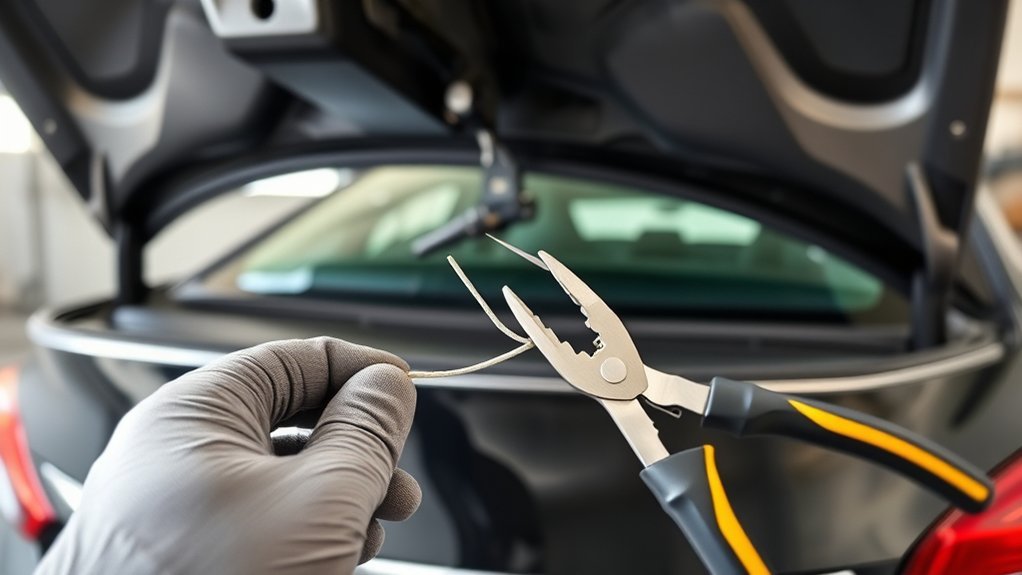
On Camrys that use a mechanical release cable, the cable must transmit enough movement from the lever or lock linkage to release the latch. The inner cable, outer sheath, retaining clips, routing, and attachment points all affect its operation.
Cable Stretching Effects
A cable can lose effective travel because of wear, sheath damage, a loose mounting point, a displaced retaining clip, or internal strand damage. The lever may move farther than normal without fully releasing the latch.
- Frequent use and contamination can contribute to wear.
- A loose outer sheath can absorb lever movement that should reach the latch.
- Fraying, kinks, crushed sections, or corrosion indicate damage.
- A cable that has pulled out of a bracket may imitate stretching.
- Only systems designed with an adjustment should be adjusted; fixed-length damaged cables normally require replacement.
Signs of Damage
Check for these warning signs:
- The release lever feels unusually loose or has excessive travel.
- The trunk opens only when the lever is pulled repeatedly.
- The cable sheath moves with the lever instead of remaining anchored.
- Visible strands are frayed, rusty, kinked, or broken.
- A plastic retaining clip is cracked or missing.
- The latch works when operated locally but not from the cabin lever.
No sound at the trunk does not prove that the cable is broken because an electronic system, lockout setting, or power fault can produce the same symptom. Identify the release-system type before buying parts.
Maintenance and Inspection Tips
- Inspect visible cable ends, brackets, and clips whenever trim is already removed for legitimate service.
- Keep the cable routed through its original guides and away from sharp edges or moving seat hardware.
- Do not sharply bend, clamp, or crush the cable sheath.
- Lubricate only where the service information or product instructions permit it.
- Record the part number and repair date.
- Test the release repeatedly with the trunk open before closing it.
Should You Replace Your Trunk Latch?
Consider latch replacement when cleaning, correct lubrication, pressure relief, and alignment checks do not restore reliable operation and the latch shows confirmed wear or internal failure.
Replacement is more likely to be appropriate when:
- The latch binds even when disconnected from the cable or actuator.
- The latch will not hold or release consistently during an open-lid bench test.
- A spring, pawl, housing, connector, or mounting point is damaged.
- There is severe corrosion or contamination that cannot be cleaned safely.
- The latch has excessive play or makes abnormal grinding noises.
- The electrical actuator receives the correct command and power but does not operate.
Do not replace the latch solely because the trunk will not open. A weak battery, switch, lockout setting, cable, wiring fault, connector, striker position, or lid alignment can make a good latch appear defective.
Match any replacement by VIN, model year, trim, key system, connector, and option package. Toyota Camry generations may use different latches, actuators, cables, lock cylinders, and mounting arrangements. Torque fasteners and adjust the striker only according to the correct repair procedure.
How to Fix a Broken Trunk Cable Yourself
A cable replacement can be a reasonable DIY repair on a clearly identified cable-operated system, but it requires safe trunk access, careful trim removal, correct routing, and an exact replacement part. An electrical trunk switch or actuator fault will not be fixed by replacing a mechanical cable.
Identify Cable Issues
- Check whether the cabin control is a mechanical lever or an electrical switch.
- Compare the lever feel with its normal movement and inspect the exposed lever attachment.
- Look for a detached cable end, cracked clip, moving sheath, fraying, corrosion, or a broken strand.
- Confirm that the latch itself moves freely before blaming the cable.
- Check the part diagram and service procedure for the exact year and trim.
A loose lever with no resistance strongly suggests a disconnected or damaged cable, but diagnosis should still confirm the attachment points before a replacement is ordered.
Access Trunk Mechanism
Remove only the trim pieces identified in the correct repair procedure. Use a plastic trim tool where appropriate, keep track of clips and fasteners, and stop if a panel is trapped by a seat, airbag component, wiring harness, or concealed fastener.
Do not grab an unidentified cable with pliers. Pliers can crush the outer sheath, damage the inner strands, or create a sharp edge. If the trunk remains closed and the approved release methods do not work, use an automotive locksmith, repair shop, roadside service, or Toyota dealer rather than forcing access.
Replace or Adjust Cable
- Obtain the correct cable using the VIN and original part number.
- Photograph the routing, brackets, and clips before removing the old cable.
- Release the cable ends and retainers without bending nearby linkage.
- Route the new cable through the same guides without sharp bends, twists, or contact with moving parts.
- Seat the outer sheath firmly in every bracket so lever travel reaches the latch.
- Adjust the cable only when the system has a manufacturer-provided adjustment.
- With the trunk open, test the cabin release, mechanical key if equipped, exterior release, and emergency handle.
- Reinstall trim only after the system operates consistently.
If the new cable still does not release the trunk, inspect the latch, lever assembly, striker alignment, and related lock linkage rather than increasing cable tension beyond specification.
Maintaining Your Toyota Camry Trunk
Routine inspection can catch stiffness, misalignment, or cable wear before the trunk becomes completely inaccessible.
- Clean the latch and striker: Remove dirt, leaves, fibers, and residue without flooding electrical components.
- Use compatible lubricant sparingly: Apply it only to appropriate moving contact points.
- Inspect the weather seal: A displaced or swollen seal can increase closing force and place pressure on the latch.
- Check the striker and mounting hardware: Look for looseness, unusual wear marks, or evidence that the lid is landing off-center.
- Watch the hinges and support hardware: Binding or body damage can alter alignment.
- Keep cargo below the closing path: Bags and rigid objects can press against the lid or interfere with linkage.
- Test all release methods: An intermittent switch, fob, or lever is easier to diagnose before a lockout.
- Review security settings: Know whether your vehicle has a trunk-opener cancel switch, valet-related function, or other lockout.
- Document repairs: Record symptoms, parts, adjustments, and dates so recurring faults are easier to trace.
Intermittent operation is an early warning, not proof that the problem has fixed itself. Diagnose it while the trunk still opens.
What Do Different Toyota Camry Trunk Symptoms Point To?
Use symptom patterns to narrow the fault before buying parts. These patterns are diagnostic clues, not proof of a failed component:
- A release that works intermittently because of a loose cable end, worn clip, switch, or actuator.
- A trunk that opens after gentle downward pressure relieves load on the latch.
- Cold-weather sticking caused by ice or moisture around the seal or latch.
- Access being blocked by a trunk-opener cancel or valet-related feature on an equipped vehicle.
- Repeated key movement temporarily operating a worn lock cylinder or linkage.
- Temporary improvement after cleaning or applying a suitable product to an accessible mechanical latch.
A temporary recovery is not a repair. If the problem returns, identify which release path failed and inspect that path before the trunk becomes fully locked.
Seeking Professional Help for Trunk Troubles
Choose the professional based on the symptom:
- Automotive locksmith: Lost or damaged key, seized lock cylinder, ownership-verified lockout, or mechanical key problem.
- General repair shop: Cable, lever, latch, actuator, switch, wiring, connector, fuse, or battery diagnosis.
- Body or collision technician: Misaligned lid, striker, hinge, weatherstrip, or collision-related body damage.
- Toyota dealer: Model-specific diagnosis, programming, smart-key concerns, campaign work, or access to Toyota repair information and parts matching.
Bring identification and proof that you own or are authorized to use the vehicle when requesting lockout access. This protects both the vehicle owner and the service provider.
Before paying for a repair, enter the VIN in the Toyota safety recall and service campaign lookup and the NHTSA recall lookup. A dealer can clarify whether an open campaign applies to the exact vehicle.
Tips for Preventing Future Trunk Issues in Your Toyota Camry
- Do not slam the lid or use the trunk as leverage when loading cargo.
- Keep objects clear of the latch, hinges, linkage, and weather seal.
- Address water leaks because moisture promotes corrosion and freezing.
- Clean the latch and striker when dirt or road salt accumulates.
- Use only a small amount of compatible automotive lubricant.
- Investigate a loose lever, weak click, delayed release, or repeated need for downward pressure.
- Replace damaged clips, cables, seals, or latch components before they fail completely.
- Keep the spare key or fob accessible, but never store it in the trunk.
- Learn the trunk-opener and security settings described in the exact owner’s manual.
- Check the VIN periodically for open recalls or service campaigns.
- Record maintenance and repairs for future diagnosis.
Related Guides
Frequently Asked Questions
What can cause a Toyota Camry trunk not to open?
Possible causes include a trunk-opener lockout, weak key-fob or vehicle battery, overloaded latch, ice, debris, corrosion, misalignment, a damaged cable, failed switch, fuse, actuator, connector, wiring fault, lock-cylinder problem, or worn latch. The exact system depends on the model year and trim.
How do you manually open a Toyota Camry trunk?
Use the mechanical key cylinder only if your Camry is equipped with one and the owner’s manual identifies the procedure. Rear-seat access is appropriate only when the seatbacks can be released from the cabin. The glowing emergency handle is inside the trunk for escape and is not an exterior opening method.
Can a dead battery stop the trunk from opening?
Yes. A weak or disconnected 12-volt battery can disable electronic trunk releases. A weak key-fob battery can also prevent remote operation while other release methods still work. Follow the owner’s manual for battery access, jump-starting, and any mechanical-key procedure. For more detail, see the dead-battery trunk-access guide.
Why does the trunk click but not open?
A click usually means that part of the release system is moving. The lid may still be held by luggage pressure, ice, corrosion, a binding or worn latch, a weak actuator, damaged linkage, or striker misalignment. Gentle downward pressure while operating the release may relieve latch load, but the lid should never be pried.
What causes a trunk latch to fail?
A latch can fail because of wear, corrosion, debris, broken springs, damaged linkage, actuator failure, impact damage, loose mounting hardware, or repeated operation while the lid and striker are misaligned. Confirm the cable, switch, power supply, and alignment before replacing the latch.
Can you use WD-40 on a Toyota Camry trunk latch?
A water-displacing or penetrating spray may temporarily loosen moisture or light corrosion on an appropriate exposed mechanism, but it is not a universal long-term lubricant. Do not flood electrical switches, connectors, actuators, plastic parts, seals, or painted areas. Use a compatible automotive product and follow its label.
How much does it cost to fix a trunk that will not open?
There is no reliable universal price. A fob battery, cleaning, or minor adjustment may cost little, while a lock cylinder, cable, latch, actuator, wiring repair, trim removal, programming, or body alignment can cost substantially more. Obtain a diagnosis and model-year-specific estimate before authorizing parts.
Conclusion
When a Toyota Camry trunk won’t open, diagnose the release path before replacing parts. Try the approved opening methods for your model year, then separate a click-with-no-opening problem from a silent electronic release or a loose mechanical lever. Check power, security settings, latch pressure, ice, cable condition, actuator operation, wiring, and alignment only as the symptoms justify. Avoid forced entry; if the approved methods fail, use a qualified locksmith, repair shop, roadside service, or Toyota dealer.
Sources
- Toyota Manuals and Warranties — model-year-specific owner information, controls, features, and operating procedures.
- Toyota Technical Information System — official Toyota repair manuals, wiring information, service procedures, and technical publications.
- Toyota Safety Recall and Service Campaign Lookup — VIN-based Toyota recall and campaign information.
- National Highway Traffic Safety Administration Recall Lookup — federal recall, investigation, complaint, and manufacturer-communication resources.
- 49 CFR 571.401 — Interior Trunk Release — federal requirements for an internal trunk escape-release mechanism in covered passenger cars.
