
If a Toyota Camry brake system warning light appears, the safest response depends on the exact symbol and color. A persistent red brake-system warning can indicate low brake fluid or a brake-system malfunction, and Toyota’s newer Camry manuals instruct drivers to stop in a safe place and contact Toyota because continued driving may be dangerous. Fully release the parking brake, read the complete dashboard message, and do not continue normal driving if the red warning remains on.
This guide covers dashboard brake-system warnings, not rear brake lamps that fail to illuminate. Warning symbols and procedures vary by Camry model year and powertrain, so the instructions in your exact owner’s manual take priority.
Last updated: September 19, 2026. Reviewed against Toyota owner-manual and warning-light guidance plus NHTSA ABS guidance.
Quick Answer
If the red brake-system warning light comes on, slow down and stop safely. Fully release the parking brake and read the dashboard message. If the red warning stays on, do not continue normal driving. Toyota’s newer Camry manuals instruct drivers to stop and contact a Toyota dealer when the red warning indicates low brake fluid or a brake-system malfunction. If braking feels abnormal, fluid is below MIN, a leak is visible, or the ABS and red brake warnings appear together, arrange towing.
Key Takeaways
- A red brake warning that remains on after the parking brake is released can indicate low fluid or a brake-system malfunction and should be treated as an urgent stop-and-service condition.
- Do not drive if the pedal is soft, low, sinking, or unusually hard, braking performance has changed, or a fluid leak is visible.
- A yellow brake-system warning, an amber ABS warning, and a red brake warning can mean different things; identify the exact symbol and dashboard message.
- The amber ABS light can indicate an ABS or Brake Assist malfunction. If it appears with the red brake warning, stop safely and arrange professional assistance.
- Warning symbols and procedures vary by Camry model year and powertrain, so confirm the dashboard message in your owner’s manual.
At a Glance
| Time Required | About 5–10 minutes for safe parked visual checks; professional diagnosis may take longer |
| Difficulty | Basic for visual checks; brake-system diagnosis and repairs require appropriate training and equipment |
| Tools Needed | Owner’s manual, flashlight, and clean cloth; an ABS-capable scan tool for electronic diagnosis |
| Cost | No cost for a visual check; towing, diagnosis, and repair costs depend on the confirmed fault |
Warning: Do not continue normal driving if the red brake-system warning remains on after the parking brake is fully released, the brake fluid is below MIN, the pedal is soft or sinking, stopping ability has changed, a fluid leak is visible, severe grinding is present, or the red brake and ABS warnings appear together. Stop in a safe place and arrange professional assistance or towing.
What the Toyota Camry Brake Warning Light Means
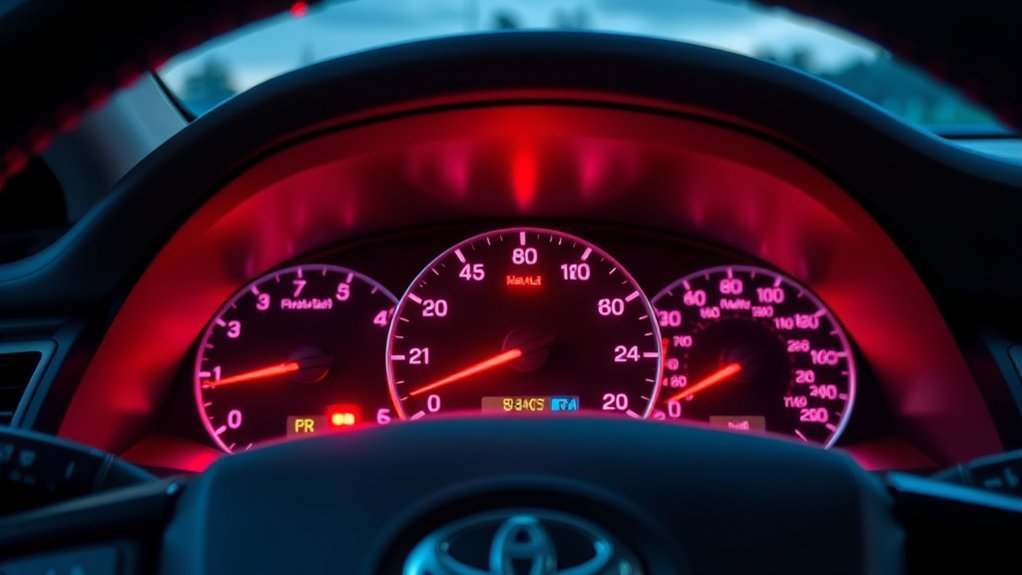
The warning often identified as the red BRAKE light or a circle containing an exclamation mark can have more than one meaning. Depending on the Camry’s year and equipment, it may indicate that the parking brake is applied, the brake fluid level is low, or the vehicle has detected a brake-system malfunction.
The color matters, but color alone is not enough. Toyota describes red icons as conditions requiring immediate attention. Some Camry Hybrid and electronically controlled brake systems also use a yellow brake-system warning for faults that differ from the red warning. An amber ABS warning normally identifies a malfunction in the ABS or Brake Assist system.
| Warning | What It May Mean | What to Do |
|---|---|---|
| Red BRAKE or brake-system symbol | Parking brake applied, low brake fluid, or a brake-system malfunction, depending on model year | Stop safely and release the parking brake. If the red warning remains on, follow the model-year manual and do not continue normal driving |
| Yellow brake-system warning | On some Camry Hybrid or electronically controlled brake systems, a fault involving regenerative braking, electronically controlled braking, or the electric parking brake | Read the full dashboard message, follow the exact model-year manual, and arrange prompt inspection |
| Amber ABS light | A malfunction in the ABS or Brake Assist system; a sensor, wiring, actuator, hydraulic-unit, or control-system problem may be involved | Arrange prompt diagnosis and avoid demanding conditions; stop immediately if the red brake warning also appears or braking feels abnormal |
| Parking brake or electric parking brake message | The parking brake may be applied, incompletely released, or malfunctioning | Stop, follow the release procedure in the owner’s manual, and seek service if the message remains |
| Brake Hold or stability-control message | A related driver-assistance function may be unavailable or have a separate fault | Read the complete dashboard message and consult the model-year manual |
Note: Dashboard symbols, hybrid brake controls, electric parking brake systems, and warning messages differ among Camry generations. Use Toyota’s owner’s manual portal to check the instructions for your exact model year.
Common Causes of a Camry Brake System Warning
The warning can have a simple cause, but you should not assume that the simplest explanation is correct until you have identified the exact warning and followed the model-year instructions.
- Parking brake not fully released: A foot-operated, hand-operated, or electric parking brake can keep a related warning illuminated when it remains partially applied.
- Low brake fluid: Fluid level can move lower as friction material wears, but a level below MIN can also indicate a leak or another problem that requires immediate attention.
- Hydraulic-system fault: A leak, master-cylinder problem, or other pressure-related fault can reduce braking effectiveness.
- Wheel-speed sensor or wiring fault: These faults commonly affect the ABS and stability-control systems rather than directly measuring brake-pad thickness.
- ABS actuator, pump, or control fault: A malfunction can illuminate the ABS warning and may also trigger related stability or brake messages.
- Parking-brake switch or position fault: A warning may remain on even when the parking brake appears to be released.
- Electrical or communication fault: Damaged wiring, low system voltage, a poor connection, or a control-module communication problem can create multiple dashboard warnings.
Worn brake pads should still be inspected, but the red brake warning should not be treated as a universal electronic pad-thickness gauge. Many brake-pad designs use a mechanical wear indicator that produces an audible squeal as the friction material becomes thin.
What Should You Do When the Camry Brake Warning Light Comes On?
- Slow down and stop safely. Avoid abrupt acceleration, hard cornering, and unnecessary braking. Use the service brake normally to bring the Camry to a safe stopping place.
- Secure the vehicle. Stop on level ground when possible, shift into Park, and keep the vehicle stationary while you identify the warning.
- Read the complete dashboard message. Note whether you have a red brake-system warning, yellow brake-system warning, amber ABS warning, electric-parking-brake message, or multiple warnings together.
- Fully release the parking brake. Follow the procedure in the owner’s manual. If the red warning remains on after release, do not perform a road test simply to see whether the brakes seem adequate.
- Perform only safe parked visual checks. If conditions allow, look through the translucent brake-fluid reservoir and compare the level with the MIN and MAX marks. Do not open the hydraulic system unnecessarily.
- Look for obvious leakage. From a safe position, check beneath the car and near the inside of each wheel for fresh oily fluid. Do not crawl beneath a vehicle supported only by a jack.
- Arrange assistance when required. If the red warning remains on, fluid is below MIN, the pedal felt abnormal while stopping, braking performance changed, a leak is visible, or the red brake and ABS warnings appear together, arrange professional assistance or towing.
Pro Tip: Photograph the warning lights and the full dashboard message before shutting the vehicle off. The image can help a technician identify an intermittent condition that disappears after a restart.
Do not treat adding brake fluid as a complete repair. If the level is low, the underlying reason must be found. Using the wrong fluid, introducing dirt, or overfilling the reservoir can create additional problems. Follow the specification printed on the reservoir cap or in the owner’s manual.
If the pedal feels soft, low, spongy, or sinks under steady pressure, see the dedicated Toyota Camry soft brake pedal troubleshooting guide. Those symptoms can indicate a hydraulic problem even when no warning light is present.
What Does the ABS Warning Light Mean on a Toyota Camry?
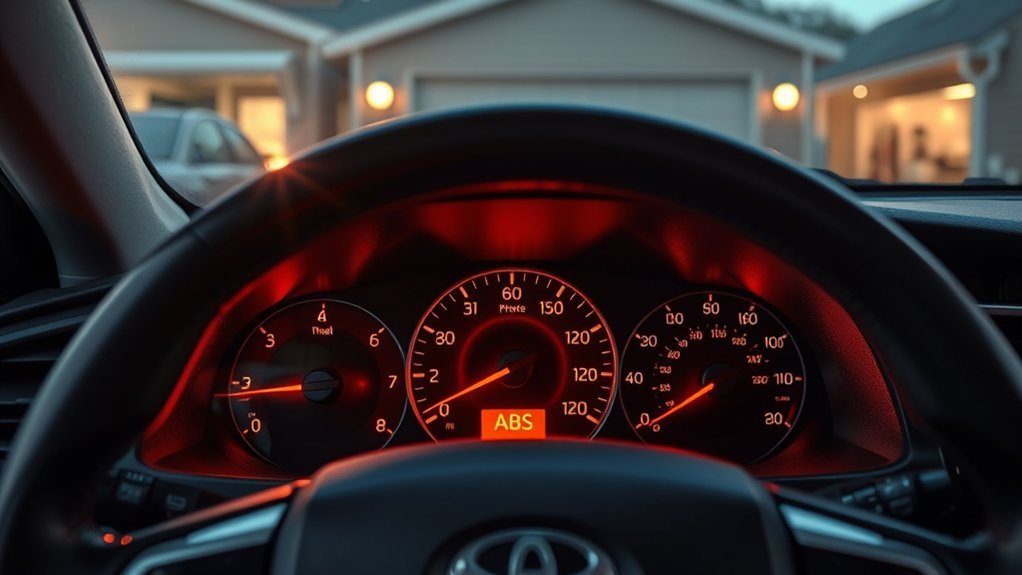
The anti-lock brake system helps prevent wheel lock during hard braking so you can retain steering control. Toyota’s warning-light guidance says an illuminated ABS warning can indicate a malfunction in the ABS or Brake Assist system. Depending on the model and fault, basic hydraulic braking may remain available while anti-lock or related assistance is unavailable.
When ABS activates normally during hard braking, you may feel rapid pulsation through the pedal and hear mechanical noises. During an emergency stop in an ABS-equipped Camry, press the brake pedal firmly and continuously while steering toward a safe path. Do not repeatedly pump the pedal; ABS automatically changes brake pressure as needed.
ABS is designed mainly to help preserve steering control during hard braking. It does not guarantee a shorter stopping distance on every road surface.
If only the amber ABS light is on and the service brake feels normal, consult the exact owner’s manual and arrange prompt diagnosis. Do not assume the warning can be ignored because ordinary braking still seems available.
If the amber ABS warning appears together with the red brake-system warning, stop safely and arrange professional assistance rather than assuming that normal braking remains available.
Common Fixes for Brake Warning Light Problems
The correct repair depends on the diagnosis. Replacing parts based only on the dashboard symbol can waste money and leave the real fault unresolved.
| Finding | Typical Correction | Important Caution |
|---|---|---|
| Parking brake partially applied | Release it fully and verify that the mechanism or electric actuator operates correctly | Do not force an electric parking brake that displays a malfunction message |
| Low brake-fluid level | Inspect for leakage and measure pad, shoe, rotor, drum, and hydraulic-component condition as applicable | Do not assume normal lining wear is the cause until leakage and other faults have been ruled out |
| Hydraulic leak | Repair the leaking component, refill with the specified fluid, and bleed and test the system using the correct procedure | The vehicle should not be driven with a suspected hydraulic leak |
| Wheel-speed sensor or damaged wiring | Test the sensor circuit, inspect the harness and connector, and repair or replace the confirmed failed component | A stored code identifies a circuit or condition, not automatically the exact part that should be replaced |
| ABS actuator, pump, or control fault | Perform system-specific testing and repair or replace the confirmed failed assembly | Some procedures require Toyota-capable bidirectional scan-tool functions and model-specific service information |
| Parking-brake switch or position fault | Adjust, test, or replace the switch or affected parking-brake component after confirming the diagnosis | Confirm that the brake is mechanically released before blaming the switch |
Check Your Toyota Camry’s Brake Pads, Rotors, and Fluid
Brake-pad wear is important, but there is no single pad thickness that should be presented as the warning-light trigger for every Camry. Toyota’s inspection and replacement specifications vary by model year, axle, brake design, and component.
Inspect Brake Pads Regularly
Have the inner and outer pads inspected on both sides of the axle. Uneven wear can reveal a sticking caliper, seized slide pin, damaged hardware, or another fault that a quick glance at one outside pad may miss.
Brake service may be needed when you notice:
- A high-pitched wear-indicator squeal that continues during normal braking
- Grinding or scraping
- Longer stopping distance
- Steering-wheel or pedal vibration during ordinary braking
- The vehicle pulling during braking
- One wheel becoming much hotter than the others
- Deep rotor scoring, cracking, or severe corrosion
Measure the friction material and compare it with the repair specification for the exact Camry. Do not include the metal backing plate in the measurement. For a broader maintenance checklist, see the Toyota Camry brake inspection interval guide.
Use the Correct Diagnostic Equipment
A basic generic OBD-II reader may retrieve powertrain and emissions codes but fail to access the ABS, electronically controlled brake, or vehicle-stability control module. Diagnosing an ABS or electronic brake warning normally requires an ABS-capable scan tool that supports the Camry’s model year and installed systems.
A technician may need to review stored and current trouble codes, freeze-frame information when available, wheel-speed data, brake-switch operation, voltage information, and system-specific test results. A code should be treated as the beginning of the diagnosis rather than automatic proof that a named sensor or module must be replaced.
How to Address Other Brake-Related Warning Lights
Several dashboard lights can appear together because the ABS, Brake Assist, traction-control, stability-control, electronically controlled braking, electric parking brake, Brake Hold, and driver-assistance functions can share sensors or control information.
- Red brake warning: Stop safely, release the parking brake, and follow the exact owner’s-manual instructions. Do not continue normal driving if the red warning remains on.
- Yellow brake-system warning: Read the complete dashboard message and arrange prompt diagnosis; the exact meaning varies by Camry model year and powertrain.
- Amber ABS warning only: The ABS or Brake Assist system may be malfunctioning. Follow the model-year manual and arrange prompt diagnosis.
- Red brake and amber ABS warnings together: Stop safely and arrange professional assistance or towing.
- Traction or stability warning with ABS: A shared wheel-speed sensor, communication fault, or related system problem may have disabled multiple functions.
- Electric parking brake warning: Follow the dashboard message and owner’s manual rather than repeatedly operating or forcing the switch.
- Brake Hold warning: Do not assume the service brakes have failed, but have the related fault checked before relying on Brake Hold.
A spongy pedal, low pedal, or pedal that slowly sinks is a physical symptom that deserves attention even when no warning light is present. Air, leakage, a master-cylinder fault, overheated fluid, or another hydraulic problem may be involved.
For a wider symbol-by-symbol reference, see the Toyota Camry dashboard warning lights guide.
When Should You Tow a Camry With a Brake Warning?

Arrange immediate professional assistance or towing when any of the following conditions is present:
- The red brake warning remains on after the parking brake is fully released
- The pedal is soft, low, sinking, or unusually hard
- The car takes longer to stop or does not stop straight
- The brake fluid is below the MIN mark
- Fresh fluid is visible beneath the car or around a wheel
- Grinding, severe scraping, smoke, or a burning smell is present
- The red brake and ABS warnings appear together
- A dashboard message tells you to stop the vehicle or contact a dealer
Prompt service is also appropriate for an amber ABS warning, yellow brake-system warning, repeated stability-control warnings, a parking-brake malfunction message, a persistent squeal, pedal vibration, or uneven pad wear.
If you are uncertain whether the vehicle is safe, choose towing. A roadside visual check cannot confirm hydraulic pressure, remaining pad material at every wheel, ABS operation, electronically controlled brake operation, or internal component condition.
Keeping Your Camry’s Brakes Safe
Preventive inspection can reveal wear and leakage before they create a warning or a change in pedal feel.
- Check the brake-fluid level periodically without opening the reservoir unnecessarily.
- Investigate any unexplained drop in fluid rather than repeatedly topping it off.
- Have all pads, rotors, calipers, hoses, and visible lines inspected, not just one wheel.
- Respond to squealing, grinding, pulling, vibration, or a change in pedal travel.
- Use brake fluid and replacement components that meet the requirements for your exact Camry.
- Keep tire sizes and inflation correct because ABS and stability systems depend on accurate wheel-speed information.
- Check the vehicle’s maintenance guide for inspection requirements that apply to its age and operating conditions.
Brake fluid absorbs moisture over time, but Toyota’s service recommendations vary by market and model year. Follow the maintenance guide rather than applying an unsupported universal replacement interval. The Toyota Camry brake fluid replacement interval guide explains the distinction between scheduled maintenance and symptom-driven inspection.
Why Model-Specific Brake Guidance Matters
A Camry’s maintenance reminder is not the same as a brake-system warning. Resetting the maintenance reminder will not repair a hydraulic leak, worn component, failed wheel-speed sensor, ABS fault, or electronically controlled brake malfunction.
Use the Toyota owner’s manual and warranty portal to find the maintenance guide and warning-light instructions for your year. Inspect the brakes sooner when symptoms, warning lights, severe driving conditions, previous repairs, or long periods of storage justify it.
You can also enter the vehicle identification number or other requested vehicle information in Toyota’s recall and service campaign lookup. A warning light does not prove that a recall applies, but checking the VIN can identify an open campaign that should be completed.
Frequently Asked Questions
What is the brake system warning light on a Toyota Camry?
It is normally a dashboard warning associated with the parking brake, brake-fluid level, or a detected brake-system fault. Newer Camrys may use different red and yellow brake warnings. The exact symbol and meaning vary by model year and powertrain, so compare the light and accompanying message with your owner’s manual.
What causes the Toyota Camry brake warning light to come on?
Common causes include an applied or incompletely released parking brake, low brake fluid, a hydraulic fault, a parking-brake switch problem, or another brake-system malfunction. An ABS or yellow brake-system warning can have different causes involving sensors, wiring, Brake Assist, electronically controlled braking, an actuator, or another control-system fault.
Is it safe to drive with the brake system warning light on?
Do not continue normal driving when a red brake-system warning remains on after the parking brake is released. Toyota’s newer Camry manuals instruct drivers to stop in a safe place and contact Toyota when the red warning indicates low fluid or a brake-system malfunction. Towing is the safer choice when braking feels abnormal, fluid is below MIN, a leak is visible, or the red brake and ABS warnings appear together.
Why is the brake light still on after I released the parking brake?
The brake may not be fully released, the fluid may be low, the parking-brake switch may be faulty, or the vehicle may have detected another brake-system problem. If a red brake-system warning remains on after release, stop and follow the exact model-year owner’s-manual instructions rather than performing a road test.
What does a yellow brake system warning mean on a Toyota Camry?
Some Camry Hybrid and electronically controlled brake systems use a yellow brake-system warning for faults involving regenerative braking, electronically controlled braking, or the electric parking brake. The exact meaning and required action vary by model year, so read the complete dashboard message and follow the owner’s manual.
Can worn brake pads turn on the red brake warning light?
Pad wear can allow the reservoir level to move lower as the caliper pistons extend, but the red warning is not a universal electronic pad-thickness indicator. Have all pads measured and compare them with the service specification for the exact model year, while also ruling out leakage or another brake-system fault.
Can I fix the warning by adding brake fluid?
No. Adding the specified fluid does not explain why the level became low. The vehicle still needs inspection for leakage, wear, or another fault. Do not continue normal driving with fluid below MIN or a persistent red brake-system warning.
What is the difference between the ABS light and the red brake light?
The amber ABS light normally indicates a malfunction in the ABS or Brake Assist system. The red brake light can indicate an applied parking brake, low fluid, or a brake-system malfunction depending on the Camry. When the red brake and ABS warnings appear together, stop safely and arrange professional assistance.
Will a basic OBD-II scanner read Toyota Camry ABS codes?
Not necessarily. Many basic readers are limited to generic powertrain and emissions information. You normally need an ABS-capable scanner that supports the Camry’s model year and installed brake-control systems to retrieve brake and stability-control trouble codes and related live data.
Conclusion
A Toyota Camry brake system warning light should never be dismissed or reset without finding the cause. Stop safely, identify the exact symbol and dashboard message, and fully release the parking brake. If a red brake-system warning remains on, do not continue normal driving; follow the instructions for your exact model year and arrange professional assistance. Towing is the safer choice when braking feels different, fluid is below MIN, a leak is visible, or the red brake and ABS warnings appear together. Electronic faults should be diagnosed with equipment that can access the Camry’s ABS and related brake-control systems.
Sources
- Toyota Warning Lights — Toyota guidance on warning-light meanings, ABS/Brake Assist warnings, color severity, and model-specific manual use
- Toyota Owner’s Manuals and Warranty Information — model-year brake-warning descriptions, operating procedures, and maintenance information
- Toyota Recall and Service Campaign Lookup — VIN-based recall and campaign information
- NHTSA Winter Weather Driving Tips — guidance to apply firm, continuous brake-pedal pressure when using ABS
- NHTSA Light Vehicle ABS Test-Track Study — ABS braking and steering behavior, including surface-dependent stopping performance
- 49 CFR § 571.126 — federal electronic stability control requirements for light vehicles
