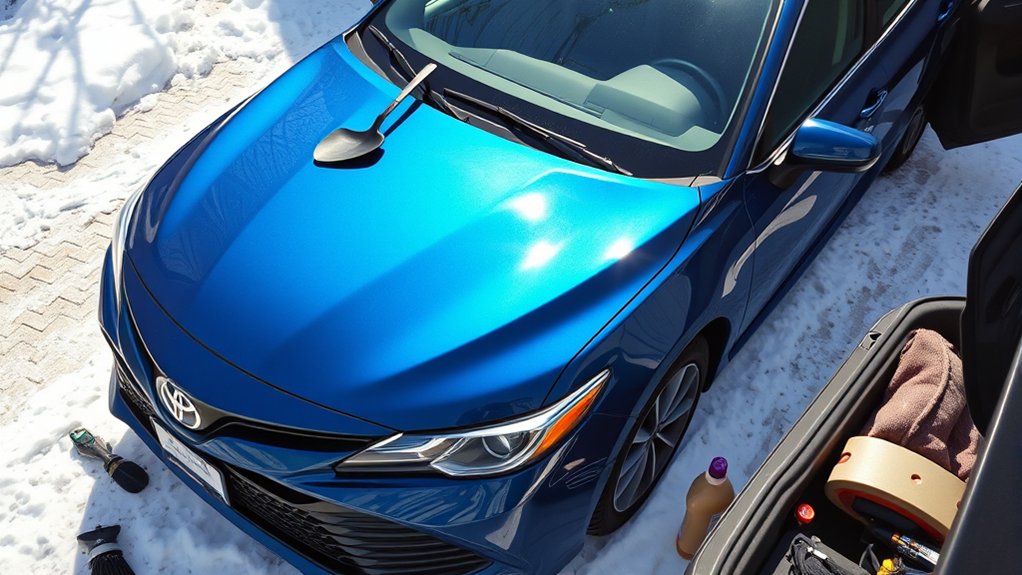
To prepare a Toyota Camry for winter, test the 12-volt battery, verify model-approved coolant and oil, set all tires to the cold pressure on the driver-door label, inspect tread and brakes, and test the wipers, lights, heater, and defroster. Before snow or freezing rain, also clear camera and sensor areas, pack emergency supplies, review the model-specific jump-start procedure, and check weather and road advisories.
Last updated: September 11, 2026.
Quick Answer
Prepare your Toyota Camry for winter by testing the battery, checking model-approved fluids, setting cold tire pressure from the driver-door label, inspecting tread and brakes, and testing the wipers, lights, heater, and defroster. Clear snow from cameras and sensors, pack emergency supplies, and postpone travel when roads are unsafe. Use the owner’s manual for your exact model year for fluid specifications, tire-chain restrictions, jump-start points, and winter parking instructions.
Key Takeaways
- Test the 12-volt battery and charging system before cold weather exposes a weak component.
- Check tire pressure when the tires are cold and use the pressure on the driver-door label, not the tire sidewall.
- Use coolant, engine oil, and winter washer fluid that meet the requirements for your exact Camry model year.
- Confirm that the wipers, lights, heater, windshield defroster, brakes, and emergency flashers work correctly.
- Clear snow and ice from the whole vehicle, including the areas used by cameras, sensors, and the climate-control air inlet.
- Review your model-year winter parking instructions because parking-brake guidance can differ between Camry generations.
- Pack winter emergency supplies, review the correct jump-start procedure, and check weather and road conditions before leaving.
At a Glance
| Time Required | Varies by vehicle condition and how many checks you perform; repairs or professional testing require additional time |
| Difficulty | Beginner for visual checks; professional service is appropriate for brakes, coolant leaks, battery testing, warning lights, or persistent safety-system alerts |
| Tools Needed | Owner’s manual, tire-pressure gauge, tread-depth gauge or penny, flashlight, microfiber cloth, ice scraper, snow brush, and approved washer fluid |
| Cost | A visual inspection may cost nothing; batteries, tires, fluids, wiper blades, emergency supplies, and repairs vary by vehicle and condition |
How Should You Check the Battery and Essential Fluids Before Winter?
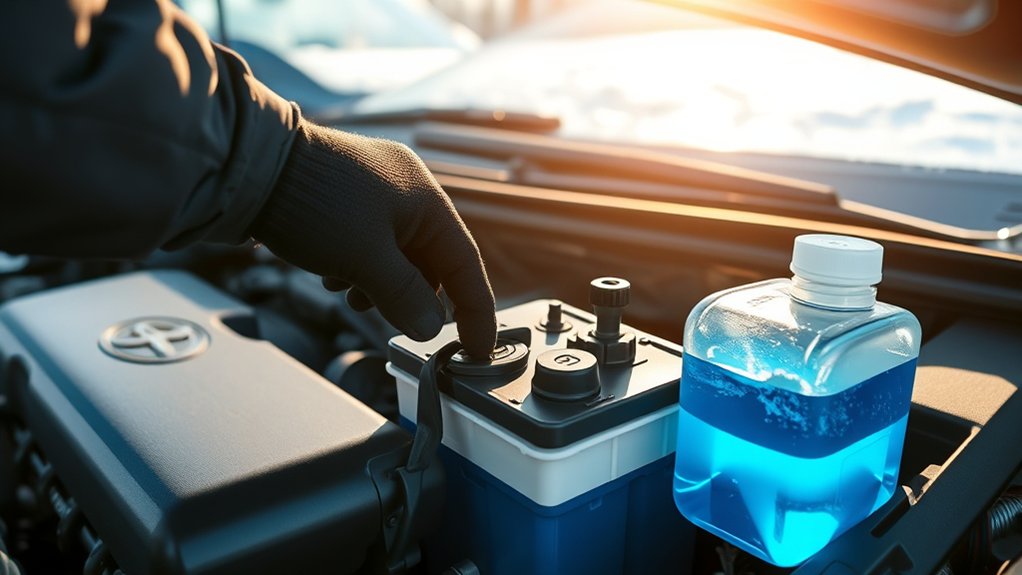
Begin with the 12-volt battery because cold temperatures reduce available battery power while the engine may require more power to start. Inspect the case for swelling, cracks, or leakage. Make sure the battery is secure and that the terminals and cable connections are tight and free from heavy corrosion.
A battery can fail before or after any particular age, so condition matters more than a universal three-year rule. Ask a qualified technician to test the battery and charging system if the engine cranks slowly, the lights dim during startup, the battery history is unknown, or winter temperatures in your area become severe. The National Highway Traffic Safety Administration also recommends checking the battery, charging system, belts, and other needed repairs before winter.
Inspect Coolant and Other Fluids
Check the coolant level only when the engine is cool and the vehicle is parked on level ground. The fluid should sit within the marked range on the translucent reservoir. Look around the reservoir, hoses, radiator area, and parking space for signs of leakage. If the level keeps dropping, a sweet odor appears, or you find wet or dried coolant residue, use a proper diagnosis rather than repeatedly topping it off; our Toyota Camry coolant-leak guide explains the common warning signs.
Warning: Never remove a radiator or pressurized coolant cap while the engine is hot. Escaping steam or coolant can cause severe burns.
Use only the coolant type and service procedure listed in the manual for your exact model year. Do not automatically add water or assume every Camry requires a homemade 50/50 mixture. Toyota provides model-specific information through its official U.S. manuals and warranties portal. Owners of vehicles sold in other markets should use the manual supplied with the vehicle or the official Toyota site for their country.
Correct coolant concentration and condition matter more than simply seeing fluid in the reservoir. Ask a technician to test freeze protection if the coolant history is unknown.
Check the engine-oil level according to the owner’s manual and investigate any warning light, visible leak, or unusually low level. Use only an oil viscosity and specification approved for your model year; do not switch to a so-called winter oil unless Toyota’s manual or a qualified technician directs you to do so. Also inspect the brake-fluid reservoir without opening it unnecessarily. Low brake fluid can indicate worn brake components or a leak that needs professional attention.
Fill the windshield-washer reservoir with a winter-rated product designed for temperatures expected in your area. Ordinary or heavily diluted fluid may freeze in the reservoir, lines, nozzles, or on the windshield.
How Do You Prepare Toyota Camry Tires for Winter?
Your Camry’s tires affect acceleration, steering, and braking on cold, wet, snowy, and icy roads. Inspect all four road tires and the spare tire or factory tire-repair equipment before winter travel.
- Check pressure when the tires are cold: Measure pressure before driving or after the vehicle has been parked for at least three hours. Use the recommended pressure on the driver-door Tire and Loading Information label, not the maximum pressure molded into the tire sidewall.
- Inspect tread depth: NHTSA states that tires are worn out at 2/32 inch of remaining tread. Winter traction can decline before a tire reaches that limit, so consider replacement sooner when snow and slush are common.
- Look for damage: Check the tread and sidewalls for cuts, cracks, punctures, bulges, exposed material, or uneven wear.
- Check tire age: Find the tire identification code on the sidewall and review the tire and vehicle manufacturers’ age guidance. Age, heat, storage, damage, and use all affect condition, so do not rely on tread depth alone.
- Watch for alignment problems: Feathered tread, rapid shoulder wear, pulling, or a crooked steering wheel can point to alignment or suspension concerns.
- Review rotation history: Rotate the tires only at the interval and in the pattern allowed by the owner’s manual. Rotation can reduce irregular wear, but some tire configurations have restrictions.
- Consider winter tires: NHTSA notes that winter tires are more effective than all-season tires in deep snow. Choose the correct size, load rating, and speed rating for your Camry, and install a matched set as directed by the tire manufacturer and Toyota.
The NHTSA TireWise guide explains tire pressure, tread inspection, tire age, sizing, rotation, and safety ratings. For the complete Camry-specific pressure-check procedure, see our Toyota Camry tire-pressure guide.
Pro Tip: Keep a reliable pressure gauge in the glove box. The tire-pressure monitoring light usually appears only after a tire has become significantly underinflated, so it does not replace monthly manual checks.
Do not install tire chains or other traction devices until you confirm that your model, tire size, wheel size, and available clearance permit them. Camry chain restrictions can differ by model year and wheel package, so follow the owner’s manual and local chain-control laws rather than relying on a generic fitment rule.
How Do You Prepare Camry Wipers and Visibility for Winter?
Winter precipitation can quickly reduce visibility. Inspect the windshield, wipers, washer system, exterior lights, mirrors, heater, and defroster before the first storm.
Inspect Wiper Blades Regularly
Do not force a frozen wiper arm or window. Thaw the windshield and wiper area first, then follow the model-year owner’s manual before moving or lifting the blades. Toyota winter-driving guidance also calls for clearing accumulated snow from the air inlet area in front of the windshield so the climate-control fan can work normally.
With the wipers fully thawed and parked, lift each wiper arm carefully only as the vehicle and blade instructions allow. Examine the rubber for cracks, tears, hardened edges, separation, or distortion. Replace blades that chatter, skip, leave streaks, or fail to clear a broad section of glass.
Winter-style blades may help in areas with frequent snow and ice, but correct fit and installation remain essential. Test the front wipers, washer nozzles, and rear-window defogger. If the windshield has a crack or chip that affects visibility or is spreading, have it evaluated before winter travel.
Keep a clean microfiber towel in the car for interior glass haze. Do not use the towel while driving, and do not rely on the wipers to remove thick ice.
Use Winter-Grade Washer Fluid
Fill the reservoir before cold weather arrives and carry a sealed spare container on long trips. Choose a product with a freeze rating suitable for your region, and never pour engine coolant or household cleaners into the washer reservoir.
Before driving, remove snow and ice from the windshield, side windows, mirrors, headlights, brake lights, turn signals, hood, and roof. Also inspect the areas around the tires and brakes and remove snow or mud from your shoes before entering. Clearing the whole vehicle improves visibility and prevents sheets of snow or ice from sliding into your view or striking another road user.
Check Lights and Emergency Flashers
Confirm that the low beams, high beams, brake lights, turn signals, license-plate lights, reverse lights, and emergency flashers work. Clean dirty lenses and replace failed bulbs or repair electrical faults before winter travel.
Check Cameras and Driver-Assistance Sensors
Many Camrys use cameras, radar, or other sensors for features such as lane-departure warning, adaptive cruise control, automatic high beams, and automatic emergency braking. Clear snow, ice, road salt, and heavy dirt from the windshield and exterior areas identified in your owner’s manual. Clean those areas only as the manual directs, and arrange service if a warning remains after the obstruction is removed.
Poor visibility, covered lane markings, and blocked sensors can limit driver-assistance features. Review any dashboard message and the model-specific manual before driving. These systems assist the driver; they do not replace steering, braking, attention, or safe speed. The NHTSA driver-assistance guide explains common system types and emphasizes that the driver remains responsible.
How Do You Test the Heater and Defroster?
Start the Camry in a well-ventilated outdoor area and let the climate system begin warming normally. Test the cabin heater, front windshield defroster, side-window vents, fan speeds, temperature controls, and rear-window defogger.
Recheck Coolant if Cabin Heat Is Weak
The engine-cooling system supports cabin heat as well as engine-temperature control. Low coolant, contaminated coolant, a leak, a circulation problem, or an HVAC fault can reduce heating or defrosting performance.
Check the reservoir only when the engine is cool. Discolored fluid, oily residue, floating debris, repeated coolant loss, a sweet odor, damp carpet, or visible leakage deserves professional diagnosis.
Test Heater and Defroster Operation
Cool air from the vents does not prove that the thermostat has failed. Possible causes include low coolant, a heater-core restriction, an air pocket, a blend-door fault, a control problem, or a thermostat issue.
Schedule an inspection if the engine-temperature warning appears, the temperature gauge behaves abnormally, the heater remains cold after normal warmup, or the defroster cannot keep the windshield clear. Avoid driving when you cannot maintain safe visibility.
What Brake, Exhaust, and Floor-Mat Checks Matter in Winter?
Winter roads demand predictable braking. Listen for grinding, scraping, or persistent squealing, and notice any pulling, vibration, soft pedal feel, warning light, or increased stopping distance. A qualified technician should inspect the brakes if you notice any of these symptoms.
Inspect the visible exhaust outlet for damage or heavy corrosion. During a snowstorm, keep the tailpipe clear. A blocked exhaust outlet can allow carbon monoxide to enter the passenger compartment.
Warning: Never run the engine in a closed garage. If you become stranded in snow, clear the exhaust outlet and run the engine only as needed for warmth while following official emergency guidance.
Make sure each floor mat fits the Camry correctly and is secured by the factory retention points. A loose, stacked, or incorrectly sized mat can interfere with the accelerator or brake pedal.
When Should You Book a Winter Maintenance Appointment?
You can perform many visual checks at home, but a professional inspection is appropriate when the battery is weak, the brakes behave abnormally, coolant is leaking, warning lights remain on, or the service history is incomplete.
A winter service appointment may include:
- Battery and charging-system test: Confirms whether the battery, alternator, cables, and connections perform correctly.
- Tire inspection: Checks pressure, tread, damage, balance, alignment, and tire age.
- Cooling-system evaluation: Checks fluid condition, freeze protection, leaks, hoses, and related components.
- Brake inspection: Examines pads, rotors, hydraulic components, warning indicators, and parking-brake operation.
- Visibility and lighting check: Tests wipers, washers, exterior lights, heater, defroster, and any persistent camera or driver-assistance warning.
Dealership and independent service packages vary. Review what is included and compare it with the maintenance schedule and current condition of your Camry instead of buying services solely because they are labeled as a winter package.
Check for Open Safety Recalls
Use your 17-character VIN to check for unrepaired safety recalls through the NHTSA recall lookup for U.S. vehicles. The VIN is commonly visible through the lower driver-side windshield and may also appear on registration or insurance documents. For a vehicle registered outside the United States, also check Toyota’s regional recall page or the national transport-safety authority.
What Should Be in a Toyota Camry Winter Emergency Kit?
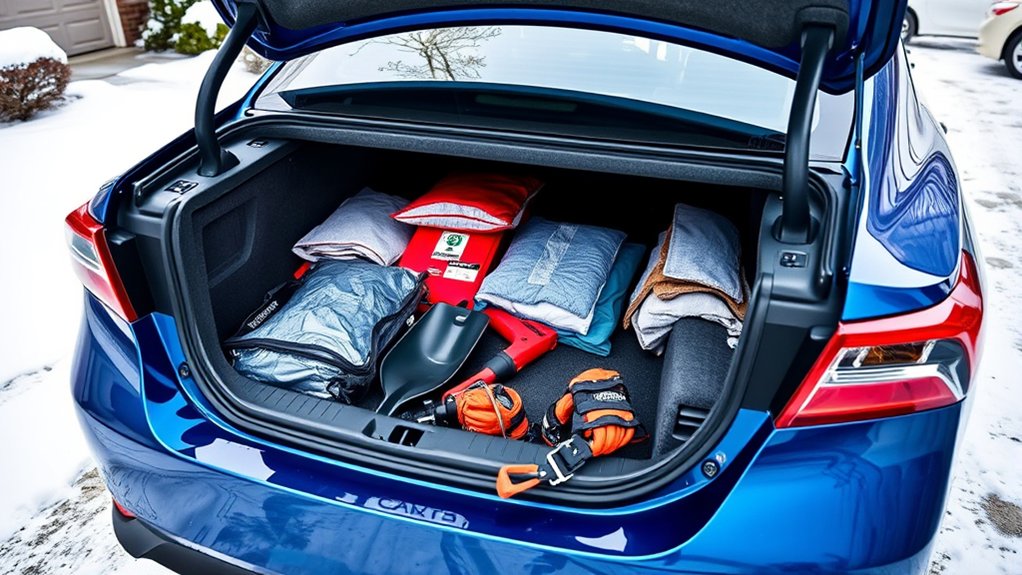
Pack the kit for your climate, route, passengers, and trip length. Inspect it at the start of each winter and replace expired food, medicine, batteries, or damaged equipment.
A useful winter kit should help you stay warm, remain visible, communicate, provide basic first aid, and deal with snow or a weak battery.
- Warm blankets, hats, gloves, and extra clothing
- Water and nonperishable snacks
- Flashlight with spare batteries
- Fully charged portable phone charger and charging cable
- First aid kit and necessary medicine
- Ice scraper, snow brush, and compact shovel
- Jumper cables or a properly maintained portable jump starter
- Reflective triangles, warning markers, or other legal visibility devices
- Sand or another suitable traction material
- Tire-pressure gauge
- Road map or written route information
- Basic tool kit and work gloves
Inspect the spare tire and jack if your Camry carries them. Some models may use a tire-repair kit instead, so learn how your equipment works before an emergency. The CDC winter-preparedness guide provides an expanded emergency-car-kit list.
Review the Correct Jump-Start Procedure
Before you need jumper cables or a portable jump starter, locate the instructions and approved connection points in the owner’s manual for your exact Camry. Battery locations and procedures can differ between model years and between gasoline and hybrid versions. Store the cables or jump starter where you can reach them without unloading the entire trunk. For more detail, see our Toyota Camry jump-start guide.
Warning: Never guess at battery polarity or connection points. Reverse connections can damage vehicle electronics and create a serious safety hazard. Do not attempt a jump-start if the battery is cracked, leaking, or otherwise damaged; use roadside assistance instead.
Note: Water can freeze inside a parked vehicle. Rotate your supply as conditions require, and store containers so expansion or leakage will not damage the interior.
What Should You Check Before Every Winter Drive?
Vehicle maintenance cannot make an unsafe road safe. Check the weather forecast, road reports, closures, and local travel advisories before leaving. Postpone nonessential travel when authorities warn that conditions are dangerous.
Follow Your Model-Year Winter Parking Instructions
Parking-brake guidance is not identical across every Camry generation. Some Toyota Camry owner’s manuals warn that a parking brake can freeze in cold conditions and provide a specific procedure for parking in P without setting it, including wheel-blocking precautions where directed. Do not apply that instruction generically. Check the winter-driving section of the Toyota owner’s manual for your exact model year, especially if your Camry has an electronic parking brake or Brake Hold.
Keep the fuel tank close to full when possible before a storm or long trip. Cold weather can reduce fuel economy, and the effect can be greater for hybrids. The U.S. Department of Energy and EPA fuel-economy guide says conventional gasoline vehicles typically lose about 10% to 20% of city fuel economy in cold weather, while hybrids typically lose about 20% to 40%, with the actual effect depending on the vehicle and conditions. Follow the hybrid-specific instructions in your owner’s manual and plan extra fuel margin for delays, cabin heating, and slow traffic.
Tell someone your route and expected arrival time when traveling through remote areas. Carry a charged phone, but do not depend on cellular service being available everywhere.
Secure Child Passengers Without Bulky Coats Under the Harness
Bulky winter coats can prevent a child-restraint harness from fitting snugly. Dress the child in thin, warm layers, tighten the harness correctly, and place a coat or blanket over the secured harness for warmth. Follow the child-seat instructions and Toyota’s seating guidance.
NHTSA includes this warning in its winter-driving guidance because a loose harness may not protect a child as intended in a crash. Never place thick padding behind the child unless the child-seat manufacturer specifically permits it.
Drive Smoothly on Snow and Ice
This checklist focuses on preparing the vehicle. For braking, steering, traction-control, and snow-driving technique in more detail, see our guide to driving a Toyota Camry safely in snow and ice.
- Reduce speed before reaching a slippery area.
- Increase following distance so you have more room to stop.
- Accelerate, steer, and brake gradually.
- Leave traction and stability control enabled during ordinary winter driving unless the owner’s manual directs otherwise for a specific situation.
- Apply firm, continuous brake-pedal pressure during an emergency stop in a Camry equipped with antilock brakes.
- Avoid cruise control when traction is poor or conditions change quickly.
- Give snowplows extra space and do not travel beside them unnecessarily.
NHTSA recommends slowing down and increasing following distance because controlling and stopping a vehicle takes longer on slick or snow-covered roads.
What to Do if Your Camry Becomes Stranded
Move as far from active traffic as safely possible, turn on the emergency flashers, and call for assistance. In severe winter conditions, staying with the vehicle is often safer than walking into poor visibility or extreme cold.
Make the vehicle visible with warning markers. Clear snow from the exhaust outlet before running the engine, and run it only as needed for warmth. Avoid overexertion while shoveling or pushing the car.
Related Guides
Frequently Asked Questions
How do you put a Toyota Camry in Snow mode?
Do not assume your Camry has Snow mode. The 2025 U.S. Camry manual lists Eco and Sport drive-mode indicators rather than a dedicated Snow-mode indicator. Controls can differ by model year, trim, drivetrain, and market, so check the console and the model-specific owner’s manual. If Snow mode is listed for your vehicle, engage it only as Toyota directs. If it is not listed, use the normal drive setting, keep traction and stability control enabled, and apply the accelerator smoothly.
What are the three P’s of winter driving?
Preparation, patience, and prudence form a useful safety mnemonic. Prepare the vehicle and route, remain patient enough to reduce speed and leave more space, and use prudent judgment about postponing travel. The phrase is not a substitute for Toyota’s operating instructions or official road advisories.
Do Toyota Camrys drive well in snow?
A properly maintained Camry with suitable tires can handle many ordinary winter conditions, but no car is immune to poor traction. Snow performance depends on tire type and condition, road treatment, snow depth, ice, vehicle configuration, speed, and driver input. Front-wheel drive or all-wheel drive can help acceleration, but neither eliminates limits on braking and cornering.
How do you prepare a Camry for winter driving?
Test the battery, check coolant and oil, fill the washer reservoir with winter-rated fluid, inspect tire pressure and tread, replace worn wipers, test the lights and defroster, inspect the brakes, check for recalls, review model-specific winter parking instructions, and pack an emergency kit. Repair known problems before driving in severe weather.
Does a Toyota Camry need winter tires?
Winter tires may be worthwhile when you regularly drive through snow, prolonged cold, or poorly cleared roads. NHTSA states that winter tires are more effective than all-season tires in deep snow. Choose tires that match Toyota’s size and load requirements, and ask a qualified tire professional when you are uncertain.
Should you add water to Toyota Camry coolant?
Do not add water automatically. Coolant products and service procedures differ, and approved Toyota coolant may already be premixed. Check the manual for your model year and use the specified coolant. Have the system tested if the fluid history, concentration, or freeze protection is unknown.
What tire pressure should a Toyota Camry use in winter?
Use the cold inflation pressure on the Tire and Loading Information label at the driver-side door or doorjamb. The correct value can vary by model year, trim, wheel, and tire size. Do not use the maximum pressure printed on the tire sidewall, and do not add extra pressure simply because the weather is cold.
Can you jump-start a Toyota Camry or Camry Hybrid?
A Camry can generally be jump-started when its 12-volt battery is discharged, but the approved connection points and sequence vary by model year and powertrain. Follow the exact owner’s-manual procedure, observe polarity, and use roadside assistance when the battery is damaged or the correct connection points are unclear.
Conclusion
A winter-ready Toyota Camry needs more than a quick tire check. Inspect the battery, fluids, tires, visibility equipment, heating system, brakes, lights, exhaust, recalls, driver-assistance sensor areas, and emergency supplies before severe weather arrives. Review the correct jump-start and winter-parking procedures for your exact model year, and secure child passengers without bulky coats under the harness. Correcting a small problem at home is safer than discovering it during a storm.
NHTSA reported 320 fatal traffic crashes and an estimated 22,293 injury crashes in 2023 when snow or sleet was present at the time of the crash. Proper preparation cannot remove every risk, but it can improve reliability, visibility, traction, and your ability to respond to an emergency.
Sources
- NHTSA Winter Weather Driving Tips — battery, tires, cooling system, visibility, winter driving, child restraints, and emergency supplies
- NHTSA TireWise — tire pressure, tread depth, damage, sizing, maintenance, and winter-tire guidance
- Toyota Manuals and Warranties — model-year-specific operating instructions, fluid requirements, controls, winter parking guidance, and maintenance information
- NHTSA Recall Lookup — VIN-based unrepaired safety-recall information
- CDC Preparing for a Winter Storm — vehicle preparation, travel safety, stranded-driver guidance, and winter emergency-kit guidance
- NHTSA Driver Assistance Technologies — system functions, limitations, and driver responsibility
- U.S. Department of Energy and EPA: Fuel Economy in Cold Weather — cold-weather fuel-economy effects for gasoline and hybrid vehicles
