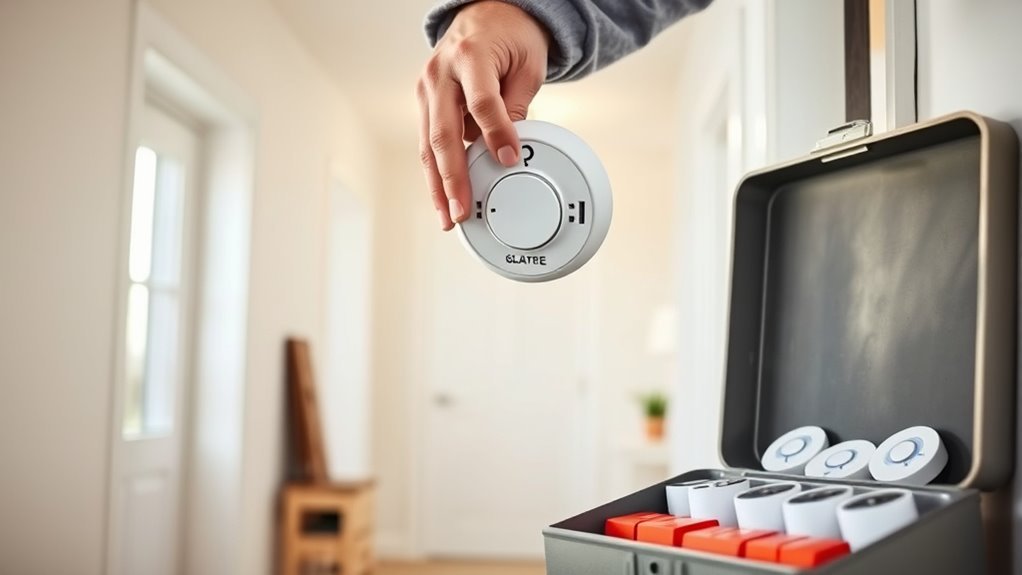
Replacing an expired smoke or carbon monoxide alarm is a small job with an important safety purpose. For household devices, “smoke alarm” and “CO alarm” are usually more precise terms than “fire alarm.” Smoke alarms generally need replacement after about 10 years, while carbon monoxide alarms should be replaced at the age or end-of-life point specified by their manufacturer. Before buying a replacement, check the old unit’s manufacture date, power source, mounting system, model information, interconnection requirements, and local code.
Quick Answer
Replace most household smoke alarms when they reach 10 years from the manufacture date. Replace carbon monoxide alarms at the age or end-of-life point specified for that model. Match the power source and interconnection system, switch off the breaker before handling hardwired units, follow the manufacturer’s installation instructions, and test every replacement before relying on it.
Key Takeaways
- Replace smoke alarms at about 10 years from the manufacture date, or sooner if the manufacturer directs replacement because of damage, malfunction, or an end-of-life signal.
- For CO alarms, use the replacement age and end-of-life indication specified in the product manual rather than assuming every model has the same lifespan.
- Match battery, plug-in, or hardwired power requirements and verify compatibility before connecting a replacement to an interconnected system.
- Turn off the circuit breaker before removing a hardwired alarm. If house wiring must be altered or you cannot safely verify the circuit condition, use a qualified electrician.
- Test smoke alarms monthly and follow the CO-alarm manufacturer’s test procedure. A CO test button checks alarm circuitry; it does not prove sensor accuracy.
- Do not assume chirp or beep patterns have the same meaning on every alarm. Check the model’s instructions.
At a Glance
| Time Required | Usually a short replacement job per alarm; allow additional time if the mounting plate or approved connector must be changed. |
| Difficulty | Easy for many battery units; moderate for compatible hardwired replacements. Electrical modifications may require a qualified electrician. |
| Tools Needed | Stable step ladder, screwdriver if the bracket changes, replacement alarm, required battery if applicable, and the manufacturer’s instructions. Appropriate electrical test equipment is needed if exposed wiring will be checked. |
| Cost | Varies by alarm type, sensor package, interconnection features, and whether professional electrical work is required. |
Warning: A sounding CO alarm is not a maintenance reminder unless the manufacturer’s instructions specifically identify that signal as one. If the alarm indicates carbon monoxide, move everyone outside to fresh air and contact emergency services. Do not re-enter until authorities say it is safe.
When Should You Replace Fire Alarms?
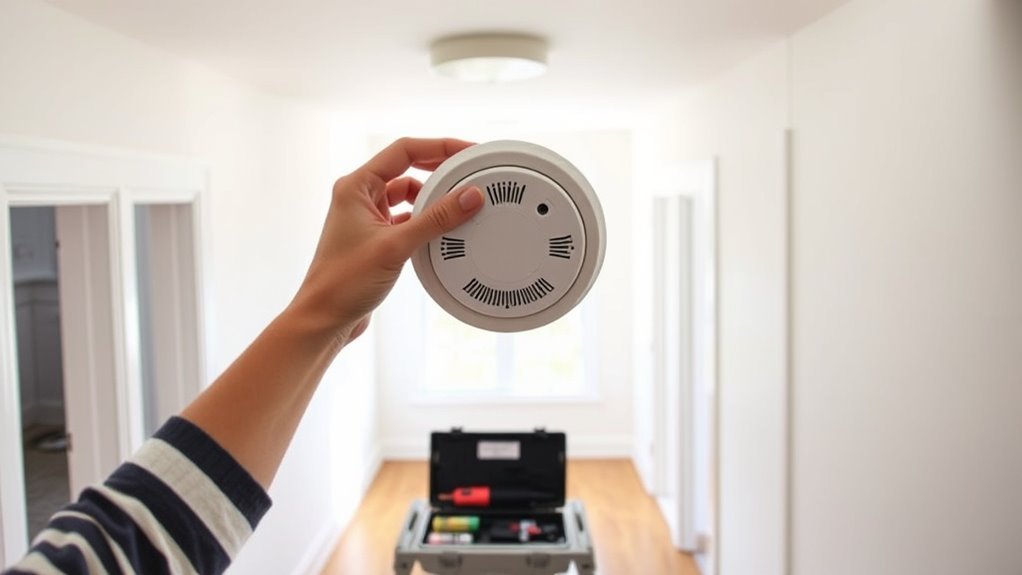
Household smoke alarms should generally be replaced 10 years from their manufacture date. The U.S. Fire Administration recommends replacing the entire smoke alarm every 10 years and testing it monthly.
Replace an alarm sooner if it is damaged, contaminated, painted over, no longer passes the manufacturer’s test procedure, or gives a verified end-of-life indication. Do not assume that every chirp or beep means the same thing; signal patterns vary between manufacturers and models.
Carbon monoxide alarms are different. Their sensors have manufacturer-defined service lives, so check the label and product instructions for the specific replacement age. CPSC notes that newer CO alarms commonly provide an end-of-life signal and that the recommended replacement age comes from the product literature or manufacturer.
In the U.S. Fire Administration’s analysis of fatal occupied residential-building fires from 2018–2020, smoke alarms were reported as not present in 24% of those fatal fires. This statistic applies to that specific fatal-fire dataset, not to all dwelling fires.
A monthly test is important, but a passing test does not extend an alarm beyond its recommended service life.
Check the Manufacture Date on the Alarm
Remove or rotate the alarm only as its instructions allow and look for the manufacture date, replacement date, model number, and certification markings on the back or side. The manufacture date is the starting point for determining the age of most smoke alarms.
For a smoke alarm approaching 10 years of age, plan to replace the entire unit even if it still sounds when tested. If the manufacture date is unreadable and you cannot reliably establish the alarm’s age, replacement is the safer choice.
For a carbon monoxide or combination smoke/CO alarm, read the model-specific instructions. The sensor life can differ from the standard 10-year smoke-alarm replacement interval.
Pro Tip: Before removing an old alarm, photograph its back label. The model number, power requirements, interconnect information, connector style, and manufacture date can make it much easier to choose a compatible replacement.
Identify Your Fire Alarm Type
Identify exactly what you have before shopping for a replacement. A household unit may be a battery-powered smoke alarm, sealed-battery smoke alarm, AC hardwired alarm with battery backup, plug-in CO alarm, battery CO alarm, or combination smoke/CO alarm.
| Type | Key Indicator |
|---|---|
| Replaceable-battery smoke alarm | Battery compartment and no household-wiring connector |
| Sealed-battery smoke alarm | Nonreplaceable long-life battery |
| Hardwired alarm | AC wiring connector, usually with backup battery |
| Plug-in CO alarm | Plugs into a receptacle, often with battery backup |
| Combination smoke/CO alarm | Label identifies both smoke and CO functions |
| Interconnected alarm | Designed to activate compatible alarms together |
Traditional smoke alarms use photoelectric, ionization, or combined/multi-criteria sensing approaches. USFA notes that photoelectric alarms tend to respond faster to smoldering fires and ionization alarms tend to respond faster to flaming fires. It recommends broad smoke-detection protection because occupants cannot predict which type of fire will occur.
Newer smoke alarms are also being designed around updated performance requirements. UL Solutions explains that updated UL 217 requirements include additional modern fire tests and a cooking-nuisance test intended to improve detection while reducing unwanted cooking alarms.
Choose the Right Replacement Alarm
Choose a replacement that is approved for residential use and complies with the requirements that apply in your jurisdiction. For U.S. homes, smoke alarms are commonly evaluated to UL 217 and residential CO alarms to UL 2034. Local building, fire, electrical, rental, or state rules may impose additional requirements.
Before purchasing, confirm all of the following:
- Alarm purpose: smoke, CO, or combination smoke/CO.
- Power source: replaceable battery, sealed battery, plug-in, or AC hardwired with required backup power.
- Interconnect compatibility: do not assume a different brand or model can communicate with the existing system.
- Mounting and connector requirements: brackets and wiring plugs are not universally interchangeable.
- Required locations: replacing one alarm should not leave the home with inadequate coverage.
- Local rules: some jurisdictions or rental properties require particular alarm types, battery designs, or professional installation.
The U.S. Fire Administration recommends smoke alarms inside every bedroom, outside each separate sleeping area, and on every level of the home, including the basement. CPSC recommends CO alarms on every level and outside sleeping areas, subject to the manufacturer’s placement instructions.
Turn Off Power to Hardwired Alarms
Before removing a hardwired alarm, switch off the correct circuit breaker or fuse supplying the alarm circuit. Do not rely only on an indicator light, silence from the alarm, or the wall switch position to decide that electrical conductors are safe to handle.
Warning: If replacement requires changing branch-circuit wiring, altering conductors in the electrical box, troubleshooting damaged wiring, or performing work you are not qualified or legally permitted to do, use a licensed or otherwise qualified electrician.
Shut Off Circuit Power
Identify the breaker serving the smoke/CO alarm circuit and switch it fully off. If other people are present, make sure they know not to restore the breaker while work is underway.
Follow the replacement alarm’s instructions before disconnecting the old unit. Some hardwired alarms use a detachable plug that can be released after the alarm has been removed from its mounting ring; others use different connector systems.
Verify Power Is Off
If the electrical box or conductors will be exposed, verify the circuit condition using appropriate electrical test equipment and accepted electrical-safety procedures. A dark status light is not a substitute for electrical verification because indicator behavior differs between products.
If you do not know how to verify de-energization safely, stop before touching the wiring and have a qualified electrician perform the electrical portion of the replacement.
Handle Wiring Safely
Keep breaker power off while the old hardwired alarm is disconnected and while any approved mounting or connector changes are made.
| Step | Action |
|---|---|
| 1 | Switch off the correct circuit |
| 2 | Follow the old alarm’s removal instructions |
| 3 | Verify electrical safety before exposed wiring is handled |
| 4 | Use only the connector, adapter, and wiring method approved for the new alarm |
| 5 | Mount the alarm, restore power, and test the complete system |
Never improvise an interconnect connection or force an incompatible plug into a replacement alarm.
Replace a Battery-Powered Fire Alarm
Battery-powered smoke alarms are often straightforward to replace, but the mounting plate and battery arrangement can differ. Read the new unit’s instructions before removing the old bracket.
Remove Old Alarm
Many round battery-powered smoke alarms release by rotating counterclockwise, but use the method specified for your model. Lower the unit carefully and remove its replaceable battery if the manufacturer or local disposal program instructs you to do so.
Check the manufacture date and model information before setting the old alarm aside. If the new alarm does not use the same mounting plate, remove the old plate only after noting the screw locations and checking what hardware is supplied with the replacement.
Install New Unit
Install the new mounting bracket according to the manufacturer’s instructions. Insert the specified battery if the alarm uses a replaceable battery, then attach the alarm to its mounting plate until it is fully secured.
Do not substitute an incorrect battery type, defeat a battery-locking feature, or reuse a bracket that the new alarm manufacturer does not approve.
Write down the installation month and year if the alarm provides a space for it. Keep the product instructions or save the model number so future chirp patterns, cleaning procedures, and end-of-life signals can be identified correctly.
Test And Record
Press and hold the test button for the period specified in the manufacturer’s instructions. Confirm that the alarm produces the expected test signal.
If the alarm does not pass its test, check the installation, battery activation tab, battery orientation, mounting engagement, and manufacturer troubleshooting instructions. Do not leave a failed alarm installed as though it were protecting the home.
Record the installation or replacement date and continue monthly smoke-alarm testing.
Replace a Hardwired Fire Alarm
For a hardwired smoke, CO, or combination alarm, start by confirming the new model is compatible with the existing power and interconnection system. A physically similar connector does not automatically mean the alarms are electrically or functionally compatible.
- Switch off the circuit supplying the alarms.
- Remove the old alarm from its mounting plate using the method in its instructions.
- Disconnect the approved plug or harness only after the circuit is safely de-energized.
- Replace the mounting plate if the new alarm requires its own plate.
- Use only the new alarm’s approved connector, adapter, or wiring arrangement.
- Attach the alarm securely to the mounting plate.
- Restore breaker power.
- Confirm the alarm’s normal power/status indication according to its manual.
- Press the test button and verify all intended interconnected alarms respond.
If installing the replacement requires splicing, changing house wiring, repairing the electrical box, or resolving an interconnect fault, have the work performed by someone qualified under local electrical rules.
Connect Interconnected Alarms Correctly
Interconnected smoke and CO alarms require more than matching voltage. The replacement must be specifically compatible with the alarms and interconnect method already installed.
| Checkpoint | Requirement | Why It Matters |
|---|---|---|
| Alarm type | Use an approved smoke, CO, or combination unit | Preserves the intended protection |
| Compatibility | Follow the manufacturer’s compatible-model list | Prevents failed or unpredictable interconnection |
| Connector | Use only an approved harness or adapter | Avoids unsafe electrical connections |
| Installation | Follow product instructions and local code | Maintains safe installation |
| Verification | Test from more than one alarm when instructed | Confirms the network responds as intended |
NFPA fire-safety guidance stresses that interconnected alarms must be compatible; mixing incompatible devices can prevent all alarms from sounding together. If one aging system uses discontinued equipment, replacing the entire interconnected group may be necessary.
Note: Wireless interconnection is also model-specific. Two alarms that both advertise wireless capability are not necessarily designed to join the same network.
Test Your Fire and CO Alarms
Smoke alarms should be tested monthly using their test buttons. CPSC also advises regular CO-alarm testing according to the manufacturer’s instructions.
For interconnected alarms, verify that the system behaves as the manufacturer specifies when a test is initiated. If one alarm is expected to activate the others and it does not, troubleshoot the compatibility or installation before relying on the system.
Test Monthly
Test every smoke alarm at least once a month. Use the manufacturer’s required procedure for combination and CO alarms.
- Tell household members that you are conducting a test.
- Press the unit’s test button as instructed.
- Confirm the expected audible, visual, or voice signal.
- Confirm compatible interconnected alarms activate if that is part of the system design.
- Record recurring failures and replace or service the affected unit as directed.
Testing also helps everyone in the home recognize the alarm sound and know that the device has power and functioning alarm circuitry.
Press The Test Button
Press the physical test button directly according to the instructions for the specific alarm. There is no general requirement to stand 2.5 feet away while pressing it.
If a battery-powered alarm does not respond, verify that its battery is correctly installed or activated. For a sealed-battery alarm, follow the product troubleshooting procedure. If the alarm remains nonfunctional, replace it or obtain manufacturer support rather than leaving it in service.
For CO alarms, remember that the CPSC explains that the test button verifies circuitry; it does not confirm the sensor’s measurement accuracy.
Confirm Alarm Response
Listen for the test pattern described in the product manual and verify any expected voice, strobe, display, or interconnected response.
Do not apply a universal meaning to “one chirp,” “three chirps,” or another beep sequence. Manufacturers use different patterns for low battery, malfunction, end-of-life, smoke alarm, and CO alarm conditions.
If you cannot identify a signal, locate the model number and consult the manufacturer’s current instructions before resetting or silencing the unit.
Warning: Never ignore a CO alarm signal. CPSC advises immediately moving outside to fresh air and calling emergency services or the fire department when the alarm indicates carbon monoxide. Do not re-enter until emergency responders permit it.
Dispose of Old Alarms Safely
Check the manufacturer’s disposal instructions and your local waste or recycling rules before discarding an old smoke or CO alarm. Remove replaceable batteries when required and recycle the batteries through an appropriate local battery program.
Some ionization smoke alarms contain a tiny sealed source of americium-241. According to the U.S. Environmental Protection Agency, these household alarms do not require special federal disposal procedures and may be permitted in household garbage, although a community may provide a separate recycling program.
Never disassemble, crush, burn, or attempt to remove the radioactive source from an ionization smoke alarm.
Manufacturer take-back programs and local electronics or household-waste programs may also accept some alarms. Requirements vary by jurisdiction, so verify local instructions instead of assuming every alarm must go to a hazardous-waste facility.
Frequently Asked Questions
How do you replace hardwired smoke and carbon monoxide detectors?
Confirm that the replacement is compatible, switch off the correct circuit breaker, remove the old alarm according to its instructions, disconnect its approved plug or harness after the circuit is safely de-energized, install the required mounting plate and approved connector, mount the new unit, restore power, and test the alarm and any interconnected units. Use a qualified electrician if house wiring must be altered.
How do I get my carbon monoxide detector to stop chirping?
First identify the exact signal in the alarm’s manual. A chirp can indicate a low battery, fault, loss of power, or end-of-life depending on the model. Replace the battery only when the instructions identify that as the correct response. If the unit has reached end-of-life or continues to report a fault, replace it. Never treat an actual CO alarm signal as a simple maintenance chirp.
Can you replace a carbon monoxide detector yourself?
Many battery-operated and plug-in CO alarms can be replaced by following the manufacturer’s instructions. A compatible hardwired unit may also be a straightforward replacement where local rules allow it. If the installation requires modifying household wiring, resolving an electrical fault, or work you are not qualified to perform, use a qualified electrician.
Do I need an electrician to replace hardwired smoke detectors?
Not necessarily for every like-for-like replacement, but local law and the installation design control. If the replacement plugs into an approved compatible connector without changing house wiring, the task may be simple. If conductors, junction-box wiring, interconnect wiring, or damaged electrical components must be changed, a licensed or otherwise qualified electrician should handle the work.
How do I know whether a chirp means low battery or end-of-life?
Check the model number and the manufacturer’s signal chart. Chirp patterns are not universal. Some alarms use different intervals, voice messages, indicator lights, or display codes to distinguish low battery, malfunction, and end-of-life conditions.
Can I mix different brands of interconnected smoke alarms?
Only when the manufacturers specifically identify the products as compatible. Interconnect signaling, plugs, adapters, and wireless systems are model-specific. Mixing incompatible alarms can prevent all units from sounding together.
Conclusion
Replacing smoke and carbon monoxide alarms is safest when you treat compatibility, age, power source, and manufacturer instructions as part of the job rather than simply swapping devices that look alike. Replace aging smoke alarms on schedule, follow the specified service life for CO alarms, turn off electrical power before working with hardwired units, verify interconnection, and test every new alarm. Keep the model and installation date on record so future maintenance is easier and safer.
Sources
- U.S. Fire Administration — Smoke Alarms — replacement age, monthly testing, alarm types, placement, and interconnection guidance.
- U.S. Consumer Product Safety Commission — Carbon Monoxide Fact Sheet — CO alarm placement, testing, replacement-age guidance, and emergency response.
- U.S. Fire Administration — Fatal Fires in Residential Buildings, 2018–2020 — smoke-alarm presence statistics in fatal residential fires.
- U.S. Environmental Protection Agency — Americium in Ionization Smoke Detectors — ionization-alarm safety and disposal information.
- UL Solutions — Updated Smoke Alarm Requirements — modern UL 217 fire and cooking-nuisance performance requirements.
- National Fire Protection Association — Smoke Alarm Installation Guide — installation, testing, positioning, and interconnected-alarm guidance.
