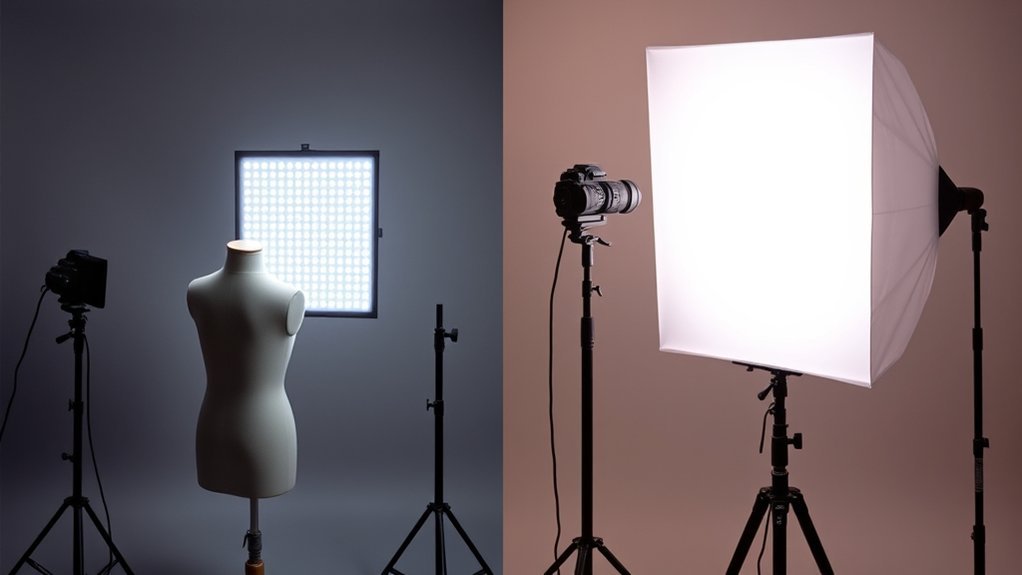
LED panels and softboxes can both improve photography and video lighting, but they are not exactly the same type of equipment. An LED panel is a light fixture that produces light, while a softbox is normally a modifier placed over or in front of a compatible light source to make that light broader and softer. Understanding that difference makes it much easier to choose the right setup.
Quick Answer
Choose a compact LED panel when fast setup, portability, battery operation, or instant brightness and color-temperature control matter most. Choose a light with a softbox when you want a larger, softer source for portraits, products, or talking-head video. They are not mutually exclusive: compatible LED fixtures can also be used with softboxes.
Key Takeaways
- LED panel: a continuous light fixture that may offer dimming, adjustable color temperature, RGB/RGBWW color, AC power, or battery operation depending on the model.
- Softbox: a light modifier that enlarges and diffuses a compatible light source to create softer shadow transitions.
- Softness depends heavily on the apparent size of the source and its distance from the subject, not simply whether the equipment is labeled “LED” or “softbox.”
- Color accuracy comes primarily from the light source. A softbox does not automatically improve CRI or make an inaccurate light color-accurate.
- For many creators, the most flexible solution is an LED fixture plus compatible diffusion or a softbox.
Understanding LED Panel Lights: Features and Benefits
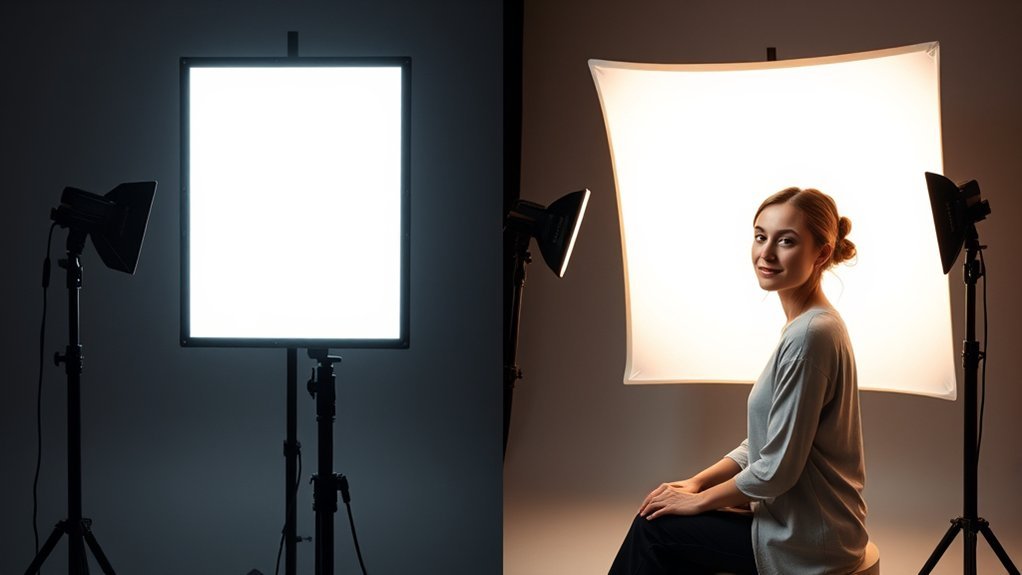
LED panel lights are continuous light fixtures built from arrays of light-emitting diodes. LED technology can be highly energy-efficient, although the actual power draw of a photography or video panel depends on its size, output, electronics, and features. The U.S. Department of Energy notes that modern LEDs combine high efficiency with useful features such as dimming and color control.
Many current LED panels let users adjust brightness directly on the fixture. Bi-color models can also change correlated color temperature (CCT), while RGB or RGBWW panels may add saturated colors, hue controls, digital gels, and effects.
The available CCT range is model-specific rather than universal. For example, the amaran P60x is rated from 3200K to 6500K, while Aputure’s Nova P300c extends from 2000K to 10000K. Litepanels’ Gemini 1×1 Soft is another current example with a 2700K to 10000K range. These differences are a good reason to compare actual specifications instead of assuming every LED panel covers the same temperatures.
Power options also vary. Some small panels use built-in rechargeable batteries. Others accept removable NP-F batteries, V-Mount or Gold Mount batteries, DC input, or standard AC power. This flexibility can make an LED panel useful for outdoor shoots, interviews, livestreaming, desk setups, and locations where running a power cable is inconvenient.
Color rendering is another specification worth checking. The Illuminating Engineering Society defines CRI as a measure of the color shift objects undergo under a test light compared with a reference source of similar color temperature. Many professional photo/video LEDs advertise CRI values in the mid-to-high 90s, but CRI should be treated as one color-quality metric rather than a complete guarantee of perfect color.
Note: CCT and CRI are different measurements. CCT describes whether white light appears warmer or cooler, while CRI evaluates aspects of how a light source renders object colors. A higher Kelvin number does not automatically mean better color rendering.
What You Need to Know About Softbox Lighting
A softbox is a light modifier, not normally a self-powered light source. It surrounds or attaches to a compatible flash, strobe, COB light, lamp, or LED fixture and sends the light through one or more diffusion surfaces.
Adobe’s photography guidance describes a softbox as an enclosure with a reflective interior and diffusion layer that directs and diffuses light. The larger illuminated front surface can create broader, softer illumination and smoother transitions between highlights and shadows.
This quality is especially useful for portrait photography, headshots, interviews, food photography, and product work where harsh shadow edges may be distracting. A broad soft source can also create large, smooth reflections on glossy products, although reflective subjects often require careful positioning.
Softbox size matters, but distance matters too. A larger source generally looks softer when other variables remain similar because it appears larger from the subject’s position. Moving a source closer also increases its apparent size and can soften shadow transitions.
Softboxes come in rectangular, square, strip, octagonal, lantern-style, and other designs. Their shape, depth, diffusion material, interior surface, and optional grid influence how the light spreads.
A softbox can help shape the beam, but it does not automatically eliminate spill. Many systems add a fabric grid when tighter directional control is needed. For example, Aputure’s Light Dome products use optional or included grids specifically to reduce unwanted spill.
Pro Tip: Judge softness by the apparent size of the illuminated surface from the subject’s position. A reasonably sized modifier placed close to a person can look softer than a much larger modifier positioned far away.
Comparing Key Features of LED Panels and Softboxes
The most useful comparison is between a bare or lightly diffused LED panel and a light source fitted with a softbox. This avoids the common mistake of treating a fixture and a modifier as if they perform exactly the same job.
| Feature | Bare / Lightly Diffused LED Panel | Light + Softbox |
|---|---|---|
| What it is | A complete continuous light fixture | A fixture plus a diffusion/shaping modifier |
| Light quality | Can range from relatively hard to moderately soft depending on panel size, diffusion, and distance | Usually broader and softer when the modifier creates a larger apparent source |
| Brightness control | Often adjusted electronically on the fixture | Determined by the attached fixture; diffusion absorbs part of the output |
| Color temperature | Fixed, bi-color, or wide-range depending on model | Determined primarily by the light source inside the softbox |
| Color rendering | Depends on the LED engine and fixture design | Still depends primarily on the light source; the softbox does not create a higher CRI |
| Setup | Often fast: mount, power, position, and adjust | May require assembling or opening the modifier and attaching diffusion |
| Portability | Compact models can be highly portable | Collapsible models travel well but generally occupy more working space once opened |
| Power | AC, internal battery, removable battery, or DC depending on fixture | The softbox uses no electrical power; the attached fixture determines power requirements |
| Best fit | Travel, small spaces, interviews, livestreams, fill, background, fast-changing setups | Portraits, product photography, controlled interviews, beauty work, soft key lighting |
Modern LED panels also vary considerably in physical size. The SANDMARC Prolight, for example, is a pocket-size panel measuring roughly 4.4 × 2.8 inches, while professional 1×1-class panels are far larger. This range illustrates why “LED panel” alone does not tell you how soft, powerful, or portable a light will be.
It is also possible to combine both ideas. Some LED fixtures have purpose-built softboxes or diffusion accessories. Litepanels, for example, lists softboxes among the accessories available for its Astra LED fixtures. In that type of setup, the LED provides the light while the softbox changes its apparent size and distribution.
Best Use Cases for LED Panels and Softboxes
LED panels are particularly useful where speed, compactness, and direct electronic control matter. They work well for interviews, livestreams, video calls, small studios, travel kits, fill lighting, background lighting, and fast-moving production environments.
Battery-compatible panels can be especially useful when access to AC power is limited. RGB or RGBWW panels can also provide colored backgrounds, accents, and effects that a conventional bi-color fixture cannot create without gels or other accessories.
A compact LED panel is valuable when speed and portability matter, while a larger diffused source is valuable when soft shadow transitions are the priority. Many professional setups use both ideas rather than choosing only one.
A softbox is particularly useful when the goal is broad, flattering illumination. Portrait photography, headshots, interviews, beauty work, food photography, and many product setups benefit from a large diffused key light.
For talking-head video, a light fitted with a softbox can produce a natural-looking key light, while a smaller LED panel can serve as fill, hair, background, or accent light. The roles can also be reversed depending on the fixtures and creative goal.
Softboxes do not inherently deliver better color accuracy than LED panels. The spectrum and color-rendering performance of the fixture remain important. A high-quality LED fixture used inside or behind a compatible softbox can provide both accurate color and soft illumination.
Impact of Lighting Quality on Your Shots
Lighting affects exposure, contrast, shadow shape, skin texture, reflections, color appearance, depth, and mood. The most important variable is not simply whether a light is called an LED panel or softbox; it is how large the illuminated source appears to the subject and where that source is placed.
A large diffused source close to a portrait subject tends to produce broader highlights and softer shadow transitions. A small or distant source appears smaller and usually creates more defined shadows.
LED panels can provide convenient real-time intensity and CCT adjustment. This is especially helpful for video because the creator can see the effect continuously while setting the shot.
Color rendering also matters when photographing skin, clothing, artwork, food, or products whose colors must remain believable. Higher CRI values are generally useful, but CRI is only one measure of light-source performance. Professional video lights may also publish TLCI, SSI, or other color-quality measurements.
If you want harder, more dramatic light, diffusion is not always desirable. A hard source can emphasize texture, create crisp shadows, and increase contrast. Soft light is a creative choice rather than a universal requirement.
Portability of LED Panels vs. Softboxes: Which Is Easier to Set Up?
Compact LED panels usually have the advantage when a setup needs to be moved frequently, but portability varies widely by fixture size. A pocket panel and a high-output professional panel should not be treated as equivalent simply because both use LEDs.
Softboxes can fold down for transport, yet once opened they generally require more physical room around the subject. The complete setup may also include a light head, stand, power supply, battery, speed ring, diffusion layers, and grid.
Weight and Size Considerations
When comparing weight and working space, consider the complete lighting system:
- LED panel size: Small panels can fit in a camera bag or even a pocket, while larger studio panels require stronger stands and more transport space.
- Softbox size: A softbox can pack relatively flat or collapse for travel, but a large modifier takes substantial room when opened.
- Stand requirements: Larger fixtures and modifiers require stable support. The stand, mounting hardware, and any counterweight may matter as much as the light itself.
- Power equipment: Batteries, chargers, power bricks, extension cables, and adapters add weight to either setup.
- Wind exposure: Large softboxes create significant surface area outdoors and must be secured carefully.
The SANDMARC Prolight example in the original comparison illustrates the compact end of the spectrum at roughly 4.4 × 2.8 inches. At the other end, professional LED panels can be many times larger and heavier.
Setup Time and Complexity
A small LED panel can be extremely fast to deploy: attach it to a stand or mount, supply power, set intensity and CCT, and position it.
Traditional softboxes may require inserting rods, attaching a speed ring, adding inner and outer diffusion, and mounting a grid. Quick-release and umbrella-style softboxes reduce this setup time considerably, so it is no longer accurate to assume every softbox is slow to assemble.
The main practical difference is that a softbox adds another physical component to the lighting system. Whether that extra setup is worthwhile depends on how much softer and broader you want the light to be.
Common Mistakes to Avoid When Selecting Lighting
Good lighting choices come from matching the complete setup to the subject, room, and shooting style. Common mistakes include:
- Treating a softbox as a competing light technology: A softbox is normally a modifier and still needs a compatible light source.
- Ignoring apparent source size: A small panel placed far away may look much harder than a large diffused source close to the subject.
- Choosing by wattage alone: Power consumption does not directly tell you how much useful light reaches the subject. Check manufacturer photometric data at realistic working distances.
- Assuming every LED panel is bi-color or RGB: Some are daylight-only, some are bi-color, and others offer full-color RGB/RGBWW control.
- Confusing CCT with CRI: A 5600K or “daylight” light is not automatically more color-accurate than a warmer light.
- Ignoring diffusion loss: Diffusion softens and spreads light but also reduces some usable output, which can matter when the fixture is already operating near maximum intensity.
- Overlooking spill control: A softbox can spread light broadly. Add a compatible grid or use flags and positioning when you need tighter control.
- Ignoring power and runtime: For location work, check actual battery type, runtime, charging method, and whether maximum brightness reduces runtime substantially.
- Forgetting video-specific concerns: If you record sound near the fixture, check whether it uses a cooling fan. For high-frame-rate or demanding video work, also verify the manufacturer’s flicker-performance specifications.
How to Choose Between LED Panels and Softboxes for Your Photography?
Start by deciding what you actually need to change: the light source, the quality of the light, or both.
If you already own a capable fixture but its light looks too hard, adding compatible diffusion or a softbox may solve the problem more efficiently than buying another light. If you need portability, battery operation, electronic CCT adjustment, or RGB effects, the fixture itself deserves more attention.
Lighting Quality Considerations
For portraits and beauty work, a broad source is often easier to make flattering because it can create gentle shadow transitions and smooth highlights. Softboxes are a common way to build that larger source.
For product photography, soft light can reduce harsh shadow edges, but highly reflective products may need precise positioning, flags, strips, or controlled gradients rather than simply the largest possible modifier.
For video, an LED panel’s continuous output makes adjustments easy to preview. A panel with enough surface area or diffusion can also produce soft light, so an LED panel is not automatically a “hard” light.
When color matters, evaluate the specifications of the fixture itself. Current professional panels commonly publish CRI and TLCI values, and some manufacturers also provide SSI or detailed spectral information.
Setup Time Requirements
Choose a compact panel when you frequently change rooms, travel, livestream, work from a desk, or need a light that can be mounted and adjusted quickly.
Choose a softbox-based setup when the quality and apparent size of the key light matter more than the smallest possible footprint. Quick-release softboxes can reduce the difference in setup time considerably.
A hybrid setup is often practical: use a softbox-equipped fixture as the key light and a small LED panel for fill or background separation.
Space and Portability Needs
Measure the room before choosing a modifier. A large softbox needs enough space for the modifier itself, the stand, safe clearance, and the desired distance from the subject.
In a small office or bedroom studio, a compact LED panel placed close to the subject with diffusion may be easier to position. In a larger studio, a bigger softbox can create the broad source needed for portraits, full-body work, and larger products.
For outdoor work, small battery-powered panels are convenient, while large softboxes require much more attention to wind and stand stability.
Note: You do not necessarily need to choose one forever. If your LED fixture accepts a compatible softbox or diffusion accessory, the same light can be configured for a faster, more direct setup or a larger, softer source.
Frequently Asked Questions
Which is better, LED panel lights or softbox lights?
Neither is universally better because they perform different jobs. An LED panel is a light source, while a softbox is generally a modifier used with a light. Choose a compact LED panel for portability and electronic control, a softbox-based setup for a larger and softer source, or combine both when your equipment is compatible.
What are the disadvantages of LED panels?
Disadvantages depend on the model. A small bare panel may create harder shadows than a larger diffused source, compact battery models may have limited runtime or output, some high-output fixtures use cooling fans, and color quality varies between products. These are better considerations than assuming LEDs inherently use excessive power or have poor color accuracy.
Which is better, soft white or daylight LED?
Choose the color temperature that matches the scene, ambient light, and creative goal. Warmer light can create a cozy appearance, while daylight-balanced light can match daylight environments more closely. A daylight CCT does not automatically mean a higher CRI; color temperature and color rendering should be evaluated separately.
Is a bigger softbox better?
A bigger softbox can produce softer light when it creates a larger apparent source relative to the subject, but bigger is not automatically better. Large modifiers require more room, stronger support, greater care outdoors, and enough fixture output to compensate for diffusion. Distance from the subject is also important.
Can you use a softbox with an LED light?
Yes, when the fixture has a compatible softbox, accessory mount, or manufacturer-approved modifier. Some LED panels have dedicated softboxes, while many COB-style LED fixtures use standard modifier mounts. Always confirm compatibility and weight limits before attaching a modifier.
Does a softbox improve CRI?
No. CRI primarily describes the color-rendering characteristics of the light source. A softbox changes diffusion, apparent source size, and light distribution, but it cannot turn a poorly rendering source into a high-CRI fixture.
Conclusion
The most important difference between LED panels and softboxes is that they are not strictly competing technologies. An LED panel produces light; a softbox modifies light. Compact LED panels are especially useful when portability, quick adjustment, battery operation, or a small footprint matters, while a large softbox can create the broad, diffused illumination often preferred for portraits, products, and talking-head video.
For many photographers and videographers, the strongest setup combines these advantages. Start with a fixture that provides the output, color quality, CCT range, power options, and controls you need, then choose diffusion or a softbox based on the desired shadow softness, available space, and working distance.
Sources
- U.S. Department of Energy — LED Basics — LED efficiency, dimming, color control, and general solid-state lighting characteristics.
- Illuminating Engineering Society — Color Rendering Index — definition and purpose of CRI.
- Adobe — Diffused Light Photography — soft light, diffusion, softboxes, apparent source size, and subject distance.
- Aputure — Modifiers & Accessories — confirms softboxes as lighting modifiers and accessories.
- amaran — P60x — current LED-panel CCT, CRI, battery, and control examples.
- Litepanels — Astra LED Panel Series — current panel specifications and compatible light-shaping accessories.
