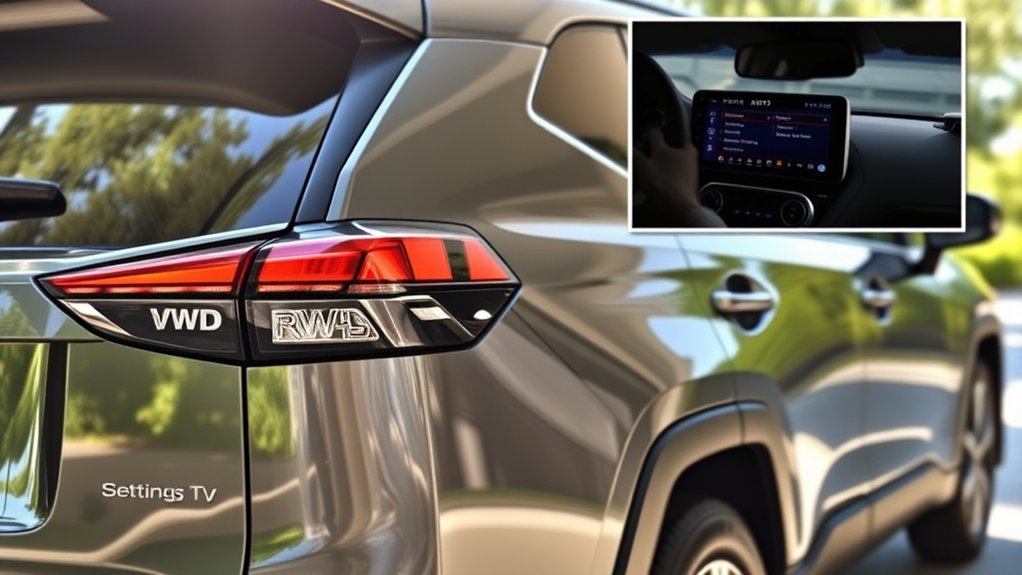
The quickest way to determine whether a Toyota RAV4 has all-wheel drive is to check its factory configuration using the vehicle’s 17-digit VIN. Badges, drive-mode controls, dashboard graphics, and underbody components can provide supporting clues, but those details vary by model year, trim, market, and powertrain.
Quick Answer
The most reliable way to tell whether a Toyota RAV4 is AWD is to enter its 17-digit VIN in Toyota’s Vehicle Specification lookup or NHTSA’s VIN decoder and confirm the drive type. Badges, controls, and underbody parts can support the answer, but they vary by model year, market, and powertrain.
Key Takeaways
- Use the full VIN and an official Toyota or NHTSA lookup for the most dependable answer.
- An AWD badge is a helpful clue, but badges can be missing, replaced, or different in other markets.
- Gas AWD models may have a mechanical driveshaft, while hybrid and plug-in-hybrid AWD models can use a separate rear electric motor without one.
- Trim badges, a generic drive-mode dial, towing capacity, and an energy display by themselves do not prove that a RAV4 is AWD.
- Never inspect rotating drivetrain parts or crawl beneath a vehicle supported only by its factory jack.
At a Glance
| Time Required | 5–10 minutes |
| Difficulty | Easy |
| Tools Needed | The 17-digit VIN, internet access, vehicle documents, and optionally a flashlight |
| Cost | $0 |
Understanding AWD in Your RAV4 and Its Importance

All-wheel drive can send driving force to the rear wheels when the vehicle needs additional traction. This can help a RAV4 accelerate on wet, snowy, loose, or uneven surfaces, although the exact system and operating strategy depend on the model year and powertrain.
RAV4 AWD systems are not all mechanically identical. Many gasoline-powered models use a mechanical connection between the front transaxle and rear differential. RAV4 Hybrid and RAV4 Plug-in Hybrid models can instead use Electronic On-Demand All-Wheel Drive, with a separate electric motor driving the rear axle.
A missing longitudinal driveshaft does not prove that a hybrid RAV4 is front-wheel drive; an AWD hybrid may power its rear wheels with a dedicated electric motor.
Model year also matters. Fifth-generation U.S. RAV4 Hybrid models were sold with AWD, but Toyota introduced front-wheel-drive RAV4 Hybrid configurations for the sixth-generation 2026 model year. Toyota states that 2026 hybrid AWD models use a dedicated rear electric motor. See Toyota’s 2026 RAV4 powertrain information for the current U.S. configuration.
AWD can improve propulsion and traction, but it does not eliminate the need for suitable tires or careful driving. Braking and cornering still depend heavily on tire grip, road conditions, speed, and available stopping distance.
Do not use towing capacity to identify the drivetrain. A RAV4’s rating can change with its model year, grade, powertrain, cooling equipment, and tow package. Confirm towing limits in the owner’s manual and certification documents for the exact vehicle.
The Most Reliable Ways to Confirm RAV4 AWD
Use the following evidence in order. The first three methods are substantially more reliable than appearance-based clues.
| Method | Reliability | What to Check |
|---|---|---|
| Toyota Vehicle Specification lookup | Highest | Enter the complete VIN and review the technical or drivetrain specification. |
| NHTSA VIN decoder | High | Look for “Drive Type,” “Axles,” or related decoded fields. |
| Window sticker or factory build data | High | Look for AWD, All-Wheel Drive, Electronic On-Demand AWD, or a comparable factory description. |
| Dealer VIN lookup | High | Ask the parts or service department to confirm the factory drivetrain from the VIN. |
| AWD-specific controls or displays | Supporting clue | Compare the controls with the manual for the exact model year. |
| Badge or underbody inspection | Supporting clue | Account for removed badges and different gas, hybrid, and plug-in-hybrid hardware. |
How to Identify AWD Badges on Your RAV4
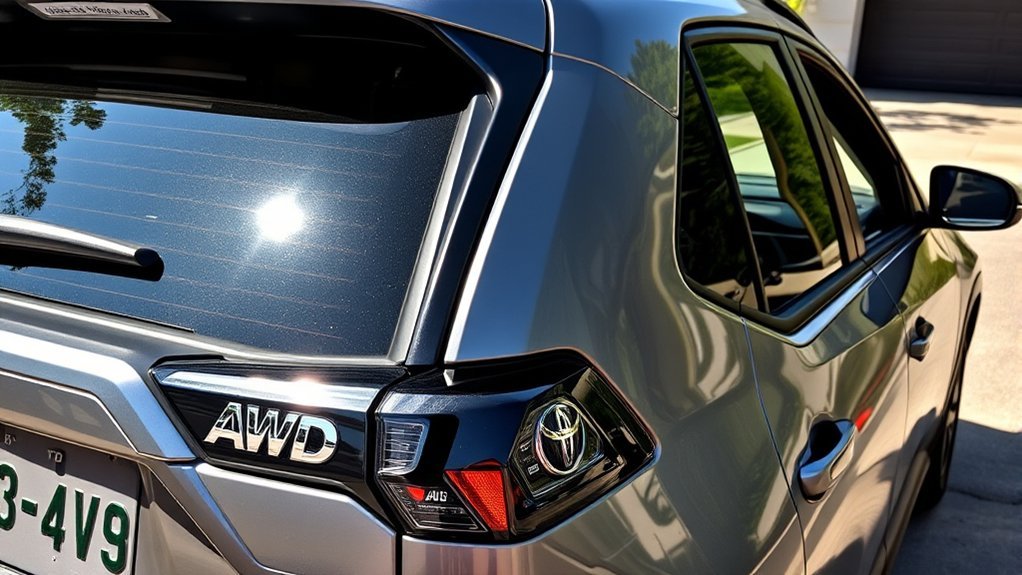
Look at the right side of the rear liftgate for an AWD marking. On a vehicle that still has its original factory badges, this is a useful first clue. It should not be your only evidence because a previous owner or body shop may have removed, repositioned, or replaced a badge.
Common AWD Badges Explained
| Marking | Meaning | Reliability as AWD Proof |
|---|---|---|
| AWD | Indicates that the vehicle was badged as all-wheel drive. | Good clue, but verify the VIN. |
| 4WD or 4×4 | May appear on older vehicles or in certain markets. | Market- and generation-dependent. |
| AWD-i | Market-specific Toyota terminology for an electrically assisted AWD system. | Do not expect this badge on every AWD hybrid. |
| Hybrid, Prime, or PHEV | Identifies the powertrain, not necessarily the drivetrain in every year and market. | Check the VIN, especially on 2026-and-newer hybrids. |
| LE, XLE, Limited, SE, XSE, Woodland, or another grade | Identifies the trim or grade. | Not proof of AWD. |
Badge Location Insights
The AWD badge is commonly placed on the rear liftgate, but its location and design can differ by model year and market. A clean area where a badge appears to have been removed, mismatched adhesive, or unusually spaced lettering should make you rely on the VIN rather than the exterior markings.
Note: A trim badge such as XLE or Limited does not identify the drivetrain. The same grade may have been offered in both FWD and AWD configurations.
How to Decode Your VIN to Confirm AWD Status

The VIN is the best starting point because it identifies the exact vehicle rather than a general trim or model family.
1. Locate and Cross-Check the VIN
A modern RAV4 has a 17-character VIN. Common locations include:
- The plate visible through the windshield on the driver’s side of the dashboard
- The label on the driver-side door jamb
- The vehicle registration or title
- The insurance card or insurance policy
- The original sales contract or window sticker
Compare at least two locations. The VIN on the dashboard should match the registration and door-jamb label.
Pro Tip: Photograph the VIN rather than typing it from memory. The letters I, O, and Q are not used in standardized VINs, which helps prevent confusion with 1 and 0.
2. Use Toyota’s Vehicle Specification Lookup
Enter the VIN in Toyota’s official Vehicle Specification lookup. Review the basic vehicle information, technical specifications, standard equipment, and factory- or port-installed equipment for wording such as:
- All-Wheel Drive
- AWD
- Electronic On-Demand All-Wheel Drive
- Dynamic Torque Control AWD
- Dynamic Torque Vectoring AWD
- Front-Wheel Drive or FWD
3. Check the NHTSA VIN Decoder
For a U.S.-market vehicle, enter the same VIN in the NHTSA VIN decoder. Look for a “Drive Type” field or related axle and drivetrain information.
If the NHTSA result leaves the drive type blank, that does not prove the vehicle is FWD. VIN data completeness can vary. Use Toyota’s specification lookup, the original window sticker, or a Toyota dealer’s factory data as the deciding source.
What the VIN Characters Mean
VIN positions four through eight form the Vehicle Descriptor Section. They identify manufacturer-defined attributes for that vehicle type. The tenth character identifies the model year under the standardized U.S. VIN system.
However, do not try to determine AWD from one character found on an unverified internet chart. Toyota’s coding can vary by model year, factory, powertrain, and market. A complete official VIN lookup is safer and more accurate.
Outside the United States, a registration certificate or Certificate of Conformity may also state the drive or axle configuration. The terminology and document fields vary by country, so compare them with the local Toyota specification or dealer record.
Using Vehicle Settings to Check the Drivetrain
Vehicle controls and displays can support an AWD identification, but they are not universal. Compare what you see with the owner’s manual for the exact model year and powertrain. Toyota provides model-specific manuals through its Manuals and Warranties portal.
Look for AWD-Specific Controls
Depending on the year and configuration, a gasoline AWD RAV4 may have controls or indicators for features such as:
- SNOW mode
- MUD & SAND mode
- ROCK & DIRT mode
- Multi-Terrain Select
- An AWD monitor showing torque distribution
An AWD hybrid or plug-in hybrid may have Trail mode or a display that depicts a rear electric motor or power flow to the rear wheels.
These features are useful clues only when the manual identifies them as AWD-specific. A Normal, Eco, Sport, Custom, or EV mode control by itself does not establish the drivetrain. Toyota states that all 2026 RAV4 models have selectable drive modes, including FWD configurations.
Interpret the Energy Monitor Carefully
A hybrid energy display may show the gasoline engine, battery, front motor, and energy flow even on a vehicle that is not AWD. What supports an AWD identification is a documented rear-motor or rear-wheel graphic and visible power flow to that rear drive unit.
Do not assume that the mere presence of an “Energy Monitor” means AWD. Likewise, the absence of visible rear power flow during one test drive does not mean the system is FWD; the rear motor may engage only when the control system calls for it.
Do Not Rely on the Gear Selector Layout
Gear selectors, buttons, dials, and console layouts can change with trim, market, production date, and optional equipment. They can help you locate an AWD-specific mode, but the shape of the shifter or the presence of a mode wheel is not proof by itself.
What to Look For When Inspecting Your RAV4 Visually
Warning: Inspect only while the vehicle is parked, switched off, and secured on level ground. Never reach near rotating components, observe the underbody while the vehicle is moving, or crawl beneath a vehicle supported only by its factory jack. Ask a qualified technician to raise it safely when a closer inspection is necessary.
A visual inspection can confirm an official VIN result or help when documents are temporarily unavailable. First determine whether the RAV4 is gasoline-only, hybrid, or plug-in hybrid because the rear-drive hardware differs.
Check for Badges
Inspect the rear liftgate for an AWD marking. Treat it as supporting evidence rather than a final answer. Also check whether the badge looks original and whether the VIN result agrees with it.
Inspect a Gasoline RAV4 for a Rear Differential and Driveshaft
On a mechanically driven gasoline AWD RAV4, you may see:
- A longitudinal propeller shaft running toward the rear axle
- A rear differential housing centered between the rear wheels
- Rear axle shafts extending from the differential toward both rear wheels
Seeing those components is strong evidence of mechanical AWD. Their presence should still agree with the VIN and factory specifications.
Inspect a Hybrid or Plug-in Hybrid Differently
An AWD RAV4 Hybrid or Plug-in Hybrid can use a rear electric drive unit rather than a propeller shaft connected to the engine. You may see a compact motor-and-gear assembly near the rear axle and half shafts extending to the rear wheels, but no long mechanical driveshaft running from front to rear.
Therefore:
- Gas model with rear propeller shaft and differential: strong AWD evidence
- Hybrid/PHEV with rear electric drive unit: strong Electronic On-Demand AWD evidence
- Hybrid with no rear drive unit or powered rear half shafts: may be FWD, including certain 2026-and-newer configurations
- Unclear view: use the VIN rather than guessing
Underbody shields can obscure components. Do not remove panels solely to identify the drivetrain.
Common Misconceptions About RAV4 AWD Features
| Assumption | Reality |
|---|---|
| Every RAV4 is AWD. | False. FWD and AWD availability depends on year, powertrain, trim, and market. |
| Every RAV4 Hybrid is AWD. | This was true for certain earlier U.S. lineups, but 2026 hybrid LE, XLE, and SE models can be FWD. |
| An XLE or Limited badge proves AWD. | False. The badge identifies the grade, not the drivetrain. |
| No longitudinal driveshaft means FWD. | False for electronic AWD hybrids, which may use a separate rear motor. |
| An Energy Monitor proves AWD. | Only a documented rear-motor or rear-wheel power display supports that conclusion. |
| A drive-mode dial proves AWD. | False. Generic drive modes are available on both FWD and AWD vehicles. |
| A higher towing rating proves AWD. | False. Towing ratings depend on several configuration details. |
| AWD makes winter tires unnecessary. | False. AWD can help the vehicle move, but tire grip remains critical for braking and steering. |
What to Do If You Discover Your RAV4 Isn’t AWD
Before contacting anyone, confirm the result with at least two reliable sources. For example, compare Toyota’s VIN specification with the original window sticker or ask a Toyota service department to verify the factory drivetrain.
If the vehicle was advertised or sold to you as AWD but the factory data confirms FWD, collect and preserve:
- The online listing or advertisement
- The buyer’s order and sales contract
- The window sticker or used-vehicle information sheet
- Emails, text messages, and written representations from the seller
- Photographs of the VIN and relevant badges
- The Toyota or NHTSA VIN result
- A written drivetrain confirmation from a dealer or qualified repair facility
Contact the selling dealer or private seller in writing and clearly explain the discrepancy. Ask for a written response and retain copies of every communication.
If the dealer cannot resolve the matter, contact the Toyota Brand Engagement Center for help confirming factory specifications. Toyota can clarify what equipment the VIN originally included, although a sales dispute may still need to be handled with the seller.
Note: Consumer remedies for an inaccurate vehicle description vary by state and country. Keep your records and seek advice from the appropriate consumer-protection agency or a qualified attorney when the seller will not address a material discrepancy. This is general information, not legal advice.
Maintenance Differences Between FWD and AWD RAV4 Models
AWD models can have additional rear-drive components, but the required service depends on the system.
- Mechanical gasoline AWD: may include a transfer unit, propeller shaft, rear differential, seals, and related fluid-service or inspection requirements.
- Electronic On-Demand AWD hybrid or PHEV: uses a rear electric drive unit and does not share every service item found on a mechanical propeller-shaft system.
- FWD: lacks the powered rear-drive system but still requires normal tire, brake, suspension, and front-drivetrain maintenance.
Do not apply a generic “transfer-case fluid” schedule to every AWD RAV4. Use the maintenance guide matched to the VIN and model year. Severe operating conditions, towing, water crossings, dusty roads, or frequent low-speed use may change inspection intervals.
Frequently Asked Questions
Can I convert a FWD Toyota RAV4 to AWD?
A practical factory-style conversion is rarely economical. It can require a different transaxle or rear drive unit, rear suspension and subframe parts, wiring, computers, fuel or exhaust components, software configuration, and extensive labor. Buying a factory-built AWD RAV4 is generally safer, more reliable, and less expensive.
Does AWD affect RAV4 fuel efficiency?
It can. Additional drivetrain mass and rear-wheel power delivery may reduce efficiency compared with an otherwise similar FWD configuration. The actual difference depends on the model year, powertrain, grade, tires, temperature, speed, and driving conditions, so compare the official ratings for the exact configurations.
What is the difference between AWD and 4WD?
AWD normally manages front-to-rear torque automatically for on-road traction and light off-pavement use. Traditional 4WD systems commonly provide driver-selectable ranges or more direct axle engagement for demanding off-road conditions. Names and designs vary, so the owner’s manual is the best description of a particular vehicle.
How does a RAV4 AWD perform in snow?
AWD can help the RAV4 start moving and maintain propulsion when traction is uneven. It does not create extra tire grip for every braking or steering situation. Properly sized winter tires, adequate tread, correct pressure, reduced speed, and longer following distance remain essential.
Is maintenance different for AWD RAV4 models?
It can be. Mechanical AWD models have rear driveline components that FWD models do not, while electronic AWD hybrids use a rear electric drive unit. Follow the Toyota maintenance guide for the exact VIN instead of assuming that every AWD RAV4 uses a transfer case and driveshaft.
Can the VIN confirm whether my RAV4 is AWD?
Yes. Enter the complete 17-digit VIN in Toyota’s official Vehicle Specification lookup. NHTSA’s decoder is a useful second source for U.S.-market vehicles. If a field is blank or the results conflict, ask a Toyota dealer to retrieve the original factory configuration.
Are all Toyota RAV4 Hybrid models AWD?
No. Availability depends on year and market. Earlier fifth-generation U.S. RAV4 Hybrid models were AWD, but Toyota introduced FWD hybrid LE, XLE, and SE configurations for the 2026 model year. Always verify the individual VIN.
Conclusion
To tell whether a Toyota RAV4 is AWD, start with the full VIN rather than relying on exterior appearance. Toyota’s Vehicle Specification lookup, the NHTSA decoder, the original window sticker, or a dealer’s factory record can provide a dependable answer.
Use the rear badge, AWD-specific controls, energy-monitor graphics, and underbody components only as supporting evidence. Remember that a gasoline AWD RAV4 may have a mechanical driveshaft and rear differential, while an AWD hybrid or plug-in hybrid may use a separate rear electric motor with no front-to-rear propeller shaft. Verifying the exact model year and powertrain prevents the most common identification mistakes.
Sources
- Toyota Vehicle Specification Lookup — factory vehicle information and installed equipment by VIN
- NHTSA VIN Decoder — official U.S. VIN decoding and manufacturer-reported vehicle data
- Toyota Manuals and Warranties — model-year-specific controls, operating guidance, and maintenance information
- Toyota: The Next Adventure Begins—2026 RAV4 — 2026 FWD/AWD powertrain and rear-motor details
- Toyota 2024 RAV4 Brochure — fifth-generation FWD, mechanical AWD, and Electronic On-Demand AWD configurations
- NHTSA TireWise — tire selection, winter-tire effectiveness, and tire-safety guidance
