
Yes. A 2026 Toyota RAV4 can be stolen by skilled thieves using CAN bus injection, which sends false commands into the vehicle network and can bypass key fob authentication. Factory alarms often miss this because the attack may leave no visible damage and does not rely on forced entry. Toyota’s stock security is not always sufficient. Layered defenses, including immobilizers, GPS tracking, and headlight security plates, improve resistance, and the details become more important from here.
Key Takeaways
- Yes, a 2026 Toyota RAV4 can be stolen if thieves access its CAN bus and inject fake unlock/start commands.
- Factory alarms may not detect this attack because it can bypass key fob authentication without visible forced entry.
- The headlight wiring area is a known access point, making the vehicle vulnerable to rapid network-level intrusion.
- Adding a standalone immobilizer and GPS tracker significantly improves protection against this type of theft.
- Security plates, OBD immobilization, and layered defenses are recommended to harden the RAV4 against thieves.
What Is CAN Bus Injection?
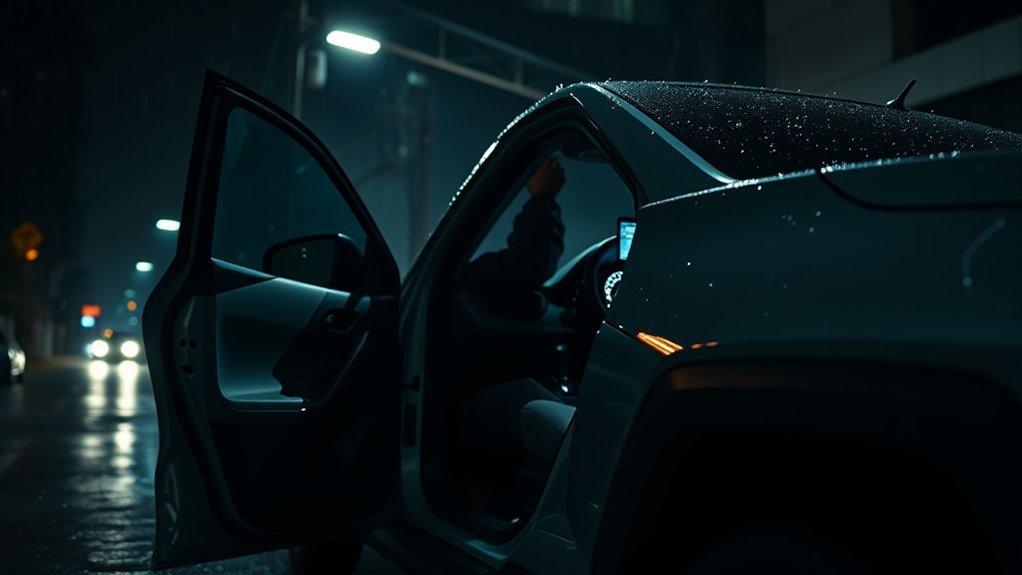
CAN bus injection is a vehicle intrusion method in which false electronic commands are introduced directly into the car’s Controller Area Network, allowing the attacker to bypass key fob authentication.
In practice, CAN Bus injection exploits exposed wiring paths rather than defeating encryption. On a Toyota RAV, thieves may access the network through smart headlight wiring, then peel back plastic trim to reach the connector. That access point can expose the CAN bus within moments.
From there, crafted messages can instruct the security system to release doors and authorize starting. Because the vehicle accepts internal network traffic as legitimate, factory alarms may not register the intrusion.
The result is a rapid compromise, often completed in under 90 seconds. The method illustrates a structural weakness: once the network is reached, traditional security boundaries collapse.
For drivers seeking liberation from surveillance and brittle controls, the lesson is plain: electronic access points can matter more than visible locks.
Why 2026 RAV4s Are Targeted
The 2026 Toyota RAV4 has become a favored target because its wiring layout can expose a pathway for CAN bus injection, allowing thieves to bypass key fob authentication and issue internal commands directly to the vehicle.
The 2026 RAV4’s wiring can enable CAN bus injection, bypassing key fob authentication and exposing internal commands.
This vulnerability makes the system attractive to organized criminal groups that seek efficient theft opportunities with minimal exposure. Once the control unit accepts illegitimate messages, security assumptions built into the vehicle architecture no longer provide reliable protection.
Public owner forums reflect growing awareness of this weakness, and many drivers have responded with layered defenses, including immobilizers and tracking devices.
Reports that theft can occur in under 90 seconds intensify concern, especially when keys remain inside a home and the vehicle is unattended.
The result is a profile that rewards precision, speed, and opportunism, making the RAV4 a high-value target for actors exploiting electronic weaknesses rather than physical force.
How Thieves Steal a RAV4
Thieves typically exploit the 2026 Toyota RAV4’s wiring by reaching the CAN bus through the headlight connector, then injecting false access and start commands that bypass key fob authentication.
Once inside the Controller Area Network, they impersonate a legitimate smart key and authorize entry, ignition, and drive-away functions. The process can take under 90 seconds, especially when the owner’s keys remain inside the home.
Because the attack operates at the vehicle-network level, it can also make the steering wheel release and the powertrain respond without visible forcing or mechanical damage.
The method is precise, repeatable, and suited to organized theft rather than opportunistic break-ins. A factory system to detect this kind of relay-free intrusion is usually absent, leaving the vehicle exposed until it is already moving.
For drivers seeking liberation from this control point, the practical defense is layered hardening: a standalone immobiliser, a tracked recovery device, and disciplined key storage away from exterior walls.
Why the Factory Alarm Fails
Because the 2026 Toyota RAV4’s factory alarm and immobiliser depend on normal key fob verification and physical disturbance triggers, they fail to detect a CAN bus injection attack that enters through the smart headlight wiring. The system expects a valid fob, a new key, or a thief to press the button in a conventional sequence, yet injected CAN commands mimic authorised requests. No glass is broken, no door is forced, and no motion threshold is crossed.
| Failure point | Effect |
|---|---|
| Key fob logic | Can be bypassed |
| Disturbance sensor | No trigger |
| Headlight wiring access | CAN entry point |
| Silent command injection | Alarm stays inactive |
| Locked vehicle state | Can be overridden |
In practice, the vehicle can be taken from another vehicle with minimal noise, leaving the factory security framework blind. This exposes a structural limitation: passive alarms cannot defend liberation from network-level intrusion. Additional layered protection is consequently required.
What Toyota’s Security System Misses
Toyota’s security architecture still leaves a gap at the CAN bus layer, where attackers can use wiring access to inject false release and start commands without authentic key verification.
The factory alarm is limited because it depends on conventional intrusion cues, so silent electronic attacks often proceed without triggering it.
For that reason, standalone immobilizers and GPS tracking are the more effective add-on protections against this theft method.
CAN Bus Vulnerabilities
The RAV4’s CAN bus architecture exposes a weakness that factory security systems are not designed to stop: by gaining access to the smart headlight wiring, an intruder can inject false commands directly onto the vehicle network and bypass key fob authentication altogether.
This is a CAN bus security failure rooted in Vehicle electronics design, not brute force. Thief tactics exploit the wheel arch liner, which can be peeled back in under 90 seconds to reach the headlight connector and speak to the network as if authorized.
Because the attack never depends on normal remote entry, the factory alarm logic is sidelined. For operators seeking liberation from this exposure, the implication is clear: layered defenses, not OEM defaults, are required to reclaim control and preserve autonomy.
Factory Alarm Limits
Factory alarm and immobiliser systems in the 2026 Toyota RAV4 do not meaningfully defend against CAN bus injection attacks, since the intrusion bypasses key fob authentication and sends false commands directly into the vehicle network. Alarm effectiveness is consequently limited, because door sensors remain silent when no forced entry occurs.
| Function | Limitation |
|---|---|
| Door sensing | No trigger |
| Immobiliser | Bypassed |
| Key fob | Unused |
| CAN access | Exploited |
| Theft speed | Under 90 seconds |
The wiring near the headlights can expose the bus, enabling access and start commands with minimal delay. This weakness makes factory reliance a poor theft prevention strategy and a predictable target for organized gangs. For drivers seeking freedom from surveillance by thieves, security enhancements must exceed the stock alarm architecture and address network-level intrusion directly.
Added Protection Options
Beyond the stock alarm, effective protection against a 2026 Toyota RAV4 CAN bus theft requires devices that operate outside the factory security architecture.
Factory immobilisers depend on key fob signalling, so injected CAN commands can still trigger drive-away. Enhanced immobilisers such as Meta AUTOBLOK or a ghost immobiliser impose independent authentication, blocking engine start without the correct sequence.
Combined systems like Meta Trak S5 DEADLOCK add GPS tracking, preserving recovery capability if the vehicle is moved.
Security plates on headlight connectors reduce access to injection points cited in Toyota bulletin WB853.
These security innovations do not rely on the same network thieves exploit, which is the essential advantage.
For owners seeking liberation from predictable compromise, layered protection is the rational response.
RAV4 Anti-Theft Devices That Work
Effective RAV4 protection depends on devices that do not rely solely on Toyota’s factory security architecture, since that system can be targeted through CAN bus injection and related electronic attacks.
Stand-alone immobilisers such as the Meta AUTOBLOK represent practical anti-theft innovations because they block engine start independently of factory logic.
For broader security enhancements, the Meta Trak S5 DEADLOCK adds vehicle tracking through GPS while also immobilising the drivetrain, which increases recovery odds and constrains drive-away theft.
The DEADLOCK PRO extends this approach with OBD port immobilisation, reducing exposure to diagnostic-port exploitation and other electronic attack paths.
Toyota-recommended security plates for headlight connectors add a physical barrier that complicates access to vulnerable components.
Together, these measures form a layered defensive posture that favors user control over passive dependence on OEM systems.
For owners seeking liberation from theft risk, the evidence supports layered, non-factory devices as the most technically credible option.
Why a Ghost Immobiliser Helps
| Feature | Security Result |
|---|---|
| Button sequence start | Blocks engine activation |
| Stealth operation | Hinders discovery |
| No key fob reliance | Reduces attack surface |
For drivers seeking liberation from insecurity, the system’s Thief deterrent effectiveness is substantial. It integrates without disabling factory alarms or immobilisation functions, preserving layered defense. In analytical terms, it converts access into control, forcing an offender to abandon the vehicle rather than simply enter it.
How Headlight Security Plates Help
Headlight security plates add a physical obstruction at the headlamp area, complicating access to the connector points used in some CAN bus injection theft methods.
Toyota’s technical bulletin WB853 identifies them as a practical countermeasure that narrows an attacker’s working space and increases the time needed to reach wiring. That delay is one of the main headlight benefits: it transforms a fast intrusion into a slower, noisier task.
Toyota’s WB853 plates narrow access, slow intrusion, and turn a quick headlight attack into a noisier, lengthier task.
For thieves dependent on rapid entry, the added barrier creates meaningful theft deterrence and raises the chance of interruption or notice.
The installation process is straightforward, but its value is functional rather than absolute. Security plates do not eliminate risk; they reduce ease, speed, and predictability.
In a broader security context, they support a more autonomous vehicle-defense posture by buying time for tracking devices and immobilizers to do their work.
Best RAV4 Security Setup
A best-practice security setup for the 2026 Toyota RAV4 pairs mechanical hardening with electronic disruption of the theft chain. Stand-alone immobilisers such as Meta AUTOBLOK raise immobiliser effectiveness by blocking unauthorized starts without dependence on factory systems. Combined tracker-immobiliser units, including Meta Trak S5 DEADLOCK, align with current security technology trends by adding GPS visibility while suppressing drive-away theft. Multi-point packages, such as Meta Trak S5 DEADLOCK PRO, extend theft prevention strategies further through OBD port immobilisation, which reduces exposure to CAN bus injection.
| Component | Function |
|---|---|
| Stand-alone immobiliser | Stops engine start |
| GPS tracker | Enables location recovery |
| OBD immobilisation | Resists CAN injection |
| Headlight security plates | Protect wiring access |
| Recommendation tool | Matches budget and compliance |
Toyota-recommended headlight security plates add physical delay at wiring access points. A free recommendation tool can identify a tailored stack in under two minutes, supporting informed, autonomous security choices.
What to Do After a Theft Attempt
A post-attempt inspection should begin with a systematic check for body, lock, ignition, and electronics damage, along with any signs of forced entry or tampering.
The findings should be documented with photographs and timestamps before the vehicle is moved.
Once the assessment is complete, the RAV4 should be secured immediately, and any compromised access points or security components should be corrected without delay.
Check For Damage
After a theft attempt, a thorough exterior and interior inspection of the 2026 Toyota RAV4 is essential, with particular attention to the headlight area where access to the CAN bus system may have been attempted.
A precise headlight inspection should identify pry marks, broken clips, or lens disturbance. A wiring assessment must confirm that no conductors are dislodged, cut, or exposed.
- Scan the diagnostic display for error messages.
- Verify that doors, locks, and windows operate normally.
- Record all findings for damage documentation.
Any irregularity suggests tampering with electronic or mechanical systems.
Careful evidence capture strengthens accountability, supports law enforcement review, and preserves the owner’s ability to respond freely and effectively.
Immediate, methodical analysis limits concealment and exposes unauthorized intrusion.
Secure Your RAV4
With damage checks complete, the next step is to harden the 2026 Toyota RAV4 against a repeat intrusion by adding independent anti-theft layers that do not depend on factory electronics alone.
A stand-alone immobiliser, such as the Meta AUTOBLOK, can interrupt engine start authorization even if factory security is bypassed.
A combined tracker and immobiliser, like the Meta Trak S5 DEADLOCK, adds GPS recovery data and remote restraint.
A wireless kill switch further disables ignition circuits.
The owner should monitor vehicle health and error messages for signs of tampering, coding faults, or anomalous battery drain.
Community insights improve theft awareness and refine prevention strategies, especially where local tactics evolve quickly.
This layered approach increases control, reduces vulnerability, and supports practical vehicle autonomy.
Frequently Asked Questions
Which Car Is the Most Difficult to Steal in 2026?
The 2026 Tesla Model Y appears most difficult to steal, due to car security innovations, theft prevention technology, and vehicle tracking systems. Its layered immobilizers, real-time monitoring, and remote disabling sharply constrain unauthorized access and escape.
Is the 2026 Toyota RAV4 Anti-Theft?
The 2026 Toyota RAV4 is equipped with security features, smart keys, and vehicle tracking options, but it is not fully anti-theft; advanced CAN bus attacks can still bypass standard protections without additional safeguards.
What Are the Most Stolen Toyota Models?
Toyota theft trends place the Camry, RAV4, Corolla, and Tacoma among the most stolen models; vehicle safety features and insurance theft coverage vary, but organized thieves still target their resale value and electronic vulnerabilities.
How Can I Prevent My Toyota RAV4 From Being Stolen?
To prevent RAV4 theft, the owner should pair keyless entry suppression with layered security systems, vehicle tracking, and a standalone immobiliser. Headlight security plates and error-monitoring add friction, while community intelligence improves resilience.
Conclusion
In the evolving chessboard of vehicle crime, a 2026 Toyota RAV4 is not invincible; it is merely better defended than many targets. CAN bus injection, factory-alarm blind spots, and signal-based attacks can still open a path if layered security is absent. Yet a Ghost Immobiliser and headlight security plates act like hidden locks and armored shutters, raising the thief’s cost and risk. The vehicle’s safety depends less on badges than on redundant defenses.
