Does the Toyota RAV4 Have Automatic Emergency Braking?
Last updated: September 19, 2026
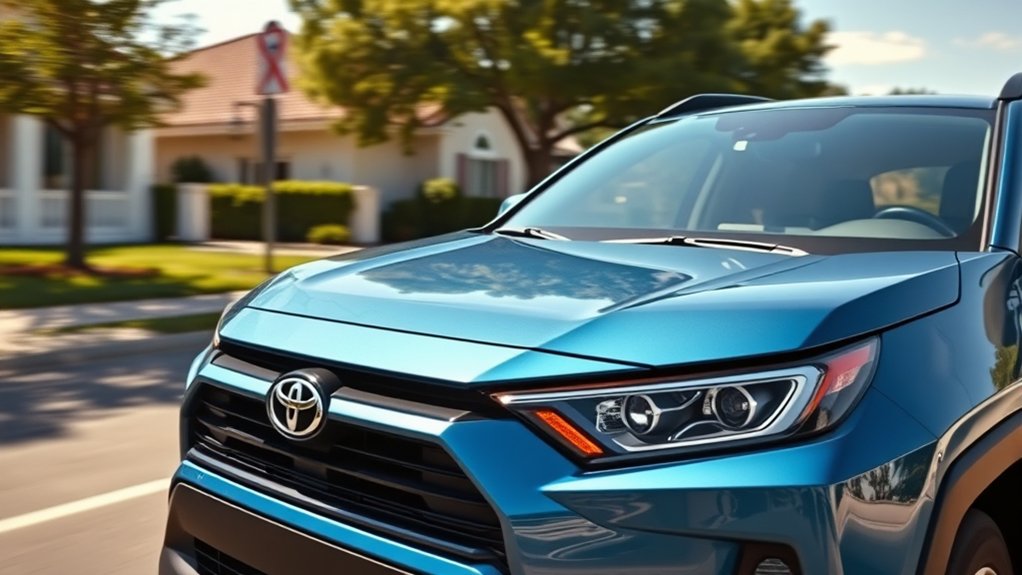
Yes—but the exact system depends on the model year and market. On the current 2026 U.S.-market Toyota RAV4, automatic emergency braking is included in the Pre-Collision System with Pedestrian Detection within Toyota Safety Sense 4.0, which is standard across the lineup. Older RAV4s may use earlier versions with different detection capabilities, controls, and operating conditions.
Quick Answer
Current U.S. Toyota RAV4 models include forward automatic emergency braking through the Pre-Collision System in Toyota Safety Sense. It can warn the driver and apply the brakes when it detects a likely frontal collision. For U.S. models, Toyota Safety Sense P with Pre-Collision System and automatic emergency braking became standard on every RAV4 grade for 2017. Detection targets, speed ranges, and settings vary by model year, and the system cannot replace attentive driving.
Key Takeaways
- Every 2026 U.S. RAV4 grade includes Toyota Safety Sense 4.0 and its Pre-Collision System.
- The current system is designed to recognize vehicles, pedestrians, bicyclists, and motorcyclists under applicable conditions.
- Toyota made Toyota Safety Sense P, including PCS with automatic emergency braking, standard on all U.S. RAV4 grades for 2017.
- Older RAV4s may have a different Toyota Safety Sense generation, fewer detection categories, or different operating limits.
- Available settings usually affect warning timing; they do not make the system capable of detecting every hazard.
- There is no universal 12,000-mile service interval for RAV4 automatic emergency braking.
What Is Automatic Emergency Braking in the Toyota RAV4?
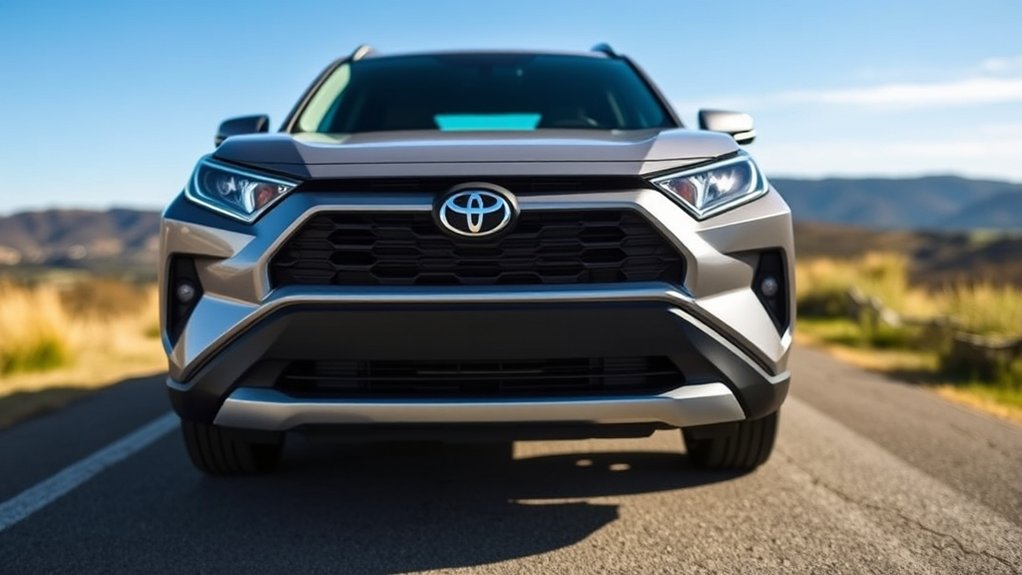
Automatic Emergency Braking, commonly shortened to AEB, is the automatic-braking function within Toyota’s forward Pre-Collision System. Toyota often lists the feature as Pre-Collision System with Pedestrian Detection, or PCS with PD, rather than using AEB as the main feature name.
According to Toyota’s 2026 RAV4 announcement, Toyota Safety Sense 4.0 is the current RAV4 safety suite. Toyota’s official RAV4 page also lists Toyota Safety Sense 4.0 as standard safety equipment.
That does not mean every RAV4 on the road has the same system. Older vehicles may use an earlier Toyota Safety Sense version, have different detection functions, or predate standard AEB equipment. Specifications can also differ outside the United States.
Note: “Pre-Collision System,” “PCS,” and “automatic emergency braking” may refer to overlapping functions, but the exact Toyota name shown in the instrument panel or owner’s manual varies by model year.
Which Toyota RAV4 Years Have Automatic Emergency Braking?
For U.S.-market RAV4s, 2017 is an important dividing line: Toyota made Toyota Safety Sense P standard on every 2017 RAV4 grade, including the Pre-Collision System with Pedestrian Detection and automatic emergency braking. Later generations continued the technology while expanding its detection and driver-assistance capabilities.
| U.S. model year | Safety suite | AEB context |
|---|---|---|
| 2017 | Toyota Safety Sense P | Toyota made TSS-P standard on all RAV4 grades, including PCS with pedestrian detection and automatic emergency braking. |
| 2019 | Toyota Safety Sense 2.0 | The redesigned RAV4 introduced TSS 2.0 across the lineup with updated PCS capabilities. |
| 2025 | Toyota Safety Sense 2.5 | PCS remained standard and was designed to detect vehicles, pedestrians, and bicyclists under applicable conditions. |
| 2026 | Toyota Safety Sense 4.0 | Current PCS is designed to detect vehicles, pedestrians, bicyclists, and motorcyclists and can provide automatic emergency braking. |
For a pre-2017 RAV4, an imported vehicle, or any used RAV4 with uncertain equipment, verify the exact vehicle rather than assuming AEB is present. Toyota’s 2017 RAV4 announcement confirms the U.S. standardization of Toyota Safety Sense P.
How Does Toyota’s AEB System Work?
The RAV4’s Pre-Collision System monitors the road ahead with forward-facing sensing hardware. Depending on the Toyota Safety Sense generation, this can include a camera and millimeter-wave radar. The system evaluates supported road users and closing distance while its operating conditions are met.
- Detection: The system looks for supported road users or vehicles ahead.
- Risk assessment: It calculates whether the RAV4 appears to be approaching a detected target too quickly.
- Driver warning: If the risk becomes significant, the system can issue visual and audible alerts.
- Automatic braking: If the driver does not respond sufficiently and the system’s conditions are met, it may apply the brakes to help avoid the collision or reduce impact speed.
The exact warning thresholds, supported targets, speed ranges, and braking behavior differ by vehicle. Toyota’s Toyota Safety Sense guide explains the general functions, while the model-specific owner’s manual provides operating details for an individual RAV4.
What Makes the RAV4’s AEB System Stand Out?
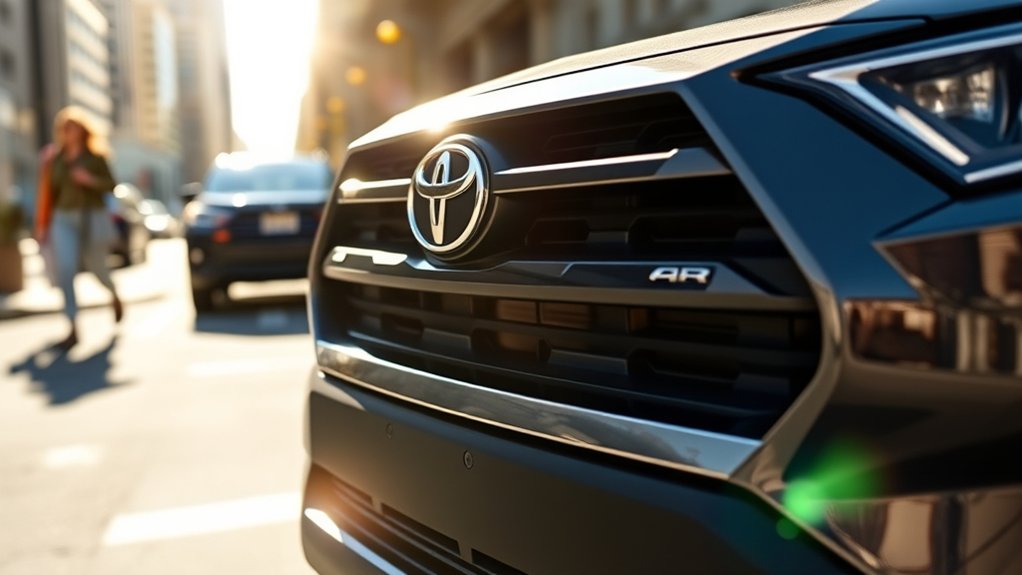
Advanced Detection Capabilities
For the 2026 RAV4, Toyota says the Pre-Collision System in Toyota Safety Sense 4.0 is designed to detect:
- Vehicles
- Pedestrians
- Bicyclists
- Motorcyclists
Detection categories are not identical across every RAV4 generation. An earlier system may recognize fewer target types or operate under different speed, lighting, and movement conditions. Owners should not assume that a feature listed for the 2026 model applies to an older RAV4.
Enhanced Safety Features
AEB works alongside other Toyota Safety Sense features instead of acting as a stand-alone substitute for the driver. Depending on the model year, the broader suite may also include lane-departure alerts, steering assistance, adaptive cruise control, road-sign assistance, or proactive driving support.
The most important benefit is the sequence of warning and braking support. A timely alert may help the driver react sooner, while automatic braking can reduce closing speed when the driver’s response is absent or insufficient.
How AEB Improves Daily Driving Safety
Forward AEB is most useful in sudden situations such as slowing traffic, a vehicle stopping unexpectedly, or a vulnerable road user entering the vehicle’s path. It provides another layer of monitoring during normal driving, but the driver must still watch the road and remain ready to steer or brake.
What real-world research shows: IIHS research has associated forward AEB with about 50% fewer rear-end crashes. Separate IIHS research found pedestrian-detecting AEB was associated with 27% fewer pedestrian crashes and 30% fewer pedestrian injury crashes. These are population-level findings, not a guarantee that AEB will prevent a specific collision.
AEB may reduce the impact speed even when it cannot stop the vehicle completely. Lower impact speed can still lessen the severity of some crashes, which is why the technology is valuable even though it has important limitations.
What RAV4 Automatic Emergency Braking Cannot Do
Warning: Automatic emergency braking is driver assistance, not autonomous driving. Never test it by deliberately driving toward a person, vehicle, wall, or other object. Keep a safe following distance and be prepared to brake or steer at all times.
The system may warn late, brake briefly, or not activate at all when it cannot confidently identify a supported target. Detection can be reduced by:
- Heavy rain, snow, fog, spray, or dust
- Ice, dirt, stickers, condensation, or damage near the camera or radar area
- Strong glare, darkness, shadows, or rapidly changing light
- Sharp curves, steep hills, dips, or road crests
- A target entering the lane suddenly or being hidden by another object
- Unusual vehicle shapes, low objects, road debris, animals, or objects outside the system’s supported categories
- Towing, vehicle modifications, misaligned sensors, or damage around sensing components
AEB can also produce a warning when the driver does not perceive an immediate threat. This may occur near roadside objects, vehicles in an adjacent curve, metal structures, or other complex scenes. The driver remains responsible for judging the situation.
How Do You Adjust RAV4 Pre-Collision System Settings?
Many recent RAV4s provide Pre-Collision System controls in the instrument display or vehicle-settings menu. The labels and available choices vary, so use the steps below as a general guide rather than a substitute for the owner’s manual.
At a Glance
| Time Required | About 2–5 minutes |
| Difficulty | Easy |
| Tools Needed | None; model-specific owner’s manual recommended |
| Cost | $0 |
- Park the RAV4 in a safe place and keep the vehicle stationary.
- Use the steering-wheel controls to open the settings menu in the multi-information display or digital gauge cluster.
- Look for PCS, Pre-Collision System, a collision-warning symbol, or a driver-assistance submenu.
- Review the available options. Some RAV4s allow earlier, middle, or later warning timing, while others provide different choices.
- Select the preferred setting and confirm it.
- Check the instrument panel for an indicator or message showing whether the system is enabled or unavailable.
Note: Changing warning timing does not increase the system’s detection range or guarantee earlier automatic braking. Menu names and behavior vary by model year. Use Toyota’s owner’s manual portal for vehicle-specific instructions.
Pro Tip: If alerts feel too late or too frequent, change only one setting at a time and evaluate it during ordinary driving. Never create a hazardous situation to test whether the brakes will activate.
Why Is My RAV4 Pre-Collision System Unavailable?
A temporary PCS or pre-collision warning does not always mean that a component has failed. The system may become unavailable when its view is blocked or environmental conditions prevent reliable detection.
If a warning appears:
- Read the full message. The instrument display may identify a blocked sensor, unavailable feature, or system malfunction.
- Check the windshield. Carefully clear dirt, fog, ice, snow, stickers, or other obstructions near the forward-camera area.
- Inspect the front sensor area. Remove dirt, packed snow, or ice from the relevant emblem, grille, or bumper area without using abrasive tools.
- Allow conditions to improve. Heavy weather, glare, extreme temperature, or a fogged windshield may cause temporary unavailability.
- Re-check after safely restarting the vehicle. If the obstruction or temporary condition has cleared, confirm whether the warning returns.
- Arrange an inspection if the warning remains. A persistent malfunction message should be diagnosed by a qualified repair facility or Toyota dealer.
Do not place stickers, electronic devices, dark tint, or accessories where they may obstruct the forward camera. Avoid decorative covers or modifications over a radar-equipped emblem or sensor area.
Does RAV4 Automatic Emergency Braking Need Maintenance?
The RAV4’s automatic emergency braking system does not have one universal mileage-based service interval. In particular, there is no general Toyota rule requiring AEB service every 12,000 miles.
For reliable operation:
- Follow the scheduled maintenance guide for the specific model year.
- Keep the windshield, camera view, front emblem, grille, and bumper sensor areas clean and undamaged.
- Investigate persistent PCS warning lights or unavailable-system messages.
- Have the sensing system checked after a front-end collision or damage near its components.
- Ask whether inspection or calibration is required after windshield replacement, camera removal, emblem replacement, grille work, bumper repairs, or other work affecting sensor alignment.
- Do not attempt to aim or calibrate safety sensors without the correct procedures and equipment.
Is Forward AEB the Same as RAV4 Parking Automatic Braking?
No. The forward Pre-Collision System is not the same as parking-support braking. Forward AEB is intended to address certain collision risks while driving ahead. Parking features use close-range sensors or cameras to help with obstacles at low speeds.
A RAV4 may list parking technology under names such as Front and Rear Parking Assist with Automatic Braking, Parking Support Brake, or another model-specific label. Availability can depend on trim and option packages even when the forward Pre-Collision System is standard.
How Do You Verify AEB on a Used RAV4?
For U.S. models, Toyota made Toyota Safety Sense P standard on all 2017 RAV4 grades. However, market differences, model-year changes, repairs, and unclear used-vehicle listings still make vehicle-specific verification worthwhile.
Do not rely only on a seller’s statement or the presence of a camera near the rearview mirror. Several driver-assistance features can share similar-looking hardware.
- Record the model year, trim, market, and vehicle identification number.
- Review the original window sticker, equipment record, or Toyota build information when available.
- Check the model-specific owner’s manual for “Pre-Collision System,” “PCS,” or “Toyota Safety Sense.”
- Look for PCS controls or status information in the instrument-display settings.
- Ask a Toyota dealer to confirm the factory equipment by VIN when documentation is unclear.
A warning light or unavailable message during a test drive should be investigated before purchase. Do not assume it only needs cleaning unless the cause has been confirmed.
Common Questions About Toyota RAV4 AEB
Most questions about the RAV4’s automatic emergency braking concern model-year availability, disabling the feature, bad-weather operation, speed limits, warning messages, trim availability, and maintenance. The answers depend heavily on model year, so the owner’s manual remains the final authority for an individual vehicle.
Related Guides
Frequently Asked Questions
Which Toyota RAV4 years have automatic emergency braking?
For U.S.-market RAV4s, Toyota Safety Sense P became standard on every grade for the 2017 model year and included Pre-Collision System with Pedestrian Detection and automatic emergency braking. Later RAV4 generations continued PCS with newer Toyota Safety Sense versions. Equipment on pre-2017 and non-U.S. vehicles should be checked individually.
Can I disable the automatic emergency braking feature?
Some RAV4s allow the Pre-Collision System to be switched off through the instrument-display settings. The exact option and what happens after the vehicle is restarted vary by model year. Because disabling it removes an important layer of assistance, leave it enabled during normal driving unless the owner’s manual identifies a reason to turn it off.
Does AEB work in all weather conditions?
No. Rain, snow, fog, road spray, ice, glare, darkness, and dirt on a sensing area can reduce detection or make the system temporarily unavailable. Keep the relevant windshield and front sensor areas clear, and rely on your own braking judgment in every condition.
At what speeds does the RAV4 AEB system work?
There is no single speed range that applies to every RAV4. Operating limits differ by Toyota Safety Sense generation, target type, vehicle speed, relative speed, and conditions. Check the Pre-Collision System section of the owner’s manual for the exact model year.
Why does my RAV4 say the Pre-Collision System is unavailable?
A temporary unavailable message can appear when the forward camera or radar area is obstructed or when weather, glare, condensation, ice, snow, dirt, or another condition prevents reliable detection. Clear safe-to-remove obstructions and check the message again. A persistent malfunction warning should be professionally diagnosed.
Is AEB standard on all Toyota RAV4 trims?
It is standard across the 2026 U.S. RAV4 lineup as part of Toyota Safety Sense 4.0. Toyota also made Toyota Safety Sense P standard across all U.S. RAV4 grades for 2017. Availability should still be checked individually on earlier or non-U.S. vehicles.
How often should I service the AEB system?
There is no universal 12,000-mile AEB service interval. Follow the maintenance guide for the vehicle, keep sensing areas clean, and seek inspection after persistent warnings, front-end damage, windshield work, or repairs that may affect a camera or radar sensor.
Can the RAV4’s AEB prevent every collision?
No. The system may help avoid or reduce the severity of certain frontal collisions, but it can miss a target, activate too late to stop fully, or remain unavailable when conditions are outside its operating limits. The driver must stay alert and ready to act.
Is parking automatic braking the same as forward AEB?
No. Forward AEB is part of the Pre-Collision System and addresses certain hazards ahead while driving. Parking automatic braking uses different close-range sensing functions and may be available only on certain trims or option packages.
Conclusion
Yes, the Toyota RAV4 has automatic emergency braking on current U.S. models, and Toyota has included PCS with AEB as standard equipment across the U.S. RAV4 lineup since the 2017 model year. The 2026 RAV4 uses Toyota Safety Sense 4.0, with PCS designed to detect vehicles, pedestrians, bicyclists, and motorcyclists under applicable conditions. Capabilities, settings, and operating limits still vary by model year, so use the vehicle-specific owner’s manual when checking speed ranges or controls. Keep sensing areas clear, investigate persistent warnings, and treat AEB as backup assistance rather than a substitute for attentive driving.
Sources
- Toyota Safety Sense — official descriptions of Pre-Collision System functions and detection categories.
- Toyota RAV4 — current U.S. RAV4 features and Toyota Safety Sense 4.0 equipment.
- Toyota USA Newsroom: 2026 RAV4 — describes Toyota Safety Sense 4.0 and current PCS detection targets.
- Toyota USA Newsroom: 2017 RAV4 — confirms Toyota Safety Sense P was standard on all U.S. RAV4 grades for 2017.
- Toyota Warranty and Owner’s Manuals — model-specific operating instructions, settings, warnings, and limitations.
- Insurance Institute for Highway Safety: Advanced Driver Assistance — research on AEB effectiveness and real-world safety outcomes.
- IIHS: Pedestrian AEB Research — reports the 27% reduction in pedestrian crashes and 30% reduction in pedestrian injury crashes associated with pedestrian AEB.


1 thought on “Does the Toyota RAV4 Have Automatic Emergency Braking? How It Works (Toyota Safety Sense)”