Last Updated: September 22, 2026 — reviewed against Toyota’s current 2026 Camry information and current battery-care guidance.
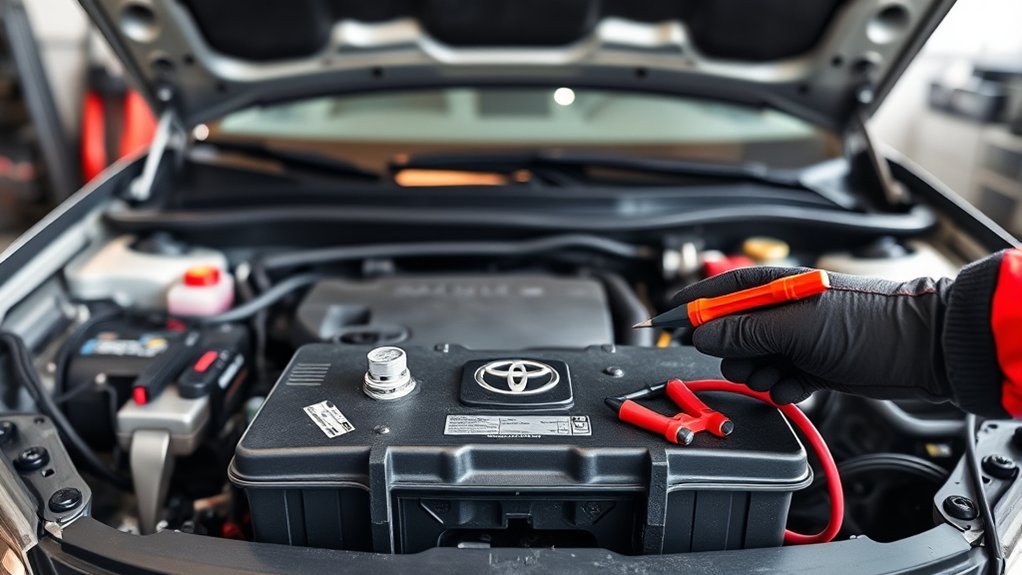
Toyota Camry battery maintenance starts with the 12-volt battery: inspect it every few months for corrosion, loose connections, case damage, and a loose hold-down; keep it adequately charged; and have it tested yearly once it is about three years old. The 2026 U.S. Camry uses an all-hybrid powertrain, so its 12-volt battery supports low-voltage electronics and hybrid-system startup rather than cranking a conventional starter. Older gasoline Camrys use the 12-volt battery differently, so always follow the procedure for your exact model year.
Quick Answer
Maintain a Toyota Camry’s 12-volt battery by checking it every few months for loose hardware, corrosion, swelling, leaks, and weak-start symptoms; keeping it adequately charged; limiting repeated short trips and key-off electrical loads; and testing it annually once it is about three years old. Use the exact battery type, access points, and procedure specified for your model year.
Key Takeaways
- A hybrid Camry has both a 12-volt auxiliary system and a separate high-voltage traction-battery system.
- Never assume battery size, chemistry, terminal layout, location, or replacement steps are the same across Camry model years.
- Clean, tight connections and a secure hold-down are essential, but they cannot restore an internally worn-out battery.
- A voltage reading is only a screening check; a conductance or load test gives a better picture of battery condition.
- Return a used automotive battery to a battery retailer or approved collection program rather than placing it in household trash.
At a Glance
| Time Required | A few minutes for a visual inspection; cleaning, testing, or replacement takes longer and varies by model year |
| Difficulty | Simple for visual inspection; cleaning or replacement complexity varies by battery access and model year |
| Tools Needed | Safety glasses, chemical-resistant gloves, flashlight, terminal brush, suitable wrench, and optional digital multimeter |
| Cost | A visual inspection requires no replacement parts; cleaner, testing, service, and replacement costs vary |
Toyota Camry Battery Maintenance Schedule by Situation
There is no single mileage-based battery service interval that applies to every Camry. Use condition, battery age, climate, and symptoms to decide when to inspect or test the 12-volt battery.
| Situation | Recommended Action |
|---|---|
| Every few months and before severe heat or cold | Inspect the case, hold-down, terminals, cables, and visible corrosion or leakage. |
| Around three years old and beyond | Have the battery tested annually; AAA recommends yearly testing after the third year. |
| After a jump start or deep discharge | Recharge correctly, then obtain a battery test; investigate the charging system or key-off draw if the problem returns. |
| Extended storage | Use a compatible automatic smart maintainer connected as Toyota and the charger manufacturer specify. |
| Repeated discharge while parked | Test the battery and charging system, then check for excessive key-off current draw instead of relying on repeated jump starts. |
Understanding Your Toyota Camry’s Battery System
Before performing battery maintenance, identify your Camry’s model year and powertrain. Toyota lists the 2026 U.S. Camry as an all-hybrid lineup, while older Camrys may have conventional gasoline engines. The correct battery location, chemistry, physical size, terminal arrangement, rating, and service procedure can differ between generations.
The 12-Volt Battery
The 12-volt battery supplies the vehicle’s low-voltage electrical equipment. In a conventional gasoline Camry, it also supplies the starter motor during engine cranking. In a hybrid Camry, it powers computers, locks, lighting, accessories, and control circuits that allow the hybrid system to initialize and enter READY mode.
Battery design and specification vary by model year and powertrain. Do not choose a replacement based only on voltage. Match the Toyota-specified battery technology, dimensions, hold-down design, terminal positions, venting requirements when fitted, and electrical ratings for the vehicle.
The High-Voltage Hybrid Battery
A hybrid Camry also has a high-voltage traction battery that stores energy for the electric-drive system. It is not the same component as the 12-volt battery and is not covered by ordinary terminal-cleaning, charging, or replacement instructions.
Warning: Do not open, disconnect, probe, charge, clean, or attempt to replace the high-voltage hybrid battery or orange high-voltage cables. High-voltage work requires trained technicians, specialized procedures, and protective equipment. The DIY guidance in this article applies only to the 12-volt battery.
Note: Use Toyota’s manual and warranty portal to find instructions for your exact model year. The manual takes priority over any general maintenance guide.
Model-year decision rule: Before cleaning, charging, jump-starting, or replacing the 12-volt battery, confirm five items for your exact Camry: battery location or designated jump point, battery type, terminal layout, venting or covers, and any reset or initialization steps required after reconnection.
Signs Your Camry Battery Needs Attention
A weak battery does not always provide an obvious warning. Symptoms also differ between conventional and hybrid Camrys, and some apparent battery problems are actually caused by the charging system, wiring, grounds, starter, or excessive electrical draw.
Signs in Conventional Gasoline Camrys
- Slow or uneven engine cranking: The starter turns the engine more slowly than usual.
- Repeated clicking: The starter solenoid clicks, but the engine does not crank normally.
- Electrical equipment weakens during starting: Interior lighting or displays become unusually dim when the key or start button is used.
- Battery or charging warning light: This may indicate a charging-system problem rather than the battery itself.
Signs in Hybrid Camrys
- The vehicle will not enter READY mode: Displays may illuminate, but the hybrid system does not become ready to drive.
- Rapid clicking or electrical cycling: Relays may click repeatedly as low voltage prevents proper initialization.
- Weak locks, interior lights, or displays: Low-voltage equipment behaves slowly, intermittently, or unpredictably.
- Multiple warning messages: Low 12-volt voltage can trigger several warnings, but diagnostic testing is needed because the warnings may have another cause.
Physical Warning Signs
Inspect the battery only when the vehicle is off and parked safely. Arrange professional service instead of touching the battery if you see any of the following:
- A swollen, bulging, cracked, or distorted case.
- Liquid leakage or wet areas around the battery.
- A strong rotten-egg or sulfur odor.
- Severe corrosion that has damaged a terminal, cable, or battery tray.
- A battery that is unusually hot.
- Signs that the battery may be frozen.
Flickering lights, intermittent power, or repeated no-start conditions should not automatically be blamed on the battery. Loose grounds, damaged cables, a faulty charging system, or a parasitic draw can produce similar symptoms.
How Often Should You Check and Maintain a Toyota Camry Battery?
A practical owner check every few months, and before severe seasonal weather, can catch corrosion, looseness, and physical damage before an unexpected failure. Once the battery is about three years old, add annual battery testing to the routine.
Step 1: Prepare Safely
- Park on a flat, well-ventilated surface.
- Turn the vehicle completely off and keep the key or smart key away from the car.
- Set the parking brake.
- Remove rings, watches, bracelets, and other conductive jewelry.
- Wear safety glasses and chemical-resistant gloves.
- Keep cigarettes, flames, sparks, and metal tools that could bridge the terminals away from the battery.
Step 2: Find the Battery and Check the Manual
Battery location varies by model year. Do not assume it is under the hood. Consult the owner’s manual before removing covers, disconnecting cables, connecting a charger, or attempting a jump start. Some Camrys provide designated jump points separate from the physical battery.
Step 3: Inspect the Case, Tray, and Hold-Down
Use a flashlight to check the case for cracks, swelling, leaks, staining, or heat damage. Confirm that the battery is held firmly in its tray and cannot slide or rock. A loose hold-down allows vibration that can damage internal parts and strain the terminals.
Also inspect the tray for rust, acid damage, or debris. Significant tray corrosion should be repaired before installing a replacement battery.
Step 4: Check the Terminals and Cables
Look for white, blue, or green corrosion around the posts, clamps, or cable ends. Check for frayed insulation, cracked terminal clamps, looseness, or a cable that moves when touched gently.
Do not overtighten a battery terminal. Excess force can damage the post or clamp. Use the model-specific torque specification when one is provided.
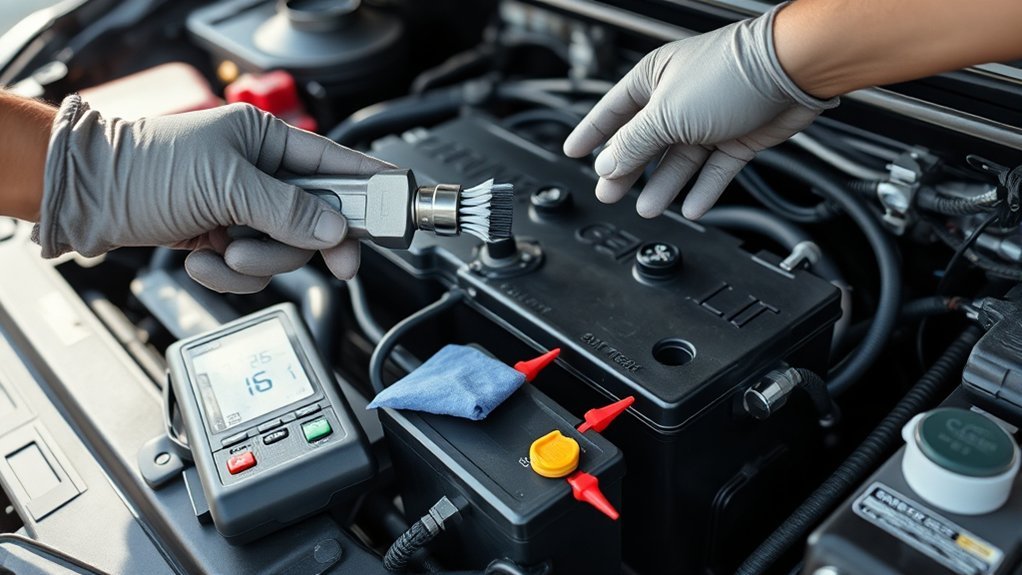
Step 5: Clean Light Terminal Corrosion
If the battery is undamaged and the manual permits owner service, use this general process:
- Confirm whether disconnecting the battery may erase settings or require an initialization procedure.
- Disconnect the negative terminal first.
- Disconnect the positive terminal second.
- Keep tools from touching both terminals or a positive terminal and grounded metal at the same time.
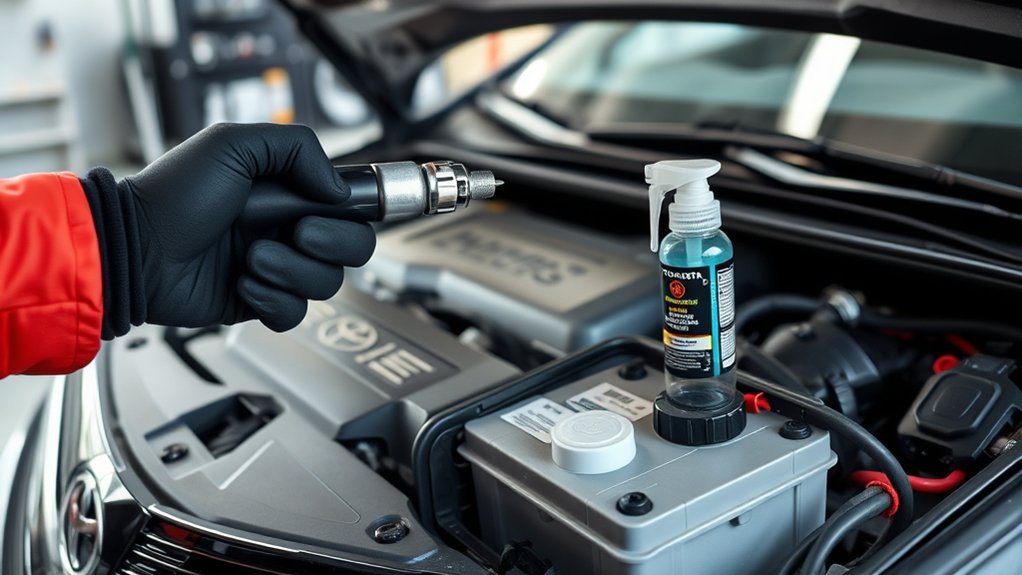
- Use a battery-terminal brush and a cleaner intended for automotive batteries.
- Keep cleaning solution and debris out of battery vents or cells.
- Dry the connections completely.
- Reconnect the positive terminal first.
- Reconnect the negative terminal last.
- Apply a terminal protectant if the product and vehicle instructions allow it.
Pro Tip: Take a clear photo of the battery orientation, cable routing, hold-down, covers, and terminal positions before disconnecting anything. This reduces the chance of incorrect reassembly.
Step 6: Confirm Normal Operation
After cleaning or reconnecting the 12-volt battery, confirm that the terminals are secure, covers are reinstalled, tools have been removed, and cables are not pinched. Start the vehicle or place a hybrid Camry in READY mode according to the manual. Check for warning messages and verify that basic electrical equipment operates normally.
Avoid These Common Battery Maintenance Mistakes
- Assuming every Camry uses the same battery: Model year, powertrain, battery technology, size, terminal position, and rating matter.
- Replacing an AGM battery with a conventional flooded battery when Toyota specifies AGM: The replacement must match the required battery technology and installation specification.
- Cleaning a cracked or leaking battery: Stop and arrange professional removal instead.
- Working near sparks or flames: Lead-acid batteries can release flammable gas.
- Letting a metal tool bridge terminals: This can create a severe short circuit, burns, fire, or electronic damage.
- Disconnecting the positive cable first: If a tool touches grounded metal, it can create a direct short.
- Leaving the hold-down loose: Vibration can shorten battery life and damage connections.
- Overtightening terminals: Excess force may crack a clamp or damage a battery post.
- Judging health by voltage alone: A battery can show acceptable open-circuit voltage but fail under load.
- Repeatedly jump-starting without diagnosis: The underlying cause may be an aging battery, charging failure, parasitic drain, loose connection, or another electrical fault.
- Working on the high-voltage hybrid system: Ordinary 12-volt maintenance procedures do not apply to traction-battery components.
How Does Weather Affect a Toyota Camry Battery?
Cold and heat affect a 12-volt battery in different ways. Cold weather reduces the battery’s available output while the vehicle may require more electrical energy to start or initialize. A marginal battery may therefore fail during the first severe cold spell.
Heat speeds up chemical deterioration and can shorten battery life. AAA identifies time, heat, and vibration as major battery-life factors, while cold weather can expose a battery that has already lost usable capacity.
Temperature swings can also expose loose connections and an already weakened battery. Inspect and test the battery before the hottest and coldest parts of the year, particularly when it is more than three years old or has previously discharged.
Battery age is only part of the picture. Heat, vibration, repeated undercharging, incorrect fitment, and deep discharge can all shorten usable service life.
How Can You Extend a Toyota Camry Battery’s Lifespan?
Regular Inspections and Cleaning
Inspect the battery, terminals, cables, tray, and hold-down every few months. Clean light corrosion before it becomes severe, but do not disturb a damaged or leaking battery. Keep the top of the battery clean and dry so dirt and moisture do not contribute to unwanted current paths.
Avoid Repeated Short Trips
Repeated short drives may use more energy than the vehicle restores, especially in cold weather or when lights, defrosters, heated seats, blowers, and other electrical equipment are operating. Combine errands or include an occasional longer drive when practical.
A longer drive cannot repair an internally failed battery or a malfunctioning charging system. If the battery repeatedly becomes discharged, have the battery, cables, charging system, and key-off electrical draw tested.
Reduce Unnecessary Key-Off Loads
Do not leave interior lights, exterior lights, accessories, chargers, diagnostic devices, or aftermarket electronics operating while the vehicle is off. Confirm that the trunk, glove-box, and vanity lights switch off properly.
Aftermarket alarms, audio equipment, cameras, remote starters, trackers, and poorly installed accessories can create an excessive parasitic draw. Professional testing is appropriate when the battery discharges while the vehicle is parked.
Protect From Extreme Conditions
Park in a garage or shaded location when practical. Do not wrap the battery in improvised insulation that could trap heat, block ventilation, or interfere with the hold-down. If Toyota fitted a heat shield or battery cover, reinstall it correctly after service.
A battery warmer should be used only when it is approved for the battery and installed according to the manufacturer’s directions. Never charge or jump-start a battery that may be frozen.
Maintain a Stored or Seldom-Driven Camry
A parked vehicle continues to use a small amount of electricity for security, computers, keyless-entry functions, and memory. During extended storage:
- Start with a tested, fully charged 12-volt battery.
- Turn off or remove unnecessary plug-in accessories.
- Store the smart key farther from the vehicle if the manual recommends it.
- Use only an automatic smart maintainer compatible with the battery type and vehicle.
- Connect the maintainer to the points and in the sequence specified by Toyota and the charger manufacturer.
- Do not use an old unregulated charger for unattended long-term charging.
How to Test a Toyota Camry Battery
A digital multimeter can show whether voltage is obviously low and may help identify a charging problem, but voltage alone does not measure the battery’s available cranking or reserve capacity.
Basic Voltage Screening
- Follow the manual’s shutdown procedure and allow vehicle systems to power down.
- Set the multimeter to the appropriate DC-voltage range.
- Connect the red probe to the specified positive point and the black probe to the specified negative or ground point.
- Compare the result with the battery manufacturer’s state-of-charge information and Toyota’s procedure.
- Do not probe orange cables, high-voltage connectors, or traction-battery components.
A recently driven or charged battery may retain a temporary surface charge. Temperature, battery chemistry, system activity, and measurement location can also affect the reading.
Professional Battery and Charging Tests
A conductance or load test evaluates how the battery performs under demand. A charging-system test checks whether the vehicle is restoring energy correctly. On a conventional gasoline Camry, diagnosis may include starter-current and alternator-output testing. On a hybrid Camry, charging behavior and system checks differ, so use hybrid-capable service equipment and model-specific procedures.
Have the battery tested when:
- It is approximately three years old or older.
- Starting or READY-mode behavior has changed.
- It has required a jump start.
- It has been deeply discharged.
- It repeatedly loses charge while parked.
- You are preparing for severe hot or cold weather.
When Should You Replace a Toyota Camry Battery?
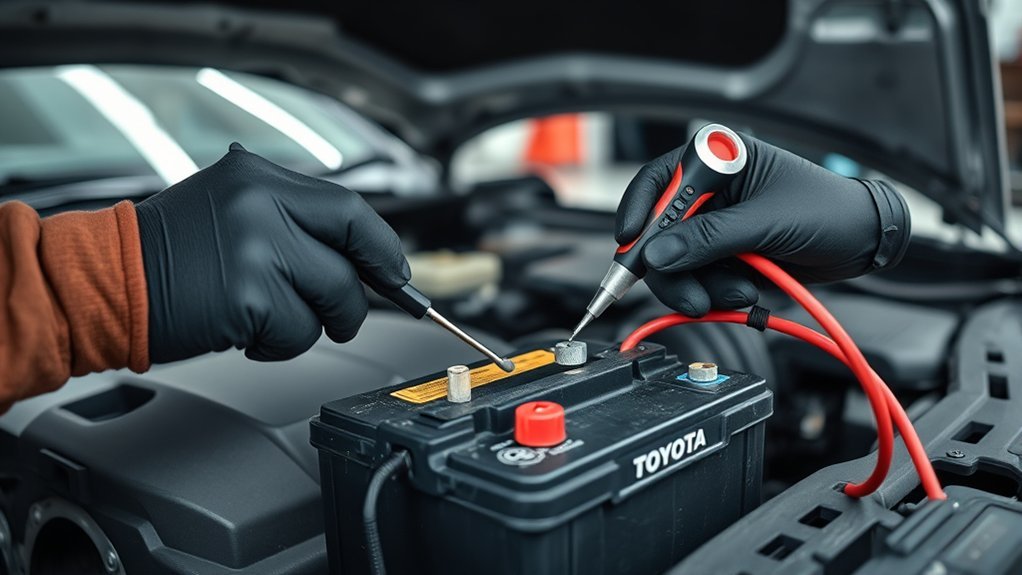
AAA says automotive batteries commonly last about three to five years, but climate, vibration, trip pattern, storage, charging performance, and battery technology can move replacement earlier or later. AAA also recommends annual testing after the battery reaches its third year rather than replacement based on age alone.
Replacement is usually appropriate when one or more of these conditions is present:
- The battery fails a proper conductance or load test.
- The case is swollen, cracked, leaking, or otherwise damaged.
- A fully charged battery cannot retain adequate charge.
- Starting or READY-mode problems continue after cables and charging performance are verified.
- Internal failure is indicated by the test equipment.
- Terminal damage prevents a reliable connection.
- The battery repeatedly requires assistance despite normal vehicle use.
Corrosion by itself does not always mean the battery must be replaced. Light surface corrosion may be cleaned, but recurring heavy corrosion can indicate leakage, overcharging, damaged seals, or a cable problem that requires diagnosis.
Choose the Correct Replacement
The replacement must match Toyota’s requirements for:
- Battery technology, such as conventional flooded or AGM.
- Physical dimensions and hold-down configuration.
- Positive and negative terminal positions.
- Cold-cranking or amp-hour rating, as applicable.
- Vent-tube connection, when fitted.
- Required covers, insulation, or heat shields.
An incorrect battery may not fit securely, may place a terminal near grounded metal, may not match the charging strategy, or may have inadequate electrical capacity.
For model-year fitment details, see Toyota Camry battery group size explained. If you are preparing to remove and install the battery, use the separate Toyota Camry 12V battery replacement overview so this maintenance guide stays focused on inspection, battery health, warning signs, and prevention.
Essential Tools for Camry Battery Maintenance
Recommended Tools Checklist
- Safety glasses or a face shield: Protects against corrosion debris and possible electrolyte splash.
- Chemical-resistant gloves: Protects hands from corrosive residue.
- Flashlight: Helps inspect the case, tray, cable insulation, and hold-down.
- Battery-terminal brush: Removes light corrosion from posts and clamps.
- Automotive battery cleaner: Helps neutralize and remove external corrosion when used according to its label.
- Correct-size wrench or socket: Prevents damage to terminal and hold-down hardware.
- Digital multimeter: Provides basic voltage screening when used correctly.
- Automatic smart maintainer: Supports a compatible 12-volt battery during long storage.
Safety Equipment Essentials
Wear eye and hand protection even during a quick inspection. Battery corrosion may contain acidic residue and lead compounds. Work in a ventilated area and wash your hands after handling battery components.
Do not lean directly over the battery while making or breaking an electrical connection. Keep loose clothing, long hair, cables, and tools away from fans and moving engine components.
If electrolyte contacts skin or clothing, flush the area with plenty of clean water. If it enters the eyes, begin flushing immediately and obtain urgent medical assistance. Follow the battery label and product safety instructions.
Should You Replace a Toyota Camry 12-Volt Battery Yourself?
A straightforward 12-volt replacement may be manageable for an experienced owner, but newer Camrys can require model-specific access, vent routing, initialization, memory preservation, diagnostic checks, or hybrid-aware procedures. For the full replacement workflow, see the Toyota Camry 12V battery replacement overview.
Advantages of Professional Replacement
- The existing battery and charging system can be tested before parts are replaced.
- The correct battery technology and specification can be confirmed.
- Technicians can identify cable, tray, hold-down, starter, charging, or parasitic-draw problems.
- Required resets or initialization procedures can be completed.
- The old battery can be handled and recycled properly.
- Parts and labor may include warranty coverage.
When DIY Replacement May Be Reasonable
DIY replacement may be reasonable when the owner’s manual permits it, the battery is readily accessible, the person has suitable tools and protective equipment, and the procedure does not involve high-voltage components.
Before starting:
- Confirm the exact replacement specification.
- Read the complete model-year procedure.
- Check whether settings or system initialization may be affected.
- Confirm how a vent tube, cover, insulation panel, or heat shield must be transferred.
- Plan safe transport and recycling of the old battery.
Disconnect the negative terminal first and reconnect it last unless Toyota’s model-specific procedure states otherwise. Never reverse polarity, force a cable onto the wrong post, or operate the vehicle with an unsecured battery.
Troubleshooting Common Camry Battery Problems
| Symptom | Possible Causes | Best Next Step |
|---|---|---|
| Slow cranking on an older gasoline Camry | Weak battery, loose connection, cable resistance, starter problem, or charging fault | Inspect connections and obtain battery, starter, and charging-system tests |
| Hybrid Camry will not enter READY mode | Low 12-volt voltage, connection problem, smart-key issue, interlock condition, or hybrid-system fault | Follow the manual’s READY and jump-start checks; obtain hybrid-capable diagnosis if the problem continues |
| Battery dies after the car sits | Aged battery, parasitic draw, accessory left on, aftermarket equipment, or long storage | Fully charge and test the battery, then measure key-off draw if discharge repeats |
| Corrosion quickly returns | Damaged seal, leakage, overcharging, moisture, or cable reaction | Have the battery, cable, and charging system inspected rather than repeatedly cleaning it |
| Multiple warning lights appear | Low system voltage or an unrelated electronic, charging, or hybrid-system fault | Test the 12-volt system and read diagnostic trouble codes before replacing parts |
| New battery becomes weak quickly | Incorrect battery, loose hold-down, charging fault, parasitic draw, or installation problem | Verify fitment and installation, then test charging performance and key-off current draw |
Final Thoughts: A Simple Camry Battery Checklist
- Confirm the model year, powertrain, battery location, and specification.
- Inspect the case, tray, hold-down, terminals, and cables every few months.
- Stop if the battery is swollen, cracked, leaking, hot, or possibly frozen.
- Clean only light external corrosion and follow the correct disconnection sequence.
- Avoid repeated deep discharge and unnecessary key-off electrical loads.
- Use a compatible automatic maintainer during extended storage.
- Test the battery annually after approximately three years or whenever symptoms appear.
- Diagnose repeated discharge instead of relying on repeated jump starts.
- Use the same battery technology and Toyota-specified fitment when replacing it.
- Keep all DIY work away from the high-voltage hybrid system.
- Return the old battery to a retailer or approved recycling program.
Frequently Asked Questions
What precautions should be taken during Toyota Camry battery maintenance?
Turn the vehicle off, keep the smart key away, wear eye protection and chemical-resistant gloves, remove metal jewelry, work in a ventilated area, and keep sparks and flames away. Do not touch a battery that is leaking, swollen, cracked, hot, or frozen, and never service high-voltage hybrid components.
What is the average life of a Toyota Camry 12-volt battery?
Many automotive batteries last about three to five years, but heat, vibration, short trips, deep discharge, storage, charging performance, and battery type affect the result. Begin annual testing at roughly three years and replace the battery based on condition and test results rather than age alone.
How can I prevent my Camry battery from dying while the car is not in use?
Start storage with a fully charged, tested battery; switch off or unplug unnecessary accessories; and use a compatible automatic smart maintainer when the vehicle will sit for an extended period. Follow Toyota’s instructions for connection points and smart-key storage, and investigate any unusually fast discharge.
Can an old battery be made 100% healthy again?
No. Charging can restore a low state of charge, and cleaning can correct resistance caused by dirty connections, but neither process reverses normal internal aging, damaged plates, a shorted cell, leakage, or every form of sulfation. A battery that fails a proper test should be replaced.
Is the 12-volt battery the same as the hybrid battery?
No. The 12-volt battery operates low-voltage electronics and allows a hybrid Camry’s control systems to initialize. The high-voltage traction battery stores energy for the electric-drive system. High-voltage components require trained technicians and should not be handled during ordinary battery maintenance.
Does corrosion mean the battery must be replaced?
Not always. Light external corrosion may be cleaned if the battery is otherwise undamaged. Heavy or rapidly returning corrosion can indicate leakage, damaged seals, overcharging, or a cable problem. In that case, have the battery and charging system inspected.
Where is the 12-volt battery in a Toyota Camry?
The location varies by model year and powertrain, so do not assume the physical battery is under the hood. Some Camrys also use designated jump-start points that are separate from the battery. Check the Toyota owner’s manual for the exact vehicle before removing covers or connecting cables.
Can I jump-start a Toyota Camry with a discharged 12-volt battery?
A discharged 12-volt battery can often be jump-started using the model-specific procedure, but connection points and steps vary. Follow the owner’s manual rather than a generic cable sequence. On a hybrid Camry, the high-voltage traction battery is a separate system and is not the battery you jump-start during ordinary roadside assistance.
Conclusion
Reliable Toyota Camry battery maintenance begins with identifying the correct system. Inspect and maintain only the 12-volt battery using the procedure for your model year, and leave all high-voltage hybrid work to qualified technicians.
Keep the battery clean, secure, and adequately charged; limit repeated short-trip use; test it as it ages; and investigate recurring discharge instead of repeatedly jump-starting the vehicle. If starting or READY-mode problems return after charging or cleaning, the next step is a battery and charging-system test rather than replacement based on age alone.
Sources
- Toyota: 2026 Camry — confirms the current U.S. Camry’s all-hybrid powertrain.
- Toyota Manuals and Warranties — model-year-specific operating, battery, jump-starting, and safety instructions.
- AAA Automotive: How Long Do Car Batteries Last? — battery-life factors, warning signs, testing intervals, fitment, vibration, and replacement specifications.
- U.S. Environmental Protection Agency: Used Household Batteries — automotive battery handling and recycling guidance.
- Toyota: Basic Car Maintenance Tips & Services Checklist — general Toyota guidance on checking battery contacts for corrosion and buildup.