
For a Toyota Camry, the safest battery choice is the same 12-volt battery technology and specification Toyota approved for that exact vehicle. Use AGM when AGM is factory-specified, keep EFB when EFB is specified, and use a conventional flooded battery when that is the approved technology. An AGM upgrade can make sense in some compatible applications, but physical fit alone does not prove the conversion is correct. Check the model year, powertrain, market, battery location, dimensions, terminal layout, venting, electrical ratings, and original battery technology before buying.
Last updated: September 22, 2026. Current U.S. Camry lineup, battery-technology guidance, fitment workflow, and safety references rechecked.
Quick Answer
Match the battery technology Toyota specifies for your exact Camry. AGM offers strong cycling ability, charge acceptance, vibration resistance, and no water topping, but usually costs more. A conventional flooded battery remains practical when it is the approved technology. Do not replace factory AGM or EFB with a basic flooded battery merely because the case dimensions appear to fit.
Key Takeaways
- Use the VIN or exact model year, trim, engine or hybrid system, and market when checking battery fitment.
- AGM batteries are spill-resistant, vibration-resistant, and maintenance-free in the sense that you do not add water.
- A conventional flooded battery can remain the sensible lower-cost choice when Toyota or a verified fitment source approves it.
- An enhanced flooded battery, or EFB, is not the same as a basic conventional flooded battery and should not be casually downgraded.
- Test the battery, cables, and charging system before replacing parts, especially if a newer battery repeatedly loses charge.
Note: This guide covers the Camry’s 12-volt starting or auxiliary battery. A Camry Hybrid also has a separate high-voltage traction battery. For the 2025 and 2026 model years, the U.S.-market Camry uses an all-hybrid powertrain, while older Camrys and vehicles sold in other markets may have different configurations. Do not open, disconnect, or service the high-voltage system unless you have the required training and equipment.
Essential Characteristics of AGM Batteries
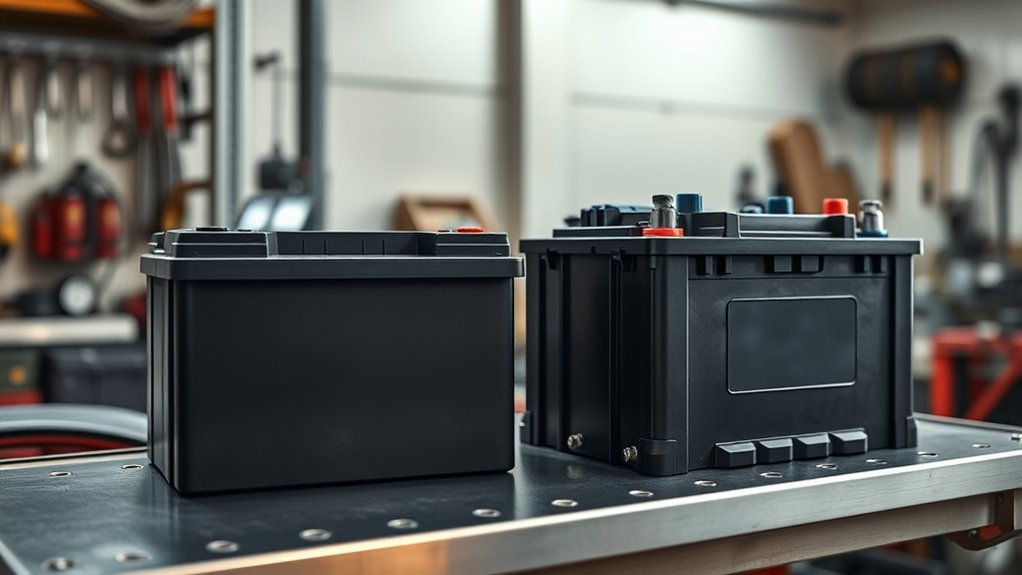
AGM stands for absorbent glass mat. In this type of valve-regulated lead-acid battery, fiberglass separators hold the electrolyte against the battery plates instead of allowing it to move freely around the case. This construction is explained in Interstate Batteries’ AGM guide.
This construction gives an AGM battery several practical advantages:
- No water topping: You do not remove caps or add distilled water to an automotive AGM battery.
- Good charge acceptance: AGM batteries can accept charging current efficiently when the vehicle and charger use a suitable charging profile.
- Strong starting performance: Low internal resistance helps a correctly rated AGM battery deliver high current.
- Vibration resistance: The packed internal construction supports the plates and limits movement.
- Lower self-discharge: A healthy AGM battery generally loses charge more slowly during storage than a comparable conventional flooded design, although it can still become discharged.
- Reduced spill risk: The absorbed electrolyte is less likely to escape during normal use.
- Better cycling capability: AGM generally tolerates repeated partial discharge and recharge better than a basic conventional starting battery of similar quality.
Better cycling capability does not make every automotive AGM battery a true deep-cycle battery. Repeatedly running accessories until the battery is deeply discharged can still shorten its life.
AGM batteries are valve-regulated rather than permanently airtight. They can vent pressure if they are overcharged, overheated, damaged, or used with unsuitable charging equipment. “Spill-resistant” is therefore more accurate than “spill-proof.”
An AGM battery still needs basic care. Keep its case clean, make sure its terminals remain tight, inspect the hold-down and vent connection, test it when starting becomes slow, and recharge it only with equipment approved for AGM technology.
Advantages and Disadvantages of Flooded Batteries
A conventional flooded lead-acid battery uses liquid electrolyte that surrounds the internal plates. This familiar design remains a suitable and cost-effective starting-battery option for many Camry model years when it matches Toyota’s specification.
The best battery for your Camry is not automatically the most expensive one. It is the battery that matches the vehicle’s required technology, fit, capacity, terminals, venting, and charging system.
Common advantages of a conventional flooded battery include:
- Lower initial cost than a comparable AGM battery in many applications
- Wide availability from battery retailers and service shops
- Reliable engine-starting performance when properly sized and maintained
- A proven design that may be all your Camry requires
Flooded batteries also have limitations. The liquid electrolyte makes correct upright installation important. A damaged, cracked, or tipped battery can leak corrosive acid, and charging can produce hydrogen and oxygen gases.
Some serviceable flooded batteries have removable caps and may require occasional distilled water. Many modern automotive flooded batteries, however, are sealed or labeled maintenance-free. Never pry open a sealed battery or add water unless its manufacturer specifically provides removable service caps and instructions.
Conventional flooded batteries can be more sensitive to repeated partial discharge, long periods at a low state of charge, and severe vibration. A secure battery hold-down and a healthy charging system are important for either battery type.
Conventional Flooded Versus EFB
An enhanced flooded battery, or EFB, still contains liquid electrolyte, but it uses construction changes intended to improve cycling durability and charge acceptance. It should not be treated as identical to a basic conventional flooded starting battery.
GS Yuasa’s advanced battery guidance recommends replacing AGM or EFB technology with the same technology originally fitted. If your Camry has an EFB, do not downgrade it merely because an ordinary flooded battery has the same outside dimensions.
AGM vs. Conventional Flooded Battery Comparison
| Feature | AGM Battery | Conventional Flooded Battery |
|---|---|---|
| Electrolyte | Held in fiberglass mats | Free-flowing liquid around the plates |
| Water maintenance | No water can or should be added | Only serviceable designs may need distilled water; many automotive versions are sealed |
| Charge acceptance | Generally stronger, with a compatible charging profile | Suitable for standard starting use when correctly specified |
| Repeated cycling | Generally tolerates partial cycling better than a basic starting battery | Best kept well charged and used primarily for normal starting duty |
| Vibration resistance | Generally stronger | More dependent on secure mounting and internal design |
| Spill risk | Lower during normal use, but not impossible | Higher if tipped, cracked, or damaged |
| Initial cost | Usually higher | Usually lower |
| Best choice | When factory-specified or verified as suitable for the Camry’s electrical demands | When factory-specified and adequate for the vehicle’s use |
Note: EFB sits between a basic conventional flooded battery and AGM in construction and cycling performance. Do not use the “Conventional Flooded” column as permission to replace an EFB with the least expensive flooded battery.
Toyota Camry Battery Decision Matrix
| What You Confirm | Best Next Step |
|---|---|
| Factory battery specification is AGM | Replace it with a correctly specified AGM battery. |
| Factory battery specification is EFB | Replace it with EFB unless Toyota or a verified application guide explicitly approves another technology. |
| Factory battery specification is conventional flooded | A correctly specified flooded battery remains appropriate. Consider AGM only when a verified application source approves the conversion. |
| The battery was installed by a previous owner and its history is unknown | Do not copy the installed battery blindly. Verify the original requirement by VIN, model year, powertrain, market, Toyota information, or a trusted fitment catalog. |
| You have a 2025 or 2026 U.S.-market Camry | Treat it as a hybrid application and confirm the exact 12-volt auxiliary-battery specification by VIN rather than using an older gasoline-Camry recommendation. |
How to Select the Correct Battery for Your Camry
Toyota Camry battery specifications can change across model years, engines, hybrid systems, trims, battery locations, and markets. Avoid choosing from a general Camry recommendation without confirming the exact vehicle. For model-year-specific sizing examples, see our Toyota Camry battery group-size guide.
- Confirm which battery you are replacing. On a gasoline Camry, this is normally the 12-volt starting battery. On a Camry Hybrid, the smaller 12-volt auxiliary battery is separate from the high-voltage traction battery.
- Test before buying. Confirm the battery’s condition and inspect the terminals, cables, ground connections, charging system, and possible key-off electrical drain.
- Check Toyota’s information for the exact vehicle. Use the VIN or select the model year and model through Toyota’s manuals and warranties portal.
- Match the battery technology. Replace factory AGM with AGM and factory EFB with EFB unless Toyota or a verified battery application guide specifically approves a different technology.
- Match the physical size. The case must fit the tray, clear nearby components, and work with the factory hold-down.
- Match terminal position and polarity. The positive and negative posts must be on the correct sides so the cables reach without stretching, crossing, or contacting sharp or moving components.
- Check the required electrical ratings. Match the specified cold-cranking amps, reserve capacity, amp-hour rating, or other values listed by Toyota or a verified vehicle-fitment catalog.
- Check the vent connection. A battery installed in a trunk, enclosed compartment, or interior-adjacent area may need the correct vent port, plug, and hose arrangement.
- Check post-install requirements. Follow the exact owner’s manual or service information for window, steering, electronic, battery-sensor, or other initialization procedures after power has been disconnected.
- Compare warranty and core-return terms. Do this only after confirming technology, fit, ratings, and venting; a longer warranty does not make an incompatible battery suitable.
Pro Tip: Use your VIN or exact model year, trim, engine, hybrid status, and market when checking fitment. Do not identify a replacement solely by the size or label of the battery currently installed because a previous owner may have fitted the wrong one.
What CCA, Reserve Capacity, and Amp-Hours Mean
- Cold-cranking amps, or CCA: Indicates starting-current capability under a standardized cold-temperature test. Do not buy by the highest CCA number alone; the battery must still match the vehicle and case size.
- Reserve capacity: Describes how long a battery can supply a specified electrical load under a standardized test. It helps describe energy reserve, but it does not replace a correct fitment lookup.
- Amp-hours, or Ah: Describes stored electrical capacity under specified test conditions. This rating is especially relevant to auxiliary-battery applications, but it must be considered with the required technology and charging system.
- Group size: Primarily identifies physical dimensions, terminal arrangement, and mounting characteristics. Two batteries in the same group can still differ in technology and electrical performance.
Test the Battery Before Buying a Replacement
A weak start or discharged battery does not automatically prove that the battery itself has failed. Loose or corroded terminals, damaged cables, an alternator or hybrid DC-DC charging fault, and excessive key-off electrical draw can produce similar symptoms. If a charging warning is present, use the diagnostic steps in our Toyota Camry charging-system warning guide rather than replacing the battery by guesswork.
Trojan Battery’s maintenance guidance notes that visual inspection alone is not sufficient to determine overall battery health. A useful diagnosis may include:
- A visual check for cracks, swelling, leakage, corrosion, loose posts, and a damaged hold-down
- A battery state-of-charge and conductance or load test appropriate for the installed technology
- A charging-system output test under the procedure specified for the exact Camry
- A voltage-drop check across battery cables and ground connections
- A parasitic-draw test if the battery repeatedly becomes discharged while parked
Charge a discharged but undamaged battery with an approved charger before condemning it. Testing a partly discharged battery without accounting for its state of charge can produce a misleading result.
When AGM Is Worth the Extra Cost for a Camry
An AGM battery makes the clearest sense when Toyota fitted one originally or when a verified fitment source approves AGM as an upgrade for your exact Camry.
AGM may also provide value when the approved application faces repeated short trips, frequent accessory operation, long storage periods, greater cycling demand, or severe vibration. Those conditions do not automatically make AGM mandatory, and a battery cannot correct a charging fault, loose connection, or excessive key-off electrical drain.
AGM is commonly used in vehicles with advanced charge management, start-stop operation, regenerative charging, or heavy electronic loads. That does not mean every Camry has those systems or needs AGM. GS Yuasa advises replacing an AGM or EFB battery with the same original technology to preserve the vehicle’s intended charging and electrical performance.
Higher purchase cost is the main AGM drawback. AGM can also be damaged by prolonged overcharging, unsuitable chargers, excessive heat, or severe discharge. Its service life depends on temperature, state of charge, driving pattern, electrical load, installation quality, manufacturing quality, and charging-system health. It is not guaranteed to outlast every correctly specified flooded battery.
AGM is usually worth the additional cost when:
- It is the factory-specified technology
- A verified application guide explicitly approves the conversion
- The battery must support greater cycling demand
- Spill resistance or vibration resistance is especially important in the approved installation
- The vehicle spends long periods parked and the battery will be maintained correctly
A conventional flooded battery is usually the better value when:
- It is the factory-specified technology
- The Camry receives normal starting use and regular driving
- The vehicle does not require AGM or EFB cycling performance
- The lower purchase price matters more than features the vehicle does not need
How Battery Types Impact Your Vehicle’s Performance
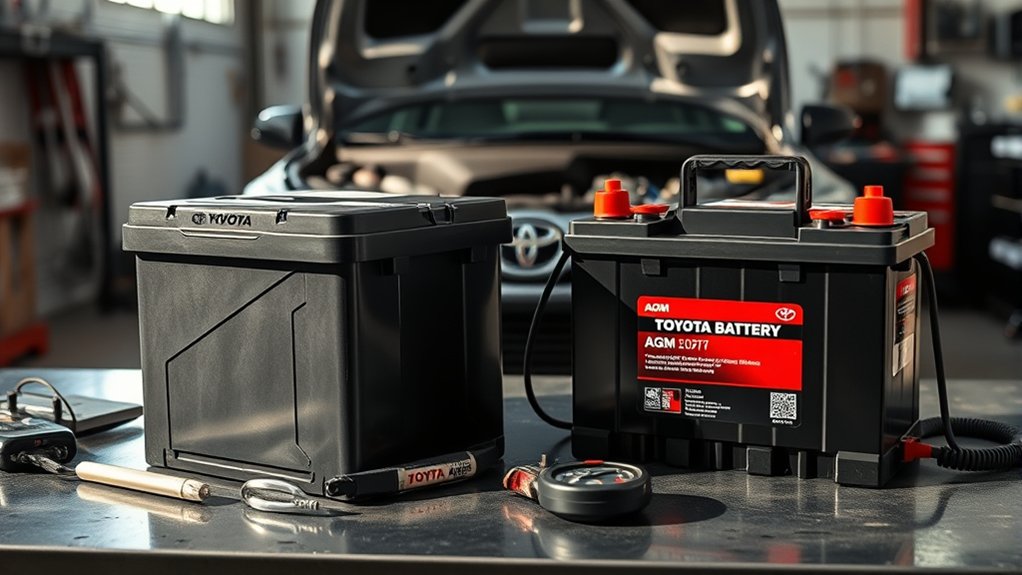
The correct battery supports dependable starting or system startup, stable low-voltage electronics, and normal charging-system operation. The wrong battery can create poor fit, weak starting, recurring discharge, shortened service life, venting problems, or warning messages.
- Starting or startup: A properly rated battery must deliver enough current for the vehicle under the expected temperatures.
- Accessory support: AGM generally tolerates repeated electrical cycling better than a basic conventional starting battery.
- Charging: The battery must accept the vehicle’s charging strategy without chronic undercharging or overcharging.
- Mounting: The case, terminals, hold-down, and venting must match the installation.
- Storage: AGM’s lower self-discharge can help during periods of non-use, although every battery can eventually discharge.
- Electronics: Stable 12-volt power helps control modules, locks, lighting, infotainment, and other low-voltage systems operate normally.
A battery upgrade does not increase engine horsepower. It also does not directly improve fuel economy in a normally functioning Camry. Its benefit is reliable electrical performance under the conditions for which it was designed.
Climate and Driving Pattern
Cold weather reduces available battery performance while increasing the effort needed to crank a gasoline engine. Use the required CCA rating rather than choosing an undersized battery or relying only on a high advertised number.
Heat accelerates battery aging and self-discharge. An AGM battery is not immune to under-hood heat, and a higher price does not guarantee a longer life in a severe climate.
Repeated short trips can leave either battery type undercharged because the vehicle may not have enough time to replace the energy used during startup and accessory operation. Long storage can cause the same problem through normal self-discharge and key-off electrical loads. An approved smart maintainer may help when the vehicle is stored, but it must match the battery technology and manufacturer instructions.
Maintenance Differences Between AGM and Flooded Batteries
AGM Battery Maintenance
You do not check AGM electrolyte levels or add water. You should still inspect the terminals, cables, case, hold-down, and vent connection when fitted. “Maintenance-free” does not mean inspection-free.
Test the battery if cranking slows, electronics reset, warning messages appear, or the vehicle needs repeated jump-starts. Long storage and repeated short trips can leave an AGM battery undercharged.
Use a smart charger specifically approved for AGM technology and follow the battery and charger instructions. Do not use an equalization mode on an automotive AGM battery unless the battery manufacturer explicitly calls for that procedure.
Flooded Battery Maintenance
Keep a flooded battery upright, clean, and securely clamped. Check for a swollen case, cracks, acid residue, corrosion, loose terminals, and a blocked or disconnected vent.
If the battery has manufacturer-provided removable service caps, check its electrolyte only as directed. Use distilled water and never overfill it. Do not remove covers from a sealed or maintenance-free battery.
Routine equalization charging is not appropriate general advice for an installed Camry battery. High-voltage charging procedures can damage the battery or vehicle electronics when performed incorrectly.
Charging and Replacement Safety
Warning: Lead-acid batteries contain corrosive sulfuric acid and can release flammable gas. Wear eye protection, keep sparks and flames away, work in a ventilated area, and never charge a cracked, leaking, swollen, or frozen battery.
- Switch the vehicle and charger off before making or removing charger connections.
- Follow the connection sequence in the Camry owner’s manual and charger instructions.
- Do not place tools across the battery terminals.
- Keep jewelry and loose metal objects away from the posts.
- Use a charger with a setting approved for the installed battery technology.
- Do not use a battery charger’s repair, reconditioning, or equalization mode unless the battery manufacturer specifically permits it.
- Stop charging if the battery becomes unusually hot, swells, leaks, or produces a strong odor.
- Reconnect every required vent hose before operating the vehicle.
- Secure the battery with the factory hold-down so it cannot move.
- Keep the removed battery upright and protect its terminals during transport.
Do not place an old automotive battery in household trash or a municipal recycling bin. The U.S. Environmental Protection Agency recommends returning lead-acid batteries to a battery retailer or an appropriate household hazardous-waste collection program.
Post-Installation Checks
Before considering the replacement complete, verify the entire installation rather than checking only whether the vehicle starts. If you are doing the job yourself, our Toyota Camry 12V battery replacement guide covers the basic removal and installation sequence.
- Confirm that the positive and negative terminals match the original orientation.
- Make sure the terminal clamps are fully seated and tightened to the correct specification.
- Check that the cables are not stretched, crossed, pinched, or touching sharp components.
- Verify that the battery cannot move in the tray when secured by the factory hold-down.
- Connect the correct vent hose and close any unused vent port as directed by the battery manufacturer.
- Confirm that no protective shipping cap remains on a terminal or required vent connection.
- Follow the exact Camry manual for any systems that need initialization after 12-volt power is restored.
- Check for warning messages and confirm normal operation of windows, locks, lighting, steering-related systems, and other affected features.
- Have the charging system tested if the old battery failed prematurely or the new battery does not remain charged.
Battery registration is not a universal Camry replacement step. After reconnecting 12-volt power, follow the owner’s manual or Toyota service information for your exact model year and market for any initialization, validation, or reset procedures.
Signs the Replacement Battery May Be Wrong
Inspect the installation or have the complete system tested if you notice any of these problems after replacement:
- The hold-down cannot clamp the battery securely.
- The cables are stretched, crossed, pinched, or pressed against sharp components.
- The positive and negative terminals do not match the original orientation.
- A required vent hose has nowhere to connect.
- The engine cranks slowly despite a fully charged new battery.
- The hybrid system or vehicle repeatedly fails to enter its normal ready state.
- The battery repeatedly goes flat after normal driving.
- The case becomes hot, swollen, cracked, or wet.
- Interior electronics reset or warning messages appear.
- The charger cannot complete its cycle on the selected battery setting.
- Corrosion returns quickly around the posts or tray.
These symptoms can also result from loose connections, an alternator or DC-DC converter problem, excessive key-off current, damaged cables, or another electrical fault. Test the complete starting and charging system before blaming the battery type.
Frequently Asked Questions
How can you tell whether a Camry battery is AGM or flooded?
Read the battery label and model number. An AGM battery normally displays “AGM,” “absorbent glass mat,” or “VRLA.” A serviceable flooded battery may have removable caps, while a sealed conventional battery may not. An EFB should normally be labeled “EFB” or “enhanced flooded battery.” Do not rely on case color or appearance alone. Confirm the specification through Toyota or the battery manufacturer.
Can you replace a flooded Camry battery with an AGM battery?
Sometimes. The AGM battery must be approved for your exact Camry and match the required size, hold-down, terminal layout, electrical ratings, and venting. The vehicle’s charging strategy and any post-install procedures must also be suitable. Do not assume that physical fit alone makes the conversion correct.
Is an EFB the same as a regular flooded battery?
No. EFB means enhanced flooded battery. It still uses liquid electrolyte, but its construction is designed for better charge acceptance and cycling durability than a basic conventional flooded starting battery. Replace a factory EFB with EFB unless Toyota or a verified application source approves another technology.
Is an AGM battery worth the extra cost for a Toyota Camry?
It is clearly worth the cost when AGM is the factory-specified technology. It can also be worthwhile when a verified fitment guide approves AGM and the vehicle faces greater cycling demand, frequent accessory use, long storage, or severe vibration. If Toyota specifies a conventional flooded battery and the Camry sees ordinary starting duty, paying more for AGM is not automatically necessary.
What are the main disadvantages of an AGM battery?
AGM batteries usually cost more, need compatible charging equipment, and can suffer permanent damage from prolonged overcharging, excessive heat, or severe discharge. They are not guaranteed to last longer than a correctly specified and maintained flooded battery in every application.
Can you charge an AGM battery with a regular charger?
Use the charger only if its manufacturer states that it supports AGM batteries and its charging profile matches the battery instructions. An older, unregulated, or incompatible charger may overcharge the battery, dry out its electrolyte, or shorten its life.
Does a Toyota Camry Hybrid use an AGM battery?
The 12-volt auxiliary battery specification varies by model year and market, so you must check the exact vehicle. This small battery is separate from the high-voltage hybrid traction battery. Never use advice for the 12-volt battery to service the traction battery.
What battery group size does a Toyota Camry need?
No single group size covers every Camry. The correct size can vary with model year, engine, hybrid configuration, trim, battery location, terminal arrangement, and market. Use the VIN, Toyota’s manual information, or a verified vehicle-fitment catalog before buying.
Does a Toyota Camry need battery registration after replacement?
Battery registration is not a universal Camry replacement step. Some model years or systems may require initialization, validation, or other procedures after 12-volt power is disconnected. Follow the exact Toyota owner’s manual or service information for the vehicle instead of applying a generic battery-registration rule.
How long should a Camry battery last?
There is no reliable lifespan that applies to every Camry battery. Heat, cold, short trips, storage, electrical load, depth of discharge, charging-system health, battery quality, and installation all affect service life. Test the battery when symptoms appear instead of replacing it only by age.
Conclusion
AGM offers useful advantages, including strong charge acceptance, vibration resistance, lower self-discharge, improved cycling capability, and no water topping. A conventional flooded battery remains a reliable and less expensive option when it matches Toyota’s requirements. An EFB occupies a separate enhanced category and should not be mistaken for a basic flooded replacement.
Do not choose by battery technology, price, warranty, or group size alone. Confirm your Camry’s exact physical fit, terminal layout, electrical ratings, venting, original technology, and post-install procedures. If the original specification is unclear, verify it by VIN before buying. Testing the complete electrical system, installing the battery securely, and maintaining a healthy charging system matter more than an automatic AGM upgrade.
Sources
- Toyota Manuals and Warranties — vehicle-specific owner-manual, warranty, and maintenance information.
- Toyota Camry — current U.S. Camry powertrain and model information.
- GS Yuasa Advanced Battery Technologies — AGM, EFB, same-technology replacement, validation, and charging guidance.
- Interstate Batteries: What Is an AGM Battery? — AGM construction, charge acceptance, vibration resistance, and replacement considerations.
- Trojan Battery Maintenance — battery identification, inspection, testing, charging, storage, and safety guidance.
- U.S. Environmental Protection Agency: Used Batteries — automotive lead-acid battery handling and recycling guidance.

