
Folding the rear seatbacks in your Toyota Camry creates a longer path for cargo that will not fit entirely inside the trunk. The process is simple when the vehicle has split-folding seatbacks, but release locations and procedures can vary by model year and market. Clear the seats, protect the belts, and verify every latch before driving.
Quick Answer
To fold the rear seats in a 2025 U.S.-spec Toyota Camry, open the trunk, pull the left or right seatback-release lever near the upper trunk area, then open the matching rear door and guide that section forward. Raise it firmly afterward and push and pull the top edge to confirm the latch is secure.
Key Takeaways
- The 2025 U.S.-spec Camry uses trunk-accessible controls to release the left and right rear seatback sections.
- Pulling a release unlocks the latch; you normally guide the seatback forward from a rear door.
- Remove passengers, child restraints, loose cargo, and anything that could trap a seat belt.
- A raised seatback is not safe until it remains fixed during a firm push-and-pull test.
- Stop and check the exact owner’s manual if your Camry’s releases, locks, or rear-seat configuration look different.
At a Glance
| Time Required | About 1 to 3 minutes |
| Difficulty | Easy |
| Tools Needed | None |
| Cost | No cost unless the release or latch needs repair |
Before You Fold the Rear Seats
First confirm that your Camry has folding rear seatbacks and that its controls match the procedure below. Equipment can differ by model year, trim, sales market, and rear-seat design. The 2025 U.S.-spec layout discussed here has separate release controls for the left and right seatback sections inside the trunk.
- Confirm the model year: Check the registration, door-jamb certification label, or use the NHTSA VIN Decoder if you are unsure.
- Inspect the seat: Look for a visible split between the rear seatback sections.
- Find the releases: Open the trunk and look near its upper left and right areas.
- Stop if the layout differs: Do not pull trim, pry a latch, or assume an older Camry uses the same procedure.
Note: Use Toyota’s Manuals and Warranties portal to select your exact vehicle. The model-specific owner’s manual is the final authority when the release location or procedure differs.
How to Fold the Rear Seats in Your Camry

On the 2025 U.S.-spec Toyota Camry, the rear seatback release controls are accessed from inside the trunk. One control releases the left section and the other releases the right section. This split arrangement lets you create room for a long item while leaving the other section upright when a passenger still needs that seating position.
Warning: Never fold a seatback while someone is sitting there. Remove child restraints and loose objects, keep fingers away from the hinge area, and do not drive with a seatback resting loosely against its latch.
- Park safely. Stop on a level surface, select Park, apply the parking brake, and turn the vehicle off.
- Clear the rear seat. Remove passengers, child restraints, bags, and anything else that could block or damage the seatback.
- Check the front seats. Move a front seat forward when the rear head restraint or seatback would otherwise strike it.
- Position the seat belts. Move shoulder belts, buckles, and belt webbing away from the seatback so they cannot become trapped or twisted.
- Open the trunk. Locate the left and right seatback-release controls near the upper trunk area.
- Pull the correct release. Operate the control for the section you want to lower. The latch may release without the seatback visibly moving.
- Lower the seatback. Open the corresponding rear door and guide the released section forward. Repeat the process on the other side when you need the full opening.
The folded seatbacks extend the usable loading length beyond the trunk. The transition between the trunk floor and the folded seatback may have a raised edge, gap, or slight angle, so inspect the surface before sliding in a long, fragile, or easily scratched item.
Pro Tip: Lay a folded blanket or protective cargo mat across the trunk opening and seatbacks before loading furniture, tools, boards, or other objects with dirty or sharp edges.
Understanding the Seat Release Mechanism
The trunk controls connect to the rear seatback latches. Pulling a control unlocks the corresponding section so you can lower it from the passenger compartment. The release does not support the seatback, lower it in a controlled way, or hold it partly open.
The release only unlocks the seatback. A physical push-and-pull check is still required after you raise it again.
Use the mechanism in this order:
- Release the latch: Pull the trunk control for the required section.
- Guide the seatback down: Lower it through the rear door rather than pulling or forcing it from inside the trunk.
- Restore the seatback: Raise it firmly until the latch engages.
- Test the latch: Push and pull the upper seatback before allowing a passenger to use that position.
Because the release controls are inside the trunk, they are not normally accessible as a workaround when the trunk itself is locked. Use the approved key, exterior release, cabin release, or roadside-assistance procedure described for your vehicle instead of attempting to pry through the rear seat.
Note: Release locations, locking features, and seat configurations can differ among Camry model years and sales markets. Check Toyota’s official manuals portal if your vehicle does not match these instructions.
Using Folding Camry Seats for Cargo
Folding the rear seatbacks does not turn the Camry into a hatchback or SUV. Its main benefit is extra loading length for narrow or moderately sized objects. Toyota does not publish a separate seats-folded cargo-volume figure, so do not describe the feature as a guaranteed increase to a specific number of cubic feet.
You can fold one section for cargo while leaving another seating position available. You can also lower both sections when an item is too wide for one side of the opening.
Items That May Fit More Easily
The folding arrangement can help with items such as:
- Flat-packed furniture
- Fishing rods or sports equipment
- Long boxes
- Rolled rugs
- Small ladders
- Building trim or lightweight boards that fit entirely and safely inside the vehicle
Published 2025 Camry specifications commonly describe a trunk of about 15 cubic feet with the seatbacks upright. That number measures the normal trunk rather than a second, officially rated seats-folded cargo area. The practical gain from folding a seatback is additional length through the opening behind the rear seats.
Choosing a Seat Configuration
The split-folding setup lets you choose the arrangement that best fits your passengers and cargo. Before loading, measure the trunk opening, pass-through, object length, object width, and clearance to the front seats.
| Configuration | Best Use | What to Check |
|---|---|---|
| Both seatbacks upright | Passengers and ordinary trunk cargo | Both seatbacks are fully latched |
| One section folded | One long or narrow item | The remaining passenger has a usable belt and clear seating area |
| Both sections folded | Wider or multiple long items | Cargo does not interfere with the front seats, controls, or driver visibility |
| Protective cover added | Dirty, rough, or awkwardly shaped cargo | Edges cannot cut the upholstery or interior trim |
How to Re-lock the Seatbacks Safely
A rear seatback must be fully latched before a passenger uses that seating position. It should also be secure before you drive with cargo in the trunk because the seatback helps separate the passenger and luggage areas.
- Clear the hinge and latch areas. Remove straps, fabric, belt webbing, debris, or small objects that could block the seatback.
- Move the seat belt aside. Make sure the belt is not routed behind the seatback or caught near the latch.
- Raise the seatback firmly. Guide it upright until you feel or hear the latch engage.
- Test the upper edge. Push the seatback rearward, then pull it forward. It should remain firmly in place.
- Check the belt again. Confirm that the belt extends and retracts normally and is not trapped or twisted.
If the seatback moves during the test, lower it again, inspect the latch area, and repeat the process. Do not rely only on an audible click.
Warning: Do not carry a passenger in that position or continue driving normally if the seatback cannot be secured. Arrange professional inspection of the release cable, latch, or seatback mechanism.
Comparing Camry Folding Seats With Other Sedans
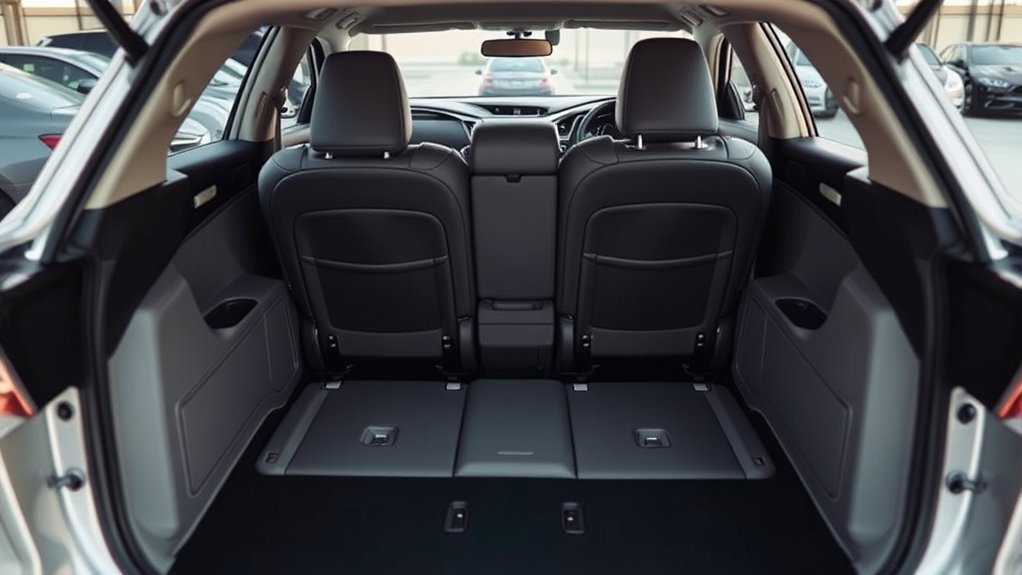
The Camry’s folding rear seatbacks are practical, but the feature is common among midsize sedans. A useful comparison should focus on the actual opening, floor shape, and release design rather than assuming one car is better because both specifications say “split-folding rear seat.”
When comparing the Camry with another sedan, check:
- Whether both seatback sections fold
- The split ratio and usable width of each section
- Whether the releases are in the trunk or passenger compartment
- The width and height of the opening behind the seats
- The height difference between the trunk floor and folded seatbacks
- Whether an armrest, brace, hinge, or trim panel restricts the opening
- Whether cargo tie-down points, nets, or organizers are available
The Camry’s main advantage is the ability to leave one section upright while lowering the other. Its limitations are the sedan-style trunk opening and a load path that may not be perfectly flat.
Toyota notes that vehicle specifications and equipment vary by configuration and region. Use the applicable owner’s manual for your model year. Toyota’s live Camry specifications page can help with current-model comparisons, but it may no longer display archived specifications for earlier model years.
Common Owner Questions About the Folding Mechanism
Most confusion comes from the location of the releases and the fact that pulling a release may not make the seatback move visibly.
- Why did nothing happen when I pulled the release? It may have unlocked the latch while the seatback remained upright. Open the matching rear door and gently guide that section forward.
- Why does the load surface have a bump? The seatback, hinge, padding, and trunk floor can sit at different heights. Use a blanket or suitable firm panel when an item needs smoother support.
- Why will the seatback not lower? A front seat, head restraint, seat belt, child restraint, or cargo item may be blocking it.
- Why will the seatback not latch upright? Inspect the latch and nearby trim for trapped belt webbing, debris, fabric, or cargo.
- Why are my releases in a different location? Your Camry may be from another model year, market, or equipment package. Check the exact owner’s manual instead of forcing the mechanism.
Troubleshooting a Seatback That Will Not Fold
Do not force a stuck seatback. Excessive pressure can damage the release control, cable, latch, upholstery, hinge, or surrounding trim.
- Confirm that you operated the release for the correct side.
- Pull the control through its normal travel, then let it return.
- Push the seatback slightly rearward to reduce pressure on the latch, then operate the release again.
- Check whether a front seat or rear head restraint is blocking movement.
- Move every seat belt, buckle, and child-restraint component away from the folding path.
- Inspect the visible latch area for debris without inserting screwdrivers or other tools.
- Check the model-specific owner’s manual for a lock or procedure unique to your Camry.
If the release feels unusually loose, has no resistance, or moves without releasing the latch, its cable may be disconnected or damaged. If the seatback cannot be secured upright, stop using that seating position and have a Toyota dealer or qualified repair facility inspect the mechanism.
Note: You can also enter the VIN at the NHTSA recall lookup to check for open safety recalls. A recall lookup does not replace diagnosis of a damaged or jammed latch.
Tips for Maximizing Cargo Space in Your Toyota Camry
Fold only the section you need when carrying passengers. This preserves a usable seating position and reduces the amount of upholstery exposed to cargo.
- Measure first: Measure the item, trunk opening, rear-seat pass-through, and distance to the front seats before loading.
- Keep heavy items low: Place heavy objects on the trunk floor. Do not treat the folded upholstered seatback as a heavy-duty platform.
- Spread pressure: Use a suitable protective panel or padded cover under an object that would otherwise place concentrated pressure on the seatback.
- Protect the interior: Use a clean blanket, cargo mat, or padded cover under dirty, rough, wet, or sharp items.
- Restrain loose cargo: Use an appropriate organizer, strap, or cargo net where the vehicle provides a safe attachment point. Do not leave objects free to slide into the passenger area.
- Preserve visibility: Keep cargo below the driver’s rearward line of sight and away from the front-seat controls.
- Protect the trunk lid: Do not force it closed against an object or drive with protruding cargo unless the load complies with all applicable securement and marking laws.
- Check the seats afterward: Remove debris and verify both latches before passengers use the rear seat again.
Seat upholstery is designed for normal passenger use, not as an unprotected work surface. Sharp, oily, wet, or unusually heavy cargo can stain, cut, stretch, or permanently deform the material.
Related Guides
Frequently Asked Questions
Do Toyota Camry back seats fold down?
Many Toyota Camry models have split-folding rear seatbacks, including the 2025 U.S.-spec configuration discussed here. Equipment varies by model year and market, so inspect the seat and confirm the feature in your vehicle’s owner’s manual.
How do you fold down the back seat of a 2025 Toyota Camry?
Open the trunk, operate the release for the left or right seatback, open the corresponding rear door, and guide the released section forward. Remove passengers, child restraints, loose objects, and seat belts from the folding path first.
How do you fold down a 2013 Toyota Camry back seat?
Many 2013 Camry configurations use releases accessible from the trunk, but release style and equipment can vary by trim and market. Inspect the upper trunk area and follow the 2013 owner’s manual rather than assuming the 2025 procedure is identical.
Why will my Camry seatback not fold after I pull the release?
The latch may be released even though the seatback remains upright. Guide it forward from the matching rear door. If it still will not move, check the front seat, head restraint, seat belts, child restraints, and latch area for obstructions.
How can I tell whether the rear seatback is locked?
Raise it firmly, then push rearward and pull forward on its upper edge. It should remain fixed. Also confirm that the seat belt is not trapped, twisted, or routed behind the seatback.
Can I fold the 2025 Camry seatbacks from inside the passenger cabin?
The described 2025 U.S.-spec procedure begins by operating the release controls inside the trunk. You then lower the released seatback through a rear door. Do not pull on the seatback forcefully before releasing its latch.
Is it safe to drive with one rear seat section folded?
It can be safe when the remaining upright section is fully latched, every passenger has a usable seat belt, and the cargo is stable, restrained, and clear of the driver’s controls and sightlines. Never carry a passenger against an unlatched seatback.
Sources
- Toyota Manuals and Warranties — access to model-specific owner’s manuals and warranty documents.
- Toyota Camry Specifications — current U.S. equipment, configuration, and regional-availability information; the live page may show a newer model year.
- Toyota Camry Overview — current official model and feature information for comparison with earlier Camrys.
- NHTSA VIN Decoder — official vehicle-identification tool for confirming model information from a VIN.
- NHTSA Recall Lookup — official VIN-based search for open vehicle safety recalls.
Conclusion
To fold your Toyota Camry’s rear seats, first confirm that the vehicle has the trunk-accessible releases described for its model year. Clear the seating area, release the required section, and guide the seatback forward through the rear door. When loading is complete, raise each section firmly and test the upper edge before carrying passengers or driving normally.
