
Choosing coolant for a Toyota Camry requires more than matching the liquid’s color. The correct product depends on the Camry’s model year, production details, powertrain, market, and cooling circuit. Checking the applicable Toyota manual before buying, mixing, or adding coolant helps prevent corrosion, deposits, leaks, poor freeze protection, and overheating.
Quick Answer
Most newer Toyota Camrys specify Toyota Super Long Life Coolant or an equivalent that matches Toyota’s exact chemistry requirements. Older Camrys may specify Toyota Genuine Long Life Coolant. Check the manual for your model year, market, powertrain, and cooling circuit, and never choose or mix coolant by color alone.
Key Takeaways
- Toyota’s 2003 Camry manual specifies Toyota Genuine Long Life Coolant, while its 2006 and 2026 Camry documents specify Toyota Super Long Life Coolant or a qualifying equivalent.
- Do not use pink, red, green, blue, or yellow color as a compatibility specification.
- Read both the vehicle manual and the current coolant-container label before adding or mixing products.
- Applicable hybrid Camrys have separate engine and inverter cooling circuits, which may have different reservoirs and replacement intervals.
- Repeated coolant loss, contamination, steam, or a high-temperature warning requires diagnosis rather than repeated topping up.
- Never remove a radiator cap or other pressurized cooling-system cap while the system is hot.
Last reviewed: July 13, 2026
What Is Toyota Camry Coolant and What Does It Do?
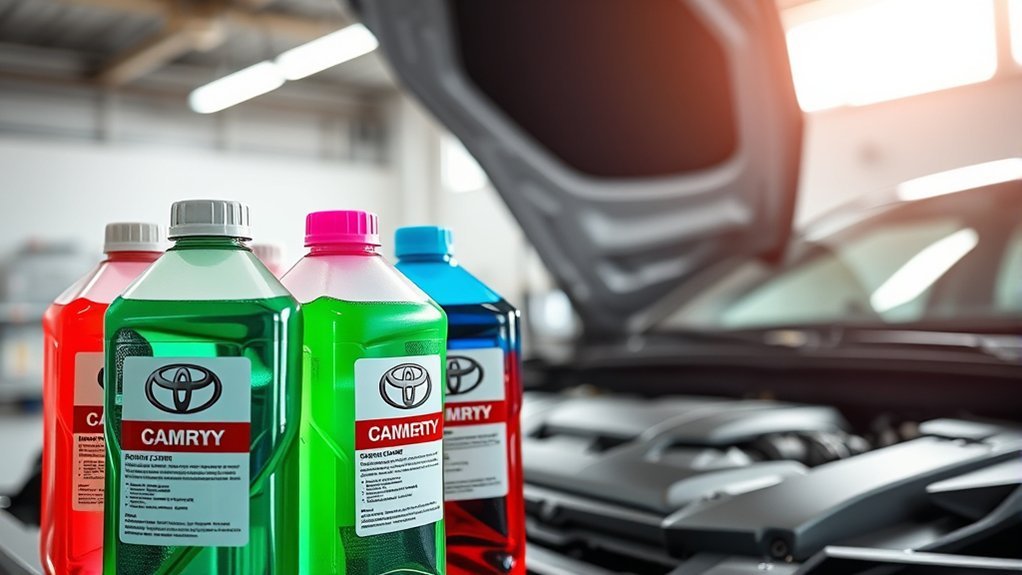
Coolant circulates through the engine and radiator to absorb heat and help the powertrain remain within its intended operating range. It also lowers the fluid’s freezing point, raises its boiling protection, and helps protect metals, seals, the radiator, and water-pump components against corrosion and deposits.
For the U.S.-market 2026 Camry, Toyota’s maintenance guide calls for Toyota Genuine Super Long-Life Coolant or a similar high-quality, non-silicate, non-amine, non-nitrate, non-borate ethylene-glycol coolant with long-life hybrid organic acid technology. Toyota describes that technology as a combination of low phosphates and organic acids.
That wording should not be copied blindly to every Camry. For example, Toyota’s 2006 Camry manual uses the term non-nitrite, while the 2026 guide uses non-nitrate. Follow the exact chemistry and application language in the document for your vehicle rather than assuming that every Toyota formula is described identically.
Coolant is often called antifreeze, but the finished fluid performs more than freeze protection. Water carries heat efficiently, while ethylene glycol and the additive package provide boiling, freezing, and corrosion protection. The correct concentration is therefore part of the specification.
Note: Do not assume every coolant container is ready to pour. Some products are premixed, while others are concentrates that require dilution. Read the current label. Never add extra water to a premixed product unless the manufacturer or vehicle instructions specifically direct you to do so.
How to Identify the Right Coolant for Your Camry
The safest way to choose Toyota Camry coolant is to verify the written specification rather than relying on a broad year range, trim badge, bottle color, or the word “universal.” Use the following process:
- Confirm the model year and production details. A transition-year vehicle may not match advice written for the generation as a whole.
- Identify the market. U.S., Canadian, and other regional manuals can specify different concentrations or service information.
- Identify the powertrain. Determine whether the Camry is gasoline-only or hybrid.
- Identify the cooling circuit. A hybrid may have an engine-coolant reservoir and a separate inverter-coolant reservoir.
- Read the applicable manual. Look under maintenance, specifications, cooling system, or coolant selection.
- Read the current product label. Confirm application, chemistry, concentration, mixing instructions, and any limitations.
Toyota provides model-specific documents through its official owner’s manual and maintenance-guide portal. Select the exact year and model instead of using a schedule or capacity copied from another Camry generation.
Official Camry Coolant Examples by Model Year
The following examples show why “all Camrys use the same coolant” is not a safe rule. They are reference points, not a substitute for your vehicle’s own documentation.
| Official Example | Specified Coolant | Important Detail |
|---|---|---|
| 2003 U.S. Camry | Toyota Genuine Long Life Coolant or an equivalent meeting that manual’s requirements | The manual describes mixing concentrate with preferably demineralized or distilled water and says not to use plain water alone. |
| 2006 U.S./Canada Camry | Toyota Super Long Life Coolant or an equivalent matching the stated chemistry | The manual lists a 50/50 Toyota premix for the U.S. and a 55/45 mixture for Canada, showing that market matters. |
| 2026 U.S. Camry | Toyota Genuine Super Long-Life Coolant or a qualifying equivalent | The guide separately lists engine/intercooler and inverter/intercooler coolant where applicable. |
You can verify the historical examples in Toyota’s 2003 Camry Owner’s Manual and 2006 Camry Owner’s Manual. Around a product transition, use the exact manual, VIN-related parts information, and production details rather than assuming a single switchover year applies worldwide.
Cooling-system capacity also varies by engine, powertrain, and whether the system has been partially drained or fully emptied. Use the capacity and bleeding instructions in the applicable repair information, but set the final reservoir level according to Toyota’s specified filling procedure.
Types of Coolant Toyota Camry Owners May Encounter
Toyota owners commonly encounter Toyota Super Long Life Coolant, Toyota Genuine Long Life Coolant, and aftermarket Asian-vehicle coolants. They should not be treated as interchangeable solely because the container mentions Toyota or the liquids look similar.
| Coolant | Typical Context | What to Verify |
|---|---|---|
| Toyota Super Long Life Coolant | Specified in many later Camry manuals and commonly recognized by pink dye. | Model year, market, cooling circuit, chemistry wording, concentration, and whether the current container is premixed. |
| Toyota Genuine Long Life Coolant | Specified in older Camry documentation and commonly associated with red Toyota coolant. | The older vehicle’s coolant-selection instructions, required concentration, water quality, and replacement schedule. |
| Aftermarket Asian-vehicle coolant | May be suitable when the current label explicitly covers the required Toyota application and chemistry. | Application list, chemistry, concentration, mixing restrictions, service interval, and manufacturer instructions—not merely “Asian,” “universal,” or a matching color. |
Zerex Asian Red Vehicle Antifreeze/Coolant is one aftermarket product a reader may encounter. This mention is not an endorsement, and its name or color does not establish suitability for every Camry. Verify the current bottle label against the specification for the exact vehicle and circuit.
How to Read an Aftermarket Coolant Label
Before buying an aftermarket product, look for a specific Toyota application or a chemistry statement that matches the vehicle manual. Then confirm whether the product is:
- Ready to use or concentrated
- Approved for topping up, a complete refill, or both
- Compatible with the coolant already present
- Intended for the engine circuit, inverter circuit, or the vehicle generally
- Covered by a stated service life that does not conflict with the vehicle schedule
A label that merely says “works with all colors” or “universal” is not the same as a model-specific compatibility statement. When the existing coolant is unknown, do not assume a universal product will make the mixture safe.
Why Coolant Color Is Not a Compatibility Specification

Coolant color can help you notice contamination or describe what appears to be in a reservoir, but color is not an industry-wide chemistry standard. Different manufacturers can use similar dyes for different formulations, and old coolant may darken or become cloudy.
- Pink is commonly associated with Toyota Super Long Life Coolant.
- Red is commonly associated with Toyota Genuine Long Life Coolant.
- Other manufacturers use red, pink, green, blue, yellow, or orange for unrelated formulations.
- A clear, bright color does not prove that two coolants are chemically compatible.
- Brown fluid, floating debris, gel, oil, or heavy sediment requires inspection.
Use color as a clue, not as a specification. The vehicle manual and current coolant label determine compatibility.
How to Recognize When Toyota Camry Coolant Needs Service
Replace coolant according to the maintenance guide for the exact model year and cooling circuit. Do not wait for obvious discoloration when a scheduled replacement is due, and do not replace it early solely because someone recommends a universal two-year interval.
An inspection or unscheduled service may be appropriate when:
- The coolant contains rust, oil, gel, or visible sediment.
- A different or unknown coolant has been added.
- The cooling system has been opened for a radiator, hose, water-pump, thermostat, inverter-cooling, or engine repair.
- A suitable test shows inadequate freeze protection or coolant condition.
- The vehicle has overheated or repeatedly loses coolant.
Pro Tip: Keep the service receipt or photograph the front and back of the coolant container. Recording the product name, concentration, date, mileage, and serviced circuit can prevent guesswork during a later repair.
Low Coolant Levels
Check a translucent coolant reservoir only as directed by the vehicle manual, with the car parked on level ground and the powertrain fully cold. The fluid should be within the marked cold range, such as the “F” and “L” or “FULL” and “LOW” lines used on that reservoir.
A small one-time correction can be necessary after cooling-system service as trapped air leaves the circuit. Repeated loss is not a normal replacement reminder. It can indicate a loose clamp, damaged hose, leaking radiator, weak pressure cap, water-pump leak, heater-core leak, inverter-circuit leak, or internal engine fault.
Top up only with the correct coolant and investigate why the level fell. Continually adding fluid can hide a leak until the engine or hybrid cooling system overheats.
Overheating Symptoms
A high-temperature warning, abnormal gauge reading, steam, coolant odor, reduced cabin heat, loss of power, or coolant escaping under the hood can indicate a cooling-system failure. Pull over safely as soon as conditions permit.
Warning: Never remove a radiator cap or pressurized coolant-reservoir cap while the system is hot. Boiling coolant and steam can escape under pressure. If steam or coolant is escaping, stop the vehicle, switch it off when safe, keep clear of the hot area, and allow it to cool before any inspection permitted by the owner’s manual.
Do not continue driving an overheating Camry merely because coolant is visible in a reservoir. A failed thermostat, electric pump, mechanical water pump, cooling fan, belt, sensor, radiator, blocked passage, inverter-cooling fault, or internal engine problem can cause overheating even when a reservoir appears full.
When to Drain, Replace, or Flush Camry Coolant
Toyota maintenance guides normally describe scheduled coolant replacement as draining the applicable cooling system and refilling it with the specified coolant. A routine drain-and-refill replaces part or most of the old coolant without automatically introducing chemical cleaners or high-pressure flushing equipment.
A more complete exchange or carefully selected flush may be justified when:
- Incompatible coolants were mixed.
- The fluid contains sludge, oil, rust, gel, or heavy deposits.
- An incorrect product or concentration was installed.
- A major cooling-system or engine repair contaminated the circuit.
- A qualified technician recommends the procedure after testing and inspection.
A flush should not be used to conceal a leak or compensate for an unresolved overheating problem. Repair the cause first. Harsh chemical flush products can create additional problems when used without a specific need or without following the product, vehicle, and disposal instructions.
Hybrid cooling circuits may require model-specific activation, bleeding, or vacuum-filling procedures. Air left in the engine or inverter circuit can cause poor circulation, warning messages, loss of cabin heat, or overheating even when the reservoir appears full.
What Happens If You Use the Wrong Coolant?
An incompatible coolant can reduce corrosion protection, alter the mixture’s freeze or boiling protection, shorten component life, or form deposits when mixed with the existing fluid. Restricted flow can contribute to heater problems, pump wear, radiator damage, inverter-cooling faults, or overheating.
What to Do After Adding Unknown or Incorrect Coolant
- Record the product and amount. Photograph the container and note which reservoir received it.
- Do not judge compatibility by color. Two matching colors can use different additive packages.
- Check for a warning or overheating. Stop driving if a temperature or hybrid-system warning persists, coolant escapes, or steam appears.
- Get application-specific advice. Contact a Toyota service department, the coolant manufacturer, or a qualified repair facility with the model year, engine, market, product, amount, and circuit.
- Have a large or contaminated fill corrected promptly. A drain-and-refill or more complete exchange may be recommended.
If only a small amount was added and the products are confirmed compatible, immediate replacement may not be necessary. If a large amount of incompatible coolant was installed, avoid extended driving until the mixture has been assessed.
Using an aftermarket coolant does not automatically void an entire U.S. vehicle warranty. The Federal Trade Commission’s warranty guidance generally prohibits conditioning warranty coverage on a specified brand except in narrow circumstances. However, a warranty may not cover damage shown to have been caused by an incompatible product, incorrect concentration, contamination, or improper service.
Tips for Maintaining Your Camry’s Cooling System

Good coolant maintenance combines safe cold-engine checks, model-specific replacement intervals, correct product identification, and prompt attention to leaks or temperature warnings. Adding fluid is only one part of maintaining the system.
How to Top Up Toyota Camry Coolant Safely
- Park on level ground. Switch the vehicle off and allow the engine and cooling system to become fully cold.
- Identify the correct reservoir. Use the owner’s manual and under-hood labels. On a hybrid, do not assume the engine and inverter reservoirs are interchangeable.
- Inspect before opening anything. Look for steam, wet areas, crusty deposits, damaged hoses, oil contamination, or a reservoir that is unexpectedly empty.
- Read the level marks. Check whether the cold level is below the specified “LOW” or “L” line.
- Confirm the coolant. Verify the model-year specification, cooling circuit, product application, and whether the product is premixed or concentrated.
- Open only as permitted when cold. Do not remove a hot radiator or pressure cap. Follow the manual’s instructions for the specific reservoir.
- Add slowly. Bring the cold level to the specified mark without overfilling. Do not fill beyond the “FULL” or “F” line unless the manual directs otherwise.
- Secure the cap and clean spills. Coolant can damage finishes and is hazardous to people and animals.
- Recheck after a complete heat-and-cool cycle. If the level falls again, arrange leak testing instead of continuing to top it up.
If the reservoir is empty, the system has overheated, or you cannot identify the correct reservoir and coolant, do not treat the situation as a routine top-up. The circuit may need leak diagnosis, filling, and bleeding by a qualified technician.
Regular Coolant Checks
- Inspect each applicable reservoir when the system is cold and the car is on level ground.
- Look beneath the vehicle for fresh pink, red, or differently colored liquid.
- Check visible hoses and connections for crusty residue, swelling, cracks, or dampness.
- Watch for a sweet chemical odor inside or outside the cabin.
- Recheck the level after any cooling-system repair.
- Have recurring loss pressure-tested rather than repeatedly topping it off.
- Keep the front of the radiator, condenser, and any applicable intercooler free of heavy debris, following the manual’s cleaning precautions.
Do not use plain water as a routine coolant substitute. In a genuine emergency, consult the owner’s manual or roadside assistance before adding anything. Only approach the system after it has cooled fully, never open a hot pressure cap, and do not add fluid to an already-full reservoir. If water is used temporarily under appropriate instructions, restore the correct coolant concentration promptly after the underlying problem is repaired.
When a concentrate requires dilution, use the water type specified by the coolant manufacturer and vehicle manual. Older Camry documentation commonly calls for preferably demineralized or distilled water. Do not improvise a concentration from another model year or climate.
Toyota Camry Coolant Replacement Intervals
The correct schedule comes from the maintenance guide for the exact model year, market, and cooling circuit. The table below gives a current U.S.-market example and should not be copied automatically to an older Camry.
| 2026 U.S. Camry Circuit | Initial Replacement | Later Replacements |
|---|---|---|
| Engine coolant/intercooler coolant, if applicable | 100,000 miles or 120 months | Every 50,000 miles or 60 months |
| Inverter coolant/intercooler coolant, if applicable | 150,000 miles or 180 months | Every 50,000 miles or 60 months |
These intervals come from the 2026 Toyota Camry Warranty & Maintenance Guide. Circuit names, initial intervals, later intervals, and applicable components can differ on older Camrys.
Monitor Engine and Hybrid-System Warnings
Use the vehicle’s factory temperature gauge, warning lights, and dashboard messages instead of relying on a universal numerical temperature range. An abnormal gauge movement, high-temperature warning, or hybrid-system cooling warning deserves immediate attention.
If the temperature rises while driving, reduce risk by pulling over safely. Do not continue toward home or a repair shop when the vehicle is steaming, losing coolant, or displaying a persistent overheating warning.
Store and Dispose of Coolant Safely
Ethylene-glycol coolant can cause severe poisoning if swallowed. Keep it in its original, tightly closed, labeled container, secured away from children and animals. Never transfer coolant into a beverage, food, or unmarked container. Clean spills promptly and prevent pets from reaching puddles or open drain pans.
If someone may have swallowed coolant, get expert help immediately rather than waiting for symptoms. In the United States, use Poison Control online or call 1-800-222-1222. Outside the United States, contact the local poison centre or emergency medical service.
Collect used coolant in a clean, sealed, labeled container. Do not pour it onto the ground or into a storm drain, septic system, toilet, or household drain. Use a local household hazardous-waste program, recycling facility, or repair shop that accepts used coolant. The U.S. Environmental Protection Agency recommends following product instructions and contacting local environmental, health, or solid-waste agencies for disposal options.
How to Troubleshoot Common Toyota Camry Coolant Issues
| Symptom | Possible Causes | Recommended Action |
|---|---|---|
| Reservoir level repeatedly drops | External leak, weak cap, pump leak, heater-core leak, trapped air after service, inverter-circuit leak, or internal engine leak | Top up only when cold and with the correct fluid, then arrange pressure testing and leak inspection. |
| High-temperature warning or abnormal gauge | Low coolant, failed fan, thermostat, pump, blocked radiator, belt problem, sensor fault, trapped air, or engine fault | Pull over safely. Stop driving if the warning persists, steam appears, or coolant is escaping. |
| Sweet odor or colored puddle | Leaking hose, radiator, reservoir, cap, pump, heater core, or inverter-cooling component | Keep people and animals away, contain the spill safely, and repair the leak. |
| Heater turns cold while the engine runs hot | Low coolant, trapped air, circulation failure, thermostat fault, or pump problem | Stop driving and have the system inspected after it cools. |
| Brown, oily, gelled, or sludged coolant | Mixed coolant, corrosion, oil contamination, stop-leak material, or neglected service | Have the contamination diagnosed before authorizing a flush or component replacement. |
| Persistent white exhaust after warm-up with coolant loss | Possible internal coolant leak, head-gasket fault, or damaged engine component | Arrange cooling-system and combustion-gas testing. Brief cold-start vapor alone is not proof of a coolant leak. |
| Milky oil on the dipstick or an unexplained rise in oil level | Possible coolant contamination or another internal engine problem | Avoid extended operation and seek diagnosis. A small amount of residue under the oil cap after short cold trips can be condensation. |
| Check-engine light without an overheat warning | Many possible engine or emissions faults, not necessarily coolant-related | Read the diagnostic codes before assuming the coolant needs replacement. |
When to Seek Professional Help for Coolant Problems
Routine cold-system visual checks are simple, but cooling-system repairs can require pressure testing, electronic diagnosis, pump activation, vacuum filling, combustion-gas testing, and model-specific bleeding procedures. Improperly trapped air can cause poor heater operation, inverter warnings, or overheating even when a reservoir looks full.
Signs That Need Professional Diagnosis
Arrange professional diagnosis when you notice:
- Repeated coolant loss without an obvious puddle
- Steam, boiling, or a persistent temperature warning
- Persistent white exhaust after warm-up together with verified coolant loss
- Milky oil on the dipstick, rising oil level, or confirmed coolant in the oil
- Coolant or a sweet odor inside the passenger compartment
- A cooling fan or coolant pump that does not operate when required
- Sludge, oil, gel, or stop-leak material in a reservoir
- An empty reservoir or a system that will not retain its level
- A hybrid-system warning associated with inverter cooling
- Uncertainty about which hybrid reservoir or circuit was filled
Benefits of Professional Diagnosis
A technician can pressure-test the applicable circuit, inspect the pressure cap, test coolant concentration and freeze protection, verify fan and pump operation, evaluate the thermostat and radiator, scan electronic control modules, and test for combustion gases when an internal engine leak is suspected.
Professional service is especially valuable on hybrid Camrys because the engine and inverter cooling systems are separate. The technician must identify the correct reservoir, electric-pump or bleeding procedure, fluid quantity, and maintenance schedule for each circuit.
Frequently Asked Questions
What type of coolant does a Toyota Camry take?
Most later Camrys specify Toyota Super Long Life Coolant or a compatible high-quality coolant meeting the exact Toyota requirements in the applicable manual. Older Camrys may specify Toyota Genuine Long Life Coolant. Verify the model year, market, powertrain, and cooling circuit before adding or replacing fluid.
Do Toyotas require special coolant?
Toyota requires coolant that meets the vehicle’s specified chemistry, concentration, and performance requirements. It does not always need to carry the Toyota brand name, but an aftermarket product should explicitly cover the required Toyota application rather than relying only on color or a universal-coolant claim.
What are the different types of Toyota coolant?
Camry owners commonly encounter Toyota Genuine Long Life Coolant and Toyota Super Long Life Coolant. Their applications, concentrations, chemistry descriptions, and replacement schedules can differ, so the applicable Toyota manual and current product label should determine which one to use.
What color is Toyota Camry coolant?
Many later Camrys use Toyota Super Long Life Coolant, commonly recognized as pink, while some older Camrys specify Toyota Genuine Long Life Coolant, commonly associated with red. Color is not a compatibility standard, so confirm the written specification instead of matching appearance.
Can I mix red and pink Toyota coolant?
Do not mix red and pink coolant unless the applicable vehicle documentation or coolant manufacturer explicitly confirms compatibility for the exact products and application. When the existing coolant is unknown, have the mixture identified and serviced rather than guessing from color.
How often should Toyota Camry coolant be replaced?
The interval depends on model year, market, powertrain, and cooling circuit. The 2026 U.S. Camry guide lists the first engine-coolant replacement at 100,000 miles or 120 months and the first inverter-coolant replacement, if applicable, at 150,000 miles or 180 months. Both are then listed every 50,000 miles or 60 months.
Does a hybrid Camry have separate coolant?
Applicable hybrid Camrys have separate engine and inverter cooling circuits. The circuits can use separate reservoirs, pumps, bleeding procedures, and replacement intervals, so identify the correct system before checking, topping up, or replacing coolant.
Can I use universal coolant in a Toyota Camry?
Use a product labeled universal only when its manufacturer explicitly confirms that it meets the exact Toyota application and chemistry required by your Camry. The word “universal” or a matching color by itself is not enough to establish compatibility.
Can I add water to Toyota Camry coolant?
Do not use plain water as a routine substitute or add water to a premixed coolant. A concentrate must be diluted only as its label and the vehicle manual direct. In an emergency, wait until the system is fully cold, follow the owner’s manual or roadside guidance, and restore the correct coolant concentration promptly.
Conclusion
The correct Toyota Camry coolant is the product that matches the written specification for the exact model year, market, powertrain, and cooling circuit. Toyota’s 2003 Camry documentation specifies Genuine Long Life Coolant, while later examples such as the 2006 and 2026 Camry specify Super Long Life Coolant or a qualifying equivalent. This is why a broad “red for old, pink for new” rule cannot replace the manual.
Check coolant only under the conditions described by the owner’s manual, identify the correct hybrid reservoir before adding fluid, and investigate recurring loss promptly. Stop driving when the vehicle overheats, never open a hot pressure cap, and use professional diagnosis when the system is contaminated, leaking, incorrectly filled, or difficult to bleed.
Sources
- 2026 Toyota Camry Warranty & Maintenance Guide — current U.S. coolant chemistry wording, cooling-circuit terminology, and replacement intervals.
- 2003 Toyota Camry Owner’s Manual — Toyota Genuine Long Life Coolant specification, dilution guidance, level checks, and hot-cap warning.
- 2006 Toyota Camry Owner’s Manual — Toyota Super Long Life Coolant chemistry and U.S./Canadian premix examples.
- Federal Trade Commission Warranty Guidance — branded-parts and service restrictions under U.S. warranty law.
- Poison Control Antifreeze Safety Guidance — ingestion risks, storage, spill prevention, and emergency response.
- U.S. EPA Household Hazardous Waste Guidance — safe handling and local disposal guidance for hazardous household fluids.
