DOT 3 brake fluid is specified for many Toyota Camry model years, but the correct choice still depends on the vehicle’s year, market, and brake-system specification. Brake fluid transfers pedal force, lubricates and protects hydraulic parts, and must resist boiling under heat. Before adding fluid, identify why the level is low and confirm the required grade in Toyota’s documentation.
Quick Answer
Use the brake-fluid grade listed in your Toyota Camry owner’s manual and on the reservoir cap. Many U.S.-market Camry manuals specify FMVSS No. 116 DOT 3 or SAE J1703. Do not use silicone-based DOT 5. Check a low level for pad wear or leaks before adding fluid, and follow model-specific bleeding procedures.
Key Takeaways
- Verify the fluid grade for your Camry’s model year and market instead of relying on a generic parts chart.
- DOT 3 must meet federal minimum boiling points of 401°F dry and 284°F wet; individual products may exceed those minimums.
- A low reservoir may reflect brake-pad wear, a hydraulic leak, or an incorrect previous fill. Find the cause before topping it off.
- DOT 5 is silicone-based, while DOT 5.1 is a different, non-silicone grade. Neither should be substituted without vehicle-specific approval.
- Opening or bleeding a Camry Hybrid or electronically controlled brake system may require an exact Toyota procedure and diagnostic equipment.
At a Glance
| Time Required | About 5 minutes for a basic visual level and leak check |
| Difficulty | Easy for visual inspection; advanced for bleeding or fluid exchange |
| Tools Needed | Owner’s manual, flashlight, and a clean lint-free cloth |
| Cost | No cost for inspection; exchange cost varies by model, location, and required repairs |
Warning: A visual reservoir check is not the same as opening or bleeding the hydraulic system. Camry Hybrid and other electronically controlled brake systems may use pumps, accumulators, and control valves that require a Toyota-specific service procedure. Do not begin hydraulic work without the correct repair information and equipment.
What Is DOT 3 Brake Fluid and Why Is It Used in a Toyota Camry?

DOT 3 is a brake-fluid performance grade defined by Federal Motor Vehicle Safety Standard No. 116. It is not one brand or one exact chemical recipe. Most DOT 3 products are non-silicone, glycol-ether-based fluids containing additives that support corrosion protection, seal compatibility, lubrication, and stable hydraulic performance.
Under Federal Motor Vehicle Safety Standard No. 116, DOT 3 fluid must have an equilibrium reflux boiling point of at least 401°F and a wet equilibrium reflux boiling point of at least 284°F. These are minimum grade requirements. A particular product may list higher figures on its label or technical data sheet.
Many U.S.-market Toyota Camry owner’s manuals specify SAE J1703 or FMVSS No. 116 DOT 3 fluid. Toyota has produced the Camry across numerous generations and markets, however, so the specification for another year or country should not be assumed from one manual.
Federal rules also require brake-fluid containers to identify the DOT grade, state the minimum wet boiling point, certify conformity with the standard, and warn users to follow the vehicle manufacturer’s recommendation. The container must advise users to keep the fluid clean, dry, and tightly closed.
Warning: Never add engine oil, transmission fluid, power-steering fluid, mineral oil, petroleum products, cleaning chemicals, or silicone-based DOT 5 to a Camry brake system designed for glycol-based fluid. Contamination may damage seals and create a serious braking hazard.
How to Confirm Your Camry’s Brake-Fluid Specification
Use the following order before buying or adding fluid:
- Identify the model year and market. Use the VIN, registration information, and production label rather than relying only on the trim badge.
- Open the correct manual. Find the vehicle through the Toyota Manuals and Warranties portal or the official Toyota site for your country.
- Read the brake-fluid specification. Look in the maintenance-data, specifications, or do-it-yourself maintenance section.
- Inspect the reservoir cap and nearby labels. Their wording should agree with the manual.
- Match the unopened container. The bottle should display the correct DOT grade and state that it conforms to FMVSS No. 116 or the applicable standard for your market.
- Resolve any conflict before adding fluid. If the manual, reservoir, and parts listing disagree, use the VIN to obtain confirmation from Toyota service information or a qualified Toyota technician.
Note: Do not choose brake fluid by color alone. New compliant DOT 3, DOT 4, and non-silicone DOT 5.1 fluids are generally colorless to amber under the federal standard, so color does not identify the correct grade.
What Does Brake Fluid Do in Your Car?
Brake fluid carries hydraulic pressure from the master cylinder to the wheel brakes. When you press the pedal, the master cylinder or electronically controlled actuator pressurizes the fluid. That pressure moves the caliper pistons, which clamp the brake pads against the rotors.
The fluid also works within the anti-lock braking, traction-control, and stability-control hydraulic circuits. It must remain fluid in cold weather, resist vapor formation under heat, and remain compatible with seals, hoses, valves, and metal components.
Most DOT 3 and DOT 4 fluids absorb moisture during service and after a container is opened. Moisture reduces boiling margin and can contribute to internal corrosion. If overheated fluid forms vapor, the vapor compresses more readily than liquid, which can increase pedal travel and reduce hydraulic response.
Brake fluid must remain liquid under heat because vapor cannot transmit pedal pressure as reliably as hydraulic fluid.
DOT 3 vs. DOT 4: Which Brake Fluid Is Best for Your Camry?
The best brake fluid is the grade Toyota specifies for the vehicle, not automatically the bottle with the highest number. DOT 3 and DOT 4 are normally non-silicone fluids, but DOT 4 must meet higher federal minimum boiling points.
A higher boiling-point grade may provide more thermal margin, but that does not prove it has the viscosity, additive package, or vehicle approval intended for every Camry. Check the owner’s manual, reservoir cap, and applicable Toyota service information before changing grades.
Boiling-Point Comparison
The dry figure applies to new fluid tested under the standard procedure. The wet figure applies after controlled moisture exposure. Neither figure predicts the exact boiling point of fluid currently inside a vehicle.
| Brake-Fluid Grade | Minimum Dry Boiling Point | Minimum Wet Boiling Point |
|---|---|---|
| DOT 3 | 401°F (205°C) | 284°F (140°C) |
| DOT 4 | 446°F (230°C) | 311°F (155°C) |
A premium DOT 3 or DOT 4 product may exceed these minimums. Compare actual product data only after confirming that the grade and other specifications are approved for your Camry.
Moisture Absorption and Storage
DOT 3 and DOT 4 products can absorb moisture, but there is no single aging rate that applies to every bottle or vehicle. Climate, container storage, hose and seal condition, previous repairs, fluid formulation, and time in service all affect fluid condition.
- Buy a sealed container in an appropriate size.
- Keep unused fluid in its original container with the cap tightly closed.
- Do not use a bottle that has remained open for an unknown period.
- Keep water, dirt, oil, cleaners, and shop chemicals away from the reservoir.
- Do not use color alone to estimate moisture content or boiling point.
Performance Under Load
Long downhill braking, repeated hard stops, high ambient temperatures, and a dragging brake can raise fluid temperature. Higher-boiling fluid may provide additional thermal margin when the vehicle manufacturer approves it, but fluid cannot repair worn pads, sticking calipers, damaged hoses, overheated rotors, or incorrect driving technique.
Investigate abnormal brake heat instead of treating a different fluid grade as the repair.
DOT 5 vs. DOT 5.1
DOT 5 and DOT 5.1 are not the same fluid:
- DOT 5: A silicone-base grade. It must not be mixed with the glycol-based fluid specified for typical Camry brake systems.
- DOT 5.1: A federally recognized non-silicone grade with different performance requirements. The similar name does not make it an approved Camry substitute.
Use either grade only when the vehicle manufacturer specifically permits it. Do not assume that DOT 5.1 is appropriate merely because it is non-silicone or has a higher number.
Why Do Boiling Points Matter for Brake-Fluid Safety?
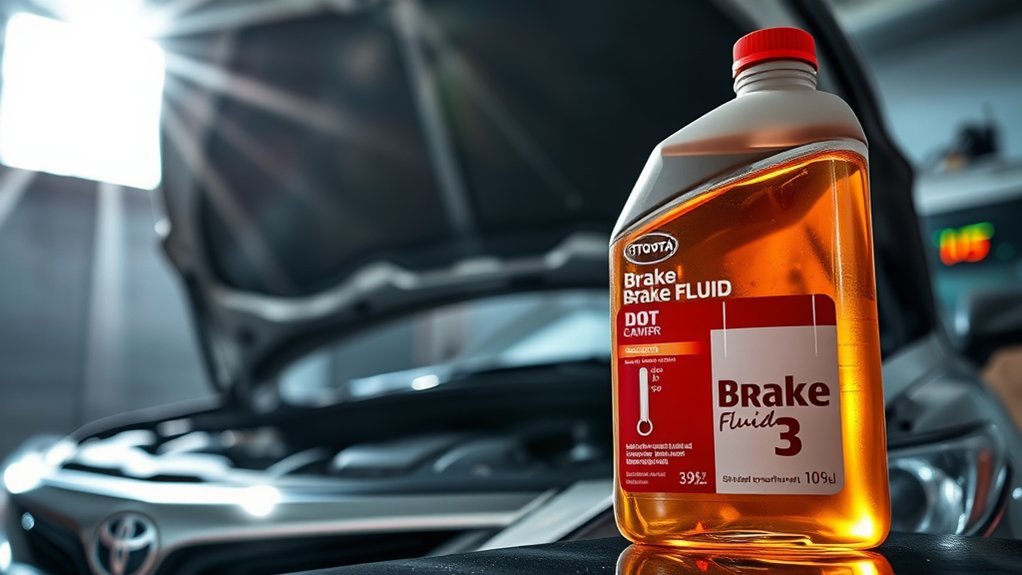
Brakes convert vehicle motion into heat. Some of that heat travels through the pads, rotors, and calipers to the brake fluid. If the fluid reaches its boiling point, vapor can form in the hydraulic circuit and increase pedal travel.
- Dry boiling point: The minimum boiling performance of new fluid under the specified federal test.
- Wet boiling point: The minimum performance after the controlled moisture-conditioning procedure.
- Vapor risk: Vapor pockets are more compressible than liquid and can reduce hydraulic response.
- Maintenance value: Correct fluid in suitable condition preserves the system’s intended boiling margin.
- Vehicle requirement: The manual and reservoir specification take priority over generic upgrade advice.
When Should You Change Your Brake Fluid?
Toyota does not publish one universal Camry brake-fluid replacement interval covering every year and market. Follow the maintenance guide supplied for the vehicle rather than treating a generic two- or three-year interval as an automatic Toyota requirement.
For example, the 2025 U.S. Toyota Camry Warranty & Maintenance Guide schedules maintenance every 5,000 miles or six months. Its chart calls for inspection of all fluid levels at every listed interval, and its footnote includes brake-fluid level and condition. The chart does not list a routine brake-fluid replacement interval.
That example applies to the 2025 U.S. model, not automatically to an older Camry or a vehicle sold in another country. Replace the fluid when the applicable Toyota schedule requires it, when reliable testing shows deterioration, after certain hydraulic repairs, or when contamination is known or suspected.
Signs of Fluid Contamination
Visible debris, separated layers, petroleum residue, water entry, or the wrong fluid in the reservoir requires professional attention. Darkening can justify further inspection, but color alone does not establish moisture percentage or boiling-point failure.
A soft or sinking pedal, warning light, leak, or reduced braking has several possible causes, including air in the lines, hydraulic leakage, worn components, an actuator problem, or an electrical fault. Treat these as brake-system warnings rather than assuming a fluid exchange will solve them.
Recommended Service Decision Process
- Read the maintenance guide for the correct model year and market.
- Review the date and mileage of the last complete fluid exchange.
- Inspect the reservoir level, cap area, brake lines, hoses, calipers, and wheel areas for evidence of leakage.
- Check for contamination or an incorrect fluid type.
- Use a suitable moisture or boiling-point test when service history is uncertain.
- Replace or bleed the fluid after hydraulic work whenever Toyota’s repair procedure requires it.
Pro Tip: Record the service date, mileage, fluid grade, and product used after a complete exchange. That record is more reliable than trying to judge several-year-old fluid by appearance.
Signs That Brake Fluid or the Brake System Needs Attention
Brake fluid may need replacement when testing, service history, repair work, or contamination points to degraded fluid. Several symptoms require a broader brake-system diagnosis rather than fluid replacement alone.
- Failed condition test: A suitable test indicates excessive moisture or insufficient boiling performance.
- Known contamination: Water, petroleum fluid, dirt, silicone DOT 5, or another incorrect substance entered the reservoir.
- Unknown service history: The fluid’s age and previous repair history cannot be established.
- Hydraulic repair: A caliper, hose, master cylinder, actuator, or related hydraulic component was opened or replaced.
- Repeatedly falling level: The reservoir requires repeated refilling or a leak is visible.
- Brake symptoms: The pedal is soft, sinks, travels farther than normal, or braking performance has declined.
- Warning lights: A red brake warning or ABS-related warning needs diagnosis according to the owner’s manual.
Warning: If the pedal suddenly becomes soft, sinks toward the floor, or braking performance drops, stop driving as soon as it is safe and arrange professional inspection. Do not rely on topping off the reservoir.
How to Check Your Toyota Camry’s Brake Fluid
You can perform a basic level, leak, and appearance check without opening the hydraulic system. A visual check cannot measure boiling point or moisture percentage.
Park on level ground, secure the vehicle, switch it off as directed in the owner’s manual, and allow hot under-hood parts to cool. For hybrid or electronically controlled brake systems, follow the manual’s stated conditions for reading the reservoir because accumulator operation can affect the indicated level.
Visual Inspection of Fluid
- Locate the reservoir. Use the owner’s manual rather than assuming its position from another model year.
- Read the level through the reservoir wall. Check it against the marked minimum and maximum lines under the conditions stated in the manual.
- Inspect for leakage. Look for wet areas around the master cylinder or actuator, brake lines, flexible hoses, calipers, and inside the wheels.
- Look for foreign material. Sediment, separated layers, oily residue, or obvious debris can indicate contamination.
- Avoid unnecessary opening. If the cap must be removed, clean the surrounding area first and prevent dirt or water from entering.
- Avoid skin and eye contact. Do not touch or taste brake fluid as a condition test.
Note: A gradual decrease can occur as brake pads wear and caliper pistons extend. A sudden decrease, a level below the specified range, or repeated need for fluid can indicate leakage or another fault. Investigate the cause before adding fluid.
Moisture and Boiling-Point Testing
Handheld testers can be useful screening tools, but they do not all measure the same property. Some estimate condition from electrical conductivity, while other equipment evaluates moisture or boiling performance more directly.
Do not treat a fixed percentage such as 3% as a universal Toyota replacement rule. Follow the tester manufacturer’s instructions, confirm that the tool is suitable for the fluid formulation, and have a qualified technician verify questionable or safety-critical results.
| Check | What It Can Indicate | Limitation |
|---|---|---|
| Level and leak inspection | Possible pad wear, leakage, or incorrect filling | Does not measure fluid quality |
| Visual appearance | Obvious debris, separation, or severe discoloration | Color cannot confirm moisture content or boiling point |
| Electronic or chemical test | Estimated condition or moisture, depending on the device | Accuracy depends on tool design, calibration, and fluid type |
| Professional boiling-point test | Thermal condition of the sampled fluid | Requires proper equipment, sampling, and interpretation |
Brake-Performance Evaluation
Pedal feel is a general safety observation, not a brake-fluid test. During normal operation, note unusual softness, excessive travel, sinking, warning lights, or reduced braking. Do not perform aggressive road tests when a fault is suspected.
Noise, pulling, vibration, overheating, or increased stopping distance can involve pads, rotors, calipers, tires, suspension, wheel bearings, hydraulic components, or electronic controls. A fluid exchange alone will not correct every braking complaint.
Top Off, Exchange, or Bleed?
These terms describe different services and should not be used interchangeably.
| Service | Purpose | Important Limitation |
|---|---|---|
| Top off | Raises the reservoir to the specified level with approved fluid | Does not repair a leak, remove contamination, or renew fluid in the lines |
| Fluid exchange | Replaces old fluid throughout the hydraulic circuits | Must prevent air entry and follow the correct sequence |
| Bleeding | Removes air after the system has been opened or serviced | May require actuator control, a scan tool, or a Toyota-specific procedure |
| Reservoir extraction only | Removes fluid visible in the reservoir | Is not a complete exchange because old fluid remains in the lines, actuator, and calipers |
When the level is low because the pads are worn, topping the reservoir to maximum before pad replacement can contribute to overflow when the caliper pistons are pushed back. Have the brake condition evaluated before adding fluid merely to restore the level.
What to Do If Your Brake Fluid Needs Changing

Use fresh fluid that matches the specification for your Camry. A proper exchange replaces fluid in the reservoir, lines, actuator or master cylinder, and wheel-brake circuits without allowing the reservoir to run dry.
Bleeding procedures vary by model year and brake-system design. ABS and electronically controlled brake systems may retain fluid or air within internal valves and accumulators. Some procedures require a diagnostic tool to command pumps or solenoids in a specified order.
Consult the vehicle-specific procedure through the Toyota Technical Information System before opening the system. Professional service is the safer choice when you do not have the correct procedure, pressure or vacuum equipment, diagnostic capability, torque specifications, or experience.
- Protect painted surfaces and clean spills promptly according to the fluid manufacturer’s instructions.
- Use fluid from a new or properly sealed container with a known storage history.
- Prevent dirt, water, and cleaning products from entering the reservoir.
- Do not allow the reservoir to run dry during an approved bleeding procedure.
- Use the specified wheel sequence and actuator procedure.
- Dispose of used brake fluid through an approved automotive-waste facility.
- Confirm a firm pedal, correct warning-light operation, and a leak-free system before driving.
Warning: If petroleum fluid, mineral oil, silicone DOT 5, water, or an unknown substance entered the reservoir, do not try to dilute it with correct fluid. Do not drive until a qualified technician has assessed the extent of contamination and the required component replacement.
Mixing Brake Fluids: Can DOT 3 and DOT 4 Be Combined?
FMVSS No. 116 includes a compatibility test intended to evaluate a brake fluid when mixed with a standardized compatibility fluid. This supports compatibility among compliant non-silicone products, but it does not authorize drivers to ignore the vehicle specification.
Adding DOT 3 to a system that requires DOT 4 can reduce the available boiling margin, and the resulting mixture should not be assumed to retain the higher grade’s performance. Adding DOT 4 to a Camry that specifies DOT 3 does not automatically create an approved upgrade.
Different brands of the correct, compliant grade should generally pass the federal compatibility requirement, but mixing still introduces uncertainty about age, formulation, storage, and the condition of the fluid already present. For planned service, use one suitable product from a sealed container and follow Toyota’s procedure.
- Follow the owner’s manual and reservoir label.
- Do not mix DOT 3, DOT 4, or DOT 5.1 with silicone-based DOT 5.
- Do not use fluid from an unlabeled bottle or a container with unknown contents.
- Do not use a bottle with an uncertain opening date or storage history.
- After accidental contamination, stop driving and obtain a professional evaluation.
Tips for Choosing the Right Brake Fluid for Your Toyota Camry
- Identify the model year, production details, and market. Specifications and maintenance requirements can differ between countries and generations.
- Read Toyota’s documentation. The correct manual and reservoir label are more reliable than a generic store application chart.
- Buy a sealed container with the required grade. The label should identify the DOT designation and conformity with FMVSS No. 116 when applicable.
- Check the actual product data. Federal boiling figures are minimum thresholds, not the exact performance of every bottle.
- Avoid unnecessarily large containers. Remaining fluid can absorb moisture after opening.
- Do not select fluid solely because it says “synthetic,” “racing,” or “high performance.” Marketing terms do not replace the vehicle specification.
- Use Toyota service information for bleeding. The sequence, actuator commands, and equipment requirements depend on the brake system.
Frequently Asked Questions
What does DOT 3 brake fluid mean?
DOT 3 identifies a brake-fluid performance grade under Federal Motor Vehicle Safety Standard No. 116. The fluid must meet minimum requirements for boiling point, viscosity, corrosion resistance, stability, compatibility, labeling, and other properties. It is not one brand or one exact formula.
Is it okay to use DOT 4 instead of DOT 3 in a Toyota Camry?
Use DOT 4 only when Toyota’s information for your model year and market permits it or a qualified technician confirms the substitution through applicable service information. DOT 4 has higher federal minimum boiling points, but that alone does not make it the approved fluid for every Camry.
Which is better, DOT 3 or DOT 4 brake fluid?
Neither is universally better for every vehicle. DOT 4 must meet higher minimum boiling points, while DOT 3 may be Toyota’s specified grade for a particular Camry. The best choice is fresh, sealed fluid that meets the vehicle’s complete specification.
What happens if the brake-fluid level is low?
A gradually lower level may accompany brake-pad wear, while a sudden drop, visible wetness, or repeated need for fluid can indicate a leak or another hydraulic fault. Inspect the entire brake system before repeatedly topping off the reservoir.
Can brake-fluid color tell you when to replace it?
Color can reveal obvious debris, separation, or severe discoloration, but it cannot measure moisture content or boiling point. Use the maintenance guide, service history, and a suitable condition test rather than color alone.
Can an ABS warning light mean the brake fluid is bad?
An ABS light indicates a detected anti-lock braking-system fault, but it does not specifically diagnose degraded fluid. The cause may involve a wheel-speed sensor, wiring, power supply, hydraulic actuator, control module, or another problem. A diagnostic scan and inspection are needed.
Are DOT 5 and DOT 5.1 the same?
No. DOT 5 is a silicone-base fluid, while DOT 5.1 is labeled as a non-silicone grade under the federal standard. The similar names do not make either one an approved replacement for the DOT 3 or DOT 4 specified by Toyota.
Can you drive a Toyota Camry with low brake fluid?
Do not continue normal driving when the level is below the specified range, a red brake warning is on, fluid is leaking, or the pedal or braking response has changed. A hydraulic leak can worsen without warning. Arrange inspection or towing according to the symptoms and the owner’s manual.
How much brake fluid does a Toyota Camry need?
There is no single quantity for every Camry or every service. A small level correction uses much less fluid than a complete exchange, and the amount needed can vary with model year, brake-system design, equipment, and bleeding method. Use the repair procedure rather than a universal estimate.
Can you mix different brands of DOT 3 brake fluid?
Compliant fluids are subject to federal compatibility testing, but planned service is best performed with one fresh product of the correct grade and specification. Never mix in fluid with unknown contents, age, storage history, or contamination.
Conclusion
DOT 3 brake fluid is the correct specification for many Toyota Camry models, but the final answer must come from the manual and reservoir information for the specific vehicle. Use a sealed product that meets the required standard, keep the system clean, and treat a low level as a reason to inspect the brakes rather than an invitation to keep topping off the reservoir.
Federal grade numbers describe minimum fluid performance; they do not approve every higher-numbered fluid for every Camry. Safe maintenance combines correct fluid selection, careful storage, reliable condition testing, model-specific bleeding procedures, and prompt diagnosis of leaks, warning lights, contamination, or changing pedal feel.
Sources
- Toyota Manuals and Warranties — model-year-specific owner’s manuals, warranty booklets, and maintenance guides.
- 2025 Toyota Camry Warranty & Maintenance Guide — scheduled-maintenance cadence and inspection of brake-fluid level and condition.
- 2007 Toyota Camry Owner’s Manual — a verified Camry example specifying SAE J1703 or FMVSS No. 116 DOT 3 brake fluid.
- Toyota Technical Information System — official vehicle-specific repair procedures, specifications, and diagnostic information.
- 49 CFR 571.116, Motor Vehicle Brake Fluids — federal boiling points, compatibility tests, labeling, storage warnings, fluid colors, and DOT 5/DOT 5.1 distinctions.